Age of Mythology: A "Oh crap! I purchased this game, how do I play RTS?" guide.
Glossary:
Villager – all purpose gatherer and builder
Drop site – building or unit that villagers can unload resources at
Train/produce/research – selecting the unit icon in a building will drain resources and start a timer. At the end of the timer, a unit appears at the building, or an upgrade becomes active.
Hero – unit specializing in combat vs myth
Myth units – powerful yet vastly expensive units, good verses everything except heroes.
Human units – bulk of an army, weak alone but powerful in large masses
Counter – units get bonuses when in combat with specific other unit classes. Hero-myth-human is simple, but in most cases, infantry (slow, sturdy) are effective vs cavalry, cavalry (Fast, aggressive) are good vs archers, and archers (weak to hand in hand, strong at range) can win against infantry. Many units will have tooltip text saying "only good vs", which means their generic low daamge is trippled when attacking their specific targets. If your enemy has only one type of unit, heavy counter units with this, or similar text, are the strongest and cheapest options for winning a melee.
Settlement – only viable locations for new town centers, and strategic points to defend.
Line upgrade – unit specific military upgrades, that greatly boost the combat effectiveness of that unit or unit type ad nothing else. For example, Heavy archer will improve all your archers, but not infantry or cavalry.
Military Building – a structure (barracks, archery range, stable, counter barracks, academy) that trains military units and can research their line upgrades. Fortresses are powerful military buildings with the more advanced units, and can attack.
Market – a building at which you can buy and sell food and wood for gold. You will never have an even exchange, and the prices fluctuate, but it is useful if you are down on a resources or have an abundance of one.
Part One: Building a Town:
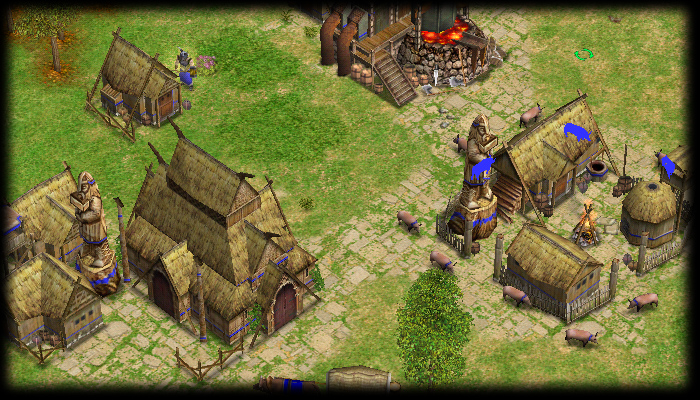 The most important building you have and will ever construct is the Town Center . You always start with one, and can later build new ones. The town center is the only place you can produce villagers from, the only building capable of researching new ages, and the only building from where basic building durability upgrades are researched. In general, town centers cannot be built until the second age. Town centers are drop off points for food, wood, and gold. Atlantean town centers can be built in the first age.
Villagers are the primary unit of a functional town. They gather all resources, and must walk to a valid drop site to collect it once their hands are full. For example, a lumberjack can hold ten units of wood, then must travel to the closest drop site to deposit the wood into your stash, and clear their hands so they can go cut more wood.
Greek and Egyptian collect food at granaries, and wood and gold at respective storage pits. Norse train Ox Carts from the town center, which are units that function as any-resource drop sites. Atlanteans do not need to drop off resources.
All drop sites can research respective upgrades for the resources they gather, except for town centers. For example, lumber yard researches improve wood chopping, granaries improve speed of farmers and hunters.
Final building to consider early on is the house. Houses support population, and units will not train if there is not enough population for them to exist. Population is a limit of the number of units you can control at once.
Early on, food and wood are the most important resources, to produce villagers, build drop sites, and houses. Egypt make these buildings for free and instead focus on gold.
When you finish the research of the second age (AKA CLASSICAL), you are ready to expand your town and make a small army.
Part Two: Staking a Claim:
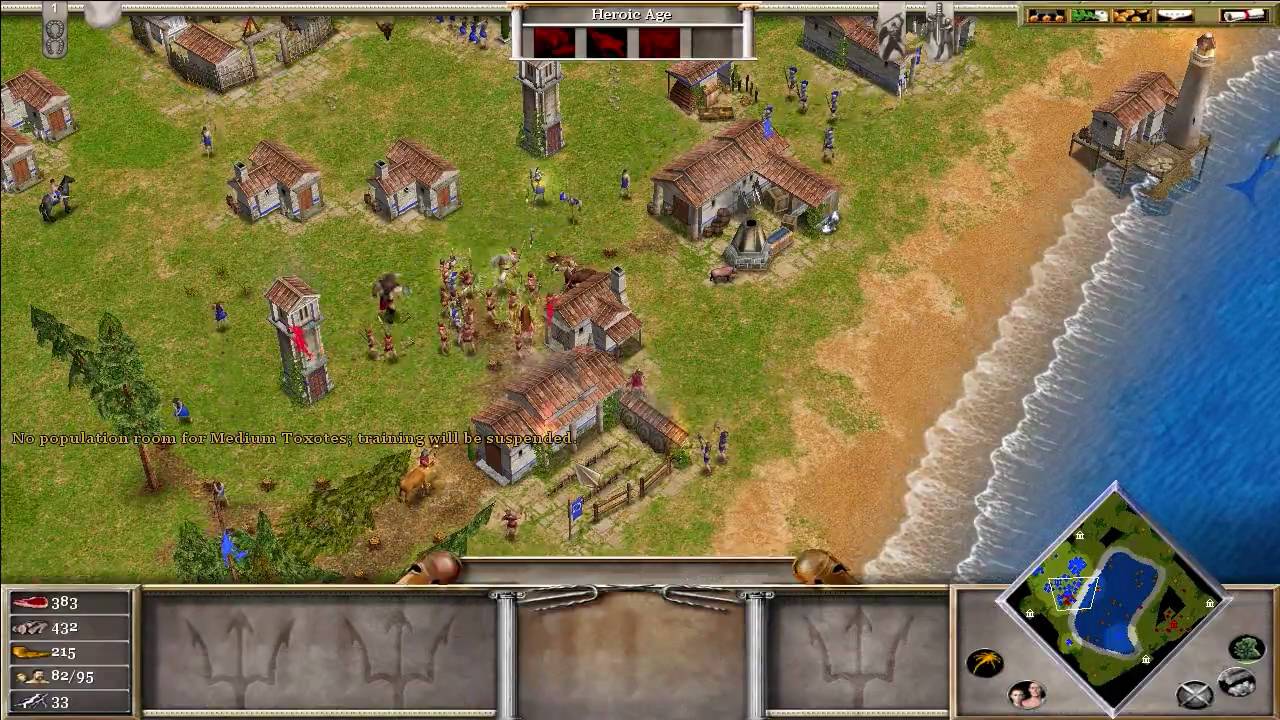 The second age is when you can first start expanding your control over the land. Outposts can research upgrades to allow them to shoot arrows and for your buildings to see farther, and basic military buildings can be constructed. You can create walls to halt advances of enemy armies, and farms to have an infinite steady (but slow) supply of food, once huntable animals run out. Build farms near town centers or drop sites, to have short walk distance for the villager to go back and forth.
Train military at your newly constructed military buildings, and send them forth into the world! Scout out important areas, and protect your settlements. NEVER stop creating villagers and sending them to collect resources (unless you need to do a research).
Eventually you will want to build an armory for general damage and armor upgrades for your human units, and line upgrades at your military buildings. “Thor” worshippers can build an armory in any age, and get the strongest endgame upgrades in the game. Expand quickly, send a force to the enemy to slow down their villagers, and advance to the third age!
Now you get access to your fortress. Greek fortress can train siege, Egyptian fortress train their strongest units. Norse fortress can train a mix of siege and anti archer, and Atlantean fortress can train siege and anti infantry
Part Three: ENDGAME:
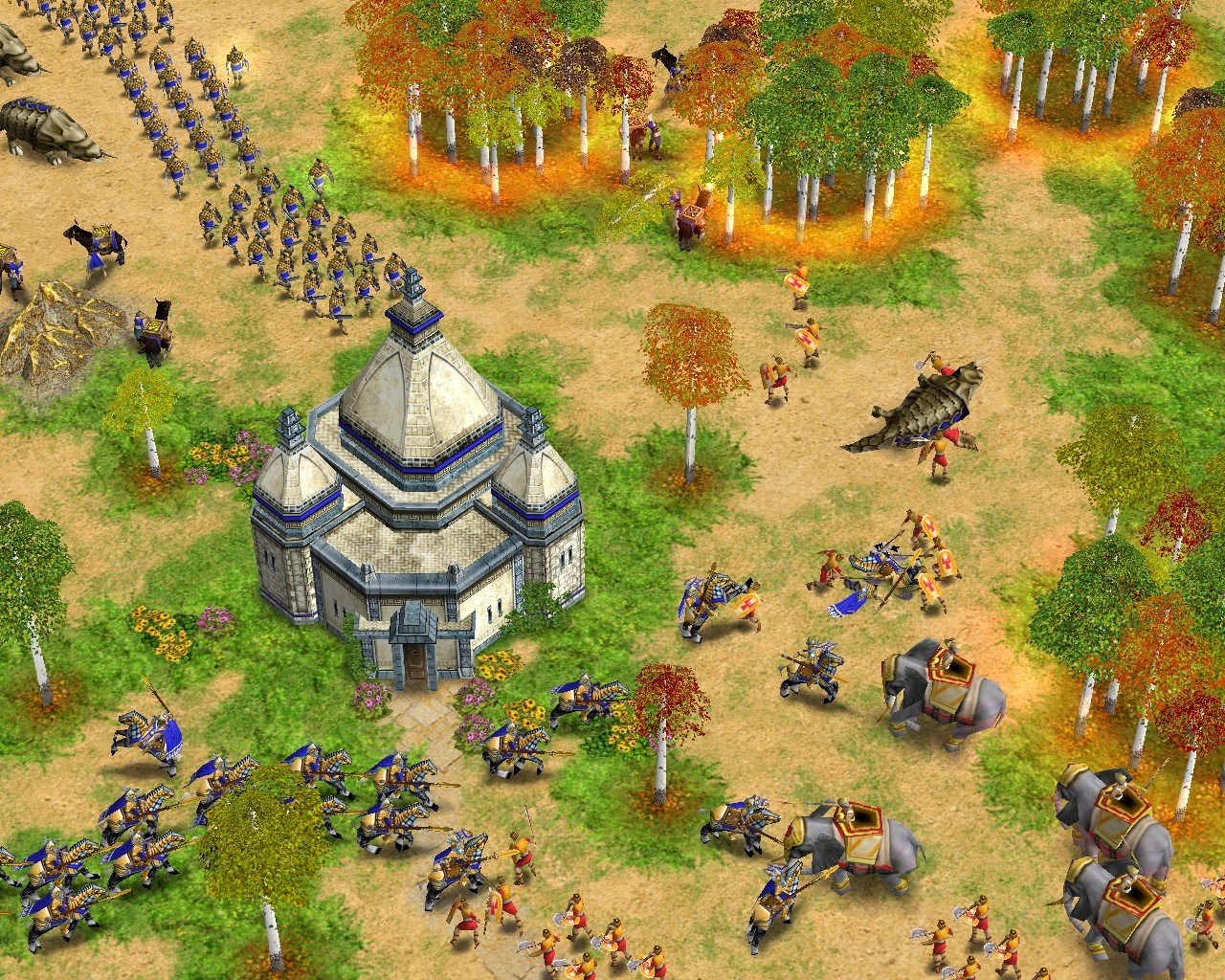 Regardless of age, god, or playstyle, it is strategy and resource management that wins the game. Got too much wood but not enough gold? Move some villagers around to be miners, or sell wood for gold at the market. Not enough favor for all your mythic upgrades? Greek=pray to temple. Egypt=build statues and have pharaoh dance at them. Norse=GO FIGHT SOMETHING, or build more heroes. Atlantean=just exist, you cheap ♥♥♥♥♥.
Where you before had one or two military buildings, now make ten, twenty. The speed at which you can reinforce your front line determines the balance of power. If both you and your opponent have massive stockpiles, those with the bigger army and more upgrades has the upper hand. Invest in siege weapons to level the enemy production, and destroy enemy siege to keep yours safe.
Finally, create the right army to defeat your enemy, and counter the enemy units. The other guy has mostly archers? Swarm him with fast cavalry! Enemy invested heavily into myth? Send a few heroes to wipe the board clean. Enemy has a varied army? Stick to your god’s army bonuses for a stronger army than theirs! Small advantages over hundreds of units add up! And, control gold mines. No civilization can train armies without gold.
Win the game.
- Age of Mythology Cheats *UPDATED 2022 with NEW cheats! (2.8)*★ 5 (954)42k views1.4k ♥2 minUpdated May 16, 2022
- How to play as Thor★ 5 (241)18k views199 ♥13 minUpdated Feb 8, 2016
- Age of Mythology: Extended Edition Cheat Overview★ 5 (208)13k views349 ♥3 minUpdated Mar 10, 2017
- Русификаторы для Age of Mythology: Extended Edition★ 5 (176)11k views242 ♥1 minRussianUpdated Dec 28, 2016
- Age of Mythology; a Broad Overview for Newbies★ 4 (156)9.8k views127 ♥15 min
- Age of Mythology: Hersir Names (Norse gods)★ 5 (169)6.9k views102 ♥25 minUpdated Oct 10, 2019



- Upgrading to PremiumTeam Fortress 2★ 5 (20k)1441k views11k ♥6 minUpdated May 11, 2022
- No More Room in Hell Official ManualNo More Room in Hell★ 5 (2.8k)569k views2.1k ♥29 minUpdated Apr 22, 2019
- NMRiH Community Hosting GuidesNo More Room in Hell★ 5 (526)351k views653 ♥1 minUpdated Aug 10, 2022
- ULTIMATE GUIDE FOR GAME DEV TYCOONGame Dev Tycoon★ 5 (5.8k)326k views10k ♥4 minUpdated 23 Jan, 2014
- How to 'Git Gud' Soon™MORDHAU★ 5 (2k)318k views3k ♥68 minUpdated Nov 16, 2024
- Лучшие кооперативные игры SteamPAYDAY 2★ 5 (1.5k)315k views2.1k ♥56 minRussianUpdated Apr 27, 2025




This guide was created by its original author on the Steam Community. Are you the author and want it removed? Request removal.