Beginner-Advanced Support Guide [Patch 2.06]
Introduction
Step 1. Start with Jenos, Seris or Grover
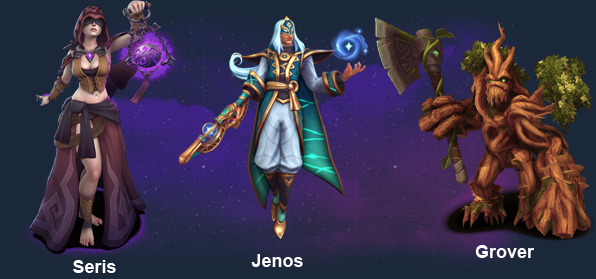
There are several support champions to chose from but if you're new, I'd recommend you to try Seris, Jenos and Grover first. You can certainly go for, say, Mal'damba, but you might find it easier to start with one of the following three:
Step 2. Chosing the right loadout

All supports start with an awful stock loadout. I don't know why Hirez Evil Mojo is doing that but what I know is that you should never use the factory loadout.
Here are the loadouts I would suggest you to start with for the following four supports:
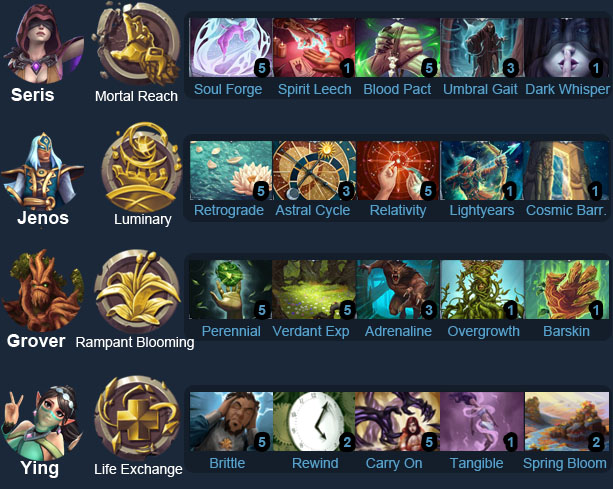
First of all, prioritize cards that reduce the cooldown of your main healing ability.
Secondly, max out cards that heal you when you heal your teammates.
Finally, try to get a card that will somehow increase your speed or reduce the cooldown of your F ability - anything that will help you to escape is a great help.
Oh and avoid anything that gives you life steal. Your damage output is not high enough for that.
Step 3. Best Items for a support

Usually, Chronos is your best friend. In 90% of the cases, you'll want to get Chronos 2 before anything else. Once you have that, I'd recommend you getting Nimble 2. Speed is more important than armor because it allows you to (a) get faster to your teammates who need healing and (b) escape from enemy fire.
After you've got Nimble, you can then get either Cauterize or some sort of defense.
Note: I am not a fan when supports go Cauterize but sometimes your team does not have enough Caut, so you have to buy it and spread it on enemies to prevent them from getting healed.
- Ying - You might want to get Morale Boost 3 instead of Chronos
- Mal'Damba - Deft Hands should go by hand by hand with Chronos
- Seris - You might usually want to avoid Chronos and start with either Morale Boost (if you have someone to combine your ultimate with) or Nimble.
- Life Rip - use cards that give you self-heal instead.
- Rejuvenate - the item does not amplify the effect of self-heal cards
- Veteran - for obvious reasons
- Master Riding - It's useless in 99.9% of the cases.
When to Pick Support?

First and foremost, you don't always get to play support. If someone picks support before you, you should chose a different class.
As a rule of thumb, teams with two or more supports always lose.
Now, if someone picked support before you, you can- (a) ask them whether they are going heals or damage. Support champions such as Pip or Mal'Damba can sometimes be used as flankers. If they say that they go heals, you can then
- (b) ask them to pick someone else so you can go support.
Positioning

As a support, you have to get used that you will be targeted by the whole enemy team. Which means that you have to stick to your teammates at all time. Any good enemy flank will keep a constant eye on you and kill you as soon as they see you alone.
Most of your teammates will be on the point, however you don't always want to be with them there either.- If the point is being targeted by enemy damagers and front lines, you better stay somewhere close and heal your teammates from the safety of cover.
- If you spot a flank coming for you, you have to reposition yourself close to your damager(s).
- If the point is being captured by your front line while the action is happening elsewhere, you usually want to stand close to your front line and heal your teammates when they get on your sight (unless you are Jenos, who can heal through walls)
- If your team got wiped and you are the last champion standing, you gotta retreat closer to spawn. Don't try to play John Wick as support.
Camping the same spot for too long is usually a bad idea.
Luckily for you, flankers have their limitations too. They can't chase you indefinitely. They can't see you through walls (unless you are Lex's target).
You have to be in the shadows, healing your teammates from cover and changing your position as often as you can.
How to deal with flankers
- Watch your back. Your damagers and front liners are usually too focused on what they're doing so they might miss the enemy flanker. As a support, you have more free time and can be more alert.
- As soon as you see an enemy flanker getting close to you, try to (a) let your team know that you are being flanked and (b) get close to your damagers, since your damagers are the ones who can counter flankers the most efficiently.
- As soon as you see your damagers engaging the flank, try to help them. Certain supports can stun or cripple enemy champions; save those abilities for said situations.
- Don't waste your F ability; save it for when you have to escape from the flanker.
Who to Heal
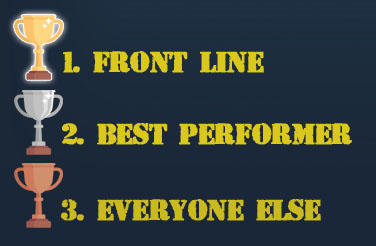
As a support, you have to chose who to heal. Sadly, most supports can only focus a couple teammates, leaving the rest out.
Some people might call you a bad support for not healing them, however they have to understand that your healing capabilities are limited and you have to prioritize your targets.
No matter what happens, your front line should be receiving the most heals.
The others are situational.
When your team is fighting on the point you have to be there and heal whoever is involved into that bloody mess. Your tanks should be the priority, though don't forget your damagers either.
Now, as soon as your team clears the point, your damagers and flank should push forward. Your role is to stay on the point and capture. If you have a long-range healer such as Furia, Seris or Jenos, you should keep healing your team from the point.
As Jenos with the Luminary talent, sometimes you want to place your healing marks on your flanker first, if they are good that is. A good flanker with the +15% damage boost and passive healing can easily take half of the enemy team on their own.
Both are close range healers, so your positioning determines who you can heal. This means that when playing as either, you have to stick close to your front line at all times.
Prioritize the teammate who is helping you to fight the enemy flanker off. Just make sure to take cover first and then heal them, unless the enemy flanker is totally focused on your defender, in which case you can stay where you are and just spam those heals.
Common Mistakes

- Rushing the point alone (unless it's a 3/3 Overtime and you have to stall at any cost).
- Positioning yourself in front of the team, right under enemy fire.
- Staying far from cover.
- Not taking cover when you get hit.
- Trying to outdamage an enemy damager or flank.
- Trying to play like Chuck Norris.
- Not healing your front line enough.
- Healing your teammates who are under the effect of Cauterize or who are in the Dead Zone.
You know the basics, now what?
Most players want to get to competitive asap because they want that shiny platinum/diamond/master rank.
If you want to play competitively, it's essential for you to know how to be a good support, and to be able to play well at least three support champions. That being said, if Support is the only class you are good at, it means it's too early for you to go competitive.
You want to learn all the four classes and become proficient at at least a dozen different champions before you can be successful in Ranked.
Now, the steps I have mentioned here are pretty basic. They are pretty easy to learn and once you do that, you can check my 5 Tips to support Like a Diamond Player guide to learn some more advanced strategies.
5 Tips to support Like a Diamond Player
How to play Tyra (Video tutorial)
In Conclusion
- Why Paladins is losing players and how to reverse this★ 5 (1.1k)60k views211 ♥9 minUpdated 21 Aug, 2018
- 100 Laws of Paladins★ 5 (685)24k views474 ♥9 minUpdated 21 Apr, 2017
- [2025] HOW TO CHEAT IN PALADINS★ 4 (454)21k views51 ♥1 minUpdated 13 Feb, 2025
- 5 Tips to SUPPORT Like a Diamond Player★ 5 (492)15k views355 ♥9 minUpdated 26 May, 2019
- 5 Tips to FLANK like a Diamond Player [Patch 2.08]★ 5 (308)15k views361 ♥6 minUpdated 25 Nov, 2019
- Did you know...★ 5 (250)14k views86 ♥1 minUpdated 28 Jun, 2018



- Upgrading to PremiumTeam Fortress 2★ 5 (20k)1441k views11k ♥6 minUpdated May 11, 2022
- No More Room in Hell Official ManualNo More Room in Hell★ 5 (2.8k)569k views2.1k ♥29 minUpdated Apr 22, 2019
- NMRiH Community Hosting GuidesNo More Room in Hell★ 5 (526)351k views653 ♥1 minUpdated Aug 10, 2022
- How to 'Git Gud' Soon™MORDHAU★ 5 (2k)318k views3k ♥68 minUpdated Nov 16, 2024
- Лучшие кооперативные игры SteamPAYDAY 2★ 5 (1.5k)315k views2.1k ♥56 minRussianUpdated Apr 27, 2025
- Desert Eagle Heat Treated | Blue GemCounter-Strike 2★ 5 (1.6k)293k views1.5k ♥2 minUpdated Jan 16


This guide was created by its original author on the Steam Community. Are you the author and want it removed? Request removal.