Fake's new and improved guide to KAT medical.
Welcome to Hell!
So, you wanna learn about KAT Medical?
Let's start off with some quick notes.
First, this guide already presumes that you know about ACE and it's medical system to a moderate degree. Meaning you know how to use your menu's and have a vague understanding on how bullet ballistics work on impacting player characters.
Secondly, this will go though multiple iterations. I'll try to note down edits and such but understand I am but one person. I'm gonna miss stuff out and at times might convey the wrong message in what I'm writing. (Currently Updated to the 05/10/2023 update focused around CRBN and BVM's.)
I implore you, if you want to learn how to Medic in Arma 3 or any Arma game. Come to a practiced medic for tips and tricks, my door is always open for training prospective medical personnel. Of any stripe and rank.
Feel free to contact me on steam or on my discord.
Fake man man#1204
The Basics
With that first part out the way, we can get to the basics of the changes between ACE and KAT medical.
Let us begin.
So as you may have guessed and well, saw. There are now blood groups, as you may guess. These blood groups are important as giving someone the wrong blood type. Doing this will induct A BO Incompatibility which when untreated has a 95% fatality rate* so generally, it's good to check the blood type of your patient before giving them anything like that.
Note that Plasma and Saline can be used in conjunction to supplement blood to a great degree. Which is much safer though can cost more resources.
This will be elaborated on in the dedicated Cardiovascular section.
* Taken from personal experience. May be incorrect but you get the point.
Ah the new stuff! So, let's get the basics out the way.
When you click on the head of a patient, you will now see a new icon show up next to your advanced medication icon. This is your respiratory menu, using this will allow you to check the airway of a patient, given they are unconscious. Currently, there are three things you should worry about.
If someone's on the floor and needs a lot of blood, give them a IO.
If someone needs a pick-me-up, use a IV.
Will be elaborated on in Advanced medication.
Let us begin.
Blood types?
So as you may have guessed and well, saw. There are now blood groups, as you may guess. These blood groups are important as giving someone the wrong blood type. Doing this will induct A BO Incompatibility which when untreated has a 95% fatality rate* so generally, it's good to check the blood type of your patient before giving them anything like that.
Note that Plasma and Saline can be used in conjunction to supplement blood to a great degree. Which is much safer though can cost more resources.
This will be elaborated on in the dedicated Cardiovascular section.
* Taken from personal experience. May be incorrect but you get the point.
Breathing?
Ah the new stuff! So, let's get the basics out the way.
When you click on the head of a patient, you will now see a new icon show up next to your advanced medication icon. This is your respiratory menu, using this will allow you to check the airway of a patient, given they are unconscious. Currently, there are three things you should worry about.
- Pneumothorax
Checked on the chest, is complex so will be elaborated on in the dedicated respiratory section. - Occlusions
When there is blood or Vomit stuck within the airways of a patient, best way to fix this would be to grab an Accuvac or preform head turning. - Obstructions
When the tongue is blocking the airway, simply hyper-extend the head and get the King LT (If you hate vomiting) or the Gudel tube to fix this issue.
IV's and IO's?
Ah yes, the new IV system. Basically now you can't give blood without putting a IV into someone's arm, leg or an IO in someone's chest. (Can be changed in settings) This is also the same for advanced medication, generally I go by the rule of.If someone's on the floor and needs a lot of blood, give them a IO.
If someone needs a pick-me-up, use a IV.
Will be elaborated on in Advanced medication.
So, what do I (Infranty man man) need to know?
Well, for a infantry man. Generally you need to 2 things.
You may be asking what BBPR is. It's an Acronym for
Bleeding
Breathing
Pulse
Recovery Position
As you can guess, Bleeding corresponds to stopping the bleeding in your patient. To prevent them from bleeding out or going into cardiac arrest.
Breathing is a bit more complex, first. Check your patients airways, if they're clear. Skip this, if not.
Did it say Occlusion? Extend airway and begin head turning until the obstruction is removed. Obstruction? Well, your screwed. Find a medic to put a Gudel Tube or King LT inside. Hyperextension will fix this issue temporarily, if your not under fire. Do this.
Pulse corresponds to the patients pulse (duh) and weather or not they've gone into cardiac arrest. Simply go into the examine menu on any limb and press check pulse. If there is none, use CPR (+ single use of Epinephrine) or find a medic with a AED.
Recovery Position is quite simple, it's in the head breathing section. From what I've seen, it's helps with SP02 Regeneration. (Take with a grain of Salt. Thanks Filemon.)
Safety Fallacy.
For the love of god, I see it way too many times. Do not sacrifice yourself to drag a mate out of a firefight, worst case scenario. You end up getting both you and your friend killed, best case. You make it out with some bullet wounds and a solider who's probably beaten to high heck. Be sensible, if the fire is minimal and you have a low chance of getting shot (or you can drag in cover) then grab your mate. But sacrificing is only going to end up with a grumpy medic scolding you.
Follow this advice and your current training, you should be able to save your friends in the field. And remember, don't be afraid to call out medic. They may shout at you but they're under stress, this job isn't easy. Give them some slack.
BBPR and the Safety Fallacy
You may be asking what BBPR is. It's an Acronym for
Bleeding
Breathing
Pulse
Recovery Position
As you can guess, Bleeding corresponds to stopping the bleeding in your patient. To prevent them from bleeding out or going into cardiac arrest.
Breathing is a bit more complex, first. Check your patients airways, if they're clear. Skip this, if not.
Did it say Occlusion? Extend airway and begin head turning until the obstruction is removed. Obstruction? Well, your screwed. Find a medic to put a Gudel Tube or King LT inside. Hyperextension will fix this issue temporarily, if your not under fire. Do this.
Pulse corresponds to the patients pulse (duh) and weather or not they've gone into cardiac arrest. Simply go into the examine menu on any limb and press check pulse. If there is none, use CPR (+ single use of Epinephrine) or find a medic with a AED.
Recovery Position is quite simple, it's in the head breathing section. From what I've seen, it's helps with SP02 Regeneration. (Take with a grain of Salt. Thanks Filemon.)
Safety Fallacy.
For the love of god, I see it way too many times. Do not sacrifice yourself to drag a mate out of a firefight, worst case scenario. You end up getting both you and your friend killed, best case. You make it out with some bullet wounds and a solider who's probably beaten to high heck. Be sensible, if the fire is minimal and you have a low chance of getting shot (or you can drag in cover) then grab your mate. But sacrificing is only going to end up with a grumpy medic scolding you.
Follow this advice and your current training, you should be able to save your friends in the field. And remember, don't be afraid to call out medic. They may shout at you but they're under stress, this job isn't easy. Give them some slack.
What do I do with this information? (Medical techniques)
So, in my previous guide. I didn't intend that to be the end all guide for KAT. It was supposed to be a cheat sheet for medic's to use for information which it served it's purpose well. Which how much it boomed, I had people asking for what to do in terms of actual situations which. I can't really say what to do for every situation, but I can give some broad spectrums for you to take information from and make your decision from there but remember.
You are a Medic, your decision is absolute. People will die, sometimes we can't help that.
The only thing we can do there is help who we can.
With that out the way.
In a MASCAS senario, generally. You have 4 or more patients to each medic. Your first priority is healing yourself, make sure you are going to be okay before healing everyone else. If you go down, there is no help for anyone else.
Understand in this situation, it's very possible that people will die. This is just how it is. After assuring your own livelihood, get to work stalling the bleeding on the patients which are easily accessible and start stabilising them. You want them to be at least not bleeding, breathing properly and generally not at risk of dying. Note: They don't need to be close to waking up, just waiting for further treatment.
After this, move to evacuating other patients (If your comrades haven't already.) if safe to do so, stabilise them and start working on waking up who you can.
Be flexible, this isn't a straight walk through. You need to use your brain.
Yeah in this situation, depending on the timing. This patient might die but generally. You want to start with tourniquets, shove them onto each red limb you can. Once done treat the chest and head first. Once done, treat the arms and legs and start removing tourniquets. Surgical and ask another mate to check airway and advise them on what to do. Right now, you want to stall the bleeding at all costs.
Once done, follow normal procedure. It's basically a normal patient at that point.
So normal procedure is pretty simple. Use the BBPR system.
Bleeding, stall bleeding and after B and P.
Breathing, check for Occlusions and Obstructions and treat as necessary.
Pulse, generally. You'll have an AED-X. You can connect this up to your patient to get BP, SP02 and HR. (Blood Pressure, Blood 02 Saturation, Heart Rate) use this to figure out if you need to shock your patients heart. If no AED-X is available, first provide some epinephrine if the first aider on scene and 3 rounds of CPR, check for pulse and repeat until pulse is found.
Check Breath and solve accordingly (Dialysis or Fluids)
Preform surgical for Fractures or wounds.
Recovery Position, same as infantryman's guide.
You are a Medic, your decision is absolute. People will die, sometimes we can't help that.
The only thing we can do there is help who we can.
With that out the way.
MASCAS
In a MASCAS senario, generally. You have 4 or more patients to each medic. Your first priority is healing yourself, make sure you are going to be okay before healing everyone else. If you go down, there is no help for anyone else.
Understand in this situation, it's very possible that people will die. This is just how it is. After assuring your own livelihood, get to work stalling the bleeding on the patients which are easily accessible and start stabilising them. You want them to be at least not bleeding, breathing properly and generally not at risk of dying. Note: They don't need to be close to waking up, just waiting for further treatment.
After this, move to evacuating other patients (If your comrades haven't already.) if safe to do so, stabilise them and start working on waking up who you can.
Be flexible, this isn't a straight walk through. You need to use your brain.
"My god all of his limbs are red"
Yeah in this situation, depending on the timing. This patient might die but generally. You want to start with tourniquets, shove them onto each red limb you can. Once done treat the chest and head first. Once done, treat the arms and legs and start removing tourniquets. Surgical and ask another mate to check airway and advise them on what to do. Right now, you want to stall the bleeding at all costs.
Once done, follow normal procedure. It's basically a normal patient at that point.
I forgot to mention normal procedure didn't I?
So normal procedure is pretty simple. Use the BBPR system.
Bleeding, stall bleeding and after B and P.
Breathing, check for Occlusions and Obstructions and treat as necessary.
Pulse, generally. You'll have an AED-X. You can connect this up to your patient to get BP, SP02 and HR. (Blood Pressure, Blood 02 Saturation, Heart Rate) use this to figure out if you need to shock your patients heart. If no AED-X is available, first provide some epinephrine if the first aider on scene and 3 rounds of CPR, check for pulse and repeat until pulse is found.
Check Breath and solve accordingly (Dialysis or Fluids)
Preform surgical for Fractures or wounds.
Recovery Position, same as infantryman's guide.
Cardiovascular Section
Ah- Cardiovascular Section.
This section will be based more around wound types, bandage types, blood types, spints, etc. So if you know this, feel free to skip this part.
So, wounds.
There are eight types of wounds in KAT medical, all having different values and scaling with size (From large to small), with this in mind. I'm gonna list them from most fatal to least.
Avulsion
Avulsions have a high bleed with very high pain, deal with these as fast as you can to help your patient the best. (I usually use Elastic on these.)
Velocity Wound
The most likely wound you'll get on unprotected parts, this has moderate bleeding and high pain. Still dangerous but less so then Avulsions. Use Elastic or Packing.
Lacerations
Moderate bleed like Avulsions but the pain is quite low, meaning a solider can still fight untreated though he or a friend should patch it up soon as. (Packing, less reopen chance.)
Cut wound
Very similar to Lacerations, simply shove a packing on it when you get the chance. Moderate bleed, low pain.
Puncture
Unlike the others, this is quite a low priority, with slow bleed. It takes a while to actually kill you without having a hundred of them. Low pain as well! (Packing or Basic will work here.)
Crush wound and Abrasions
Putting these together because in bleed and pain terms, very low priority. Rarely get's you killed. Packing.
Remember to stitch your patient after treatment.
For bandage types!
Packing
Great if you have a moderate time to get bandaged, reopen chance is low and is my general go to.
Elastic
Fast and easy to apply but has the downside of a rather large reopen chance.
Basic
It's better then nothing and is probably what a infantryman is going to have.
Quickclot
Is a go-between for Packing and elastic, moderate reopen time and efficiency.
Splints?
When a limb is damaged, it has the chance to break a bone. Such as in the leg or arm, the effects are self-explanatory but slap one of these on and it'll be fixed Can differ from server to server.
Well, these are quite simple. You get the wrong blood type you give your patient A BO Incompatability, this is bad... The fatality rate is quite high with it. So use this quick sheet.
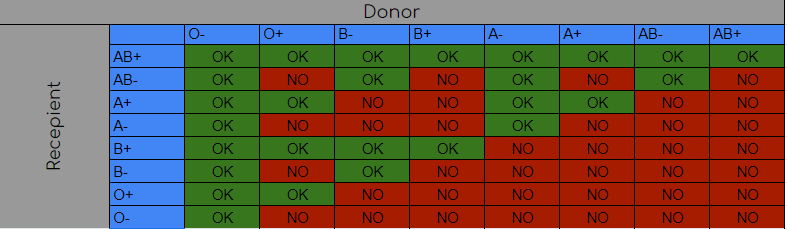
Note: You can use plasma and saline if in a rush to act like a lot like blood!
Extra note: If you somehow induce A BO Incompatibility, give the patient painkillers and pray.
This section will be based more around wound types, bandage types, blood types, spints, etc. So if you know this, feel free to skip this part.
Wound and Bandage types?
So, wounds.
There are eight types of wounds in KAT medical, all having different values and scaling with size (From large to small), with this in mind. I'm gonna list them from most fatal to least.
Avulsion
Avulsions have a high bleed with very high pain, deal with these as fast as you can to help your patient the best. (I usually use Elastic on these.)
Velocity Wound
The most likely wound you'll get on unprotected parts, this has moderate bleeding and high pain. Still dangerous but less so then Avulsions. Use Elastic or Packing.
Lacerations
Moderate bleed like Avulsions but the pain is quite low, meaning a solider can still fight untreated though he or a friend should patch it up soon as. (Packing, less reopen chance.)
Cut wound
Very similar to Lacerations, simply shove a packing on it when you get the chance. Moderate bleed, low pain.
Puncture
Unlike the others, this is quite a low priority, with slow bleed. It takes a while to actually kill you without having a hundred of them. Low pain as well! (Packing or Basic will work here.)
Crush wound and Abrasions
Putting these together because in bleed and pain terms, very low priority. Rarely get's you killed. Packing.
Remember to stitch your patient after treatment.
For bandage types!
Packing
Great if you have a moderate time to get bandaged, reopen chance is low and is my general go to.
Elastic
Fast and easy to apply but has the downside of a rather large reopen chance.
Basic
It's better then nothing and is probably what a infantryman is going to have.
Quickclot
Is a go-between for Packing and elastic, moderate reopen time and efficiency.
Splints?
When a limb is damaged, it has the chance to break a bone. Such as in the leg or arm, the effects are self-explanatory but slap one of these on and it'll be fixed Can differ from server to server.
Blood types?!
Well, these are quite simple. You get the wrong blood type you give your patient A BO Incompatability, this is bad... The fatality rate is quite high with it. So use this quick sheet.
Note: You can use plasma and saline if in a rush to act like a lot like blood!
Extra note: If you somehow induce A BO Incompatibility, give the patient painkillers and pray.
Surgery Section!
The Newest addition to KAT Medical, the new and improved Surgery system. (As of 31/10/2022, HALOWWWWEEEEN!)
All you need to do is go to the Examination tab on the Fractured limb and simply click 'Check Fracture' and it'll hint in the top right corner (Default)
Simple Fractures are well... Simple, all you need to do in this situation is:
This one is a bit more... Complex and might require a MEDVAC. In anycase, follow this procedure to get ya patient moving:
Simply bandage ya wounds, stitch, Debride and then use NPWT. (Requires Dressing Vaccum)
How to check what type of Fracture my patient has?
All you need to do is go to the Examination tab on the Fractured limb and simply click 'Check Fracture' and it'll hint in the top right corner (Default)
Simple Fractures
Simple Fractures are well... Simple, all you need to do in this situation is:
- Push some Morphine
- Preform Closed Reduction
- Continue on your day.
Surgical Fracture
This one is a bit more... Complex and might require a MEDVAC. In anycase, follow this procedure to get ya patient moving:
- Push Lorazepam to sedate (If awake)
- Push Etomidate for general anaesthesia, reapply in 40 second intervals.
- Preform an Incision with a Scalpel
- Expose the fracture with a Retractor
- If Compound, Irrigate with 250ml. If Comminuted, Clamp the wound.
- Preform Open Reduction. (Bone Plate)
- Push Flumaenzil to remove Sedation
- Wakey wakey =3
Stitching and fixing normal wounds
Simply bandage ya wounds, stitch, Debride and then use NPWT. (Requires Dressing Vaccum)
Respiratory Section
Let's start with the simple stuff with breathing first, starting with!
In your respiratory menu, the one next to your advanced medication menu in the medical menu. You should be able to see a multitude of options. I'm going to run you through what you should do if you're treating a person's airway.
1: Check airway
2: Occluded? Use Accuvac or hyperextend head + turn it. Obstructed? Use King LT or Gudel tube after fixing the obstruction. Hyperextension will temporarily fix Obstruction.
3: Click on establish recovery position (Unless any further medical procedures are required.)
Kudo's to Polski for this!
Pneumothorax is when the lungs have been punctured and have collapsed, being unable to properly bring in air. There are two ways of checking this.
A: It will say on the chest if the server has this activated, if not. Oh boy.
B: Check the chest regions airway management, click on Lung sounds. Listen for wheezing or anything out of the ordinary in the lungs, if there is anything. There's a good chance they have Pneumo, simply shove a chest seal on them or use needle decompression.
So, SP02 is oxygen saturation within the blood. When it get's to 90* the patient goes unconscious, when it goes down to 65* the patient dies. To check this, you need a blood oximeter or AED-X which'll show you the SP02 quite cleanly, otherwise. Check for Cyanosis, if there's signs of it, the SP02 is getting low. Deal with the respiratory system.
*Taken from personal experience, take it with a grain of salt. Second note: The SP02 limits are changable in settings.
If you haven't found out yet from your friends, you can slap unconscious people. This is called 'Reorientation' and is used when a patient has some or less blood lost, above 90 SP02 and isn't currently under cardiac arrest. Allowing you to get them up and into the fight again.
Occlusions and Obstructions
In your respiratory menu, the one next to your advanced medication menu in the medical menu. You should be able to see a multitude of options. I'm going to run you through what you should do if you're treating a person's airway.
1: Check airway
2: Occluded? Use Accuvac or hyperextend head + turn it. Obstructed? Use King LT or Gudel tube after fixing the obstruction. Hyperextension will temporarily fix Obstruction.
3: Click on establish recovery position (Unless any further medical procedures are required.)
Kudo's to Polski for this!
Pneumothorax
(I'm Shortening that to Pneumo for writing's sake.) Pneumothorax is when the lungs have been punctured and have collapsed, being unable to properly bring in air. There are two ways of checking this.
A: It will say on the chest if the server has this activated, if not. Oh boy.
B: Check the chest regions airway management, click on Lung sounds. Listen for wheezing or anything out of the ordinary in the lungs, if there is anything. There's a good chance they have Pneumo, simply shove a chest seal on them or use needle decompression.
SP02 and Cyanosis?
So, SP02 is oxygen saturation within the blood. When it get's to 90* the patient goes unconscious, when it goes down to 65* the patient dies. To check this, you need a blood oximeter or AED-X which'll show you the SP02 quite cleanly, otherwise. Check for Cyanosis, if there's signs of it, the SP02 is getting low. Deal with the respiratory system.
*Taken from personal experience, take it with a grain of salt. Second note: The SP02 limits are changable in settings.
The power of the almighty slap
If you haven't found out yet from your friends, you can slap unconscious people. This is called 'Reorientation' and is used when a patient has some or less blood lost, above 90 SP02 and isn't currently under cardiac arrest. Allowing you to get them up and into the fight again.
What in the world is BVM?
So! BVM's are what's known as a Bag Valve Mask, in KAT these are used to help with the recovery of SPO2 for a patient which can be incredibly useful in a MASCAS situation.
There are two main types:
Pocket BVM
And The BVM
BVM's, when dealing with breathing related conditions can be the difference between life or death for your patients. Do not underestimate the help some bag can give.
[05/10/2023]
There are two main types:
Pocket BVM
- Lightweight
- Easily applied
- Useful in the chaos of battle
And The BVM
- Can utilise oxygen tanks, increasing effectiveness.
- Can provide a lot more aid then the Pocket BVM
- Can serverly nullify Pneumothorax temporarily.
BVM's, when dealing with breathing related conditions can be the difference between life or death for your patients. Do not underestimate the help some bag can give.
[05/10/2023]
Kidney Section
Wait, my kidney's can fail?!
Yes, albiet quite rare. It can happen. The fix is quite easily really though. To identify if your kidney's have ceased functions. Follow these instructions.
- Go to Examination section of medical menu (Must be doctor btw)
- Check Breath
- If Stinky execute immediately
What if the breath is not okay?
Has you Kidney's failed or under pressure? Well your in luck, with the low low price of one medical vehicle. You can have Dialysis done on your body to restore your pH levels to normal amounts, therefore preventing cardiac arrest.
(If a medical Vehicle isn't handy, use fluids until the kidney is sorted.)
M.A.R.C.H
So, I've been getting a lot of feedback lately from my own escapades and other medics, I've known of this for a while but thought it'd be more of a Unit-to-Unit thing but for the sake of Units looking to train their troops, let me introduce:
[/list]
This short list should give you a idea of in what order you should be doing things, have fun!
M.A.R.C.H
Massive Hemorrage
Dealing with large amounts of bleeding, making sure the patient isn't losing any more blood in this case! Airway
As the name suggests, ensuring the airway is unclogged and the patient can breath regardless if their body is trying to respire.Respirations
Actually making sure the patient can breath, in this case checking pulse and doing CPR if needed to get the heart to work to actually respire. Circulation
Blood blood and more blood! (Also drugs if needed.) Head Injury/Hypothermia
While these injuries are small I typically use this part for auxiliary treatment like broken bones or other such injuries.[/list]
This short list should give you a idea of in what order you should be doing things, have fun!
The all new warcrimes! (CRBN)
Ah boy! The new CRBN stuff is out and by this point... Your zeus has already gassed the whole squad? Here's what you need to know.
First things first, protection:
A simple gas mask will work, vanilla has the most compatibility with the mod though anything with the gas mask overlay in first person should work.
A filter to of course, filter all the bad gas and ensure you don't die a horrible painful death.
And finally a chemical detector always helps.
This should all you need to detect and protecc from any CRBN threat.
But what do you do when a teammate or yourself get's gassed?
Not to worry! For there is a simple solution, first clear the patient or yourself of the threat by getting out of the gassed area or donning the aforementioned mask with filter.
Then grab a stick of Atropine and stick in yaself
Fixed!
(Keep in mind, only use one Atropine every 1.5-2 minutes.)
[05/10/2023]
First things first, protection:
A simple gas mask will work, vanilla has the most compatibility with the mod though anything with the gas mask overlay in first person should work.
A filter to of course, filter all the bad gas and ensure you don't die a horrible painful death.
And finally a chemical detector always helps.
This should all you need to detect and protecc from any CRBN threat.
But what do you do when a teammate or yourself get's gassed?
Not to worry! For there is a simple solution, first clear the patient or yourself of the threat by getting out of the gassed area or donning the aforementioned mask with filter.
Then grab a stick of Atropine and stick in yaself
Fixed!
(Keep in mind, only use one Atropine every 1.5-2 minutes.)
[05/10/2023]
Advanced Medication Section
Advanced medication what?
Advanced medication relates to the many medications you can give to a patient via IV either to help them wake up or in some cases keep them stabilised during transit.
I'll be taking the stats off these medication straight off the KAT Medical update notes and will attempt to update them whenever things change.
(Note: I generally never have to use these.)
Naloxone (NARCAN)
Simple drug, needs no IV. Click on the head and onto medication and use Naloxone, it diffuses morphine from the blood. 1 Naloxone = 1 Morphine.
(Note: Pain will return from all the morphine's, be prepared for that.)
Amiodarone
An Antiarrhymic increases the chance of breaking out of shockable cardiac arrest by 8-20 (RNG) points. Bad part being that has a 1-3 chance of causing bradycardia.
Lidocaine
A safer substitute to Amiodarone with a 8 point increase to SCA (Shockable Cardiac Arrest) recovery with no chance of Bradycardia.
Atropine
To treat Bradycardia, this is your drug. Currently all you need to do is shove this into your patients system and your problem will go away, this will most likely change in new updates.
Ammonium Carbonate
Otherwise known as ‘Smelling Salts’ is basically a re-orientation. Use it on the head and you’ll basically wake up the person (If they’re stable enough.)
TXA
Tranexamic Acid encourages the clotting of wounds (helpful for idiots who get blown up by 120mm howitzers everyday) which is a staple of a advanced medical kit, be warned. The usage of TXA will dampen the speed of blood IV’s, use with care. (The speed of blood is taken from IRL knowledge, might not be represented in game.)
Norepinephrine
Simply increases blood pressure by about 15%, useful if ya need that for blood flow.
Phenylephrine
Norepinephrine but better by another 15 points with the trade off of lowering heart rates by 10-15 points.
Nitroglycerin
The Reverse of Norepinephrine, lowers Blood Pressure by 15 points.
Painkillers
Simple, Suppresses pain (0.3) and raises HR slighty. Lower's BP.
EACA
'Stitches' a wound every 6 seconds until all wounds are stitched or the patient is dead.
Ketamine
Suppresses pain (0.8), increases HR and Lower's BP.
Fentanyl
Suppresses pain (1), decreases HR and Decreases BP.
Nalbuphine
Suppresses pain (0.6), decreases HR and decreases BP.
Etomidate
Supresses Pain, Reduces HR and works as an General Anaesthetic.
Lorazepam
Reduces BP, Sedates, 33% chance of Bradycardia.
Flumazenil
Removes Sedation (Will still need a good slap)
A Medic's arsenal.
In this section. I'll be going over all the items a medic could and probably should have some of on them, placed into neat little sections.
Cardiovascular
- Bandages (See Cardiovascular section of document.)
- Tourniquets
Used to stall all blood to a limb, good if you want to stop a limb from bleeding at the drawback that IV's and Autoinjectors will no longer work in that limb specifically. - AED
Automated External Defibrillator, allows you to shock the thorax region to jumpstart the heart and get blood pumping. - AED-X
Same as the AED but with the ability to monitor a patients HR, SP02 and BP. Also helps with detecting shockable and non-shockable rythm. - IV/IO
IV's are quite good at giving a lot of blood without the risk of a giant spike in pain, useful for awake patients.
IO's are for unconscious patients, it causes a lot of pain but will ignore tourniquet'd limbs. - Painkillers
Lowers Blood pressure by a bit but also helps with pain, quite useful if morphine's off the table.
Respiratory
- King LT
Clears up Occlusions and prevents vomiting, extremely useful. - Gudel tube
Same as King LT but without the vomit part, better then nothing. - Chest Seals
Used to combat Pneumothorax - AAT Kit
Treats Tension Pneumothorax and Hemothorax. - Pulse Oximeter
Used on a Arm or leg, can be used to check the SP02 and Heart Rate of a patient, helpful and cheap. - Accuvac
Can suck all the vomit out of a throat easily and quickly.
Medication
- Morphine Autoinjector
Lowers the heart rate and Blood pressure while decreasing pain. Do not use more then 1 in a 5 minute period. - Epinephrine
Increases the heart rate and Blood pressure of a patient, increases wakeup chance by 5 points in a patient when injected. - Adenosine
Decreases Heart rate and blood pressure without any other side effect, simple.
Notes and Summary
What to do if I've done something wrong here?
Simply hit the comments, or come into my DM's. This guide is built on medic's criticising each other in a way that helps them evolve. I'm just one person and I'm bound to miss things, get things wrong or worse. The thing that prevents that, is you the viewer bringing it up to me.A quick thanks!
To Cryptozoom for checking this thing out to make sure it was class.
The Medics in 3rd Brigade, 82nd Airborne group for giving me a reason to make the first one of these and such.
The community who asked if I could improve on my old guide before this one.
And the KAT Mod-makers in general alongside it's community, it's a great mod and I'm so glad it's as big as it is. (Also thanks specifically to the Dev's for helping with some last minute issues. Specifically to MiszczuZPolski and Battlekeeper! Also Filemon for pointing out some issues with the guide.)
Edit (30/10/2022): Oh my Lord, so many comments and ratings. Thanks to everyone who supported this, this guide is in the top 5 popular!
(31/10/2022): Thanks to the KAT medical team for making an official guide and allowing me to steal some data from there, specifically around the Surgery update. =D
[05/10/2023]: Hecc, it's been a year now and so much has been added! Hopefully the new additions should help with all the new and improved functions of KAT. Keep healin' folks!
A final goodbye
It's been... A bit painful making this. But it's worth it if one person is inspired to go out there and be invested in the medical field of Arma.
Thanks for viewing this and making this possible.
I hope all you prospective and current medics out there can help as many people as you can with the skills you've acquired both here and with your own exploration.
Senior Medic, M.Wills.
More Arma 3 guides
- How to increase FOV in ARMA★ 5 (323)51k views586 ♥2 minUpdated Oct 10, 2022
- ACE3 Adv Medical + Cheat Sheet★ 5 (973)48k views2.2k ♥11 minUpdated Feb 21, 2024
- Управление ArmA 3.★ 5 (752)48k views997 ♥4 minRussianUpdated Oct 11, 2015
- ARMA 3 Complete Performance Guide [2020] [ENG]★ 5 (686)48k views1.5k ♥12 minUpdated Oct 10, 2022
- Arma 3 Movement & Weapon Controls (List)★ 5 (513)44k views593 ♥1 minBulgarianUpdated Mar 7, 2016
- How to fly in Arma 3★ 5 (459)40k views746 ♥10 minUpdated Apr 8, 2019


This guide was created by its original author on the Steam Community. Are you the author and want it removed? Request removal.