How to Learn Every Mechanic (Begin With Directional Air Rolls)
Goals and Outcomes
https://docs.google.com/document/d/1eZAbWPrSGT1qq7hcyeuUKee8XOcb8S0K/edit?usp=sharing&ouid=105319463969498769846&rtpof=true&sd=true
This version will include gifs, images, and videos which will aid your understanding of the instructions.
GOALS:
- Mastery of all three air rolls (manual, left, and right)
- Application of analog inputs and chains to all complex mechanics
After 3000 hours of gameplay, and a deep fascination with air mechanics, I came to a daunting realization that something was missing. I had never learned to use directional air rolls.
I realized that certain motions, such as a tornado spin, literally are not possible with only a manual air roll. As someone who is a freestyler at heart, this didn't sit well with me.
This sucked.
Why Directional Air Rolls?
Before we Start
Before we dive into practice, we must ask ourselves a very important question:
- Why should I use directional air roll? How would it help me?
Directional air roll is a very helpful tool which is often overlooked by many beginning and intermediate players. I firmly believe that learning to play for the first time with at least one directional air roll (and manual) is greatly beneficial to the player.
Here are three major reasons why:- Directional Enables Control Over Two Separate Axes (Axis)
- Unlike manual air roll - which is only capable of turning in one direction at a time, directional air roll allows players to assume control of two axes simultaneously.
- Because of this enhanced control, one can execute quicker rotations which are impossible to execute with manual air roll.
- As one moves up the ranks, speed and precision become increasingly essential and may just determine who wins and who loses.
- Unlike manual air roll - which is only capable of turning in one direction at a time, directional air roll allows players to assume control of two axes simultaneously.
- Directional is Much Simpler (Requires Less Analog Input)
- Manual air roll requires one to constantly use the analog stick. This means that you must focus more and take more time to accomplish certain tasks. This is not the case with directional air roll.
- With directional air roll, you need only use the analog stick when adjustments are needed. That is, one who is adept with directional air roll may only briefly pull the analog stick and let go, causing the car to smoothly change directions even after the analog stick is no longer being used (See pg. 6, “Advanced Analog Input”)
- Manual air roll requires one to constantly use the analog stick. This means that you must focus more and take more time to accomplish certain tasks. This is not the case with directional air roll.
- Directional and Manual Used Together
- While directional air roll certainly has its benefits, manual air roll tends to be more intuitive for aerials.
- Using both types of air rolls interchangeably is the most beneficial to players. There will always be situations where one type of air roll will be better than the other. So, the best option is to learn to use both manual and directional air roll.
- While directional air roll certainly has its benefits, manual air roll tends to be more intuitive for aerials.
Okay, okay… But WHY? Imagine THIS:
- My main car is the Breakout. It takes 2 seconds to complete an entire air roll rotation, start to finish. Because we split this rotation into two parts, we time our analog movement during 1 second intervals. This means that with cleverly placed analog input, we can perfectly align our car for ANY aerial shot in only 1 second or less. Following this guide WILL enable you to do this!
Directional Air Rolls - The Basics
First of all, know that left air roll is a clockwise rotation, and right air roll is a counter-clockwise rotation:
- Left Air Roll = Clockwise Rotation
- Right Air Roll = Counter-Clockwise Rotation
When performing a basic analog movement (or input), it should be noted that one must hold the analog in position throughout the entire half of the rotation. That is, one should strive to initiate the analog movement at the very beginning of the rotation (starting position) and let the analog stick return to resting position ONLY at the very end of the rotation (ending position). Eventually, one might stray from this rule.
It is equally as important not to hold the analog stick for too long; otherwise, it will affect the beginning of the secondary rotation, offsetting the position of your car.
Air Roll Left - Standard and Secondary Rotation
Standard and Secondary Rotation are terms I coined with the purpose of breaking down a single air roll rotation into two separate parts. Knowing when either section of the rotation starts and ends will aid people with timing analog inputs correctly.
- Standard rotation begins when the bottom of the car is facing left and ends when the bottom of the car is facing right.
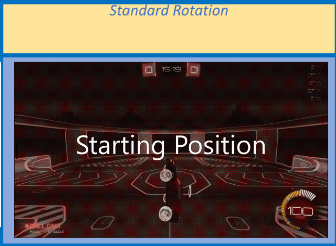
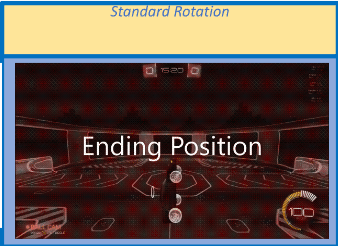
- Secondary rotation begins when the bottom of the car is facing right and ends when the bottom of the car is facing left.
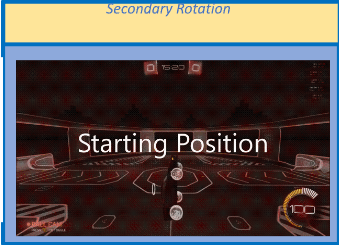
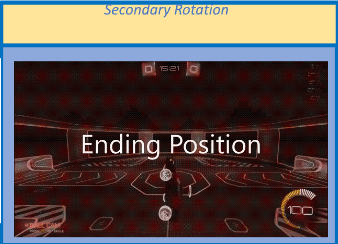
The objective with this exercise is to train your eyes and brain to know what rotation you are in and where in the rotation you are at all times. This is possibly the most difficult hurdle to overcome, so practice this until you feel comfortable.
Air Roll left – Basic Analog Input
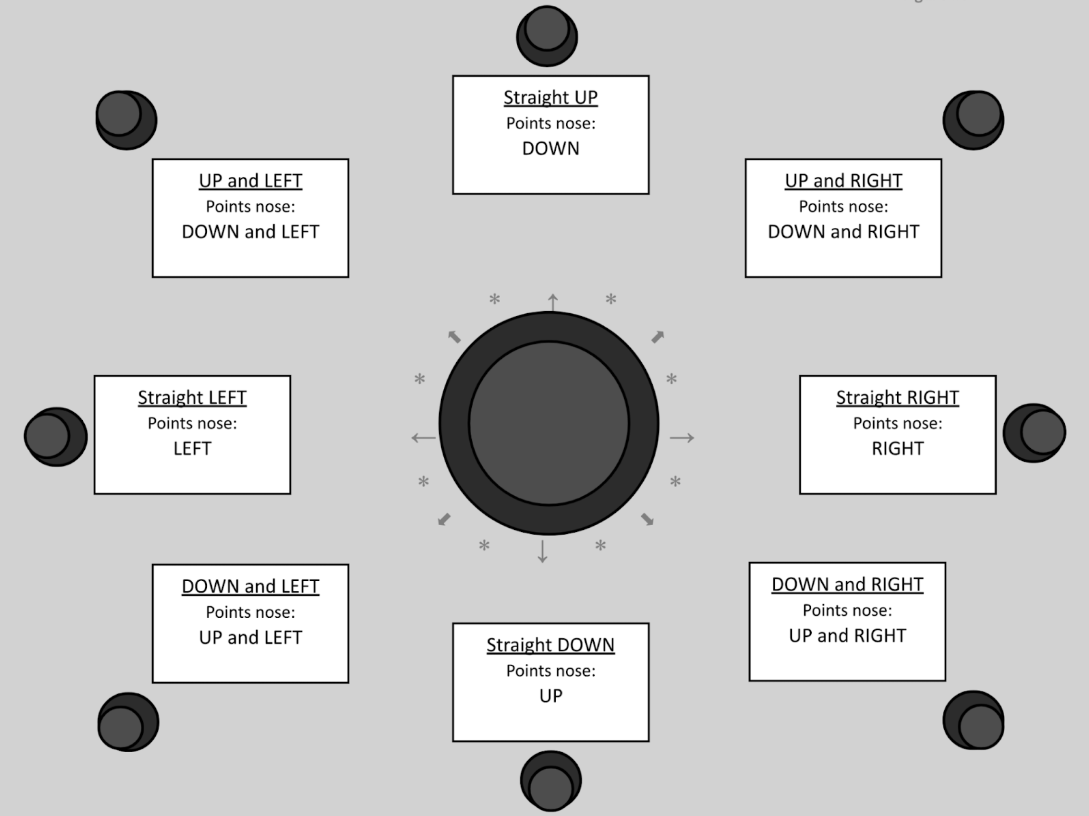
“initiate the analog movement at the very beginning of the rotation and let the analog stick return to resting position ONLY at the very end of the rotation.”
Here is an example of why one should adhere to this rule:
Suppose Rocket League player SquishyMuffinz is learning to use directional air roll for the first time. In an online match, his teammate passes the ball into the air. Upon jumping into the air, SquishyMuffinz holds left directional air roll without using his analog stick and realizes that he must turn left to reach the ball (SquishyMuffinz is holding down left directional air roll throughout this entire example). Once his car is in the Standard Rotation Starting Position, SquishyMuffinz pulls and holds his analog stick in the SOUTH-WEST position. This pulled the nose of his car LEFT and UP. HOWEVER, SquishyMuffinz fails to bring his analog stick back to the resting position by the end of the standard rotation. Instead, he holds it in the SOUTH-WEST position until the end of the Secondary Rotation! In the Secondary Rotation, the South-West analog position pulls the nose of the car RIGHT and DOWN. This is the opposite of Standard Rotation where the SOUTH-WEST position pulls the nose of the car LEFT and UP. As such, the car returned to the Standard Rotation Starting Position, and he missed the pass!
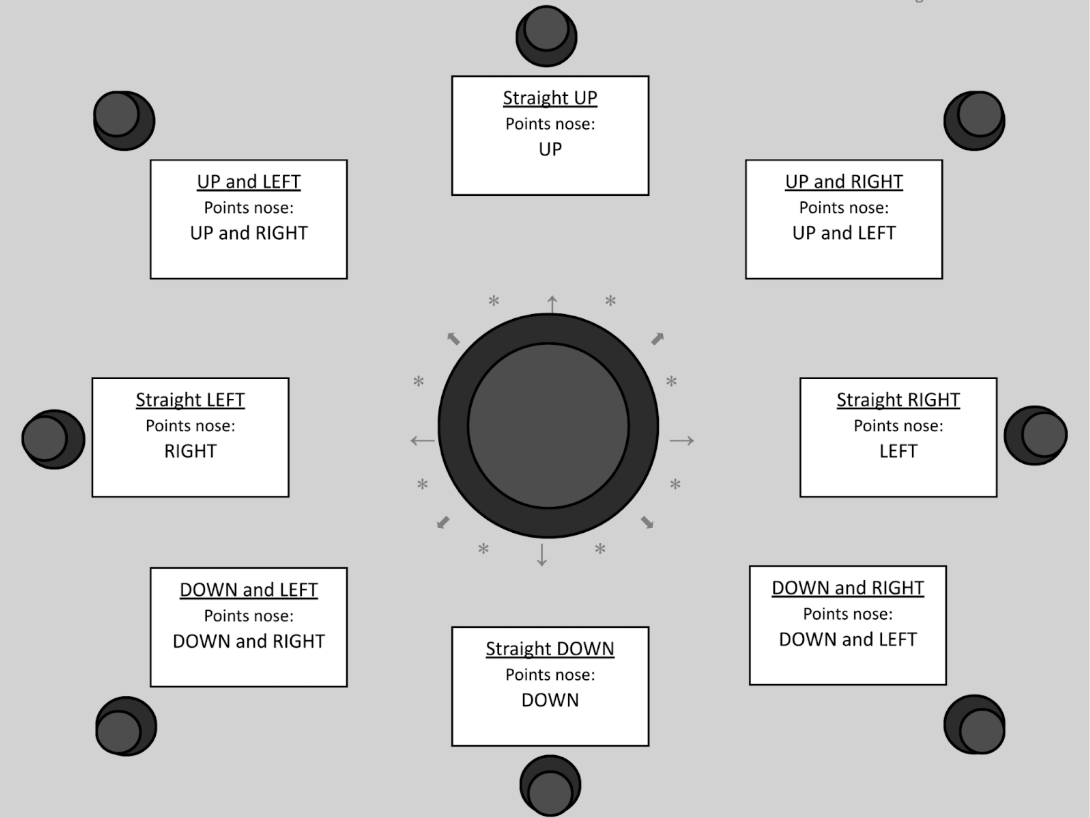
WORK IN PROGRESS
https://docs.google.com/document/d/1eZAbWPrSGT1qq7hcyeuUKee8XOcb8S0K/edit?usp=sharing&ouid=105319463969498769846&rtpof=true&sd=true
- Pro's camera★ 5 (1.4k)101k views1.3k ♥1 minBulgarianUpdated 4 Feb, 2017
- Rocket League Workshop Maps Upload Guide★ 5 (606)64k views850 ♥3 min
- New Scamming Tactics★ 5 (760)62k views285 ♥2 minBulgarianUpdated 15 Oct, 2022
- Rocket League Trading★ 5 (2.4k)57k views1.7k ♥2 minUkrainianUpdated 4 Nov, 2024
- Rocket League Achievements★ 5 (565)36k views553 ♥24 minBulgarianUpdated 16 Oct, 2016
- In-depth Basic Aerial Guide [w/Gif illustrations]★ 5 (403)27k views476 ♥12 min




- Upgrading to PremiumTeam Fortress 2★ 5 (20k)1441k views11k ♥6 minUpdated May 11, 2022
- No More Room in Hell Official ManualNo More Room in Hell★ 5 (2.8k)569k views2.1k ♥29 minUpdated Apr 22, 2019
- NMRiH Community Hosting GuidesNo More Room in Hell★ 5 (526)351k views653 ♥1 minUpdated Aug 10, 2022
- ULTIMATE GUIDE FOR GAME DEV TYCOONGame Dev Tycoon★ 5 (5.8k)326k views10k ♥4 minUpdated 23 Jan, 2014
- How to 'Git Gud' Soon™MORDHAU★ 5 (2k)318k views3k ♥68 minUpdated Nov 16, 2024
- Лучшие кооперативные игры SteamPAYDAY 2★ 5 (1.5k)315k views2.1k ♥56 minRussianUpdated Apr 27, 2025




This guide was created by its original author on the Steam Community. Are you the author and want it removed? Request removal.