Line Infantry: Making the most of them
Introduction

Regiments of the line, colloquially known as line infantry, are the primary unit of warfare in Empire: Total War. Understanding their strengths, weaknesses, tactical requirements and overall strategy is critical to doing well, so here I will attempt to collect my own historical knowledge and game experience to give you a few tips, hints and ideas.
The History
[this section contains mostly information about the British Army, but can be applied to most European nations]
[steam doesn't like the word c o c k so it's missing a k everywhere in this guide]
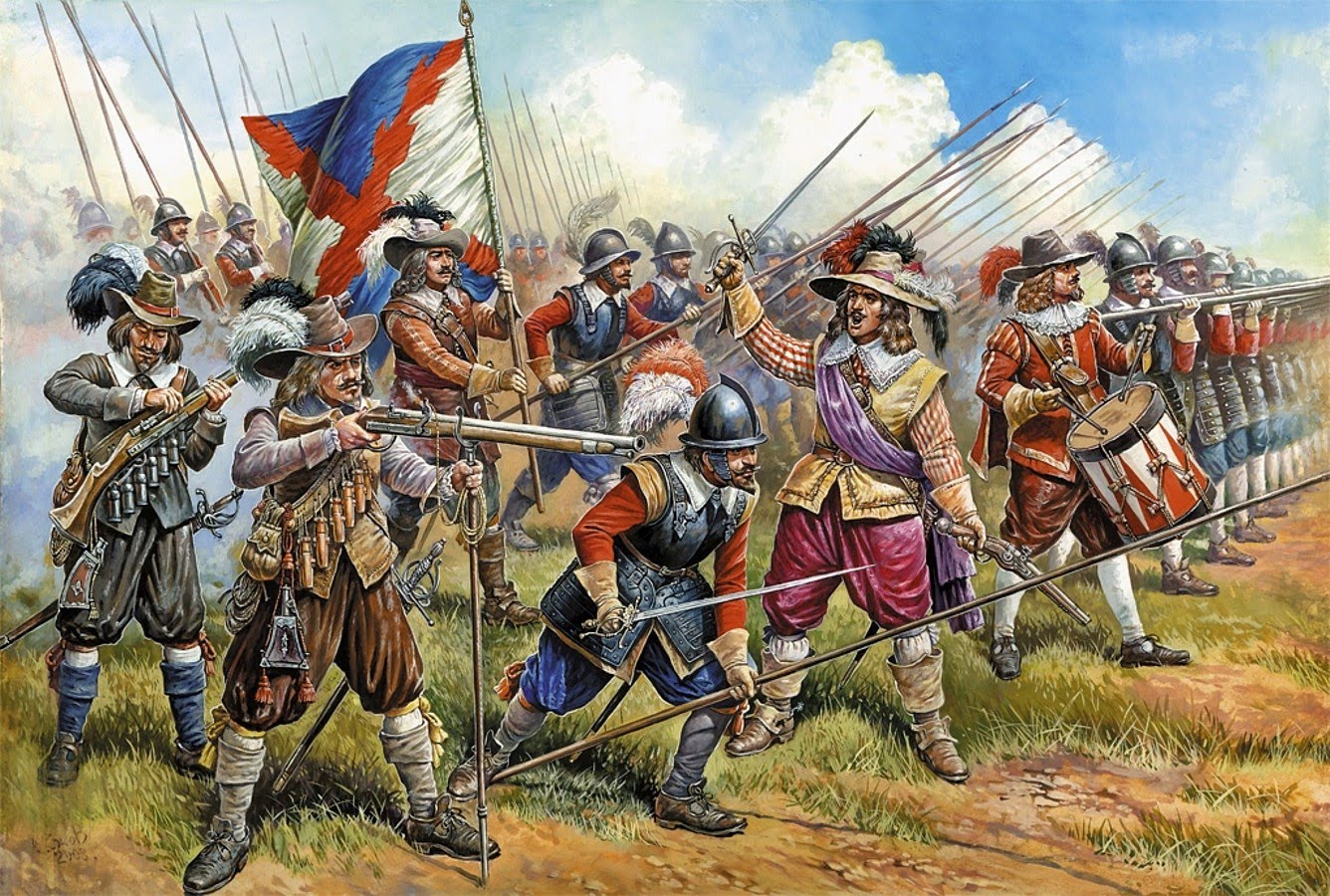 An illustration of mid-1600s pike and shot warfare.
Regiments of the line as we see in Empire (set from the year 1700 onwards) are continuations of a much older style of warfare originating in the mid-to-late 1500s known as pike and shot. It was so called because large regiments of pikemen protected equally large regiments of musketeers from cavalry while the musketeers used their primitive firearms to win the battle. These firearms were known as matchlock rifles and required the lighting of a small length of hemp cord, pulled into contact with the powder in the pan by the trigger mechanism, to fire the piece.
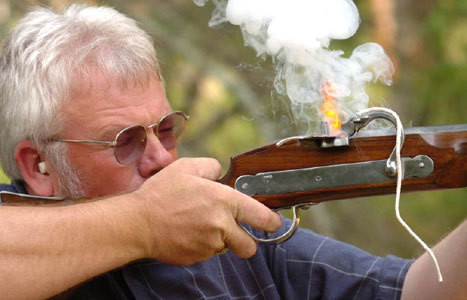 A matchlock musket.
Matchlocks begun to lose prominance in the late 1600s as a new type of weapon - the flintlock - became more widely used. Originally supplied to the men guarding the magazine (powder supplies), these flintlocks were superior to their older brothers as they relied on the strike of a piece of flint within the cocing hammer against a piece of steel called the frizzen in order to launch the sparks into the powder - thus no lit flame was carried on the soldier and this made it, for obvious reasons, much safer to guard the powder carrying a flintlock rather than a matchlock. These men, after the French word for gun (fusil), became known as Fusiliers and some soldiers in the British Army retain this title to this day.
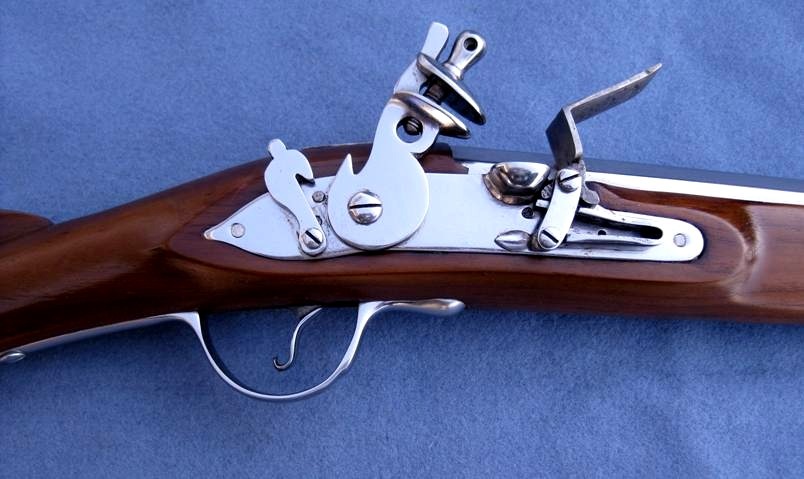 A dog lock, with a clear look at the steel "dog".
The flintlock musket used in Empire: Total War is an earlier version of the weapon seen in most film and TV shows depicting the era, known as a dog lock musket. These models were named thus due to the lack of a half-coc position on the hammer which was an invaluable safety mechanism. Instead of a half-coc position, the lock contained a small hook of metal called a "dog" that effectively retained the hammer at a mid-way point between released and coced, allowing the soldier to open the frizzen and pour his powder into the pan without having to hold the hammer back with one hand. The dog lock was phased out by the much more common Land Pattern Brown Bess in the 1740s, becoming the weapon we see in the game, before it was finally replaced by weapons such as the cap-lock musket and Baker rifle by the mid-1800s.
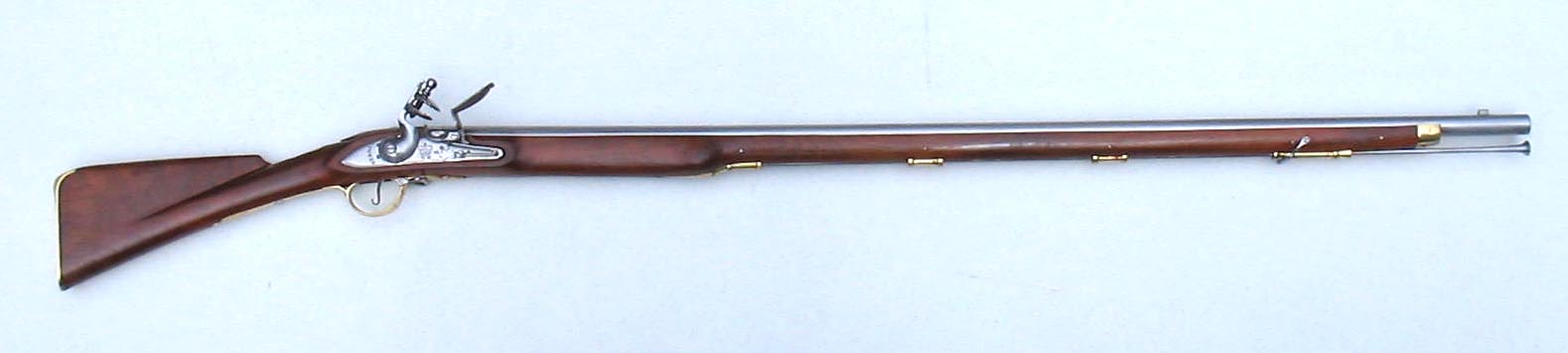 A Land Pattern Brown Bess, the typical "musket".
The ubiquitious order of battle has always been the regiment and little else. Since the creation of the English Army in the 1680s (before the nation became the Kingdom of Great Britain in 1707) regiments had been marshalled under the Colonels whom had raised them and thus named after them. During the 1700s this changed, and regiments became identifiable by number contingent to the order in which they were originally founded. This numbering is known as the Order of Precedence and still remains a part of the Army to this day; with the Household Cavalry and Foot Guards ranked in order of precedence right to left during Trooping the Colour.
Regiments during the time of the Seven Years' War (1756-1763) and American War of Independence (1775-1783) were composed of around five hundred men (though this was an ideal number and often varied massively) with numbered regiments being largely distinguished by differences in buttons and the colour of their trimmings (uniforms always remained the same shade of red throughout the infantry with minor exceptions such as the Queen's Rangers). Each regiment was commanded by a Colonel with a Lieutenant Colonel and Major as second- and third-in-command respectively. Regiment HQ had five further staff officers and a number of craftsmen.
The regiment was divided into ten roughly equal companies of fifty men each. The Col, Lt. Col. and Maj. commanded a company each; these companies were styled after their commanders (i.e. Major's Company, 46th Regiment of Foot). The other seven companies were commanded by Captains with a Lieutenant and Ensign each to help with management. Eight of these companies, formed of regular redcoats, were known as battalion companies. The other two were a grenadier company armed with grenades and famous for their tall mitre caps and a light infantry company trained to screen the main force and provide protection on the flanks and rear. During the latter half of the 18th Century, the Army would often detach these two companies, known as 'flank companies', from the regiment and combine them with other flank companies to form their own specialised brigades.
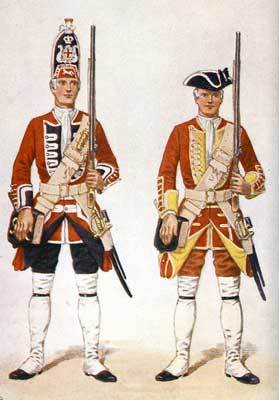 A British grenadier (left) and musketeer (right) during the Seven Years' War. Grenadiers can be distinguished from Fusiliers by the presence of a small gold container on the cartridge belt which was for holding the lit fuse for his grenades. Fusiliers also wore slightly shorter caps.
[steam doesn't like the word c o c k so it's missing a k everywhere in this guide]
Tactics & Weaponry
An illustration of mid-1600s pike and shot warfare.Regiments of the line as we see in Empire (set from the year 1700 onwards) are continuations of a much older style of warfare originating in the mid-to-late 1500s known as pike and shot. It was so called because large regiments of pikemen protected equally large regiments of musketeers from cavalry while the musketeers used their primitive firearms to win the battle. These firearms were known as matchlock rifles and required the lighting of a small length of hemp cord, pulled into contact with the powder in the pan by the trigger mechanism, to fire the piece.
A matchlock musket.Matchlocks begun to lose prominance in the late 1600s as a new type of weapon - the flintlock - became more widely used. Originally supplied to the men guarding the magazine (powder supplies), these flintlocks were superior to their older brothers as they relied on the strike of a piece of flint within the cocing hammer against a piece of steel called the frizzen in order to launch the sparks into the powder - thus no lit flame was carried on the soldier and this made it, for obvious reasons, much safer to guard the powder carrying a flintlock rather than a matchlock. These men, after the French word for gun (fusil), became known as Fusiliers and some soldiers in the British Army retain this title to this day.
A dog lock, with a clear look at the steel "dog".The flintlock musket used in Empire: Total War is an earlier version of the weapon seen in most film and TV shows depicting the era, known as a dog lock musket. These models were named thus due to the lack of a half-coc position on the hammer which was an invaluable safety mechanism. Instead of a half-coc position, the lock contained a small hook of metal called a "dog" that effectively retained the hammer at a mid-way point between released and coced, allowing the soldier to open the frizzen and pour his powder into the pan without having to hold the hammer back with one hand. The dog lock was phased out by the much more common Land Pattern Brown Bess in the 1740s, becoming the weapon we see in the game, before it was finally replaced by weapons such as the cap-lock musket and Baker rifle by the mid-1800s.
A Land Pattern Brown Bess, the typical "musket".Organisation & Hierarchy
The ubiquitious order of battle has always been the regiment and little else. Since the creation of the English Army in the 1680s (before the nation became the Kingdom of Great Britain in 1707) regiments had been marshalled under the Colonels whom had raised them and thus named after them. During the 1700s this changed, and regiments became identifiable by number contingent to the order in which they were originally founded. This numbering is known as the Order of Precedence and still remains a part of the Army to this day; with the Household Cavalry and Foot Guards ranked in order of precedence right to left during Trooping the Colour.
Regiments during the time of the Seven Years' War (1756-1763) and American War of Independence (1775-1783) were composed of around five hundred men (though this was an ideal number and often varied massively) with numbered regiments being largely distinguished by differences in buttons and the colour of their trimmings (uniforms always remained the same shade of red throughout the infantry with minor exceptions such as the Queen's Rangers). Each regiment was commanded by a Colonel with a Lieutenant Colonel and Major as second- and third-in-command respectively. Regiment HQ had five further staff officers and a number of craftsmen.
The regiment was divided into ten roughly equal companies of fifty men each. The Col, Lt. Col. and Maj. commanded a company each; these companies were styled after their commanders (i.e. Major's Company, 46th Regiment of Foot). The other seven companies were commanded by Captains with a Lieutenant and Ensign each to help with management. Eight of these companies, formed of regular redcoats, were known as battalion companies. The other two were a grenadier company armed with grenades and famous for their tall mitre caps and a light infantry company trained to screen the main force and provide protection on the flanks and rear. During the latter half of the 18th Century, the Army would often detach these two companies, known as 'flank companies', from the regiment and combine them with other flank companies to form their own specialised brigades.
A British grenadier (left) and musketeer (right) during the Seven Years' War. Grenadiers can be distinguished from Fusiliers by the presence of a small gold container on the cartridge belt which was for holding the lit fuse for his grenades. Fusiliers also wore slightly shorter caps.
Choosing a Faction
Nation Choice:
Choosing a nation based on the quality of its line infantry might seem like a narrow-minded idea, but in some cases it can be the difference between victory and defeat depending on the theaters you choose to fight in. Having a slight edge in the line of battle will more often than not carry the day.
Line infantry (as well as similar units such as sepoys, colonial infantry etc.) is available to the following factions:
Austria
France
Great Britain
Poland-Lithuania
Prussia
Russia
Spain
Sweden
United Provinces
United States
For the purposes of a fair trial, I have established nine areas of comparison:
Cost
Upkeep Cost
Melee Attack
Charge Bonus
Defence
Morale
Accuracy
Reloading Skill
Number of Men
Turns to train, ammunition and range are equal across all factions and thus have been ignored.
Cost Efficiency:
BEST: Russia (1040 cost, 260 upkeep cost)
WORST: Prussia (1150 cost, 280 upkeep cost)
Melee:
BEST: Russia (8 melee attack, 13 charge bonus)
WORST: Austria (5 melee attack, 8 charge bonus)
Defence:
BEST: Great Britain (15 defence, 8 morale)
WORST: Austria (11 defence, 6 morale)
Ranged:
BEST: Prussia (40 accuracy, 35 reloading skill)
WORST: Russia (35 accuracy, 15 reloading skill)
Nation Comparison:
(nations with "average" have default stats for line infantry)
Austria: Fields 125% the men of other factions. Poor in all areas.
France: Above-average melee performance, good all-round.
Great Britain: Expensive, but the best defence and morale in the game with impressive reloading skill.
Poland-Lithuania: Average.
Prussia: The most expensive in the game, but excellent charge and morale. Unparalleled reloading skill.
Russia: The cheapest and best melee line infantry though suffers in defence, morale and has poor ranged capabilities.
Spain: Average.
Sweden: Average.
United Provinces: Average.
United States: Average.
Tactics
Deployment
As a rule, it matters more about the arrangement and angle of your formation than the actual placement. You must understand the concept of a frontage in 18th Century warfare, that is to say the amount of men in your front rank and therefore the amount of muskets trained on the enemy at any one time. The core of firelock warfare is to concentrate volleys of disciplined fire upon the enemy with organisation, ammunition efficiency and minimal friendly casualties.
Depending on your technological advancements (more on that later) your formation should change. If fighting AI, deploy your line infantry in two separate lines of four to five companies each. This will present a shorter frontage than your enemy, and the AI will naturally bunch its flanks together as it homes in on the center of your army. If fighting a player, ensure your frontage either matches or extends past your opponent's, though be careful not to stretch your line too thin and retain a number of companies in reserve just in case.
Line infantry should be deployed three ranks deep in Empire: Total War. There is an argument that two ranks, as used in the American War of Independence, would better suit the maps and allow for more musket fire, but I have personally found this to be ineffective as melee-based units such as Native American Warriors can simply crack two ranks wide open. A third retains an element of safety and also allows for the use of advanced manoeuvres further on down the line.
Line Infantry should retain clear gaps between one company and the next, as in order to fire at an angle without moving the formation or changing facing will require shooting through the corner of the adjacent company if proper space is not kept. Reserves, second lines, dragoons and auxiliary units are all more than capable of plugging gaps if need be. The flanks of the line of battle should be adequately supported and protected, as it will not only refuse any manoeuvres but also strengthen the morale of your line infantry on the flanks. If no cavalry, militia or spare units are available, slant the wings of your line slightly back to facilitate easier redeployment if required in the midst of the battle.
Lastly, if you must place line infantry in front of other units or artillery that will fire through them, place them DOWNHILL of the artillery/other unit.
Tactics
Your main tactic with line infantry is to place as much as the enemy unit inside your arc, or the area covered by the muskets in your front rank. Turning off the Fire at Will control will ensure you do not waste half a rank's ammunition before the other half has come within range. To this effect, ensuring you keep units within the original formation is crucial. Do not allow individual units to wander out of formation, as once their flanks become exposed they are more likely to waver and they become easy prey for more mobile enemies.
Above all, do not break formation. Make sure you keep tabs on the location of all enemy units relative to the facing of your line infantry, so you can make adjustments well before they are needed and ensure you are always presenting a static, fully reloaded front rank to the enemy at all times.
Two defences can be used by line infantry: earthworks and chevaux de frisés. The former is a large ditch and mound which massively reduces the impact of incoming fire and artillery, though is noticeably weak against grenades, mortars and howitzers. Chevaux de frisés are large wooden frames which break cavalry charges. These are largely useless unless you have limited lines of sight and are unable to concentrate at least two volleys on an enemy cavalry unit before they reach your lines. They provided limited to no protection against musket fire and artillery.
Technology
Superior Line Infantry
This unit can be trained by only Prussia and Sweden with an Army Board. They are vastly superior to normal Line Infantry and carry the additional benefits of being able to hide in lighter cover, inspiring units around them much like a general would and having almost unbreakable morale.
Bayonets
Three types of bayonets are available through researching technology on the campaign map:
Plug Bayonet: Permanent bayonet, handle of a knife right down the barrel.
Ring Bayonet: Removable bayonet, a tight metal ring. Reduces reloading skill.
Socket Bayonet: Removable bayonet, ring with lock. No skill reduction.
Formations & Advanced Manoeuvres
Fire and Advance: The unit breaks down into sections, advancing while firing. Excellent for cover, low mobility.
Fire by Rank: Each rank fires, then kneels and reloads. Allows all three ranks to participate in a battle rather than only the first, crucial technology.
Square Formation: The company forms a square, watching all angles. Useful against highly mobile and harassing enemy but forces the company to remain static.
Epilogue
Well, cheers for reading through, this is most of what I've learned from playing this game. I rely heavily on my line infantry and take pride in mowing down any army with superior discipline and organisation. That said, if anybody has any morsels of information or corrections to apply to the guide, please do let me know and I will update it frequently.
Now get out there, and defend those colonies!
Now get out there, and defend those colonies!
More Total War: EMPIRE - Definitive Edition guides
- The Proper Use of Dragoons★ 5 (722)45k views448 ♥5 minUpdated Jul 4, 2024
- Empire II: Total War: A Pool of Suggestions★ 5 (1k)44k views309 ♥17 minUpdated Mar 12, 2016
- Graphics settings High and Very High★ 5 (391)43k views505 ♥1 minUpdated Apr 12, 2021
- A quick and general Guide To Empire Total War★ 5 (699)43k views1k ♥42 minUpdated Feb 20, 2015
- Why CA should make Empire 2: Total War★ 5 (1k)40k views184 ♥3 min
- Warfare in the 1700s★ 5 (528)31k views662 ♥15 min




This guide was created by its original author on the Steam Community. Are you the author and want it removed? Request removal.