Saint George
Rationale
I'm someone that likes to obsessively create ideal characters in games. These are usually just adaptations of characters that don't already exist in the game, but are mentioned in the lore. The best examples of this would be in Fallout, Demon's Souls, and obviously Dragon's Dogma. Usually this is accompanied by some irrational tics, like saving three times in a row because I wasn't attentively watching the save animation the first two times, and restarting a game entirely if I've missed a detail that doesn't even necessarily require me to restart. I'm sure people can relate to this kind of behavior, considering how people can relate to taking hours to come up with a character's name.
So when I found a few potential indicators of an ideal character in Dragon's Dogma, I began to be obsessed. Usually, I try to take a comprehensive, long-term approach to this process so I'm not wasting any more time than I already am by obsessing over a video game, by obsessing over a video game in the wrong way. So I opened my strategy guide, which I totally have no remorse about purchasing and summarily throwing in the garbage after it was made obsolete by a few patches and the development of the Dragon's Dogma wiki, and started looking to see if the strongest equipment wasn't ugly. I was pleasantly surprised to find that a mask and the strongest sword in the game, Ascalon, both looked pretty neat, and were direct references to Saint George.
As anyone that's as shamefully obsessed about the game as me would know, there are also several other pieces of equipment that directly refer to other legendary European heroes. This wasn't a dilemma though, since none of the swords were compelling or uniquely modeled, and none of the masks had an accompanying sword. The only hero to receive more than one direct reference was Saint George, and the odds were stacked in his favor otherwise.
Grigori's entire design and conception in the lore, Aelinore's design and her context, and the medieval style of Gransys are all strongly suggestive of Saint George. Grigori as an antagonist that came about through failed defiance of 'the Maker' and his following transformation into the Dragon, clearly comparable to Satan's defiance of God and fall from Heaven, is therefore analogous to the dragon (also said to be representative of the devil) fought by Saint George. Grigori's appearance as 'the great red dragon', while not biblical, is a no less iconic analogy for Satan. While Capcom's interpretation of 'the great red dragon' is more sensational and easily digestible, than the more literal seven-headed interpretation it refers to directly, it still serves to reinforce Grigori as an antagonist that is objectively congruous with Saint George.
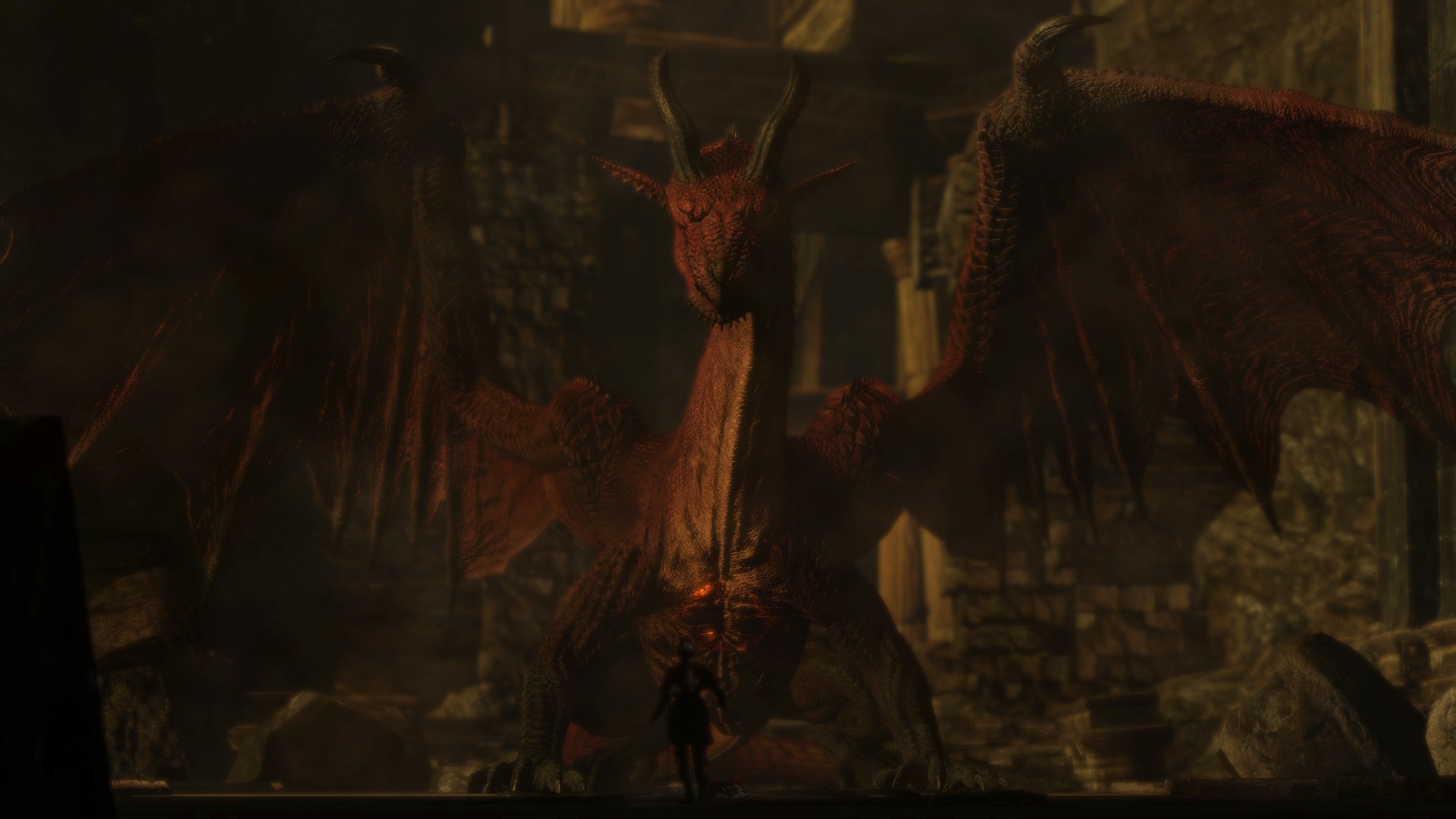
Aelinore's role as the token princess is no less obvious a reference than Grigori's appearance. The most vapid love interest of the game, effectively pushed on the player, though perhaps not as much as Fournival, and the most contrived, yet idyllic, love interest to save from Grigori. While her place in the story was practically perfect for me, her outfit left a lot to be desired, which I will address later on.
Finally, the most important feature apart from the princess, the dragon, and the sword, is the style. Apart from one, all other referenced heroes were outright incongruous with the medieval style of Gransys. Mostly fitting into Nordic or classical mythological contexts, it would have been illogical to pursue any of them. The aesthetic of Gran Soren and much of the armor in Dragon's Dogma were some of the most important factors compelling me to turn this obsession into a serious project.
So I have the long-winded justification, what did I do with it?
Prototypes
Since I've played Dragon's Dogma from its release on consoles to this year, I've had a lot of time to sift through what does and does not work in making an ideal Saint George. When trying to find an image to correspond with what costumes there were in-game, one of the most eye-catching Saint George's I first saw was one of Carlo Crivelli's. Already having known about the Chimeric Half-Plate, this particular rendition of lion-headed pauldrons was very compelling.
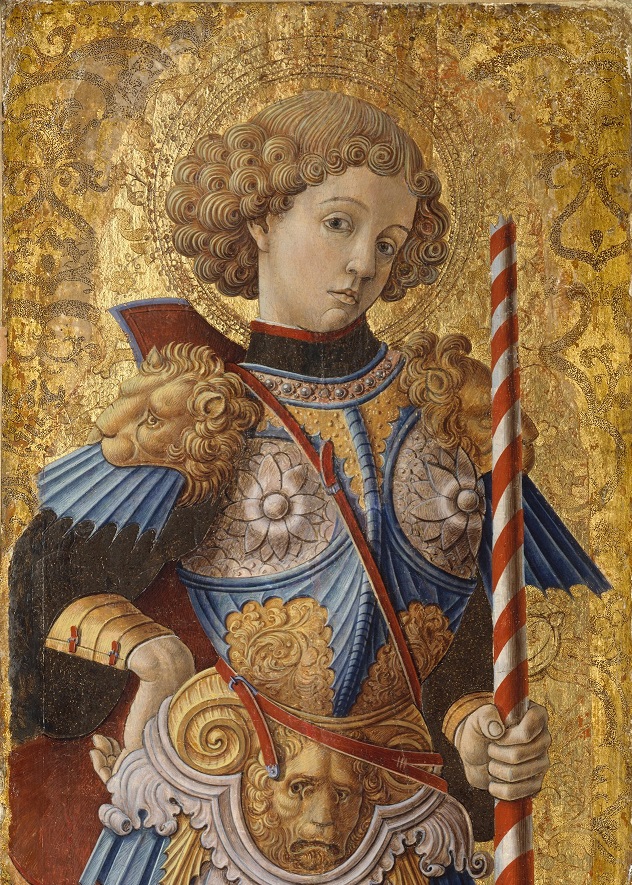
Carlo Crivelli - Portrait of Saint George
To be honest, this costume was so ornate that it was obviously very naive to think it could ever be worth attempting to imitate in Dragon's Dogma, especially for just one feature. While I persisted with some decent results on the console version, suffice to say it all paled in comparison to what I could do with the PC release.
With Dragon's Dogma, people don't give its flexibility for modding potential nearly enough credit. Some of the ugliest, most entitled attitudes towards modding as just a form of free content have made their appearance with the advent of the game's PC release. While I will officially list these in the credits, it should be said here that the three most important sources of modding Dragon's Dogma have been FluffyQuack, the Dragon's Dogma section of the Resident Evil modding forum, and the pastebins by users on the Dragon's Dogma general of /vg/. Without these incredibly insightful guides, this project would not have been worth writing about.
Being blunt, Hex Editing has not been nearly as important as other modifiable features of Dragon's Dogma's assets. Apart from the ARCtool, the most important feature to modding Dragon's Dogma has been the ability to edit textures. In the particular endeavour of creating new textures, my input has been minimal. My friend, listed as a contributor to this guide, has done the vast majority of the texture creation. Without the ability to remove and otherwise extensively edit textures, again, this project would not have been worth writing about.
The next feature that has been integral to refining the mod, and especially integral to avoiding the tedious substitute of Hex Editing, is model swapping. Experimenting with model swapping, and taking a shamefully long time to understand basic facts about folder structures, has been very important to working out the finer details of this project. If there is any elaborate contribution I am sincerely proud of making, it is model swapping.
Some important context to be aware of is that in the same time between Dragon's Dogma's initial release and its PC release, my favorite artistic ideal of Saint George narrowed down drastically. Completely disregarding artistically-licensed Italian Renaissance costume, I had become obsessed with the Italian-derived, German Renaissance fashion and the resemblance of German Saint George's to German knights of the period. Even with all the Orthodox, Gothic, Baroque, and Romantic contributions, the Northern Renaissance Saint George had a style and dignity that stood out above all, which was complemented by the simultaneous technological ceiling plate armor had reached. It was at a time when German armor smithing had perfected function to a legendary extent, and risen above it to focus on form. When this armor was accompanied by beautiful, dignified garments; the doublets and pleated bases said to have originated in Italy, and had been circulated by the French after their conquest of the region. With too many magnificent, compelling images to ignore, and too much potential in Dragon's Dogma to go unrealized, the Saint George I had to have in the game was obvious.
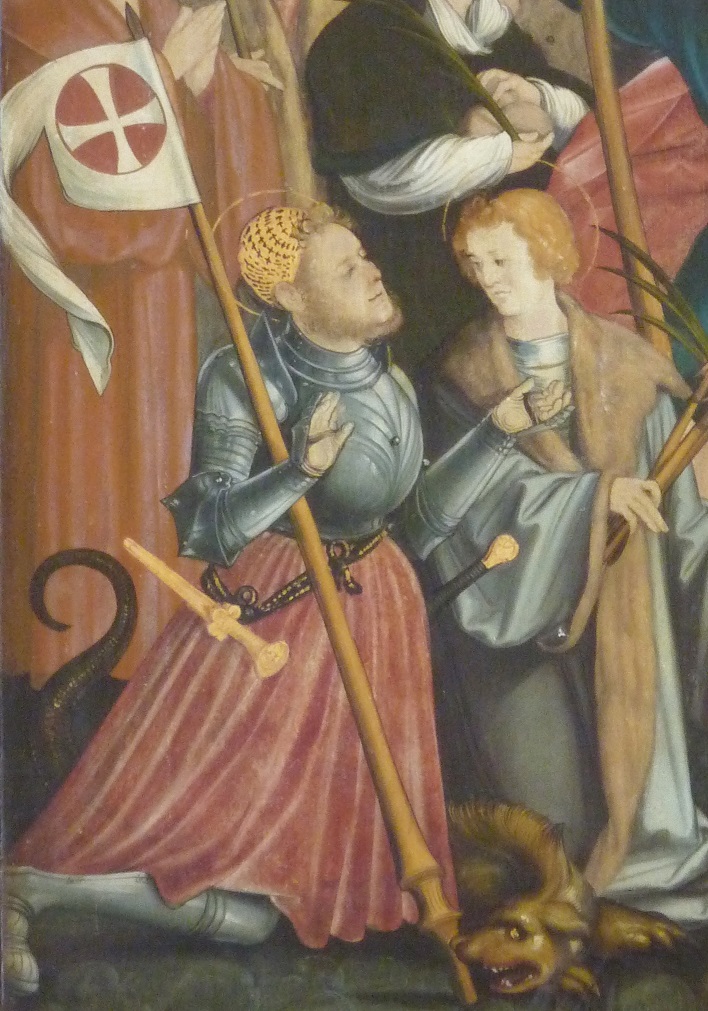
Hans Schäufelein - Altar of Saint Maria
This project was still contingent on and inspired by one other factor, the in-game equipment. The first piece of equipment to undergo any significant modification was the Chimeric Armet, in removing the horns on the helmet. Next, the Shadow Gauntlets and Meloirean Greaves underwent modifications in removing any fabric on them, and standardizing their color. The most important model in Dragon's Dogma that had any potential to resemble this costume is the Bronze/Steel/Solar Cuirass. If it wasn't for the skirt mesh on that equipment, it wouldn't have been possible to create anything resembling a bases. The breastplate on the equipement was also edited to be more congruous with the rest of the equipment and the references we were using.
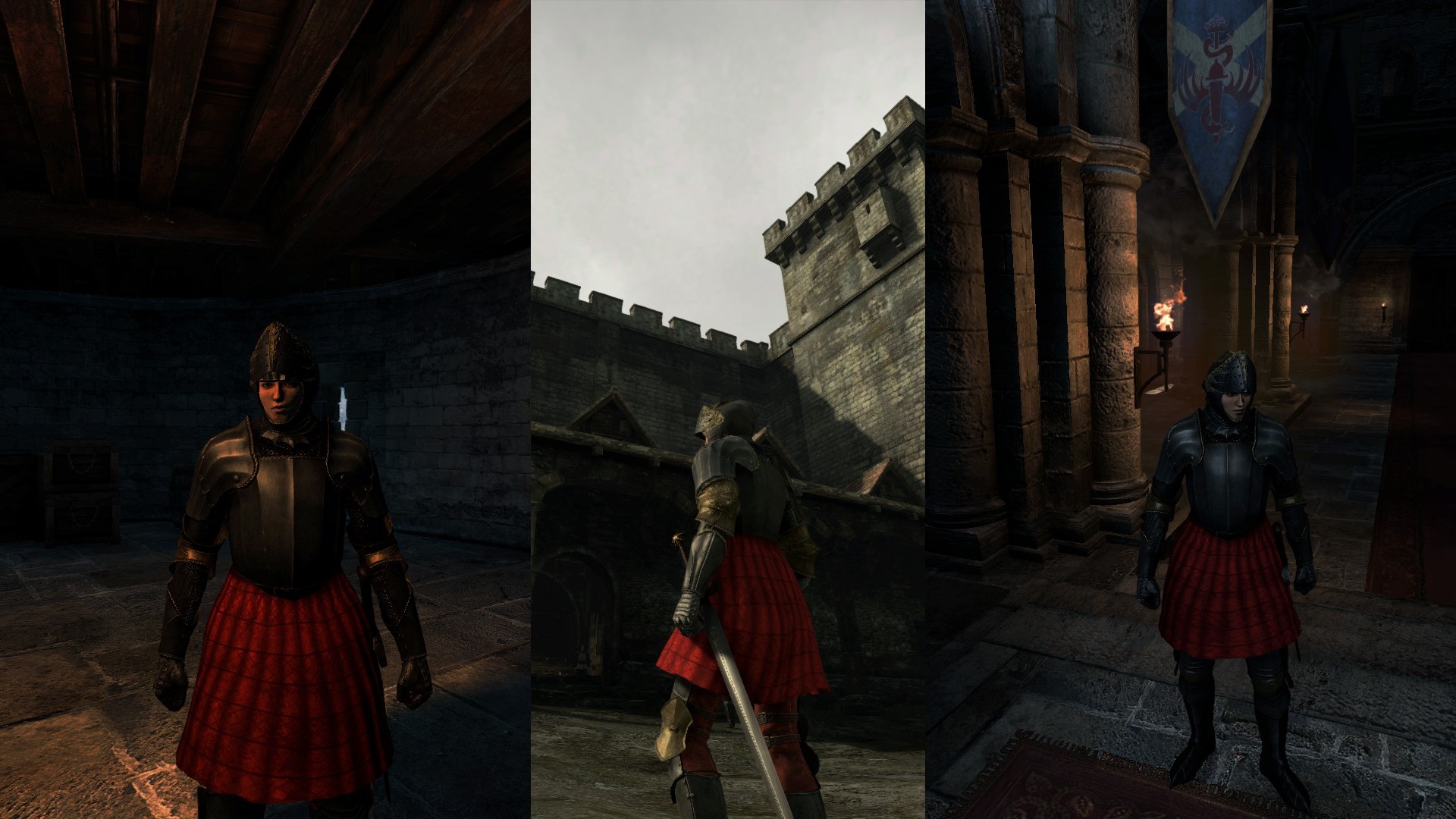
While this wasn't a bad first attempt, it left a lot to be desired. I was satisfied with most of the outfit, but the breastplate, pauldrons, gorget, and helmet were disappointing. They didn't correspond with the details of the images that I adored most, and only vaguely corresponded with some reference material that I didn't really care for.
By this point, my friend had already been worn out by the tedious processing of textures necessary in unpacking, re-packing, and testing in-game. Also having edited normal maps, only to have the completed costume look mediocre, was fairly disappointing. So I had to renew his interest in the project by demonstrating there was still more potential for improvement. This part of the process was possibly the most tedious, yet most fruitful of them all. I aimed at fixing the breastplate, pauldrons, and gorget with a single model providing the cohesion for it all. The Gryphic Armor provided a breastplate more congruous with the bases, and also a better looking gorget than the default one we had been tolerating on the Chimeric Armet. I decided it was best to avoid visible pauldrons all together for the time being, opting instead for the animated sleeves of the Royal Mantle I had loved since the console version.
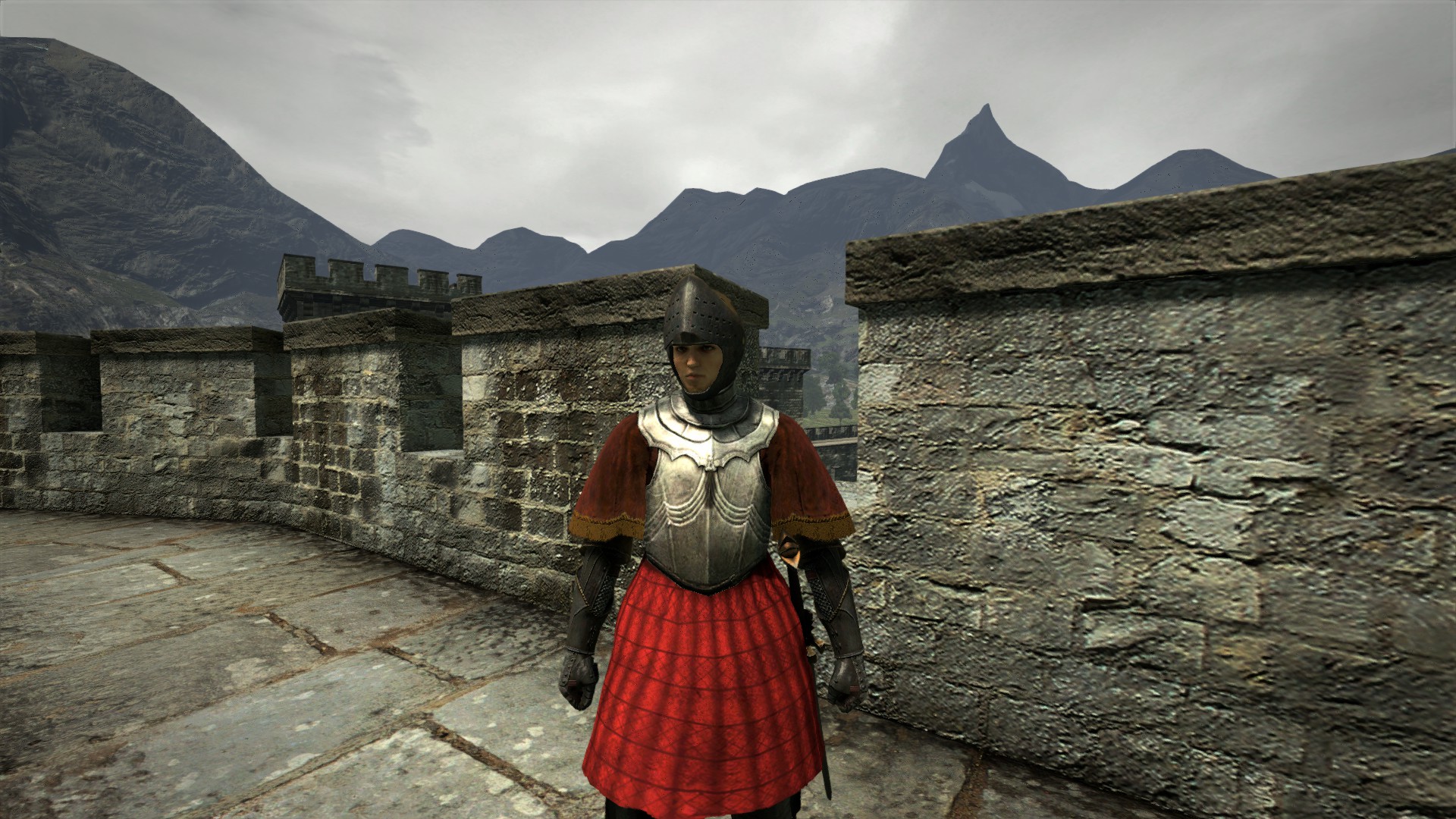
All of this required extensive trial-and-error; in editing the sleeves, gorget, and breastplate textures; to get a coherent idea of which texture modifications would lead to which results in-game. Thankfully, it provided the exact basis I wanted for all future additions.
Completion
With renewed interest, some vague directions, and an over-abundance of references provided by me, my friend set to work on finalizing the project. It is worth discussing here the exact references that were used for the final mod. Although I initially had a purist inclination to use the typical form of Saint George's cross, which is red on white as seen below, I had come to terms with several facts. Firstly, garments carrying the typical Saint George's cross in German Renaissance paintings weren't my first preference. Secondly, it would have taken even more work to retexture the bases, sleeves, and doublet as white to accommodate for a typical Saint George's cross.
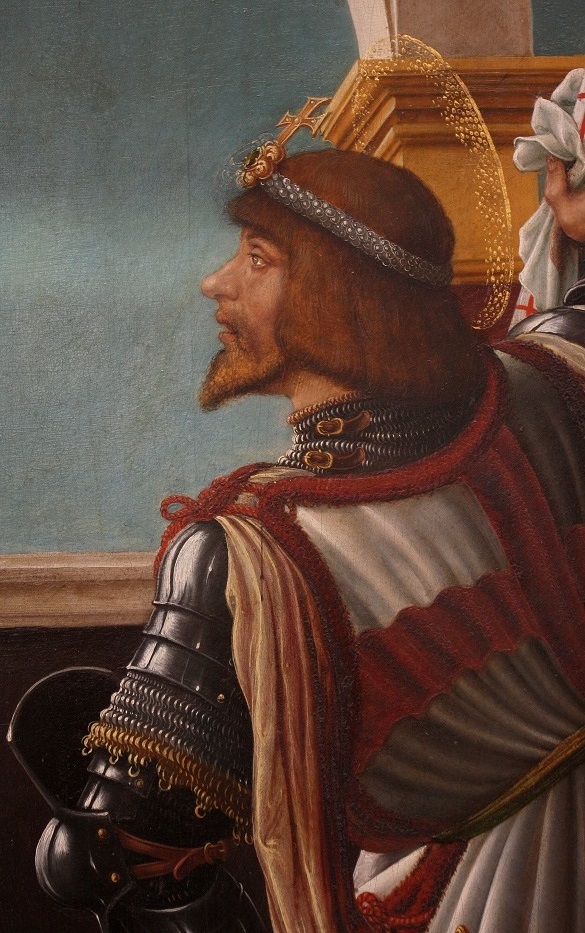
Hans Burgkmair - Crucifixion Altarpiece
Lastly, I had come to really appreciate not only the red-brown on several references and the Royal Mantle, but also the inverted form of Saint George's cross. So, clearly, an inversion of the cross was ideal, and still congruous with several references, which was very pleasing.
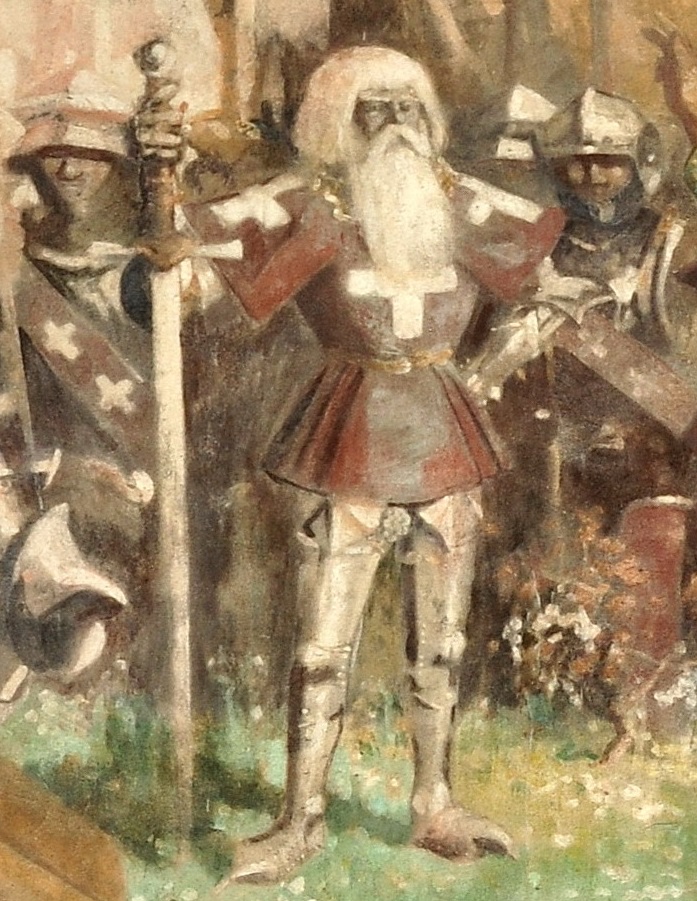
Gustav Adolf Cloß - Rapperswil joins the Old Swiss Confederacy in 1461
Just to clarify, while the painting above depicts the Swiss cross and not necessarily Saint George's cross; to my knowledge the Swiss cross was derived from the plundered war flag of the Austrians, which was itself designed as an inversion of Saint George's cross. I wanted the pattern on the bases to be subtle. I was well aware of some of the more elaborate patterns on bases in art, however Dragon's Dogma is not a game for particularly elaborate costumes. It would have looked gaudy, and so I found a simple pattern on a red-brown bases that I liked, seen below.
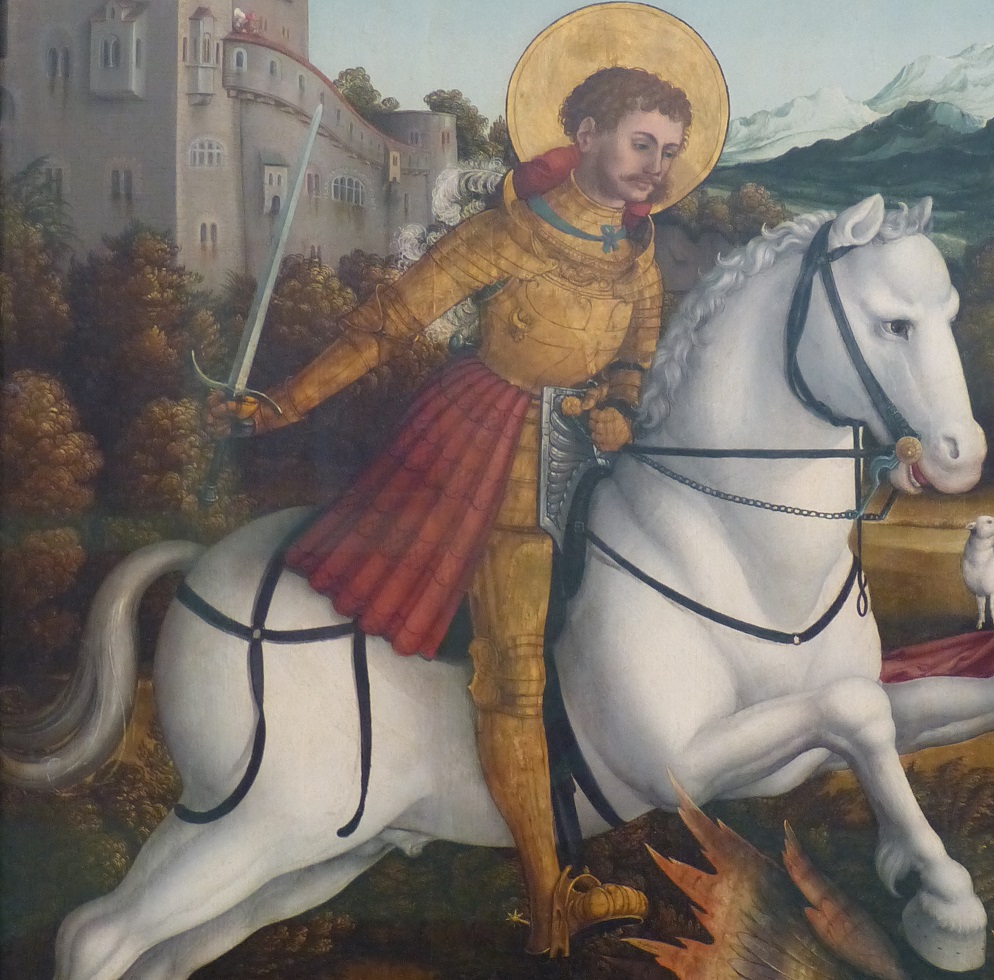
Martin Schaffner - Saint George fighting the Dragon
This particular reference also brings up the prospect of gold armor. Even though there are several German Saint George's with gilded plate, the asset quality and aesthetic of Dragon's Dogma simply would not accommodate such a costume. I sincerely contemplated an entirely gilded set of armor for some time, but plain steel with gilded accents has proven far more flexible, giving longevity to the equipment it would have otherwise been deprived of. The accenting was inspired by the tourney costumes below. Striking just the right balance between dull gold accents and steel plate; I believe it breaks up the armor nicely.
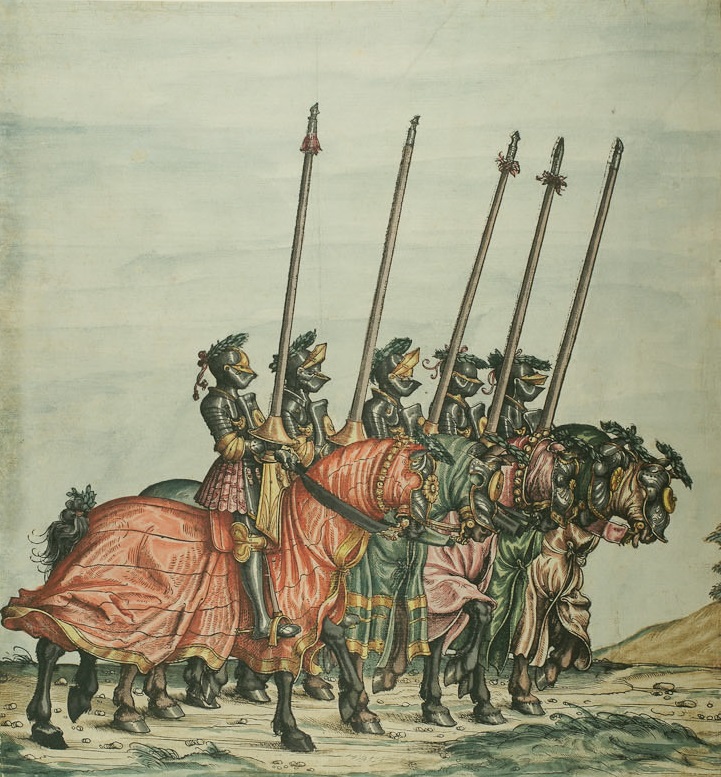
Hans Burgkmair - Triumph of Maximilian: The Italian Course
Finally, the most important references of all, are the prints below. These prints entail the entire costume we aspired to create, and while the preceding references each had a desirable element; these references had drawn them together for a glimpse of the finished product. These references definitely provided the most coherent vision for the whole project.
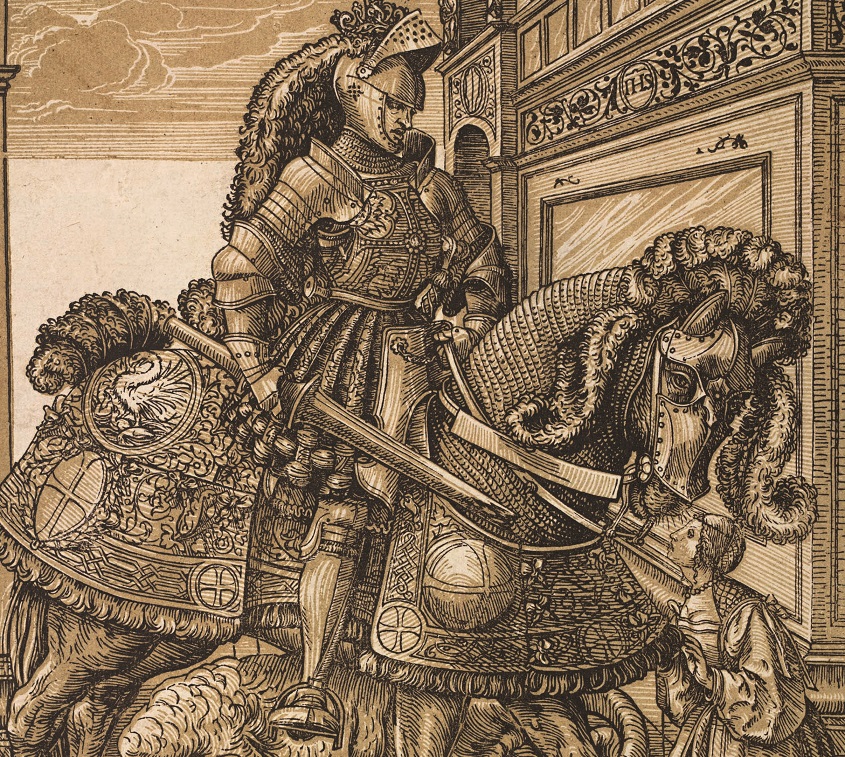
Hans Burgkmair - Saint George
As can be seen on this particular print, the tasseled sleeves of the knight on the left pleasantly coincides with the tasseled sleeves of the vanilla Royal Mantle.
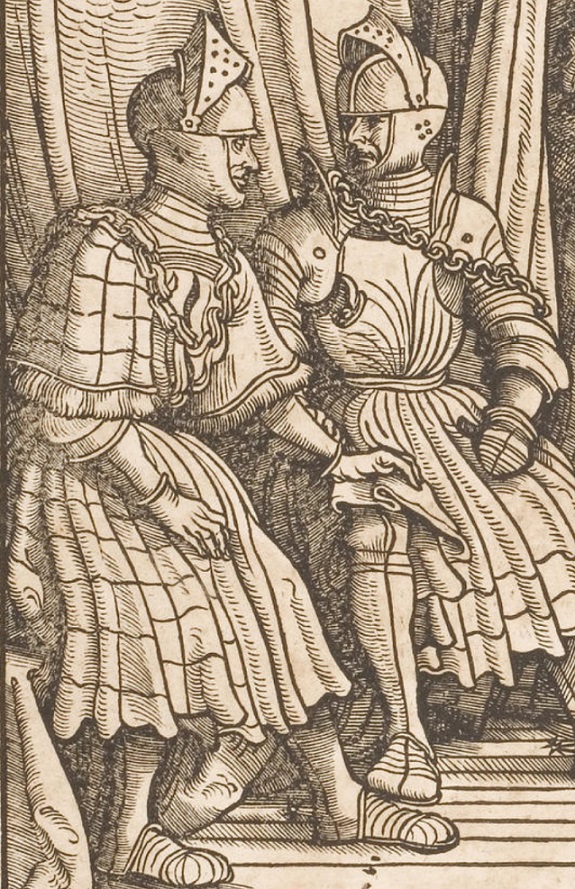
Hans Burgkmair - The White King
Providing the most refined portrayal of this costume I have ever seen, from the definition of the garments, to the excellent poses struck by the knights wearing them, it is the marvel I hoped to imitate most.
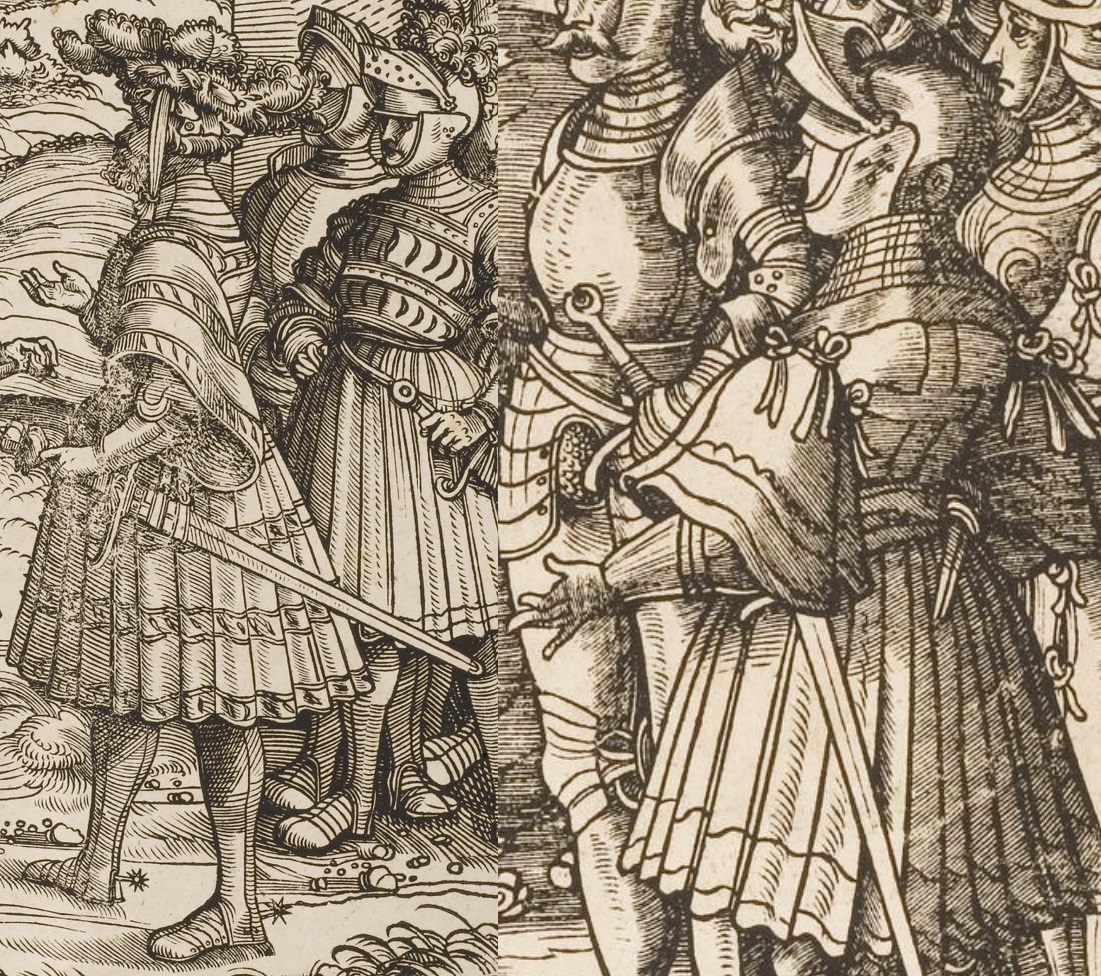
Ibid
Although there are still a couple of caveats, none of them are within my power to change. These include the shape of sabatons, unfortunately not square-toed like those in many references, and some particularities of the gauntlet and vambrace models we chose to use. Otherwise, with few and futile exceptions, I'm confident my friend and I have adapted the assets in Dragon's Dogma into the most excellent homage in a video game of a German Renaissance knight, and for the intent and purpose of this mod; Saint George, particularly in the style of Hans Burgkmair.
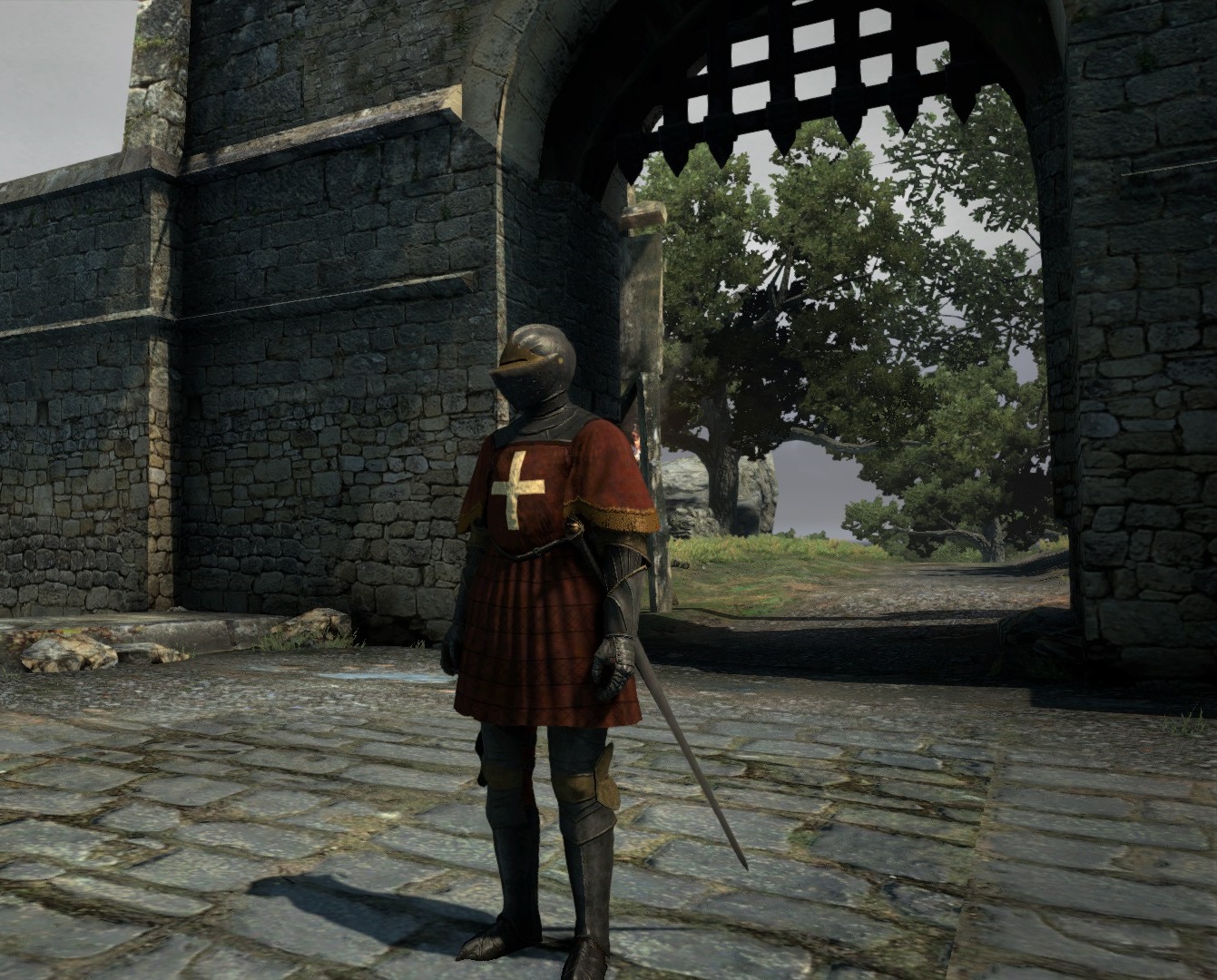
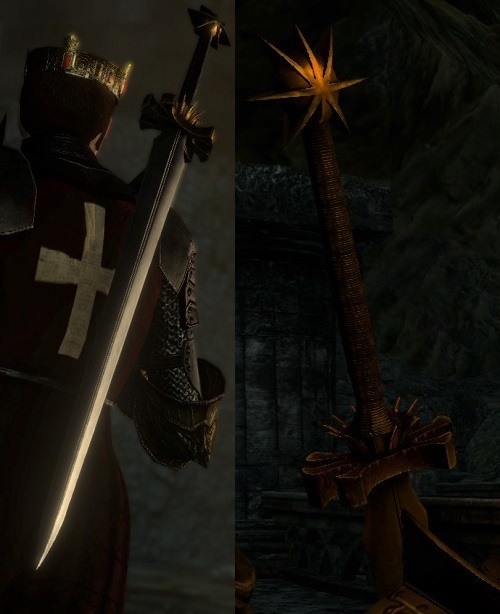
What's a hero without his sword though. The original Ascalon was also decidedly lame, with its ugly glowing effect on the blade, and white and gold grip. Originally I thought to disregard the sword all together, and opt for the Trusty Sword instead. However upon further inspection of some of my favorite Saint George's, they coincidentally had swords with comparably elaborate designs to Dragon's Dogma's Ascalon.
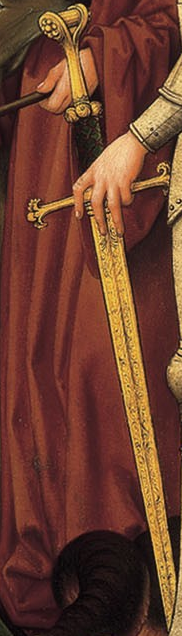
Hans Burgkmair - Basilica Cycle
So I model swapped Ascalon onto a sword with similar strength but no glowing effect, and had my friend edit the blade and grip texture. Even though it was exactly what I had requested, I didn't like the retextured grip my friend made me because the design I requested didn't translate into the game very well. So instead, I edited Ascalon's grip texture to be the Broad Sword's grip texture, since it corresponded exactly with several references, and turned out well.
Further Developments
Apart from Saint George himself, and the single costume that has been much of the focus of this project, there are also some very important accoutrements that were implemented during and after the main developments. To finish off the literal accoutrements for the costume, I made some more elaborate model swaps, and actually digressed to some other saints. The primary model swap was of the pauldrons of the Meloirean Plate with an accoutrement that didn't invalidate pauldrons. Thankfully I was so obsessed with this game, I already knew which exact accoutrement type would do this, and applied it to the Dragon Knight's Cloak. I had already model swapped the Royal Mantle sleeves with the Paladin's Mantle (ironically, swapping an accoutrement with an accoutrement), because the default model of the Royal Mantle would invalidate desirable parts of the Gryphic Armor. So with the knowledge in mind that the Paladin's Mantle was the least-obstructive accoutrement, and the Dragon Knight's Cloak simply being a blue Paladin's Mantle, it was an obvious choice.
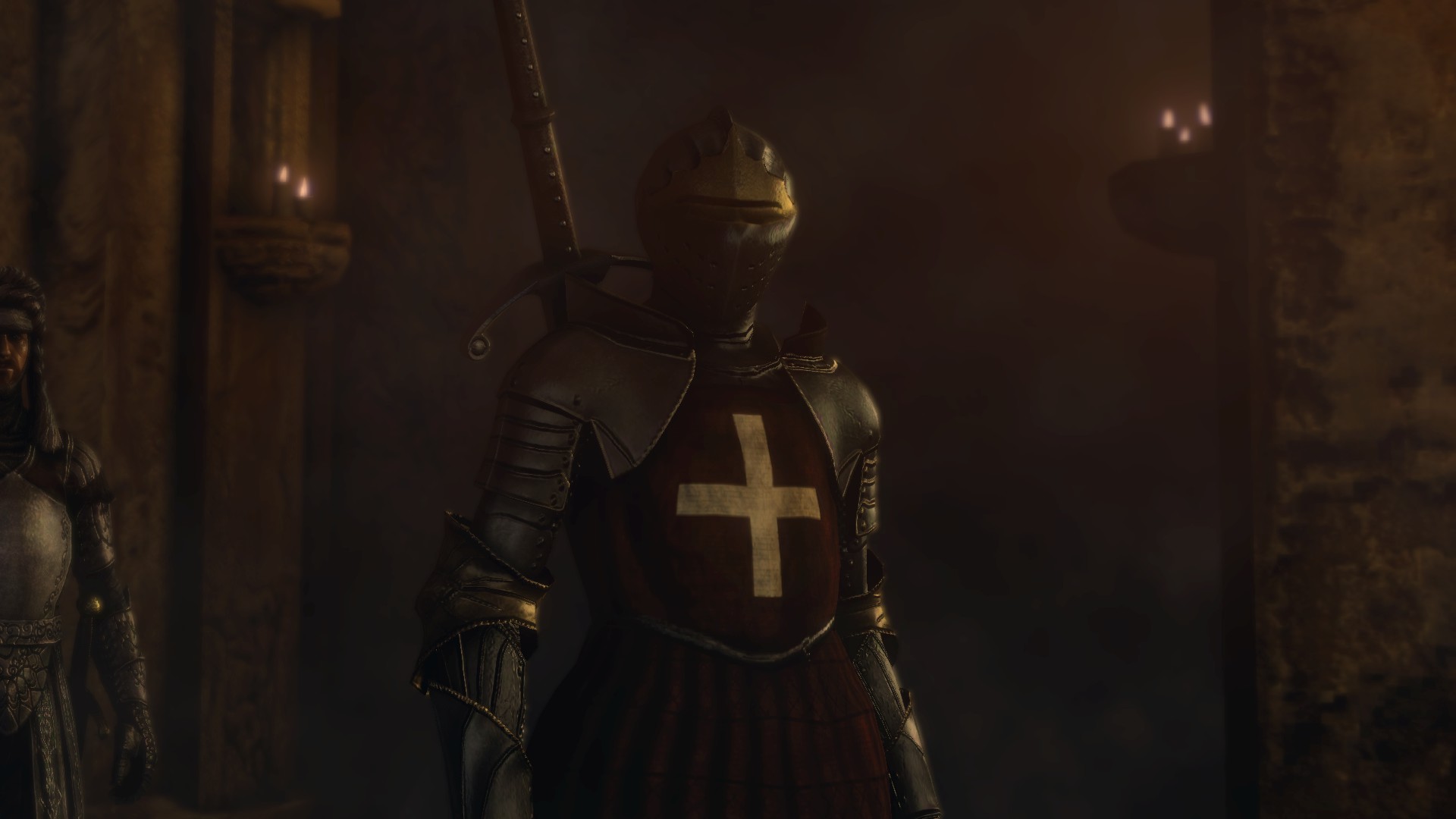
These pauldrons were important because they corresponded with several references that I was otherwise, disappointingly, not able to imitate. To some extent, I did have to settle on my favorite, German knights, but thankfully no longer.
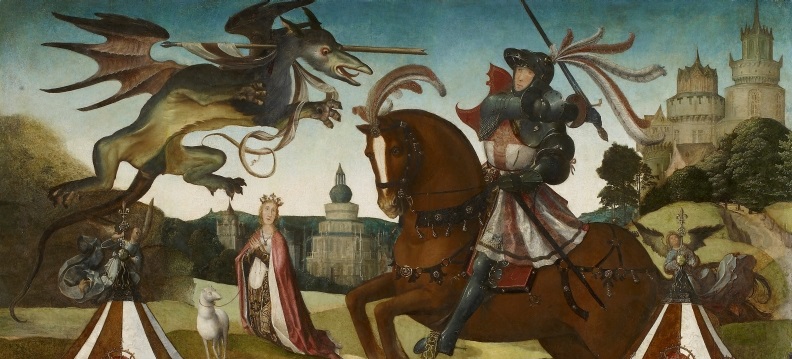
Unknown (Presumably Dutch) - Elizabeth of York, Henry VII, and Their Seven Children
The next little modification was a crown. In art, there are many depictions of saints wearing crowns, some of which are royal saints, and otherwise I suspect may be the crown of immortality. At any rate, it's a motif I came to appreciate, and although a nice helmet came first and foremost, I do like variety if it's warranted and dignified. There was one easily accessible crown that was unfortunately ugly, but I wanted the Duke's crown, because it was much prettier and its model was higher quality. So I removed almost all of the Duke's costume except the crown, and swapped it with a headpiece I had no desire for.
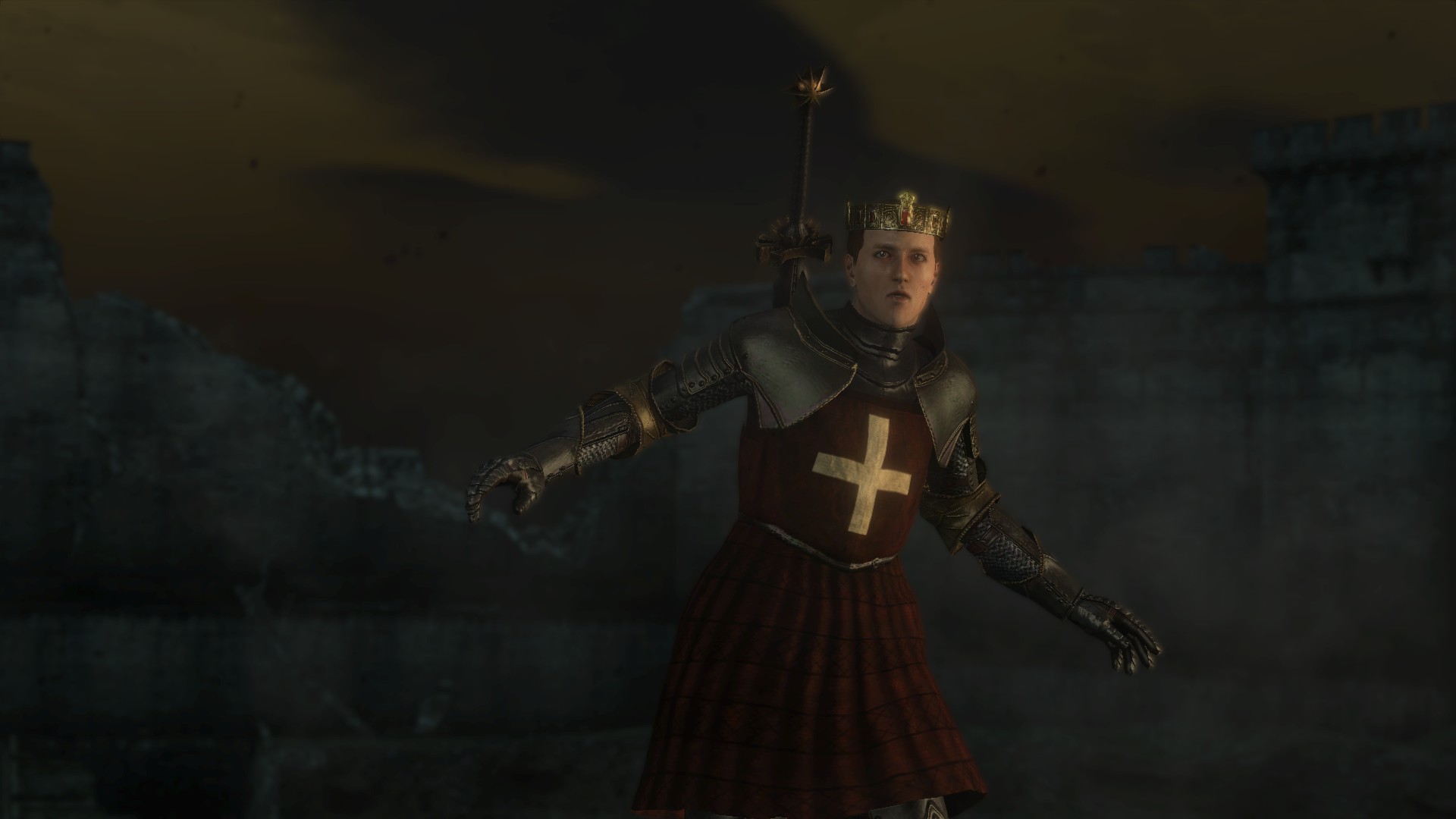
As I experimented further with other variations to the core costume, another particular saint served as an ideal model. Typically venerated in the West as Saint Hubert, and rather interchangable with Saint Eustace; donning some of the most beautiful hunting costumes of the Renaissance, it was an unavoidable match.
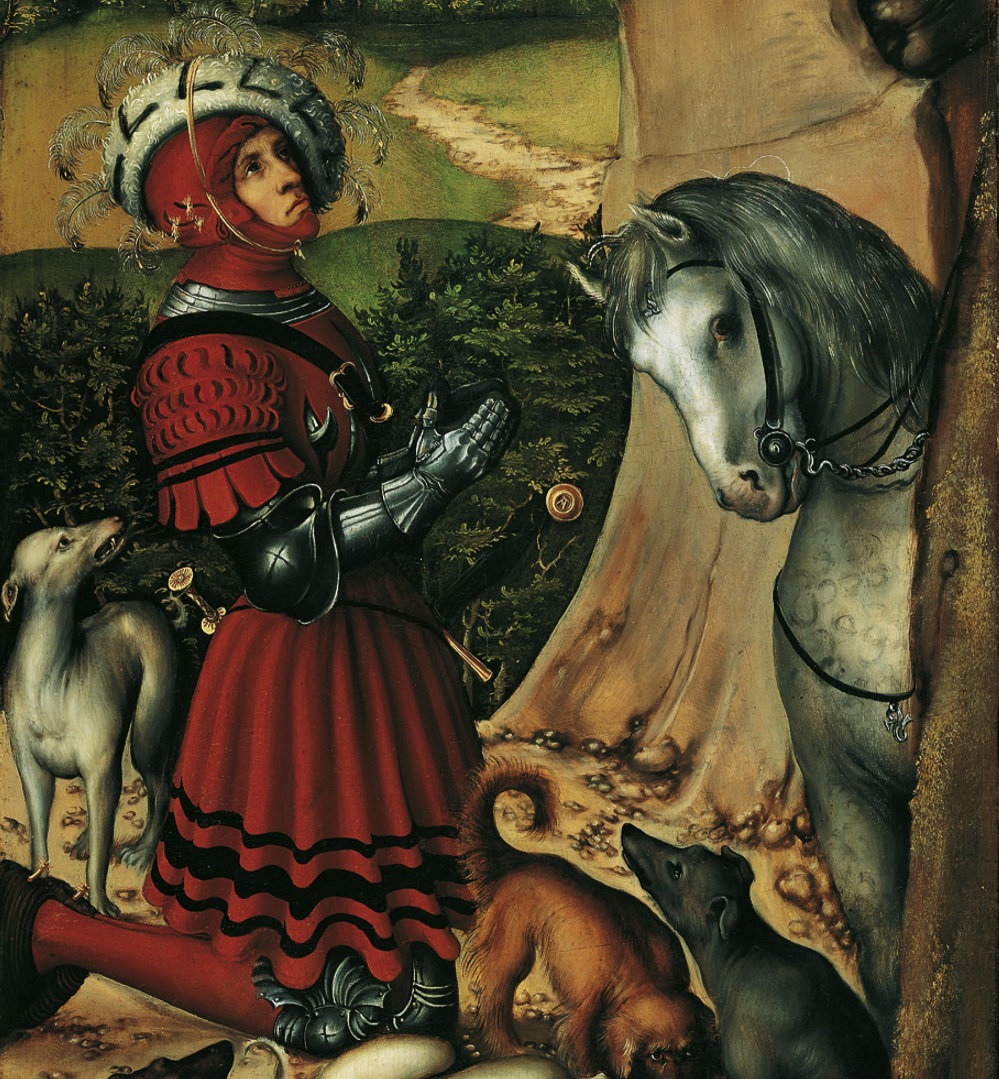
Lucas Cranach - Saint Eustace
Also, to be honest, I was looking for an excuse to use a bow. The mods for this costume were relatively simple. I retextured the Shortbow with a plain wood texture borrowed from the Reinforced Longbow, a surprisingly tedious process, and swapped its model with a bow that had decent strength. More notably, I removed the ear flaps and straps on the Farseer's Cap so it resembled a hunting cap more closely, which turned out pretty nicely, since the red of the cap was fairly congruous with the red-brown of the doublet. Worn with the vanilla Dark Over-Knee Boots, the costume resembles the references to satisfaction.
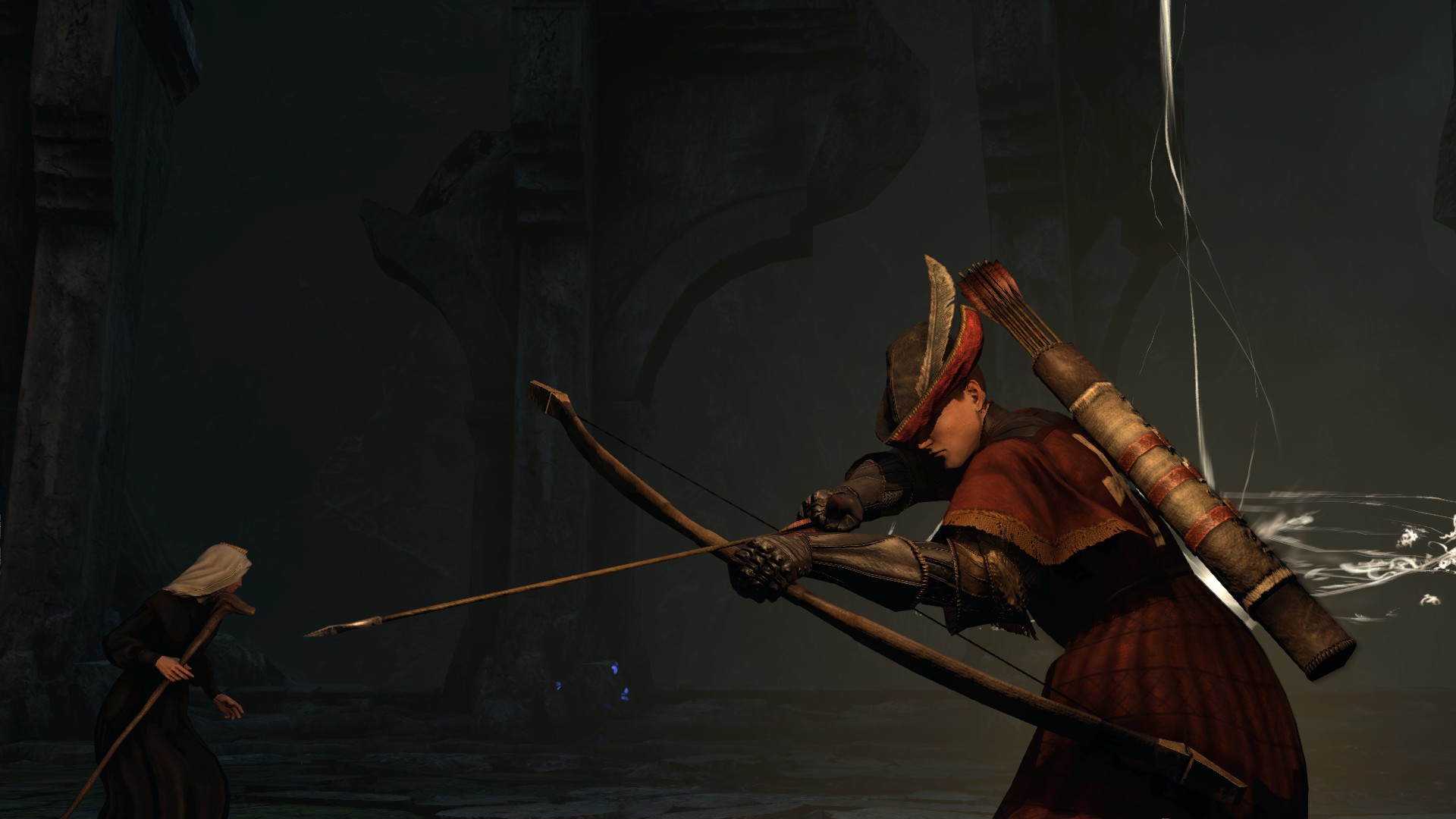
Something I had always found challenging was the issue of pawns. I considered attempting to make doublets of several colors and playing as a band of knights, but there are simply too many issues with model swapping to do that. In the end, the only satisfying design I could think of were saints in clerical outfits, since Saint George is one of the Fourteen Holy Helpers, and is often depicted with other saints in paintings commissioned by donors. I was confident I could make a dignified nun and monk, but after hours of disappointment at other people's pawns, I decided to make my own. The prospect of setting up several steam accounts and sharing my library with them wasn't exactly appealing, but I did it anyway. I didn't want to break the balance of the game after putting so much work into it, but ultimately I just used cheats to set their levels and skills, because going back and forth between accounts to make them progress incrementally was making it hurt to live.
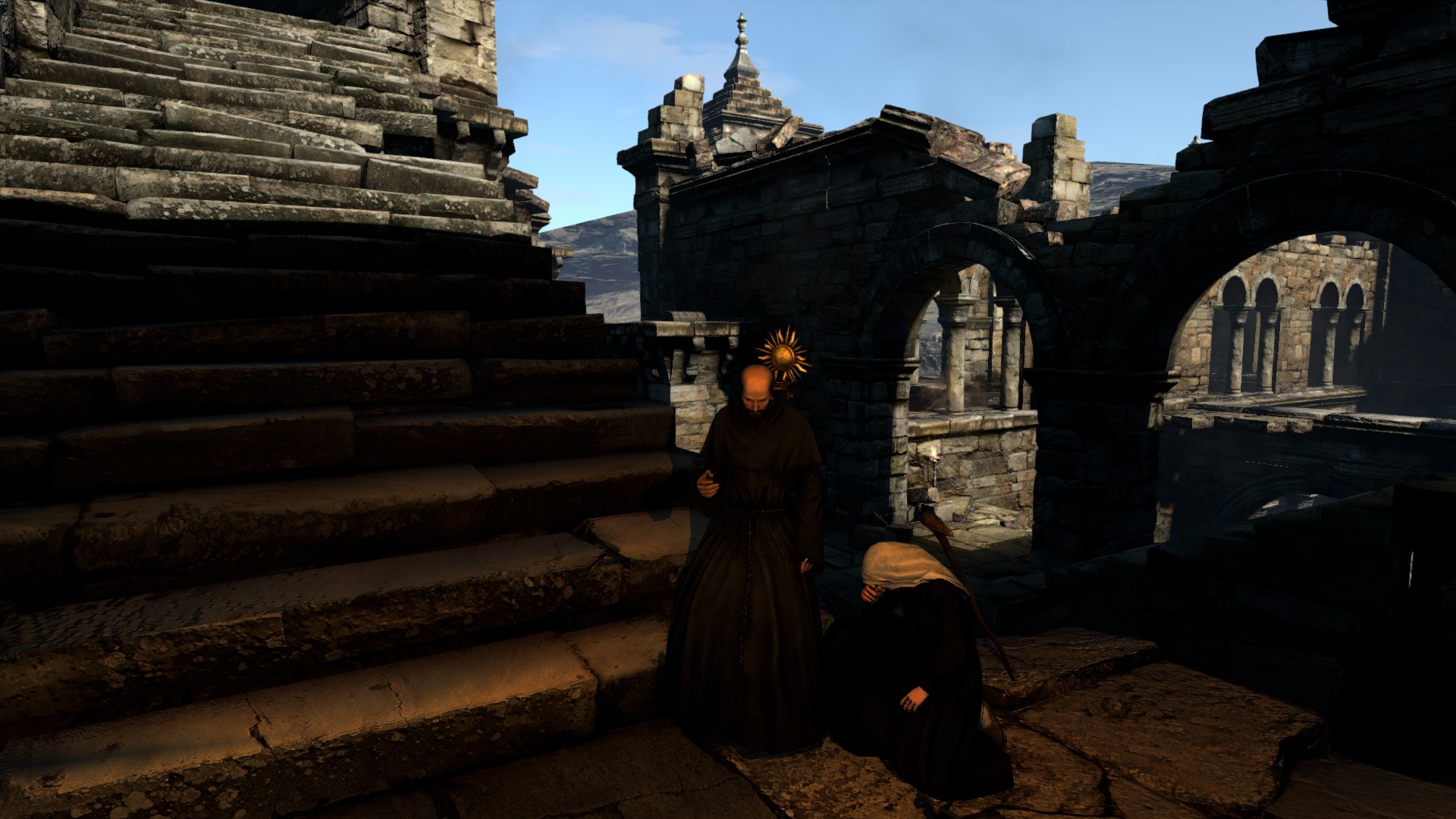
I'm somewhat proud of the mods themselves though. Like most of the mods I completed by myself, they took time, and were convoluted, but used simple methods. First I edited the Set of Nun Vestments with the typical black accents, and model swapped it with a piece of equipment that wasn't an outfit, so I could equip other pieces.
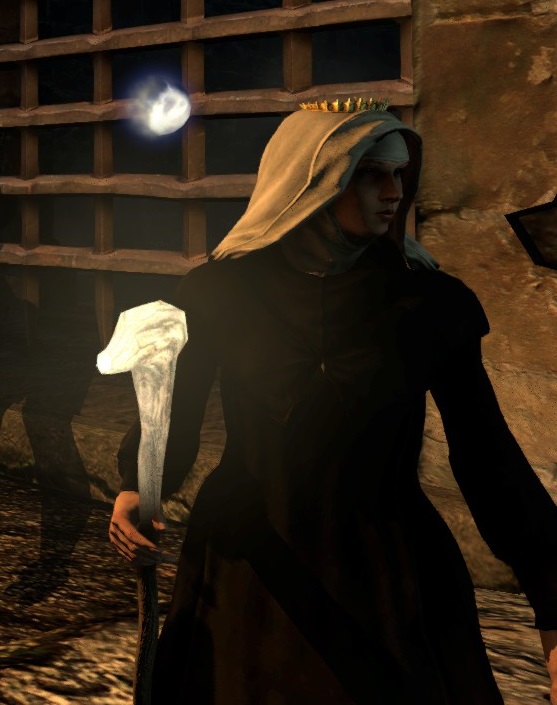
Next I applied the same method to isolate the Duke's crown onto the Duchess's, and equipped it all onto my female pawn, based roughly on this painting of Saint Elisabeth.
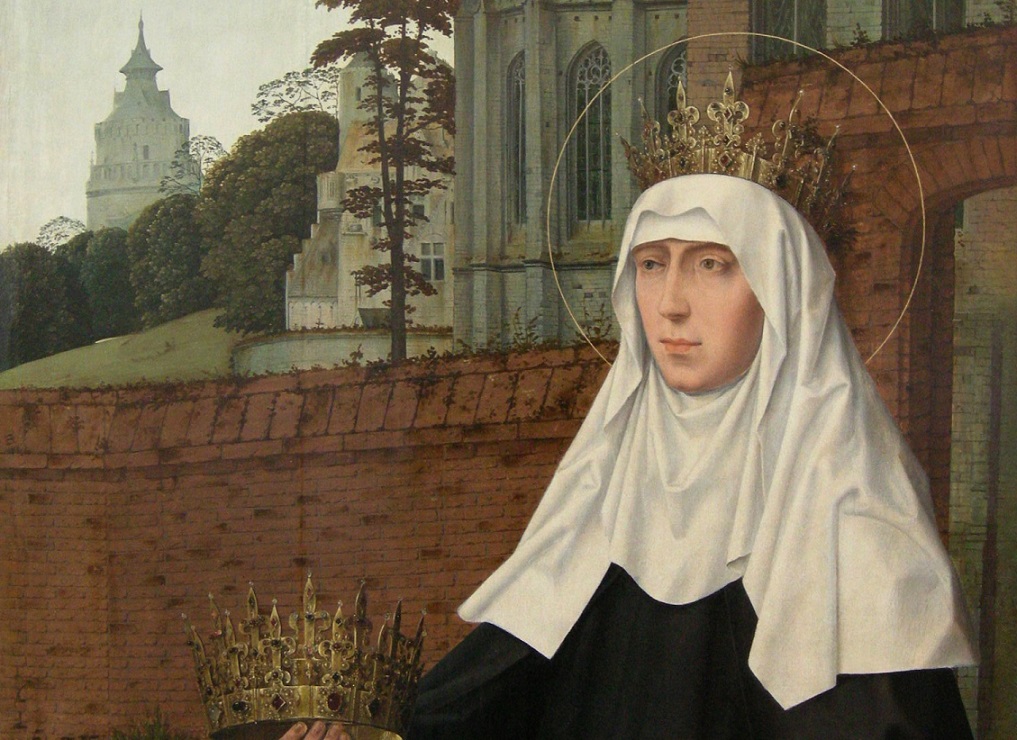
Jan Provoost - Saint Elisabeth of Hungary
The male pawn is based entirely on Saint Giles, which when considering the legend of Saint Hubert, is actually quite congruous in tandem. That is, Saint Hubert's legend is of a stag hunt that ends when Hubert sees the stag has a crucifix in its antlers, compelling him to revere the animal instead of kill it. Saint Giles' legend entails a red deer which Giles protects from a hunt, and in the process he is shot by an arrow aimed at the deer (usually rendered as a crossbow bolt). Therefore it's a fairly compelling coincidence that both the costumes of Saint Hubert and Saint Giles were so simple to imitate in modding Dragon's Dogma.
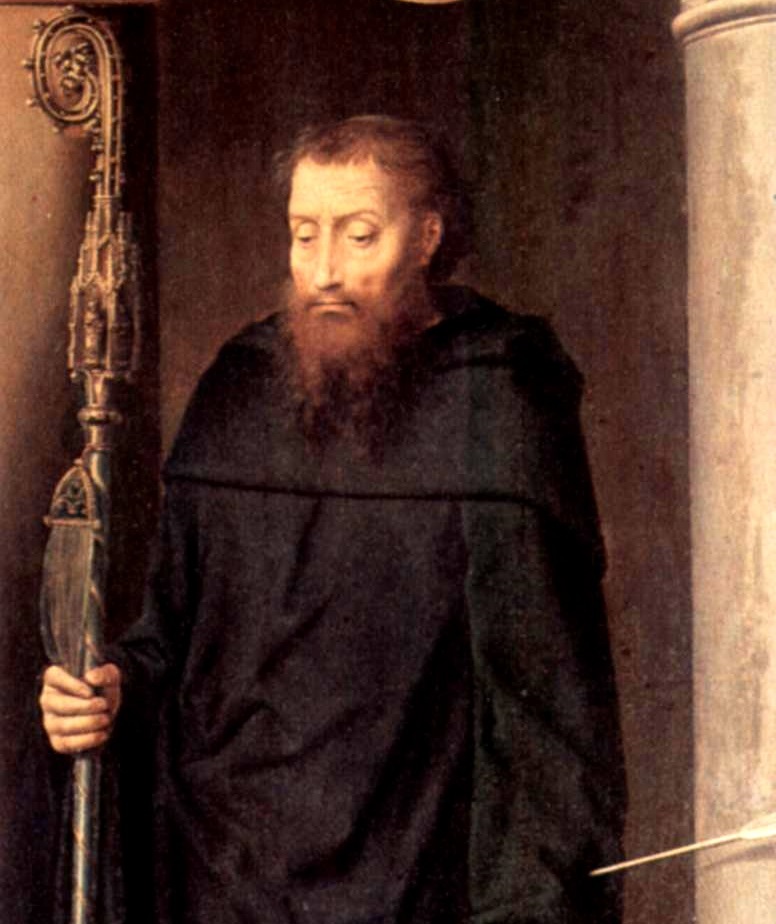
Hans Memling - Greverade Altar: Saint Giles
For some time I was at a loss how to approach a male clerical outfit, but I came up with a plan. Editing the hood off of the Set of Salvation Robes, and again model swapping it with something that isn't an outfit for the same reason as before, was the first step. However I needed a solution to the large gap in the collar left by the removal of the hood, so I tediously, carefully removed only so much of the Ebon Neck Wrap as I needed, and used that to fill the gap. It came out well. Thankfully the Solar Providence archistaff closely resembles a bishop's crozier, which contrasts nicely with the humble outfit.
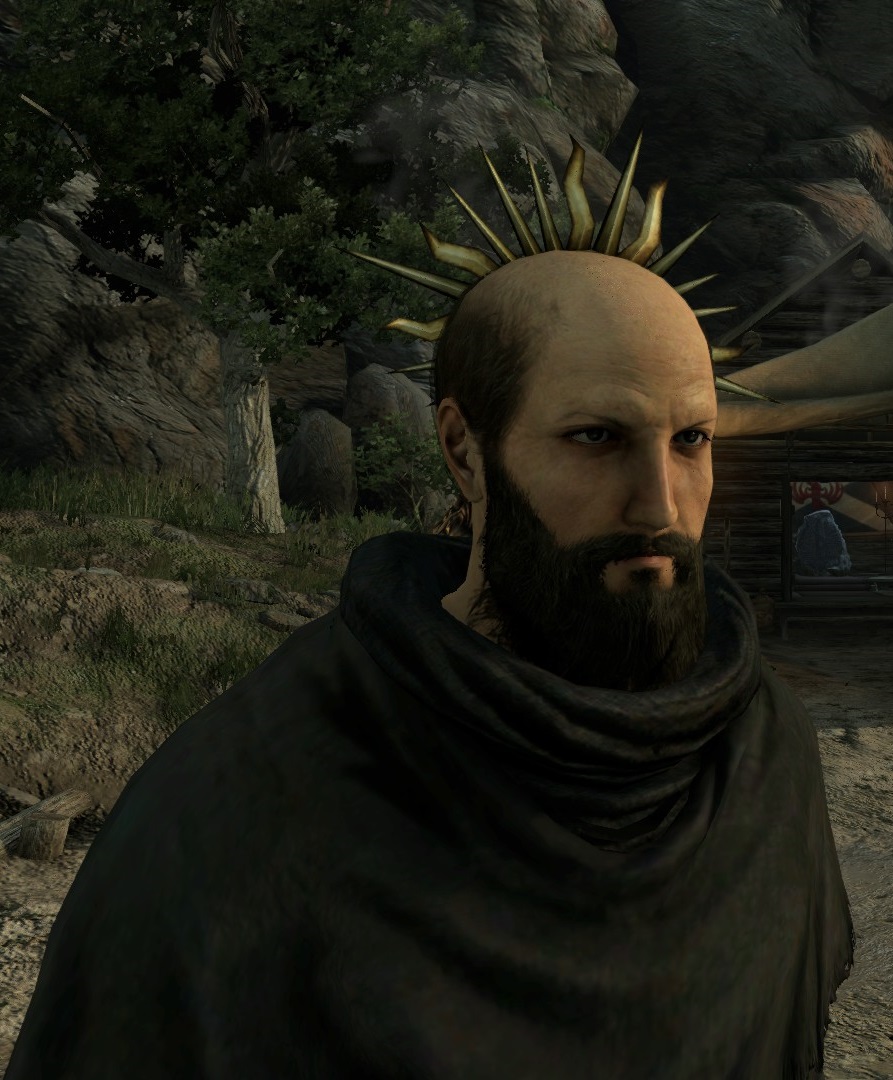
The last mods I implemented were simple outfit swaps for a few important NPCs. Following the already established red theme, there were several outfits on characters in the Noble Quarter in the same vein as what I was already imitating.
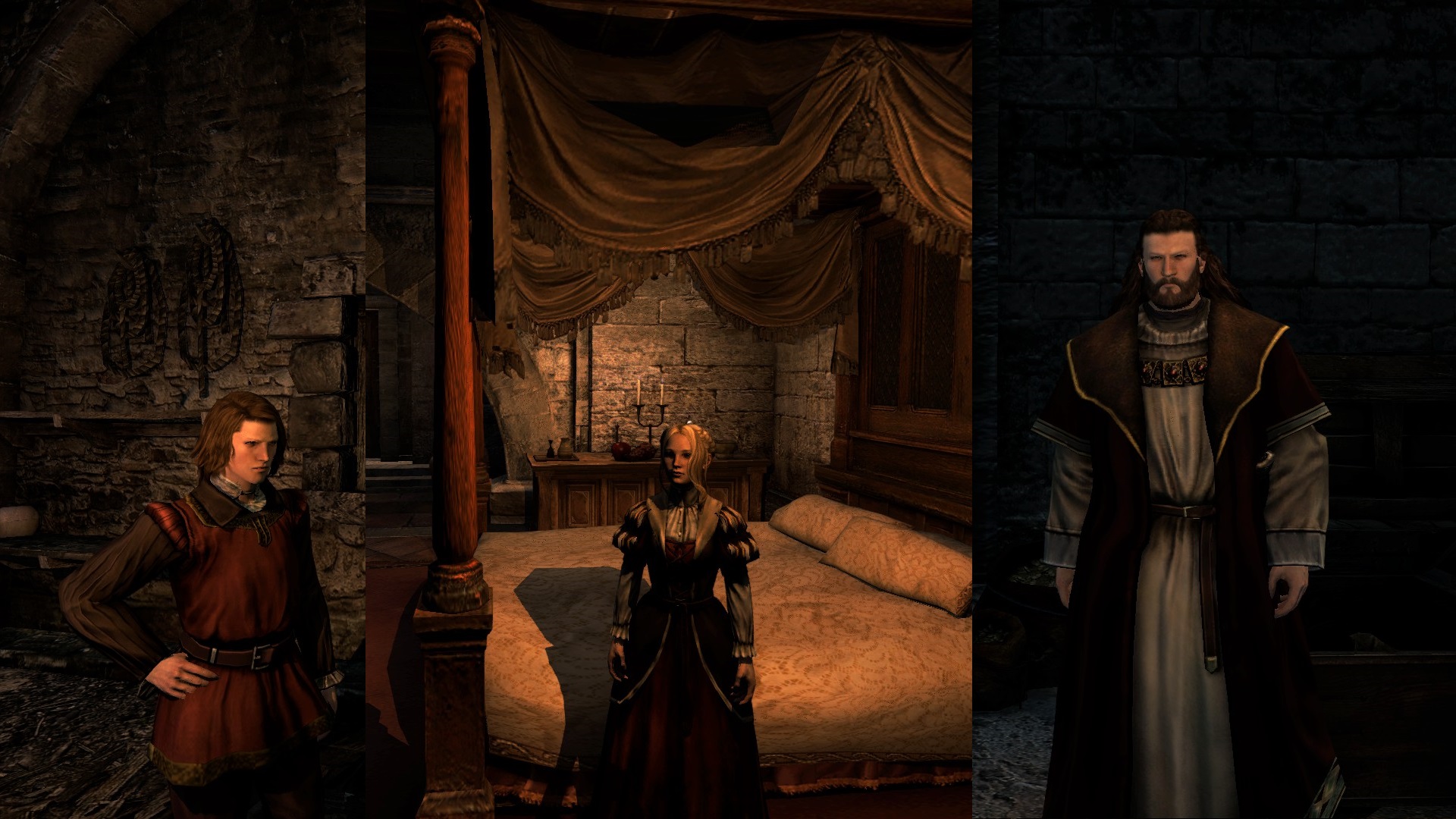
Particularly in scenes with the Duke and Duchess though, these different outfits were far more congruous with mine than the vanilla configurations. This was somewhat annoying to do, because the Duke and Duchess each have several arc files while being single NPCs, so I had to find and change several arc files per character.
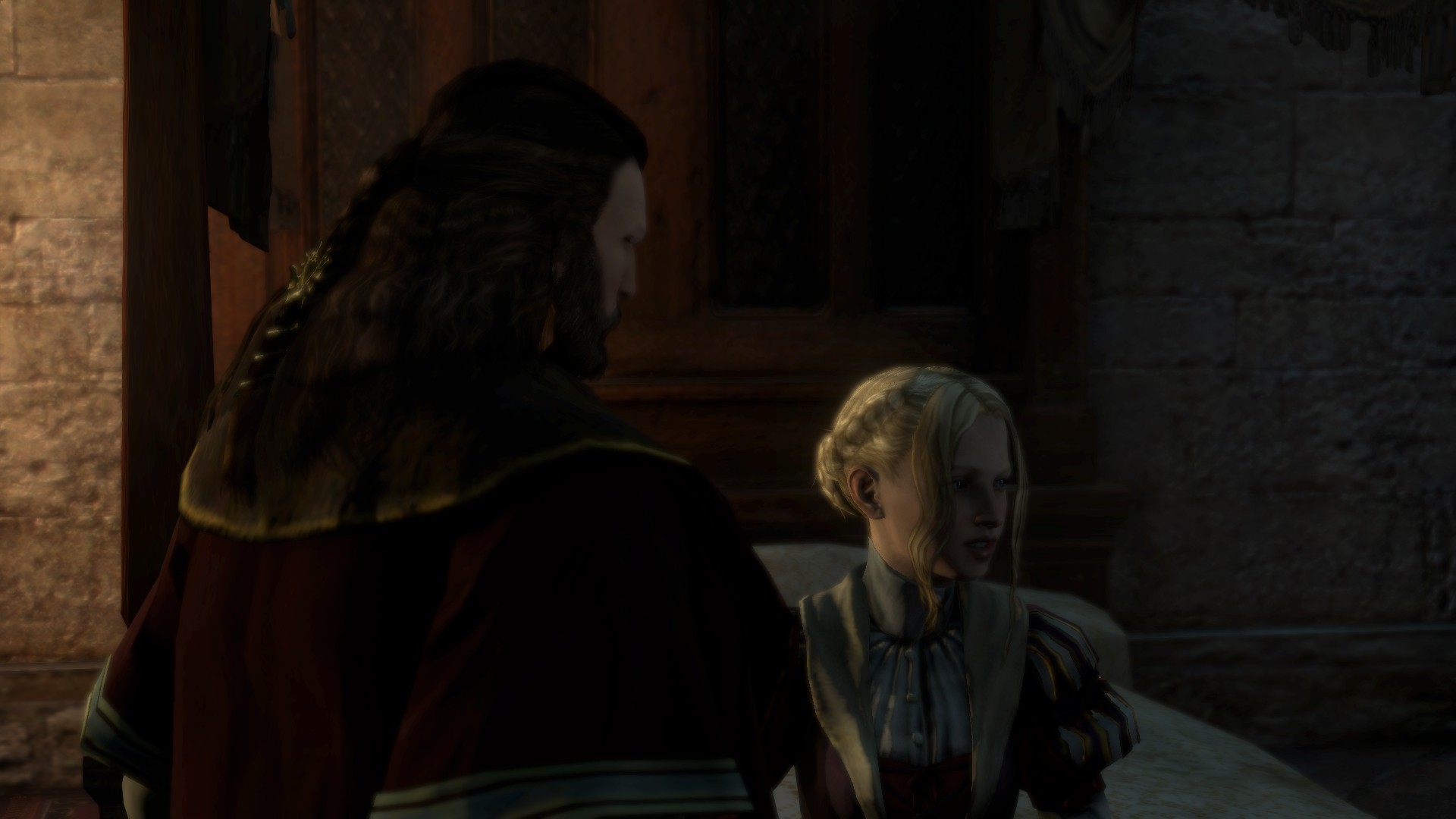
I also streamlined the outfits of all nuns and monks to look more dignified.
Credits & Rudimentary Mods
The resources here have been invaluable to modding Dragon's Dogma. Without FluffyQuack's resources, and the content lists and tutorials compiled by other users, we could not have created any mods.
http://residentevilmodding.boards.net/board/132/dragons-dogma-arisen-modding-tutorials
This tool has made the entire experience much more efficient and convenient.
http://www.nexusmods.com/dragonsdogma/mods/96/
Many of the tutorials here have also contained very useful information.
It's also worth thanking Capcom for having even created this game. Without such an unassuming, sterile, medieval-fantasy setting, and without a PC release that enabled files to be accessed, there would be none of this content. Not to mention, it was only worth doing because the combat is so good.
I have also uploaded a few of the mods featured in this guide (and some not) here:
http://www.mediafire.com/download/pcmdft97dq86mun/Rudimentary_Mods.7z
This includes:
-Beltless Coat of Shadow
-Dragon's Rancor to Retextured Shortbow
-Ferric Talon to Bloodthirsty Beak
-Monk's Robes
-Nun's Habit
-NPC Outfit Swaps
-Red Leather Cap to Flapless Farseer's Cap
I've structured the folders so you can pick and choose which mods to use.
- Hero Achievement and Missable Quests Guide★ 5 (3.5k)58k views7.1k ♥30 minUpdated Aug 2, 2016
- Dragon's Dogma: Dark Arisen. Getting started 101 and "did you know's?"★ 5 (918)53k views1.1k ♥17 minUpdated Jan 20, 2016
- The Arisen's Handbook: A Guide to Adventuring in Gransys★ 5 (1.7k)42k views3.4k ♥91 minUpdated Oct 8, 2023
- The Guide to Vocations and Skills★ 5 (806)42k views1.9k ♥86 minUpdated Jan 1, 2020
- Chronological Quest Guide for dd:da★ 5 (779)33k views2k ♥54 minUpdated Jul 5, 2023
- Vocations, Strengths and Weaknesses, all Part of a Whole - Writings of an Aged Arisen★ 5 (575)32k views873 ♥33 minUpdated Jan 3, 2021


- Upgrading to PremiumTeam Fortress 2★ 5 (20k)1441k views11k ♥6 minUpdated May 11, 2022
- No More Room in Hell Official ManualNo More Room in Hell★ 5 (2.8k)569k views2.1k ♥29 minUpdated Apr 22, 2019
- NMRiH Community Hosting GuidesNo More Room in Hell★ 5 (526)351k views653 ♥1 minUpdated Aug 10, 2022
- ULTIMATE GUIDE FOR GAME DEV TYCOONGame Dev Tycoon★ 5 (5.8k)326k views10k ♥4 minUpdated 23 Jan, 2014
- How to 'Git Gud' Soon™MORDHAU★ 5 (2k)318k views3k ♥68 minUpdated Nov 16, 2024
- Лучшие кооперативные игры SteamPAYDAY 2★ 5 (1.5k)315k views2.1k ♥56 minRussianUpdated Apr 27, 2025




This guide was created by its original author on the Steam Community. Are you the author and want it removed? Request removal.