Western Roman Empire Grand Strategy
Foreword
Total War: Attila - Western Roman Empire strategy guide
Out of all the total war games Attila is the most deserving of the title strategy game: strategy with the roman empires can make the campaign difficulty from guaranteed failure to manageable.
This guide does not hold your hand: There are very few exact commands, but there are a lot of guidelines. The strategy is somewhat Machiavellian: you are sacrificing much to win.
The Core, the Border and the Lost
First, you look at your empire, and it is a vast one. You will not be able to hold on to all of it. You want to hold on to a reasonable area, and near that area you want to have a border area, or a buffer zone. Beyond that you some far flung areas are just a lost cause, you basically don't do anything except extract money from them, leaving them to their fate entirely.
The Core wants to be large enough that reducing to it still leaves you strong, but not too large to stabilize somewhat quickly. The area should also be chosen to reduce the size of the border you need to defend.
The Core should include Italy, western islands, the Iberian peninsula as the minimum, adding southernmost province of France (Narbonensis) and Africa(the province, from which the whole continent got it's name from) as an elective. These areas are the only ones you will build stuff in for now.
The border are the other coastal African provinces (Mauretania, Tripolitana), other provinces in france (Aquitania, Lugdunensis, Maxima Sequanorum), area north of the alps (Raetia et Noricum), the east coast of the Adriatic (Dalmatia). In the border provinces, you will downgrade any tier 2 or higher settlements, sell all non-food producing buildings immediately. The food buildings you will sell slowly, and pay attention to your food storage situation, selling too much too fast will get you into famine, which you should avoid. Sell ones nearer to enemies first, and from minor settlements before major ones.
The amount you can sell depends on your global food supply, your food buildings that will be completed next turn. If you sell fields that provide +40 food, you need to either have global food at +40 or above, or you need to have a food production building finish building next turn that gives the difference.
You can manipulate the global food supply by not taxing regions that do not provide much wealth that do consume food: a non-taxed region has no effect on the food supply. Work the numbers. (Also beware selling any food buildings in autumn, when you get the harvest food bonus, you will think the food situations is fine, and then winter comes...
The lost provinces are British ones (Britannia Inferior&Superior), Belgian (Belgica), non-coastal Balkan one (Pannonia). Sell all you can, as fast as you can.
The difference between border and lost is that you care about who controls settlements in the border areas. The lost provinces you leave to their fate till much later.
In the core provinces, you have a few tasks.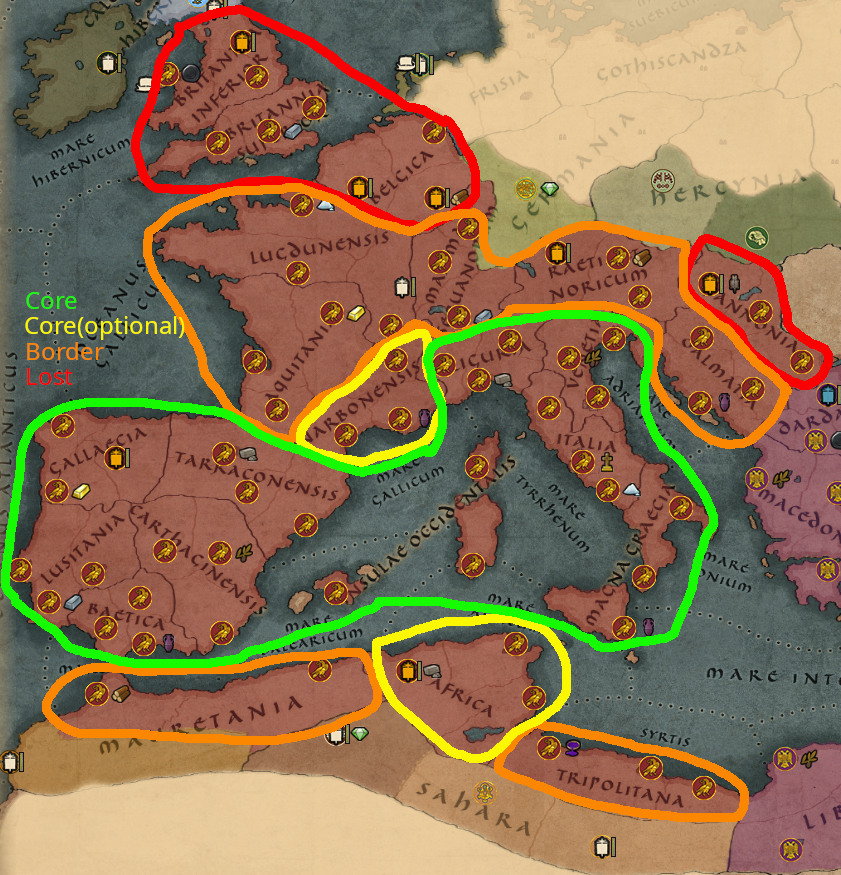
Stabilize the Core
First, will you go pagan? If so, sell most churches, leaving one tier 2 church in one of the Spanish provinces (tier 2 church is needed to recruit priests). Once you have 3 priests, sell that church too (you will need to wait a few turns to be able to recruit the third priest, but not too many.)
Recruit 2 spies and 2 priests (as that is your agent limit on them) on turn 1, spies for wealth and priests for public order. The spies need to get one level-up to get the ability to root out corruption, priests can do inspiration immediately. Send the spies to north, do any assignments you can, preferably cheap with decent chance, but any will do.
Once they level, put both choices into surveillance, and park one spy in each of your most money producing provinces. The spies will make you a bucketload of money by reducing corruption.
The priest should go to Hispania, spread among the provinces with worst public order there.
Their presence will slow down your pagan influence, but they are an important part of the early turn stabilization of the core. If you choose to remain christian, do not sell core province religious buildings, obviously.
When you get imperium upgrade, recruit the third priest and spy. Then, if going pagan, sell the last church.
The Attila province management makes having buildings that are not producing food, sanitation or public order quite hard to justify. You should, however, have one rally field you upgrade to skirmisher range as soon as possible. Seriously consider building the Supply Storage and upgrade to carpenter, onagers are very good when assaulting settlements, and the mercenary onagers cost a ton.
You can immediately start on that in Venetia province, delaying it is quite all right.
Other than that, build food, build public order (delay sanitation a bit, you need to sort food and public order first. Your buildings should be built in provinces where the public order is bad. In the very first turns only build buildings in core provinces with negative public order, and places where you can get good food yields with limited investment.
If you choose paganism, theatres are the building of choice, if christian, churches. Wheat fields should only be built in the fertile provinces, go for sheep and cattle elsewhere. In the first turns when you sell buildings you will have a massive treasury: trust me, you will go through it fast. Stick to building things where they matter the most.
To get the most of sanitation, one major and one minor settlement sanitation tends to suffice, as long as you can upgrade them to max level. In the early game you don't need that much, as the major sanitation penalties only come after higher tier buildings are researched and built.
Utilize governors, prioritize high income provinces with negative public order, and use the bread and circuses edict.
Summary: utilize your priests, governors and money to stabilize provinces, so public order is not negative, and your global food supply is positive. Do not invest in provinces that are doing okay with public order: that can wait till the core is stable.
Early Turns Military
Research the technology immediately for upgrade to the Borderguards (Comitatensis Spears) and allows upgrading rally field to skirmisher range. The one in Liguria works fine for your early recruitment needs.
There is an army of Suebians in your land. The army in Britain and the two in northern France can easily take it out, given a few turns of replenisment. Move them but end turns in towns, the Suebians will pick your depleted armies if they see a nice target.
When enemy factions attack you, and the garrison is full strength, going into manual battle, parking your defenders under an arrow tower will lead to decent damage on the attacking army. You should do it, but I understand it's quite boring. The strategy does not require this, especially if you're not at high difficulty. When you face emergent factions (see later), you want them to take the settlement with casualties. If you are attacked by western roman rebels, you want to lose the battle with no casualties on attacker: go manual combat, immediately exit.
Now, this is a prospect I have not seen in other guides: do not just passively defend in the early turns: you need to attack. In Africa - the continent - there are three enemy nations, and they will turn hostile soon enough. Burn them to the ground. Bring the armies in Spain (Gallaceia) and Africa (Constantina) together, recruit troops, hire cavalry and archer mercenaries, maybe even one mercenary onager.
Bring one more army from the north, the one in Raetia et Noricum is a good candidate.
Once the three starting ones and the emergent active rebel faction are out of the game, that whole area is peaceful, generating no hostile forces, requiring no garrisons. If you pacify Africa your whole game gets much easier. Not only that, this helps the Eastern Roman Empire too, so they will guard your flank longer. Before this operation you had enemies to north, north-east, east, and south. You just reduced your threatened areas significantly, meaning more army density where you have enemies.
Your one army in the Balkans, in Savaria, faces an immediate attack. Your response depends on your skill: stay put, use the half-strength army with the garrison if you can win, great. If you are a bit hesitant, move the army just north, past the river, hire mercenary archers, slingers, pikemen, the horse, and then return to the town, now much stronger. That army should defend the area, slowing enemies down, and eventualy take up defense of Italy.
In your early armies you have javelinmen, Levis Armaturae. I would suggest disbanding them all, and as soon as your skirmisher range is up recruiting 4-6 Sagittariae archers for each army - they are cheaper, easier to use, have access to the specialty ammo types.
Your skirmisher range allows the basic sword infantry as well, and I would certainly get some, though the bulk of the armies should be spearmen. Once you have carpenter up, you should either have each army with 1-2 onagers, or have field armies with none and siege armies with 3-4. The latter is better if your planning is top notch, but the first version works too.
As far as cavalry goes, keep your few scout equites, but also recruit mercenary germanic warbands, mercenary desert raiders in Africa. They are both better light cavalry than your native ones, and being so light you should learn to use them to hit archers and the backs of your enemies only: destroy enemy cavalry with spears and arrows.
Do not immediately fill all armies to the brim. Do make the armies stronger, but not too much: in the early game your income is poor, and the more surplus you can dedicate to improving the provinces, the faster they get wealthy. A 12 unit army should be just fine in settlement defense even in the hands of a less experienced player.
You likely have more army capacity than armies you can afford to keep: You can raise an army at a recruitment province, recruit units, run to the main armies, hand the units over, moving to the next army and so on. Use these armies to shuttle in reinforcements. Now, once that task is done, you can disband the leader to keep him safe, or if he is a stinker, move him outside friendly support range and so the enemy can just reach him. He can finish the job as a bait. Just make sure you have armies around to kill the enemy stack after they took the bait.
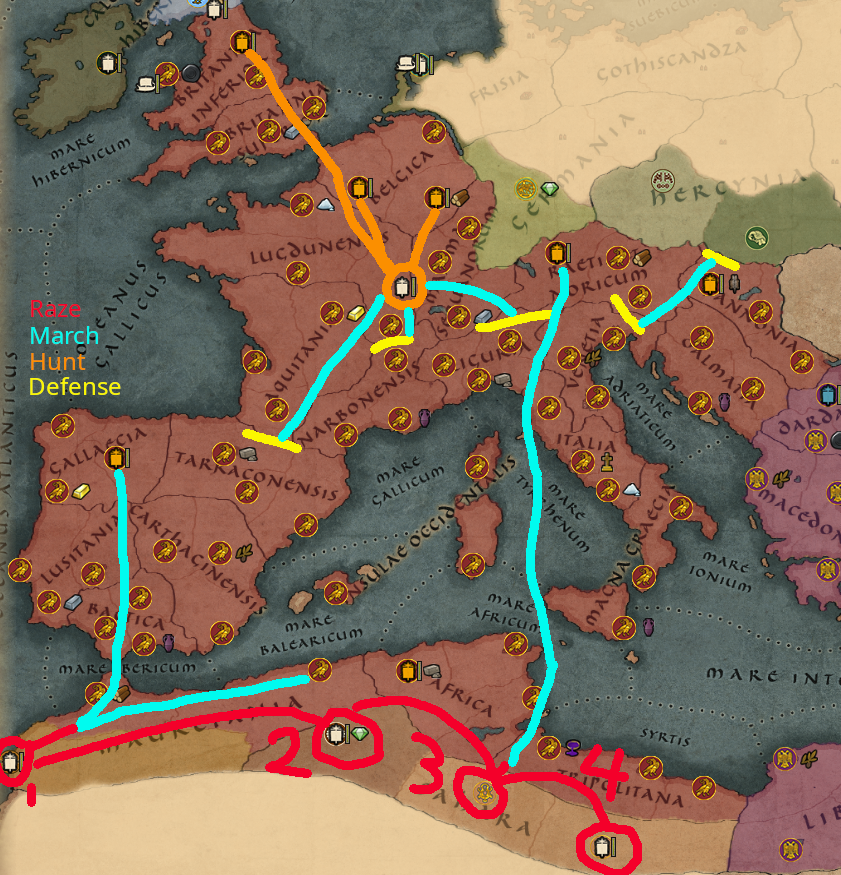 Treat this more as a suggestion than gospel
Rebel Management
The way rebels form in Attila is pretty standard between regions. In most areas the first rebellion is the named rebel faction that will act line any other faction in the game. I call this an emergent faction, as once they have a settlement, they will build armies, raid and conquer other settlements. The subsequent rebels, if that emergent faction holds a settlement, will be (in your case) western roman rebels. These rebels are passive, will take a settlement but then just hold it, doing nothing. You want these. They are caretakers for the future. Buffer. The AI tends to let them be. So should you.
Never abandon any settlements. That goes against the principle of stabilizing the core: you end up with public order penalty to all provinces, for no real gain. You leave the settlements there, honey traps to slow down enemy advance. They may sack the settlements as long as they like, and if they burn them, it's like you abandoned it without public order penalty, and delayed the enemy a turn. They can of course occupy, and that is not ideal, but you will deal with that later.
There are guides that recommend abandoning settlements. I see it as having downsides of public order penalty and the other factions using less time, with the only upside being you have to press the autoresolve combat button less.
You want to let the emergent faction keep controlling the settlement they take. If you have a free army, and there are still areas in your hands in that location, such as any province in France for the Gaul faction, you may attack them and kill the army, sack the settlement. Once the whole area has no settlements you control, go in and burn the faction's settlement down. Ruins bother no-one, unless someone settles them - distance between you and your enemies is a good thing.
Ideally, you would have one ruin and the rest in the hands of western roman rebels. If there are other factions controlling settlements, once you have the armies for it, burn those too. The border is in good shape once it has only western roman rebel held settlements and ruins - the more the first the better.
Building Up
Here, you are defensive, you build your settlements, research technologies.
Mostly concentrate on the civic side, though all of military 1 and from military II the standardization and Imperial transport services are notably good. Upgrading cohors to legio is a major step, and upgrading comitatensis spears to auxilia palantina are massive upgrades. You can also upgrade your skirmisher range and recruit crossbowmen. They are great, but do not replace all archers in your armies. Have a mix, with more archers than crossbowmen being my recommendation. All these upgrades and new units cost more upkeep, so do not rush these.
Do not research Elite Privileges. Having your generals mounted means they are MUCH more vulnerable to missile fire, and cost more to upkeep. There is no comparable advantage. I suppose they can help run defeated enemy down, whoopee! You can research it when you are at the reconquest stage, much, much later.
Concentrate on researching civic side, but do not research any of the techs disabling legacy techs. (Imperial church and it's successors). Basically never if pagan, very late even if christian.
The key in this phase is to try and keep your costs low, so more money is available for constructing civic improvements. Notably develop special resources that give food with priority, theatres if you go pagan (and disband the christian priests when the public order allows).
You will want to distribute the forces you have, something like 2 armies in handle the French front, 2 in northern Italy, 1 in mid-south Italy.
At some point you will want to raise fleets: one in Northwestern Spain (Brigantium), one in Adriatic Sea (near Ravenna), third in Sicily (Syracusae).
They don't need to be full stacks, as the enemy is likely only embarked land armies until much later, and a nice archer boat fleet will destroy those. The one most likely to face enemy fleets is the Spanish fleet, so that should be the strongest.
Other military tasks:
- Take out (burn) the civil war faction. Very important. Most likely this will be in Raetia et Noricum. The game makes it like this is a burning issue, but don't rush to your death. Try to have a few armies go on a well coordinated strike.
- Take out (burn) emergent rebel factions once all of the area is out of your hands.
- Take out (burn) any settlements in border area in the hands of enemy faction
- Kill and hordes too close to core, even nominally peaceful ones.
- Secure lead supply. Two choices: Wales (Segontium), Macedonia (Scupi). The Eastern Roman empire has likely lost this. You need lead for higher tier sanitation. As long as you can trade for it from Eastern Roman Empire, who have 2 lead sources, it's fine, but at some point you need to decide which lead settlement you need to take. Treat the areas around that settlement as border from that point onwards. I would likely go for Britain over Greece. It is initially worse, but better for reconquest.
Also, there's no big rush, it's only the top tier sanitation that requires lead.
Depending on your skill as a player, having garrison buildings in many of your settlements can help you out. Higher tier settlement buildings are also quite a bit more defensible not only with increased garrison but also by the layout.
Huns
The huns are coming. There is a small chance they will not bother you much. Most likely they will.
Being pagan helps a lot. Christian armies have a massive morale penalty against the scourge of the God, making the already difficult battles much harder, as their elite unit stats already puts a strain on your frontline holding.
Having a good amount of spear infantry is great. When Attila assumes control of the hun nation, the rules on huns are: try not to kill any stacks. Attack them, try to make them weak, especially you want to kill much of their elite units. Then let those beat up stacks stay alive. When you see Attila himself, attack head on, preferably killing him in the battle, and when the army runs you can hopefully follow and kill him again.
Keep on taking him till his fate is sealed. The huns are very oppressive, but you should have enough time to build your economy followed by armies, so you the tools to fight back.
Once Attila is dead dead, kill any and all hun stacks with gusto.
Reconquest
Now, even during the previous phase, you can slowly start rebuilding the African coast. Maybe the inlands, if you want, but that province is probably not worth it, despite the gems. You'll get gems from germany later on.
You should only start this phase if all of the following is true:
- Attila is gone
- Your core are is basically in it's maximal state
- Your borders are secure: you can devote a 4-5 armies for the push.
- You have much of the tech tree researched. (not the bad techs)
What you want to do is expand in a controlled way: do not go every which way. Keep defending the Italy and the Mediterranean, advance in France then Britain, Low Countries, Germany, Scandinavia following that. Only after all that is Greece and the Balkans in general a good target.
Do not yet go to Anatolia, instead secure the rest of Europe. The idea is to have as little border at any given moment, and incursions to Balkans or Greece too early would have you have vastly expanded front.
When taking over provinces, this is the priority:
- Settlements in active enemy hands
- Ruined capital settlements
- Ruined port minor settlements
- Ruined other minor settlements
- Settlements in passive rebel control
The building slots unlock faster when you have less of the province in your controls, so you usually want to only settle one of the three settlements, grow it to 5 slots (major) or 4 slots (minor) settlement, and only then ruins dwelling or taking it from passive rebels. As roman, your first building should be the sanitation latrine line that gives +growth. Do not tax, so you do not need to worry about food in the beginning.
As for the reasons you leave the rebels for the last is their settlements likely have several unlocked: this order prioritizes getting the whole province up and running, if you want short term gains then taking rebels right after settlements in active enemy hands makes the province provide some economy faster, but being full built is much later.
- Western Roman Empire: Opening Moves★ 5 (1.2k)40k views1.6k ♥26 minUpdated 5 Mar, 2015
- The Obscure mechanics of Attila.★ 5 (304)35k views410 ♥6 minUpdated 27 Sep, 2020
- Total War: Attila - The Overall Guide★ 5 (582)33k views1.1k ♥30 minUpdated 16 Mar, 2018
- Understanding politics in Attila★ 5 (275)32k views241 ♥3 min
- ***UPDATED*** How to win battles ***UPDATED***★ 4 (157)30k views175 ♥8 minBulgarianUpdated 26 Feb, 2017
- [HUGE DISCOVERY] How to bring ToB optimization to Attila★ 5 (239)28k views528 ♥3 minUpdated 18 Dec, 2018




- Upgrading to PremiumTeam Fortress 2★ 5 (20k)1441k views11k ♥6 minUpdated May 11, 2022
- No More Room in Hell Official ManualNo More Room in Hell★ 5 (2.8k)569k views2.1k ♥29 minUpdated Apr 22, 2019
- NMRiH Community Hosting GuidesNo More Room in Hell★ 5 (526)351k views653 ♥1 minUpdated Aug 10, 2022
- ULTIMATE GUIDE FOR GAME DEV TYCOONGame Dev Tycoon★ 5 (5.8k)326k views10k ♥4 minUpdated 23 Jan, 2014
- How to 'Git Gud' Soon™MORDHAU★ 5 (2k)318k views3k ♥68 minUpdated Nov 16, 2024
- Лучшие кооперативные игры SteamPAYDAY 2★ 5 (1.5k)315k views2.1k ♥56 minRussianUpdated Apr 27, 2025




This guide was created by its original author on the Steam Community. Are you the author and want it removed? Request removal.