Colony Building Guide
Base Types
- Convenient
- Saves building materials and some space
- More resistant against toxic fallout
- Improved temperature control
- Shortest walking paths
- Very flexible
- Does not require large patches of continuous land
- Best satisfies Outdoors need
- Best temperature control
- Easy to defend
- Immune to mortar strikes
- Leaves more soil available for farming
- Saves most building materials
- Most resistant against toxic fallout
- Fires can spread all over the base if flammable materials are used
- Requires a large, continuous area of buildable land, making it not ideal for swamp biomes
- Less flexible
- Less able to satisfy Outdoors need
- Requires most space and building materials overall
- Requires more planning to defend
- Worst temperature control
- Longest walking paths
- Infestations can happen within base
- Least flexible
- It takes a lot of time to mine out separate rooms and clear stone chunks
- Least able to satisfy Outdoors need
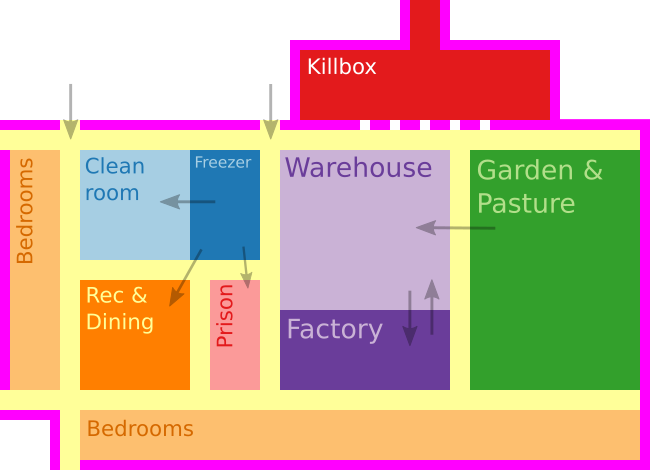 Arrows indicate where items are commonly transported. Room sizes are not necessarily to scale, and many variations of this layout are reasonable. The "killbox" is not mandatory; with a layout like this, enemies can also be lured into the long corridors and shot at from the doorways. The "clean room" would include hospital beds and a kitchen.
Base Structures
Different structures suit the different needs of your colony. The maps generate with old structures around, sometimes just walls and others are squares/rectangles just missing some sections. If conveniently located, these can work perfectly as starting points, reducing considerably the initial workload of characters with low-level skills and reducing the beginning stresses when you still have nothing.
Give special consideration toward explosive items such as chemfuel or mortar shells as they may set blow up and set ablaze your entire stock. Place them separate in a stone made compartment and far from the exterior of the base to prevents doomsday rocket launchers from hitting the items as they can pierce through walls. Place a firefoam popper here to protect against fires igniting your munitions.
In mid-game, you can add orbital trade beacons to sell your stuff to trade ships.
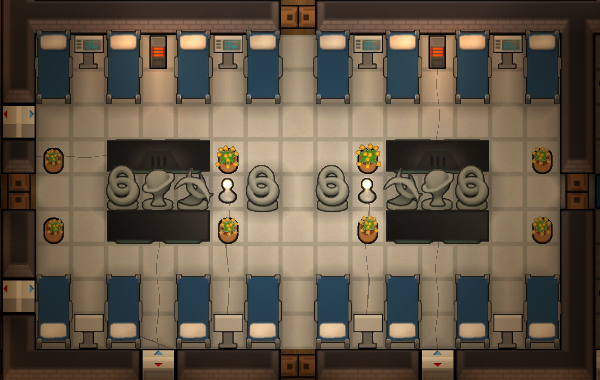
You can upgrade a barracks with positive mood modifiers by placing sculptures, nice flooring, temperature control utilities and high-quality furniture like dressers and end tables which increase the comfort of many beds at once.
Colonists like to eat as soon as they wake up. You may place a table and chairs inside at the beginning, but try to reinstall them elsewhere when you can as colonists entering to eat will disturb the sleep of others. Build the dining room close to the barracks once the sleeping quarters are done.
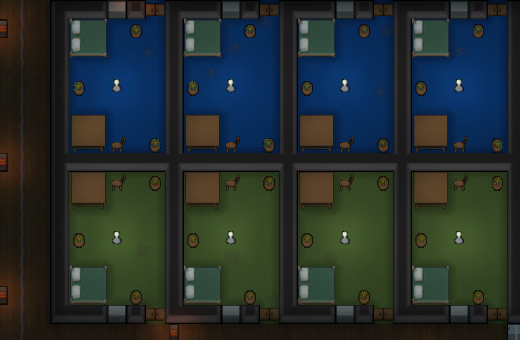 Bedrooms are private sleeping spaces which removes the "disturbed sleep" mood penalty caused by other pawns, and provides better mood bonuses than a barracks. Couples will want to sleep together and won't disturb the sleep of their partners. However, they will need a double bed.
You can improve comfort and rest effectiveness by building beds of higher quality.
Colonists often carry a meal with them (gear tab) and without a table, they will resort to eating their breakfast on the floor and receive a mood debuff. Depending on your base overall layout, you may:
- Build the "Dining room" close.
- Build one set of table and chairs outdoors near many bedrooms.
- Place tables and chairs inside. However, make sure to turn off the "Gathering Spot" option of tables, as others seeking recreation may enter someone else's bedroom and disturb their sleep.
General design principle
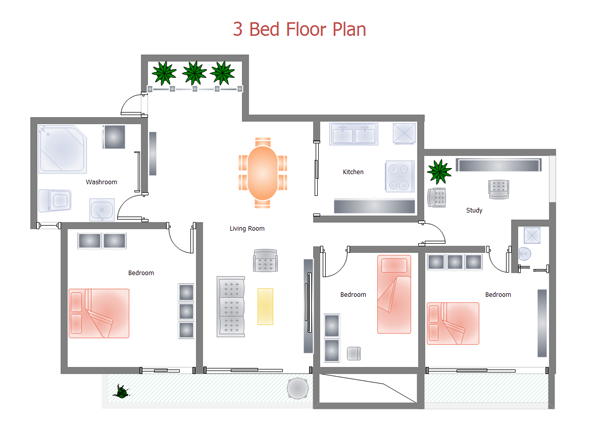 An efficient base allows your colonists to get stuff done and stay happy. They must be able to reach their assigned jobs in time, and the base needs to be pleasing and comfortable to work and live in. The base should also be secure, but that is probably the easiest part.
It is not possible to make all places easily accessible, so you need to decide what spots are more important, and lay out the base accordingly.
The most important principle here is to not put the living quarters in the center of the base. Bedrooms should be at the edge of the colony: they are not needed during the day and will be an obstacle.
 Also, it is difficult to plan ahead how many beds you will need, unless you make a hard commitment to limit the head count of your colony (and to kill or sell everybody else...). If your living quarters have other buildings surrounding them, it becomes impossible to add more beds without creating an entirely new housing zone. This quickly leads to a cluttered base layout that is difficult to defend.
The recreation and dining area should also be off center, probably close to the sleeping area. Recreation and eating happens mostly in the morning and evening (before and after night time). Colonists visit this place only very sparingly during the day.
This principle does, however, not apply to every room that happens to have beds in it – the hospital and prison can, and should, be more centrally placed. Hospitals and prisons require frequent visits, to tend to and feed patients and "guests". Prison breaks are more easily contained if the fugitive is in the middle of your base.
Make sure that related areas are close: kitchen, freezer, warehouse and factory floor. Some rooms are very frequently accessed from the outside (the freezer is one example). Provide short walkways to these places.
Colonists do not like to exist in a cluttered and ugly environment. They do not want to walk through disgusting places all the time. For example, do not put a dumping stockpile next to a Geothermal generator next to the main walkway of the colony.
Ugliness that is unavoidable can be countered with decor bombing. Make some really expressive sculptures, and put them right into the mess. You can spread a few large sculptures throughout your main stockpile, for example. This will make it beauty-neutral or even "beautiful". Like all furniture, sculptures do not have to be kept roofed or indoors, so they can be placed anywhere. Smoothed floors and walls, as well as carpets, are an effective source of beauty (+2 beauty per tile), but somewhat work and resource intensive to make.
 Comfortable furniture is very important. Keep a good carpenter (with high "construction" skill), and have them craft all the furniture in the base (especially the beds and chairs). Put dining chairs in front of all workstations (they are both "beautiful" and "comfortable"); they will not make anyone work faster, but they give a mood bonus while anybody is using them.
With regards to construction work, it is best to let your most capable constructors prioritize on the "artisan work", ie furniture with a quality rating that matters. The second league of constructors can do things like lay carpets, smooth floors and build walls. These structures do not have a quality rating – the contruction skill only influences success chance and work speed. Sadly it is difficult to impossible without the requisite mods to direct your colonists in the required way.
 Securing the base is not difficult, as long as your floor plan is compact. You can simply surround the entire complex with walls, keeping a deliberate weak spot that enemies will most probably attack from. If you give enemies the opportunity to enter your base, they will take it, even if tactically unsound. If there are long hallways, you can use the doorways as natural cover, by having one shooter stand in each doorway and shoot down the hall at incoming attackers. This is an effective maneuver that can contain even mid-size raids and does not require any purpose-built defenses.
On higher difficulties, advanced tactics like "killboxes" and turret spam might be in order.
In general you want the attackers come to you, and not fight them outside of your base in the open. Siege crews and lone pyromaniacs should be lured close to your base before engaging them.
Conjoined facilities
The Freezer, Kitchen, Dining Room and Recreation Room are often adjacent to one another. The kitchen should be isolated from the other rooms to reduce dirt caused by walking in. The dining room and kitchen should be attached to the freezer so it isn't necessary to have to pass through the kitchen to get a meal.
Parties and wedding ceremonies take place at Gathering Spots where chairs are detected, and since pawns don't eat during these times, their proximity to the freezer is convenient to go get a meal and come back to the tables.
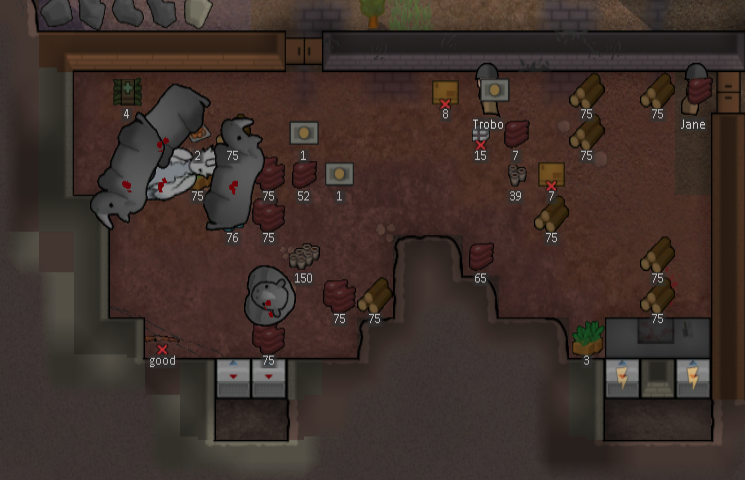 The Freezer is a stockpile room to preserve raw food, plant matter and fresh animal corpses. In non-freezing biomes, this is accomplished with the addition of coolers set to freezing temperatures. Freezers are vital for food preservation in hot biomes. Cold biomes, on the other hand, may be able to perform well without the need of air conditioning. Even though food freezes at 0 °C (32 °F) you should have your freezer at least set at -5 °C (23 °F) since it will gain heat whenever a colonist comes in. Cooler placement is of crucial importance, as these devices have a very low 100HP, making them the weakest point in a wall from where raiders can break in easily and most likely ignite your food supply. Because of this, one of the best ways to protect your coolers is to place them facing a mountain, if there is one nearby, or to build a wall around their hot side. In both cases, make sure to remove any roofs. If your base is in a cold biome, another option is to direct their hot sides into your living space to help heat it. It is common to make the freezer with double walls to increase insulation. The freezer is vulnerable to solar flares. In freezing biomes, food still needs to be kept from spoilage to exposure. In which case, wall it off and add vents to the exterior to let in the cold air.
Unlike any other room, the freezer will need to be expanded as population increases, meaning that you should leave one of its sides unoccupied by other structures so that in the future you can just increase the size of it without needing to deconstruct other rooms. Because you will be storing your harvests here, it is wise to position this room in close proximity to your fields to shorten hauling jobs, with the doors also pointing towards your growing zones. It is common to make airlocks(a door, a short space, and then another door leading to the freezer itself)in the entrance of the freezer to reduce temperature exchange. Since colonists and haulers will enter this room quite often, build autodoors once available to both speed up entry/exit and minimize temperature change.
Butcher spots, butcher tables and crafting spots can be placed inside the freezer to butcher corpses, make kibble and make smokeleaf joints since the work to make those is so small and the ingredients are in the freezer your colonists might as well do it there. However, for mass production, it's better to have it close but outside the freezer due to the work speed penalty.
Consider making an exclusive stockpile with high priority at the front of your freezer which only allows meals, so that cooks will always store them closer to ease retrieval. The same planning can be applied for two more stockpiles at the front of your freezer for meat and veggies, to speed up ingredient pick-ups (colonists assigned to hauling and trained animals will move ingredients from the back of the freezer to the front).
Nutrient paste dispensers act as walls. They are usually placed with their hoppers in the freezer and activation spot in the dining room.
- The butcher table should be placed in a different room as it creates a lot of filth just by being there, besides all the animal blood.
- Zone out colony animals.
- Sterile tiles for flooring.
- Place your doors so that your dining room has a shorter path to the freezer than walking through the kitchen
Shelves or small stockpiles can really improve cooking efficiency when placed right next to your stoves. Set one to accept berries and vegetables only, and the other to accept meals only the as these do not spoil in a matter of days, unlike meat which should always be in the freezer. Hauling colonists will do the transport work for your cooks instead, assuming you can actually spare the manpower and the cook is also useful for other tasks.
It is usually a good idea to add a little art since colonists tend to stay there for a long time. It should be temperature controlled for better working speed.
Since the kitchen is placed near the freezer, some crafting stations which include plants ingredients may be also placed in here. The brewery and drug lab are good choices. Also, if you making chemfuel with food you may place the biofuel refinery here.
Colonists, as well as visitors, will search in a 20 tile radius for a table to eat at. For this reason, a dining room should be built as close as possible to the freezer/food storage so that your colonists will actually use the dining room, instead of eating on the floor of the storage, giving them a -3 mood debuff. This is especially true for larger freezers, in which colonists retrieving food from the far end may simply give up searching for a table and eat on the floor.
Since colonists spend a lot of time here, increase their mood by decorating your dining room with sculptures, plant pots or quality furniture. Having an impressive dining room also provides a small mood bonus to colonists who eat there.
In the early game, all you'll need is a horseshoes pin somewhere in the colony, and colonists will proceed to use it when they are bored.
Once you reach midgame, you can afford more recreation facilities such as chess tables or billiards tables, or Tube televisions, which provide different kinds of recreation for additional variety. In addition, you can also obtain additional recreation sources from exotic goods traders, such as telescopes or megascreen televisions, which offers more recreation than the craftable tube and flatscreen televisions.
Similarly to the dining room, decorating it can improve the mood bonus from using the room.
Courtyard
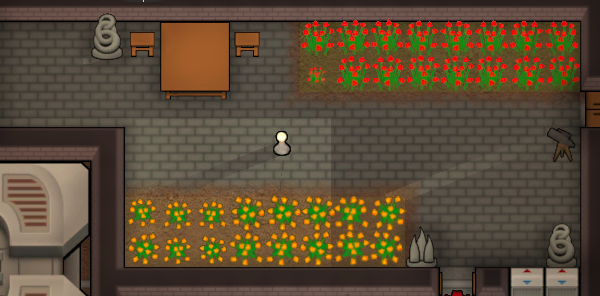 Most colonists like getting outside once in a while. In superstructure bases, you may consider building an unroofed courtyard where colonists can get some fresh air.
You can use it as a common area, putting recreation items and dining tables for colonists to use, making the courtyard behave exactly the same as an unroofed dining/recreation room. Alternatively, it may also be used as a place to put your mortars as putting them in the middle helps reduce their minimum range blind spot. Also consider keeping transport pods here, but place them in a separate unroofed area as they are not beautiful to look at.
Laboratory
Workshop
Workshops are places where you put all your crafting stations and benches. You should put them near your warehouse so your colonists can spend less time hauling the needed resources to the workshop for crafting, while keeping them separate due to the beauty penalty of raw materials. Also remember to put chairs of any sort at the interaction spot so your colonists won't have to keep standing while crafting.
The tool cabinet is handy for increasing productivity of your craftsmen. The work speed bonus is quite valuable, and each bench may benefit from two tool cabinets.
It is an excellent idea to put decorations such as sculptures inside the workshop, as a beautiful environment gives up to +15 mood, improving colonists' productivity and even allowing for the occasional mental inspiration.
Armory
Hospital
 Dedicated hospitals are more of a mid-game thing when you have enough resources to build the specialized equipment used in them. Hospital beds provide a boost to treatment quality, immunity gain speed, and healing speed, meaning colonists will recover faster from illnesses and injuries, making them the choice for hospitals. The vitals monitor brings even better boosts to treatment and immunity gain, so when available it's recommended that you put them down near your hospital beds.
Hospitals should be built somewhere where colonists can quickly bring their downed comrades to treat them. Keep doors open, or use autodoors so they don't obstruct colonists' access. If you need to, you can build more elsewhere in the base.
Store your medicine in or near your hospital using shelves so your doctors can quickly grab them to patch up colonists before they bleed to death. Sometimes just that little distance can make the difference between life and death.
Hospitals should have sterile tiles as flooring as they provide a slight cleanliness buff that can increase surgery success chance and reduce wound infection chance. Keep in mind that wounded colonists will bleed out considerably, so you may want to assign another colonist to specifically clean the hospital to improve their treatment chances.
Decorating hospitals to make them beautiful can give colonists inside a great mood boost (max +15, plus impressive room stats). This is good, especially considering that some colonists will stay in the hospital for some time, such as the severely injured, incapacitated or sick.
To provide recreation, you may also install televisions into your hospitals. Patients lying in hospital beds within the viewing area will watch TV to entertain themselves when they are bored, and you won't need colonists coming to cheer them up as their only recreation source.
Your operating theater should be forbidden at all times except when someone is about to have surgery. This prevents colonists from tracking dirt or blood into it, staining it.
Medical treatment for animals benefits from cleanliness as well, but not proper hospital beds (and in turn, vitals monitors). Once you enter midgame, sterile flooring should be easy enough to get.
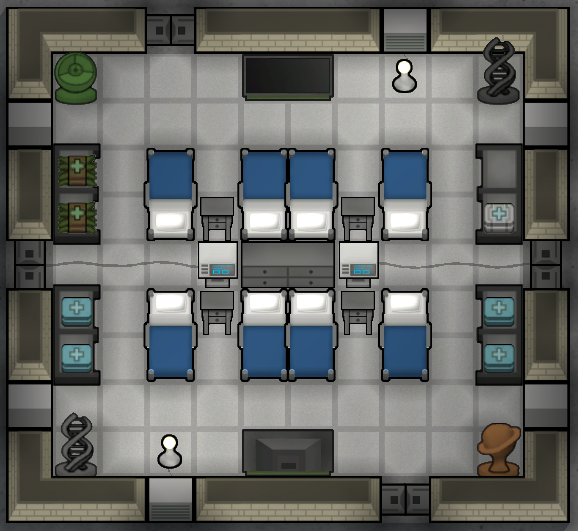 Dresser and end tables provide maximum comfort. Two vitals monitors cover all 8 beds. Flatscreen TVs provide extra recreation for the patients. Medical supplies are close by, the room is well lit and accessible from all sides. The vents equalize room temperature with the hallway. Up to six more beds could be installed here rather easily: four in place of the end tables, and one each to the left and right of the vitals monitors; all beds will have dresser, TV and monitor coverage.
Prison
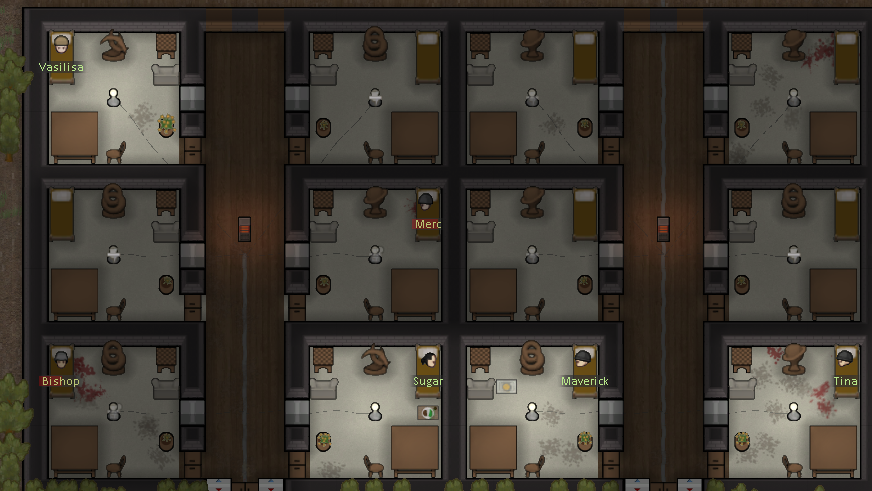 In the early game you can simply convert any existing ruins into a makeshift prison barracks or build a simple prison hut which holds all the prisoners you capture. Try not to build it too far away from your main structures, otherwise it becomes harder to catch escaping prisoners. Another option is to mark one of your colonist's bedrooms as a temporary prison while you build another bedroom or a proper prison.
You should include tables and chairs for prisoners to use. This will improve their mood, which by extension lowers their chances of mental breaks and improves their recruitment speed.
Each cell should have a table with a chair, a bed, and a light source. This is the bare minimum you need for a prisoner to be decently kept. Decorating the cell and making them bigger also increases mood bonuses for easier recruitment. They can't use any recreation items put in the cell, nor do they have a recreation need, so don't bother with recreational items other than for room impressiveness.
Prisons should have doors facing towards your base, so escaping prisoners will go towards your base instead of away, giving your wardens more time to deal with a break.
Multipurpose rooms
These are more of an early to early-midgame thing that you can use before you get dedicated structures erected, such as hospitals or bigger prisons. Yet, these can still prove useful sometimes, like when your freezers or warehouses overflow, or you need somewhere to house an influx of injured or sick colonists.
This is rather simple; just make an empty room, along with suitable temperature control. You can add beds if you intend on someone living in it (be it colonists or prisoners), which you can uninstall and tuck away in a corner when unused.
Shelters: Building small rooms with emergency supplies can save your colonists from enraged animals. Thick enough walls (at least 4 layers) can stop raiders from killing your colonists hiding inside.
Nutrient paste dispensers: When food is running low or you forecast that it will, a paste dispenser can significantly slow down food consumption by efficiently converting raw foods into nutrient paste.
Production
You will also need various buildings to produce or manufacture the stuff that your colonists need.
You need to carefully check the soil fertility before marking out your areas.
Stony soil looks quite similar to dirt at first glance, but has a greatly reduced fertility, reducing the growing speed of plants.
Rich soil on the other hand, is visibly darker and has improved fertility, making it suitable for long growing time plants such as devilstrand.
You will need to keep most animals from eating your crops. You can zone out the area from your tamed animals, but you will need to build walls to keep out wild animals. If you're not building a greenhouse, then watch out for your builders automatically roofing this "room".
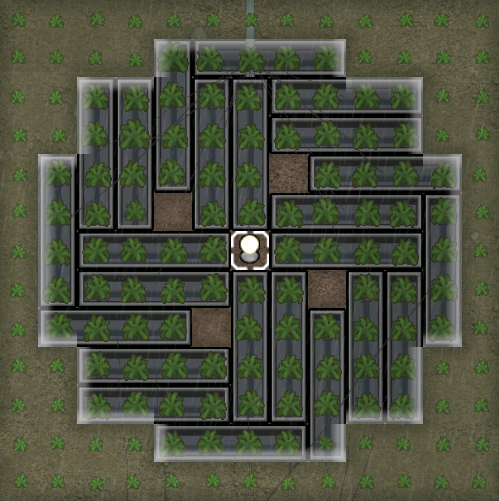 Enclosed areas that grow crops with the aid of temperature control, sun lamps and possibly hydroponics basins. They allow you to continue growing crops regardless of soil or weather conditions. Note that greenhouses are subject to power draining events like solar flares, knocking out lamps, heaters and hydroponics. All plants in a basin without power will slowly take damage until they are destroyed. So beware, solar flares or damage to the power grid can destroy whole hydroponics crops.
Once all visible mineral outcrops are mined, you can continue to mine resources in a couple ways.
Covering up your mine to prevent infestations is a good idea, using cheap materials such as wood it is possible to completely seal up the mines at a low cost. Alternatively, set up defenses at the mine entrance and just farm the insects.
It is not recommended to start deep drilling without an active scanner as you cannot see the locations of mineral locations.
Some deposits will be directly underneath your base. You can deconstruct or relocate buildings to give access to your drills. Be careful when you mine in colonists' bedrooms as they can easily disturb sleep. Turn off the mineral scanner when you aren't placing new drills, and beware that bugs can be attracted by the drills. Be prepared to deal with infestations near or close to the drill.
Building animal sleeping boxes or animal beds can help animals rest faster, though this doesn't really do much and is not cost efficient.
Due to their explosive nature, they won't be attacked by predators, so you can let them roam freely without much danger. Keeping them confined is dangerous as the death of one boomalope can injure others, and if you don't intervene the other boomalopes will die, exploding and causing a chain reaction.
Power
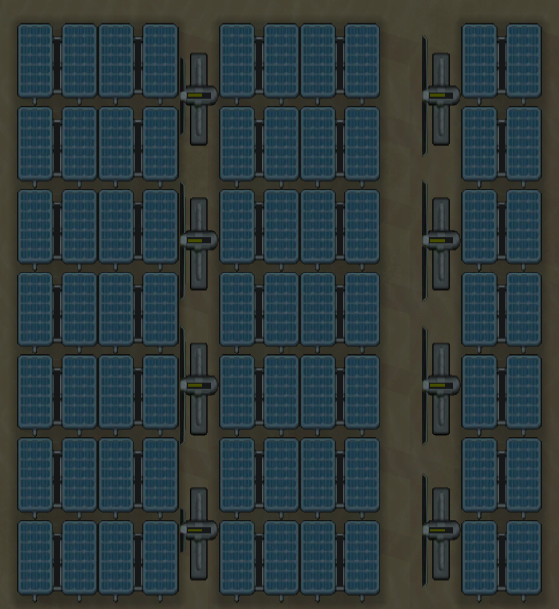 Solar generators provide power only during the day except during eclipses. It provides a constant 1700W, quite a decent figure, but still shouldn't be fully relied on.
It requires plenty of open space for maximum efficiency, and any obstacles in its area reduce efficiency. To prevent trees from growing and obstructing the turbines, put down floors, grow crops underneath the turbines or fill in the gaps with solar generators.
Chemfuel is significantly more efficient than wood, so once you research the refinery it's a better idea to refine wood into chemfuel before usage as fuel.
3 boomalopes give enough fuel to continuously power 4 generators for a total of 4000W. This is not taking into account any energy costs from growing food for use by the boomalopes.
3 infinite chemreactors can generate enough fuel to power 5 generators, for a total surplus power of 4100W.
Infinite chemreactors are only available as a reward for quests.
Research is required to unlock it. The generator itself is quite costly so it's best left to midgame. It is possible to rush the research for geothermal power, though you should be careful not to neglect other more important research projects. However, once researched and built you can have a constant power supply.
Make sure your geothermal generators and their connecting conduits are well-protected as they often have to be placed far from base. Walling the generators helps protect them against raiders, but walling the conduits isn't recommended due to the cost and its hindrance on colonist field work.
Be aware of the heat that the geysers release. If you closely wall and roof in a geothermal generator, the temperature inside will be quite high, enough to set combustibles on fire (including the generator itself). It is thus necessary to remove the roofs on such buildings. However, if the vent is close to your base in a cold biome, consider attaching it to your own base to help heat it.
- Backup batteries: Always have spare power stores, such as separate battery systems with switches. Once charged, flick the switch to isolate them from the rest of the power grid. Only reconnect it when your main grid has run out or the reserves need charging.
- Backup generators: Have some fueled generators that you bring online only if there's not enough power in the colony. This can allow your backup batteries to discharge slower or even recharge. If they are turned off they will not consume fuel.
If not currently being used, batteries will slowly self-discharge. A vanometric power cell can be placed next to your reserve batteries to keep them topped off (connecting them using conduits makes them vulnerable to short circuits) if you have a large number of batteries, though most of the time it would be better to connect the cell to the main grid instead.
Since geothermal generators must be built on top of existing geysers, they are often located far from your base. It is best to connect geothermal generators to other geothermal generators so that events such as wildfires and raider attacks won't easily disconnect them from your power network, causing severe power shortages.
Defenses
Unless you're playing on Peaceful difficulty, you will eventually encounter major threats, so you will need to prepare defenses for that.
The greatest advantage on your side is cover. While enemies are hiding behind rock chunks, you have sandbags and walls on your side, giving you a significant upper hand. You can even clear the rock chunks to force enemies behind trees which are less optimal a cover choice, widening the advantage.
You also get to choose where the enemy attacks(unless they use sappers to tunnel in). It is a good idea to only have one or two entrances with lots of defenses and traps to repel attacks.
You can also choose to build turrets if you have unlocked them. They are essential if you don't have enough colonists to defend against raids, most typically the start of the Rich Explorer scenario.
Temperature control
Room should have its temperature regulated by some method or another, so as to keep a comfortable temperature for colonists to live in, and protect them from extreme temperature conditions such as heat waves, cold snaps or simply the ambient temperature outdoors.
Large rooms such as your dining room or rec room should have their own heaters and coolers. If they are interconnected you may want to open doors for faster colonist access and temperature exchange. If you choose to do so, remember to close doors if a fire breaks out in the room.
Colonists will complain if sleeping in the extreme heat or cold. Bedrooms and other smaller rooms should be thermally connected to a larger central space via vents. Your heaters and coolers should be all placed outside the bedrooms. This reduces the number of heaters and coolers you need to build while keeping your bedrooms at a comfy temperature at the same time.
Keep in mind that you will also need to be prepared in case of a freak temperature event such as heat waves or cold snaps. Without enough temperature devices rooms can get uncomfortably cold or hot, and in severe cases begin to cause hypothermia or heatstroke.
To fix this, you can plug the gap by building a cheap wooden wall in front of or behind the cooler blueprint, then starting work on the cooler. The wooden wall will prevent temperatures from equalizing easily. Remember to deconstruct the wall after the cooler is done.
If your colony is in a cold but not quite freezing biome, consider venting the heat from the coolers for your freezer into your living spaces instead.
These are best used to keep colonists comfortable during heat waves or cold snaps. If you always encounter uncomfortable temperatures during summer or winter, then it's time to upgrade your heaters or cooler system.
Miscellaneous
For places like hospitals however, it's better to use sterile tiles and manually clean them instead.
This should obviously be done only if you have enough janitors, otherwise it's better to just not build any floors (see above).
Notes
Thanks to RimWorld Wiki, Ludeon Studios and friends for providing information for this guide.
 Special thanks for graphic examples goes to:
- PigeonGuru
- Yoshida Keiji
- Gottoni
- AvrixSpectre

 ------------- Video Game History Curator ------------------------------ Video Game History Steam Group -------
- Мультиплеер, Кооп с друзьями в Rimworld★ 5 (282)60k views830 ♥4 minRussianUpdated Mar 29
- Rimpy Mod Manager使用指南——集排序、管理、下载于一身的优秀工具★ 5 (838)57k views2k ♥6 minSimplified ChineseUpdated Jul 14
- A beginner's detailed guide. Up to date for 1.4 (2023).★ 5 (954)54k views2.7k ♥121 minUpdated Sep 15, 2025
- RIMWORLD PERFORMANCE OPTIMIZATION GUIDE (Rimworld 1.4 + All DLCs).★ 5 (616)48k views1.4k ♥35 minUpdated Sep 23, 2024
- A Definitive Guide to Efficient Freezers [1.4]★ 5 (667)37k views1.1k ♥8 minUpdated Nov 7, 2022
- Rimworld Slaver's Guide to Slavery★ 5 (601)36k views819 ♥10 minUpdated Jun 21, 2022



- Upgrading to PremiumTeam Fortress 2★ 5 (20k)1441k views11k ♥6 minUpdated May 11, 2022
- No More Room in Hell Official ManualNo More Room in Hell★ 5 (2.8k)569k views2.1k ♥29 minUpdated Apr 22, 2019
- NMRiH Community Hosting GuidesNo More Room in Hell★ 5 (526)351k views653 ♥1 minUpdated Aug 10, 2022
- Лучшие кооперативные игры SteamPAYDAY 2★ 5 (1.5k)315k views2.1k ♥56 minRussianUpdated Apr 27, 2025
- Desert Eagle Heat Treated | Blue GemCounter-Strike 2★ 5 (1.6k)292k views1.5k ♥2 minUpdated Jan 16
- Treasure Hunt Puzzle SolutionsTotal War: WARHAMMER II★ 5 (6.9k)281k views15k ♥3 minUpdated Aug 19, 2021





This guide was created by its original author on the Steam Community. Are you the author and want it removed? Request removal.