Guide to Rome 2 Multiplayer Sieges
Lobby & Battle rules
- Lobby Rules
- Unspoken Rules
- Using the Chat
1. Lobby Rules
One of the first issues that new players run into is misunderstanding rules. Many new players may see "124" or "no dep" or more rarely "gc" and be understandably confused by the meaning. While there is no way to say every rule and abbreviation, the most common can be defined.
"124"- The most common rule in Rome 2, it defines the maximum number of units of a specific type. While some may adjust the numbers, it always means # of artillery, # of pikemen, and # of missile infantry in that order. The competitive rule is 124. (1 artillery, 2 pikemen, 4 missile). Keep in mind that this is a maximum, not the mandatory number. Many enemy players would surely be glad if you brought less of any of these types of units.
"no dep"- Another common rule, no deployables. Campaign players may be confused by this. Deployables can cause a multitude of problems. Glitches are prevalent across all deployables, and can cause lag in an already poorly optimized game. Defenders are commonly thought to have an advantage, and this is at least true for the majority of new and/or casual players. The deployables further this advantage. For example, the spike traps are essentially free kills, and are near impossible to see. Stakes can basically close off chokepoints to cavalry and chariots, ruining flanks and last ditch plays by attackers. Finally, they can simply annoy people. Who wants to be spammed by 25 sets of sharp stone beds? Not to mention, these deployables can damage your allies. I have personally seen many units of my own infantry be decimated by spike traps teammates placed, sabotaging our own chances of winning. (The "No deployables" rule doesn't apply to attacking siege equipment)
"gc"- (The only way to play these campaign factions is by creating a preset in a custom game, and using the preset in multiplayer. This should not apply to you.) A confusing one. It means only factions from the grand campaign. This includes DLC factions, but not ones from campaign sets. If this seems confusing, Sparta (Greek States Culture Pack) and Kush (Desert Kingdoms Culture Pack) are allowed as they are playable in the grand campaign, but the Palmyrenes and Gallic Romans (Empire Divided Campaign Pack) are not, as they are only playable in the Empire Divided campaign.. It is really just a glitch.
Extras- "NO ___, NO____;" pretty self explanatory, outlawing specific factions, usually meta or overpowered ones. Most commonly "NO ROME NO KUSH" which are both incredibly powerful factions.
" _ Melee, _ Missile, _ Cavalry": essentially 124 taken to the extreme, forcing a specific number of each type of unit. These numbers are usually both a minimum AND a maximum, unlike 124. For example: "8 melee infantry, 4 cavalry, 5 missile infantry, 2 pike, 1 elephant"
2. Unspoken Rules
There are three special rules that everybody should follow in battle, pertaining to what you should
NOT do in battle. You may violate these rules/perform the following actions, but don't be surprised if you are yelled at in chat for doing so.
- Starting before everyone is ready: This is a simple one. When you click ready up to begin a battle after the setup phase, a timer begins to tick down, and the battle will start automatically when the timer hits 0. This can be completed immediately when everyone readies up. Please, for the love of god, go into chat and see if everyone is ready first, and say ready yourself. Nobody likes it when a random decides to just ready up immediately and make everyone rush.
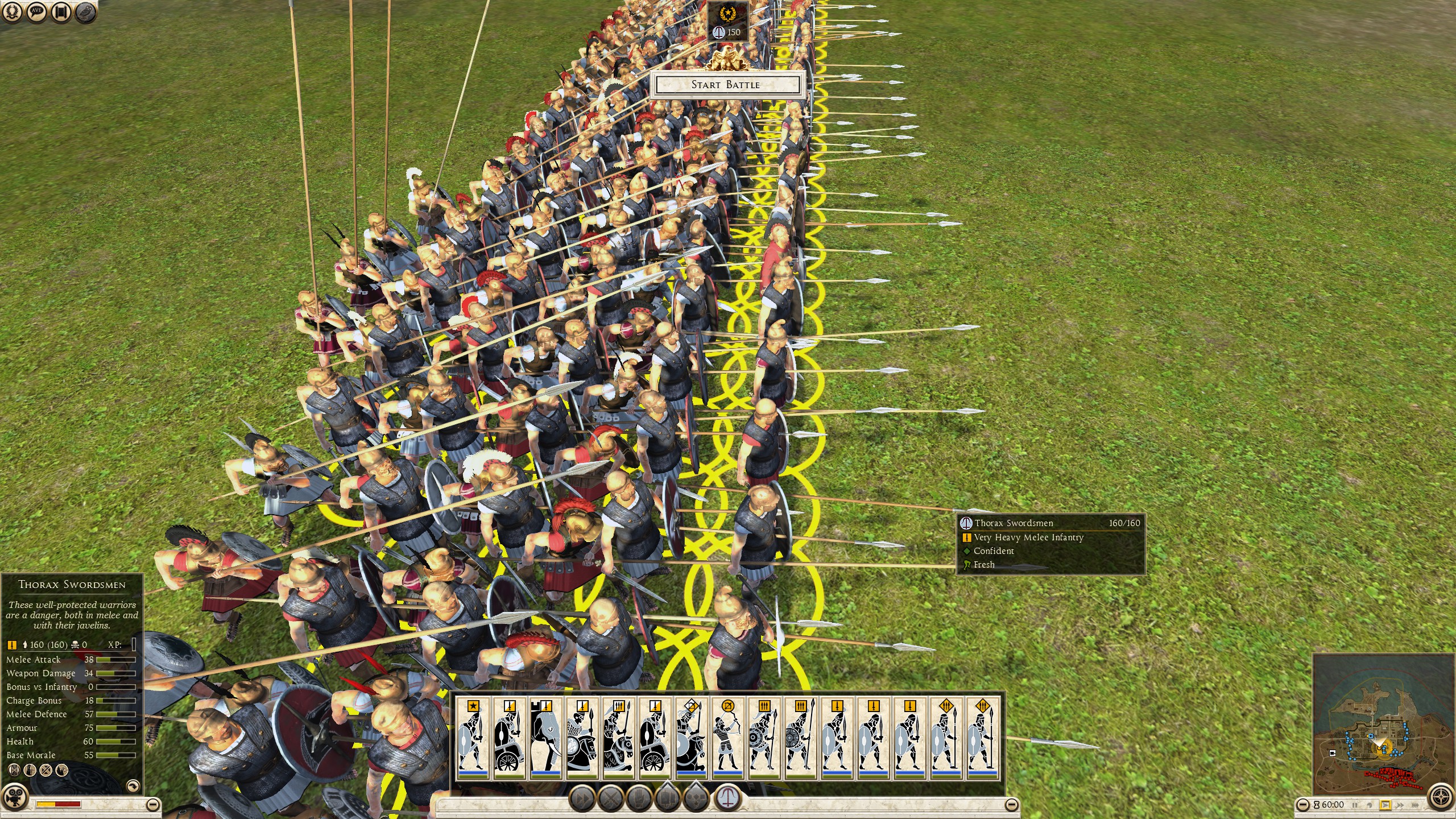
When you are ready, just go into chat, say "ready" or "rdy" or "r" or something like that, and when everyone says it then you can go - Pikestacking: Pikestacking is that act of placing a unit, usually melee infantry right in front of or within a pikemen unit. These densely packed combo formations remove the main weakness of the incredibly powerful pikemen (overviewed in section 3) by making them basically immune to missile fire. Pikemen not dealt with properly can singlehandedly stall chokepoints and kill hundreds, or even thousands of enemy troops. Traditionally, the easiest way to deal with a pike unit that cannot be flanked is to destroy it with missiles. When in pike formation, pikemen cannot block missiles, so they become easy to kill. In standard battles, a significant portion of the game is therefore spent maneuvering archers around the map, with each side playing a game of cat and mouse, each side attempting to kill enemy archers or drain their ammo so end-game pikemen can be used to their full extent. All that being said...
Pikestacking destroys that. The melee units absorb missiles while the pikes stab through the bodies of the infantry, making a clump of invulnerable troops.
⠀
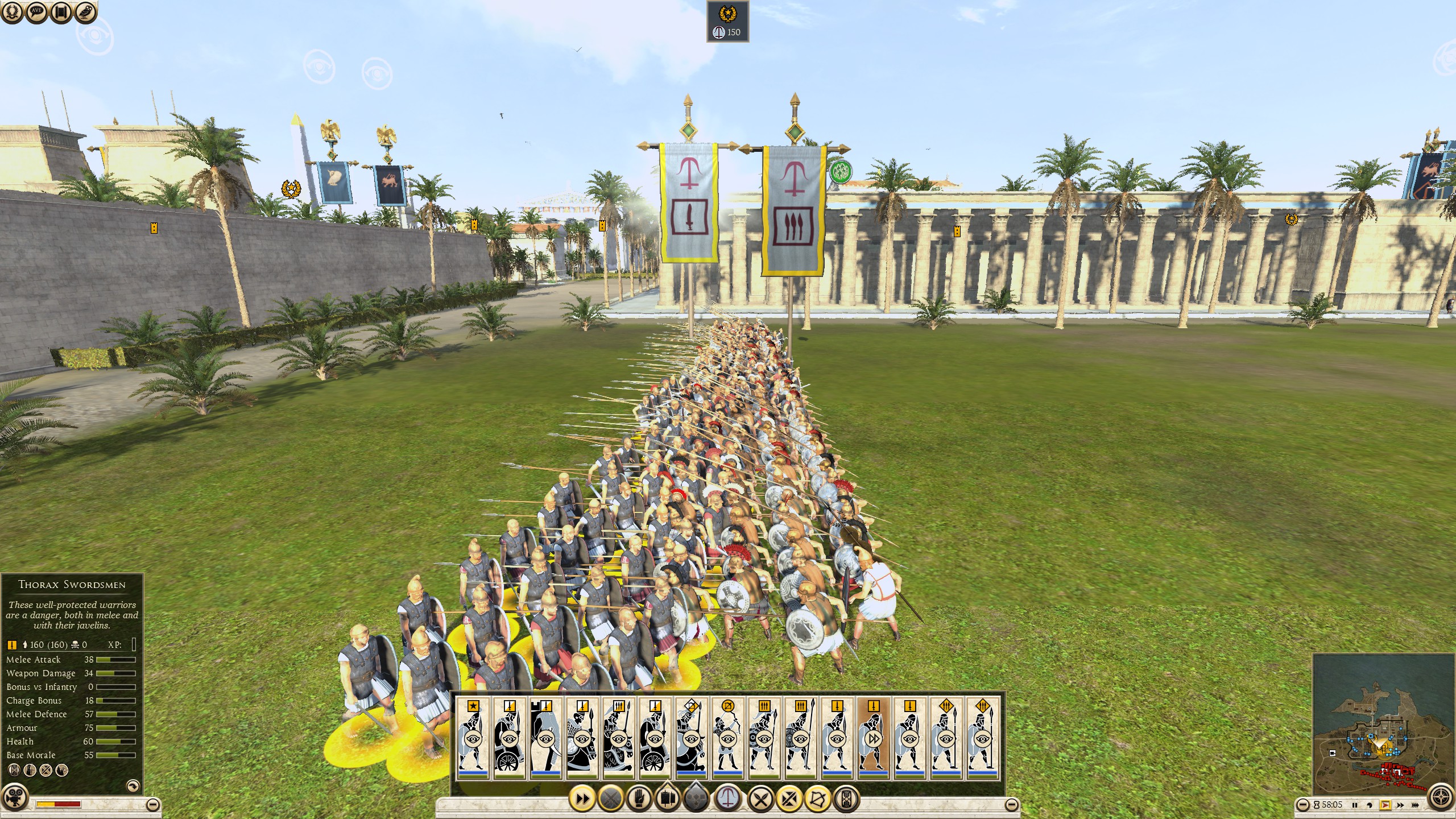
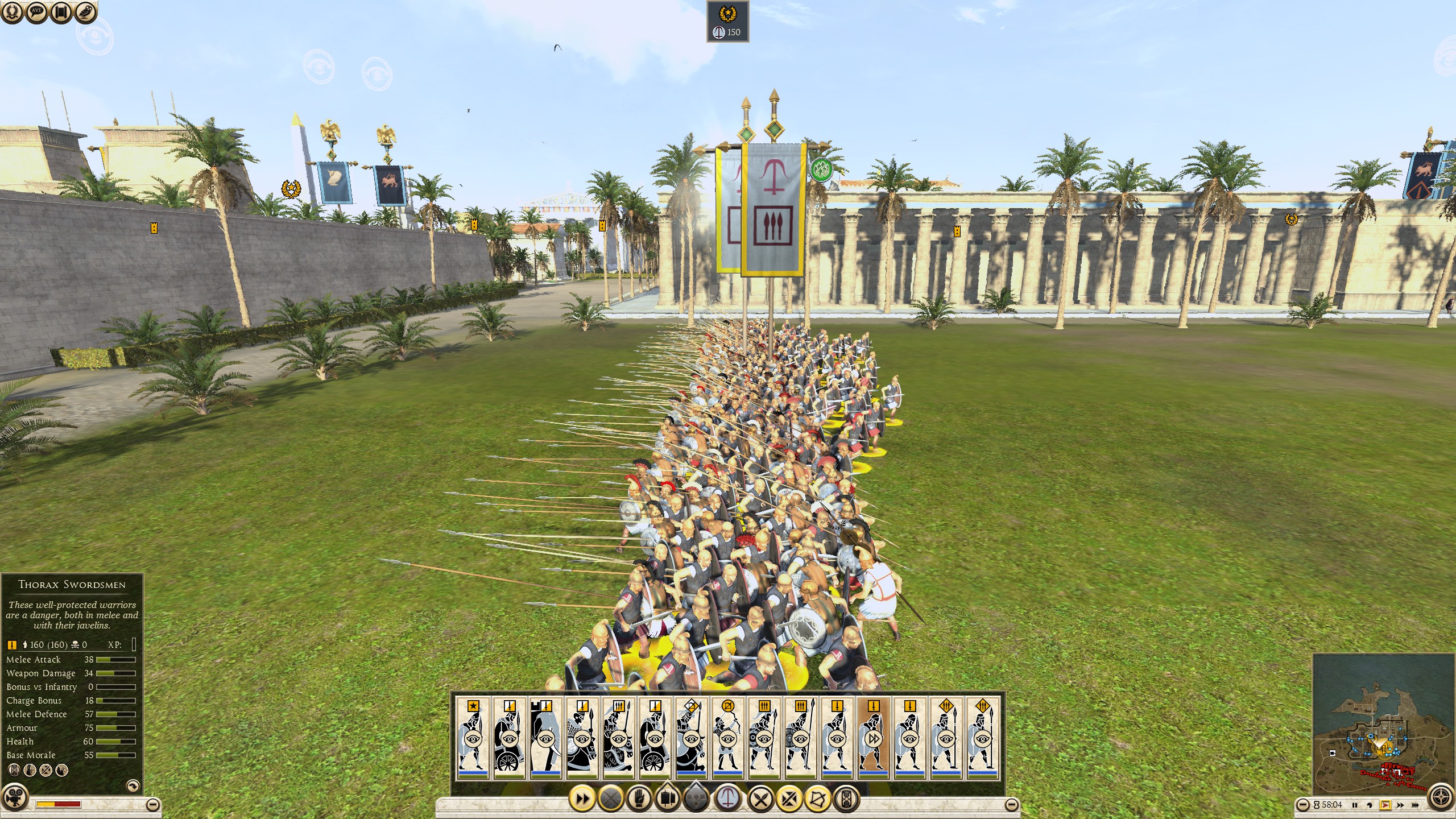
- Pushthrough. A simple concept, pushthrough is one that many new players learn quickly. It's which you take any various type of unit and spam click straight through enemy troops holding a static chokepoint or position. Despite the enemy troops being in an organized, tightly held position, enemy troops, your troops will glitch through the unit, as if it were running forward normally. While pushthrough usually causes many casualties for the units performing it, it allows them to attack safely protected units like archers, or charge into the rear of the units they just pushed through, without actually fighting for the position.
 ⠀
⠀3. Chat- Another common problem for new players in multiplayer is using the chat. The chat can be accessed by clicking on the small chat circle on the top left.

"All" chat is simple. Just type what you want to say, then enter. To private message, left click on the username of whoever you would like to chat with on the right side of the chat box, and click on private message, type what you want to say, then enter. Keep in mind you must do this every time you private chat.
To team chat, type out your message, then hold shift, then click enter while still holding shift. Alternatively you can type /team at the beginning of your message, but the first way is quicker.
When a yellow exclamation point is shown on the side of the chat circle, it means there is a new message.
Creating Armies (Defense-Focused Section)
- How to create a Ultra & Ultra+ Gold army
- How to create a Large & Large- Gold Army
- How my playstyle biases my armies + adjusting for sallying
- Which countries are good at what, & choosing the right one for the job
- Extra notes on army creation
4. Army Compositions
As you improve at the game and learn the details of units and factions, feel 100% free to make different comps. While my rules and advice create decent/passable armies with almost any faction, many factions can be made much better with more tailored comps.
Ultra & Higher-
While this highly depends on faction and cash, generally the optimal path, especially for a beginner is to max out on limited units (124), then max out on mid tier infantry (500-800 gold per unit).
From there upgrade your limited units. Once you have the most elite possible limited units, you may then move on to upgrading your melee infantry
to the higher level of itself:Thorax Pikemen-Silver Shield Pikemen. Persian Light Archers- Syrian heavy archers
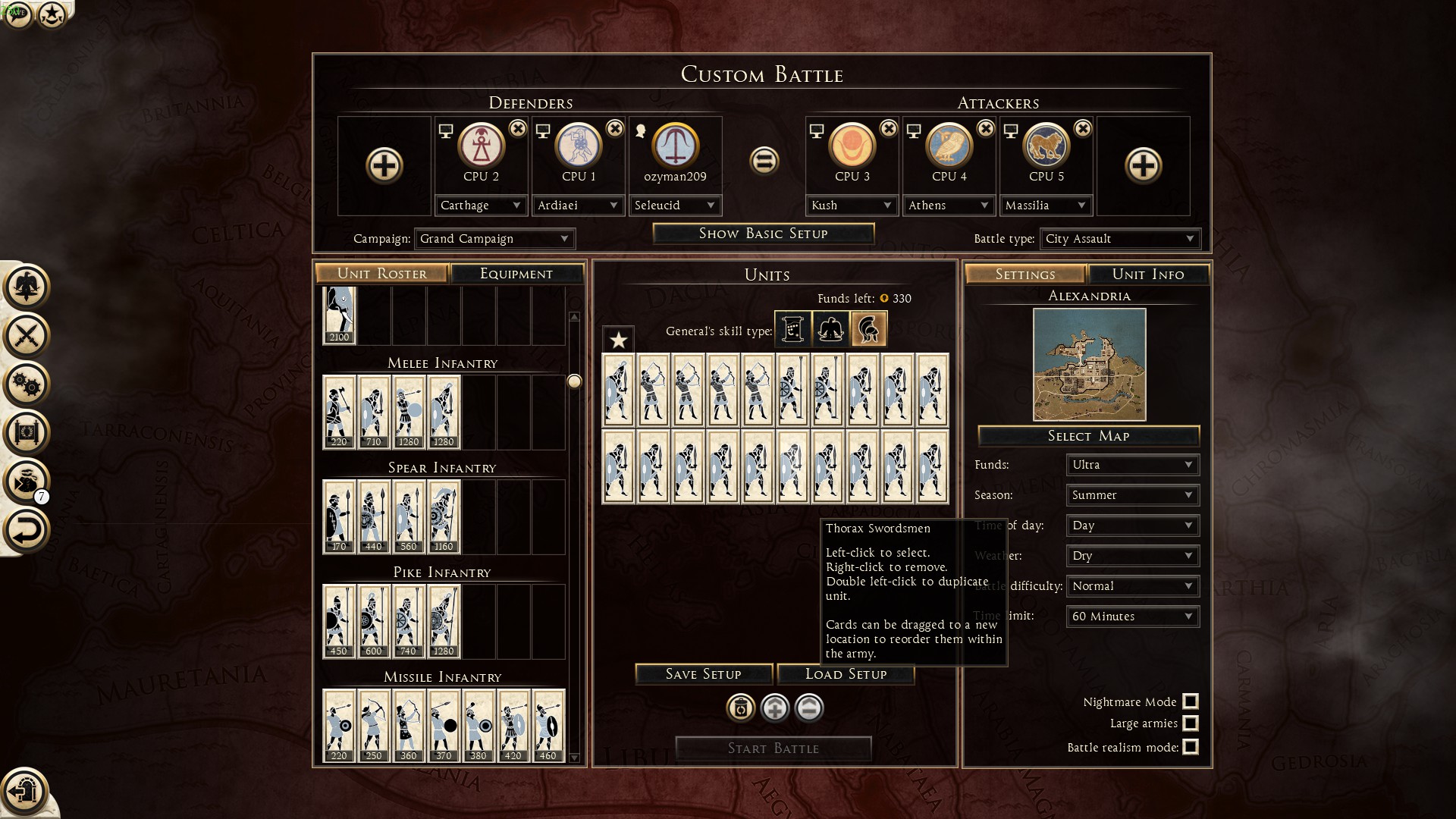
(A Seleucid 124 army comp on Ultra/16000 gold)
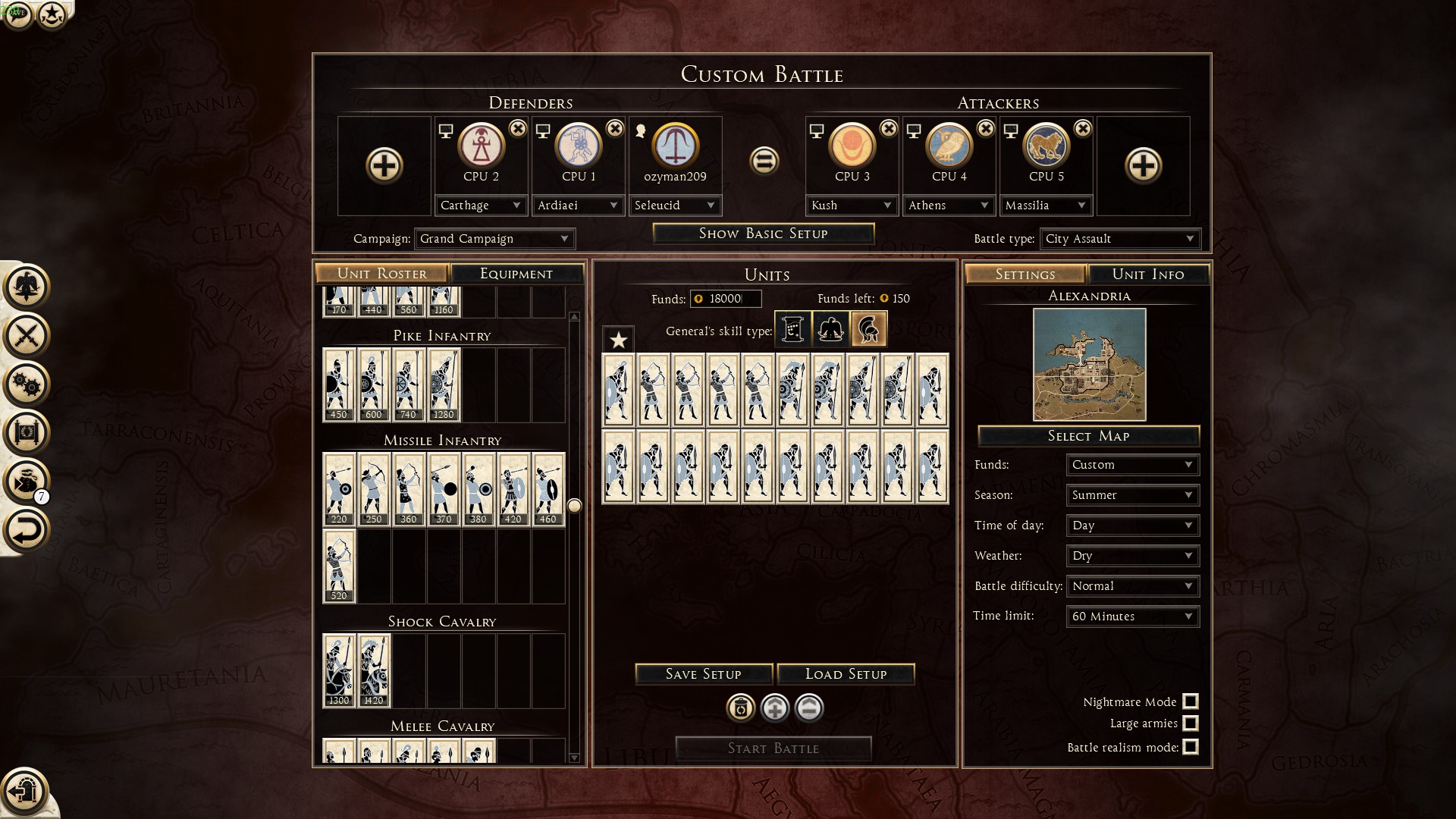
(A Seleucid 124 upgraded army comp on Custom/18000 gold)
Large and smaller-
From here you will have to make do with a much weaker army comp. Fortunately, this will affect the attacker more than you. Still max out on the limited (124) units, however they may not all be able to be high tier/expensive. After, get as many mid tier infantry as possible, if you don't have enough money, get cheaper units, if you have more than enough, upgrade your limited archers or pikemen. It's better to have distributed wealth than funnel all your money into a few high tier infantry.
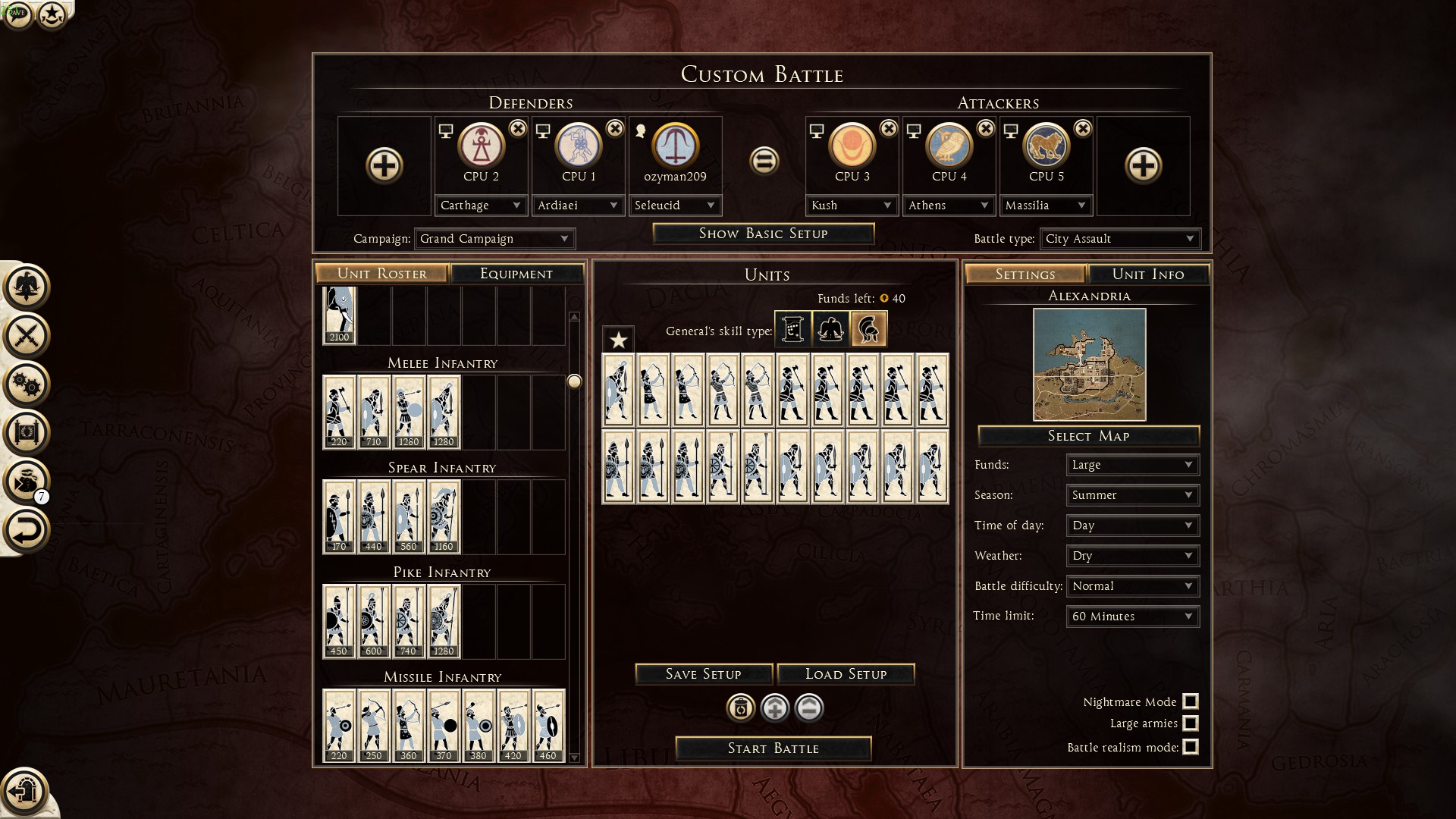
(A Seleucid 124 army comp on Large/11400 gold)
I chose Seleucid for these examples because they are great attackers, and defenders. They have a wide variety of both light and heavy reliable infantry, as well as strong archers. However, these tips hold true for the vast majority of factions. This comp is essentially the same for all of the successor kingdoms (Seleucid, Egypt, Macedon, and Baktria), who are good all-around factions.
IMPORTANT
I personally play a fairly defensive and reserved strategy. I play within the confines of the city, and play a relatively riskless defense. This is important to know because it effects how I build my army. The one thing not included in my defense comps is cavalry. Cavalry is used to "sally out". Basically sending cavalry out of the gates to harass enemy movements and formations, killing unaware archers and swordsmen.
IF YOU WANT TO SALLY OUT: replace 2-5 units of swordsmen with cavalry. Let your teammates know what you are doing in the chat. They will need to cover for you. Even a single unit of infantry can decide games, and going into battle missing multiple without coordinating can, and will, cost games.
4. Best factions for different roles
I would describe 5 roles (2 for attackers, 2 for defenders, and a misc) that almost any given country could be assigned to. This is what they are best at doing.
Attack
Assault- Fighting directly with the defenders, using heavy frontline infantry and missile units.These countries attempt to win an assault by fighting in extended melee battles to whittle down and eventually break the defenders
Flanking - Attempting to defeat the defenders through less conventional means, such as large flanks, shock charges, use of cavalry etc. The common trait among these factions is that they are not as good at direct combat, with lighter infantry and smaller or no shields, and must use special tactics to be effective.
Defend
Win- These attempt to stop attackers by means of killing the opposing army. They fight until either they run out of troops, or the enemy does.
Hold- These attempt to stop attackers by simply holding them back, and fighting as long as possible to win based on time. These are not effective at killing enemy troops, but they can last in sustained combat for such a time that they can win by letting the timer tick down.
All-rounders- All-rounders are basically exclusively made up of successor kingdoms, as they all have a very similar roster. They are very effective at both defense and offense, and have a wide variety of units and potential troop compositions. While they are not truly exceptional at any role, they are always effective and are a great choice for new players.
Attack-
Assault- High armor, large shields, decent damage
Rome
Masaesyli
Tylis
Galatia
Arverni
Flank- Low armor, lack of shields, high damage, armor piercing, and speed
Suebi
Odrysian Kingdom
Iceni
Kush
Defense-
Win- Less armor, more damage (win by killing attacking army)
Nabatea
Colchis
Saba
Ardiaei
Hold- Less damage, more armor (win by holding until the time runs out)
Sparta
Cimmeria
Athens
Syracuse
Massilia
All Around- high armor, large and varied roster, fits many roles
Seleucid
Macedon
Egypt
Baktria
5. Important notes-
- Any unmentioned countries are either so bad they don't excel at anything or are so extremely outlandish that they cannot be placed (such as the nomadic tribes)
- Some factions don't get certain units like pikemen or archers, don't freak out.
- Archers are generally the best for new players, and the easiest to use. The difference between slingers, archers, and peltasts is explained in section 3.
- Don't bring elephants, at least as a new player. Their problem will be explained in section 3
Unit types, and their Uses
- Melee & Spear Infantry (including pikemen)
- Missile Infantry
Both melee and spear infantry play similar roles on the battlefield. "Melee" encompasses both axe and sword using infantry, while "Spear" encompasses both spear and hoplite infantry.
IMPORTANT: Spear infantry and Hoplites are not the same. Spear infantry is generally weaker and faster, and is more well equipped to guard flanks and deal with cavalry, while hoplites are more well equipped to fight enemy infantry and serve as a frontline force.
Swordsmen: Frontline infantry, mostly used vs enemy infantry, but generally good all round. Often have a small supply of "pila", or throwable javelins
Axemen: Shock troops, high charge bonus designed to charge into enemy infantry, and deal quick damage. Poorer armor, and not as good at prolonged fighting as swordmen.
Spearmen: Flank guards, and often have a quite large supply of throwable pila. Great vs elephants, cavalry, and chariots, but poorer in infantry combat
Hoplites: More heavily armored, and better frontline infantry than spearmen. Many factions use them as the frontline, including Cimmeria, Sparta, Athens, and Nabatea. Weaker melee attack than swordmen, but much stronger melee defense. Also have a slightly smaller bonus towards mounted units (greater than swords, less than spearmen) However, they don't get pila, which can be a huge drawback depending on the situation.
Pikemen: Weak sword infantry, but have the ability "Pike formation) in which the pikemen draw pikes, or exceptionally long spears, and set them in front of them, creating an impenetrable wall of blades. Great vs everything in a direct confrontation, but are glitchy, slow in pike formation, can only really wait in formation until the enemy comes, instead of marching forward, and have to set themselves up, which takes 2-5 seconds. When in formation they are amazing against not only infantry, but also mounted, as elephants, cavalry, and chariots impale themselves on the wall of pikes. Extremely vulnerable against enemy missile infantry (pikemen are often their main target) and flanking. Pikemen must never be put combat into using their swords. It would be an incredible waste of killing potential.
Note: Pikemen cannot use their pikes on walls, so DON'T PUT THEM THERE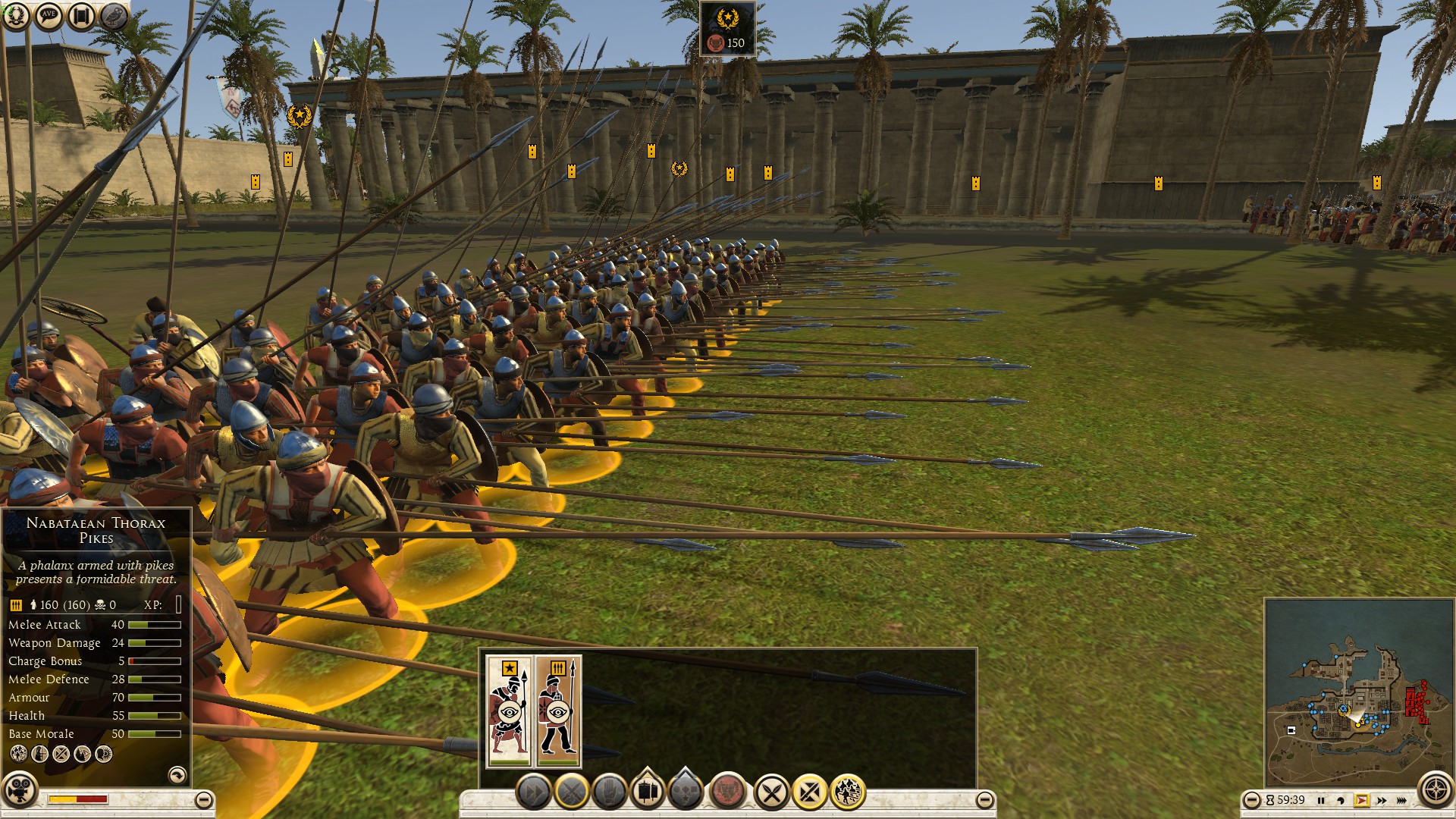
Missile Infantry
There are 3 types of missile infantry, each of which play and are used radically differently. These include archers, slingers, and peltasts. However all 3 of these are often referred to by other players during a match as archers, unless the type of unit needs to be distinguished. Some factions may miss out on certain kinds of missile infantry. This is usually for balancing, rather than historical accuracy. For example, the DLC faction Tylis does not have any archers, instead using low quality slingers and peltasts, as their mid-tier sword infantry (Tribal Warriors) are incredibly dangerous.
Slingers: A common, often cheap missile unit. Slingers have a lot of ammo, thanks to the small size of their rock ammunition, and have a good range. They also get shields to protect themselves from enemy fire. However, they have a straight forward firing arc, requiring either direct line of sight with the enemy, with enemy units directly in front of them, or a distinct height advantage to fire over allied infantry. They also have poor damage, and awful armor piercing, so they will do almost no damage to heavy or very heavy infantry. If you can properly position them, they become easily the best type of missile infantry for dueling with other missile infantry. Their range allows them to go head to head with archers, their shields protect them from return fire, and the lack of armor piercing means little when facing lightly armored missile units. Generally their usage is more common in land battles than siege battles, as in land battles there are no buildings or walls to block their fire.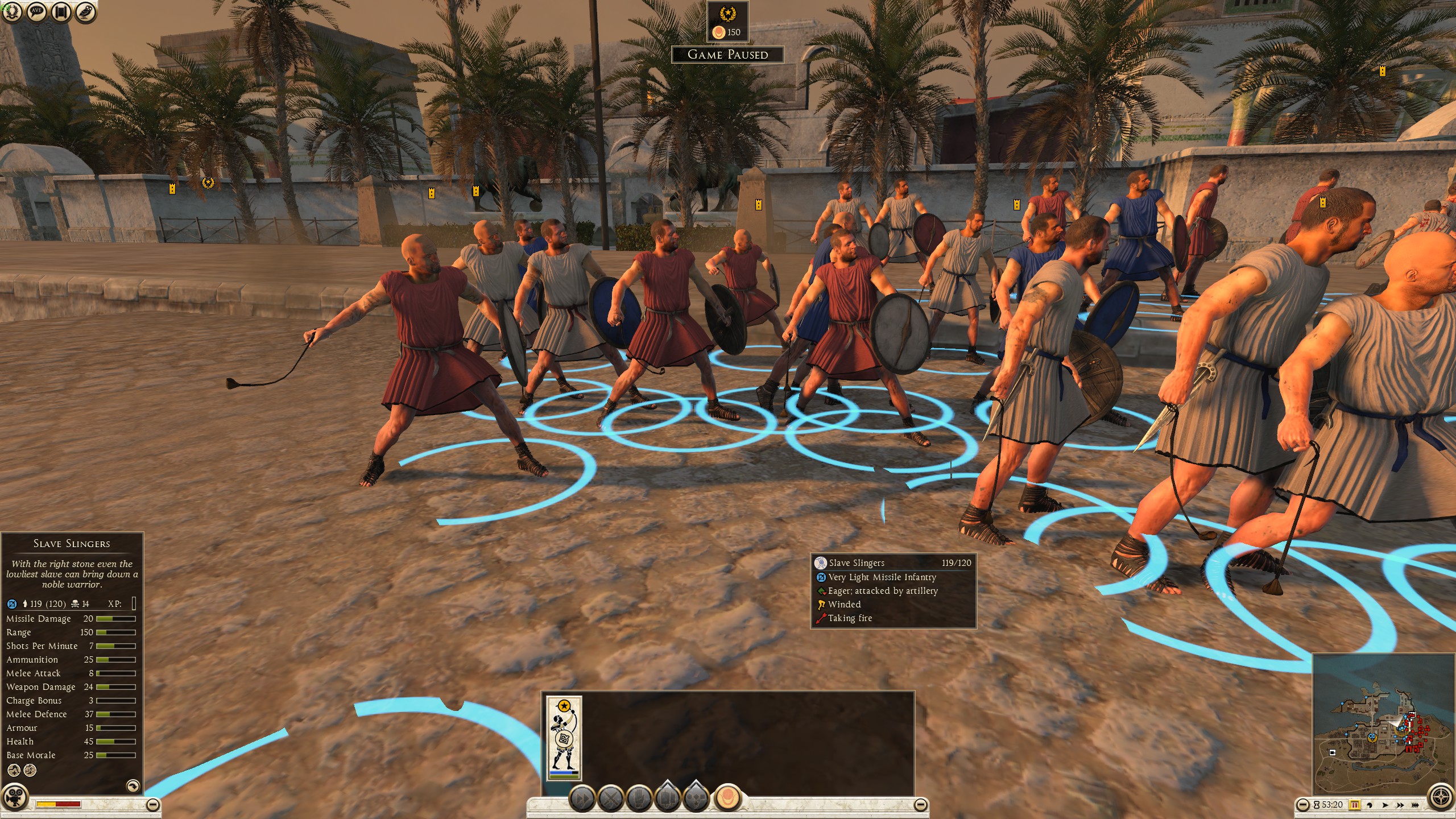
Archers: The most famous type of missile infantry, these are what are most commonly seen
in siege battles. They have good range, a variety of ammo types, strong standard damage, with decent armor piercing. They have a higher range of armor levels than the other 2 types of missile infantry, ranging from very light, to even medium levels of armor, and can fire over buildings and walls. However, they don't have shields, meaning worse protection against enemy projectiles, and they have less ammo then slingers. Generally archers are what should be used in a siege battle, as they are good all-rounders, and the addition of an actual firing arc gives them a huge positioning advantage. They also have the crucial advantage of different ammo tyes.
- Standard- Decent armor piercing, decent damage, good range, accuracy
- Fire- Less damage, less armor piercing, longer reload time, but reduces morale of all units the arrows touch (including your own) and can burn down arrow towers and other buildings in barbarian settlements
- Heavy shot- Lower accuracy, significantly lower range, but has much higher armor piercing and damage, reaching heights similar to peltasts. GLITCHES MAKE HEAVY SHOT UNUSABLE: Heavy shot consumes more ammunition than standard. This is, in fact, a glitch.
- Poison- Worse damage, but can lower the statistics of any unit it touches (including your own) and can fatigue their target.
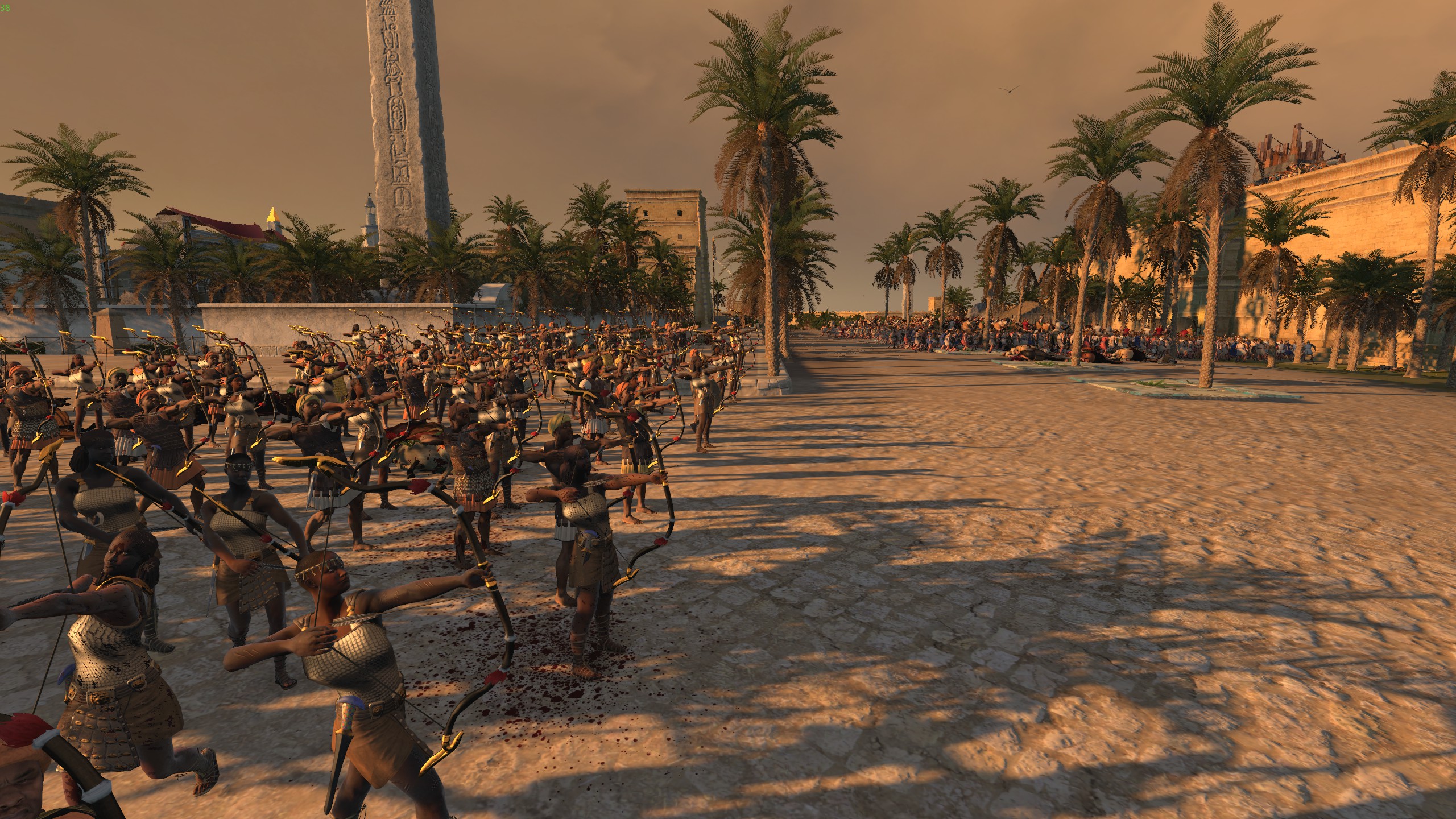 Peltasts: The most rare type of missile infantry to see in a siege, peltasts use javelins, similar to the ones thrown by swordsmen and spearmen, however they have some distinct buffs. First, they can target who they throw their javelins at, swordsmen and spearmen cannot. They also are generally cheaper than other infantry carrying javelins. Peltasts also have shields similar to slingers. They have far more ammo than even spearmen. These javelins thrown by peltasts also have higher accuracy than spearman and swordsmen. These missile units are characterized by huge amounts of damage and armor piercing. They are the only type of infantry with which it is not wasteful to fire at the direct front of enemy heavy infantry. Peltasts are also often better than their counterparts at fighting at melee. Some peltasts have spears (as opposed to javelins) and armor in addition to their shields, meaning that they can at least hold for a short period of time in melee. However, they have huge drawbacks. They have the ammo of archers, less than slingers. They have abysmal range, and a bad firing arc. Archers are often better, as they can deal more damage when properly positioned, especially in sieges.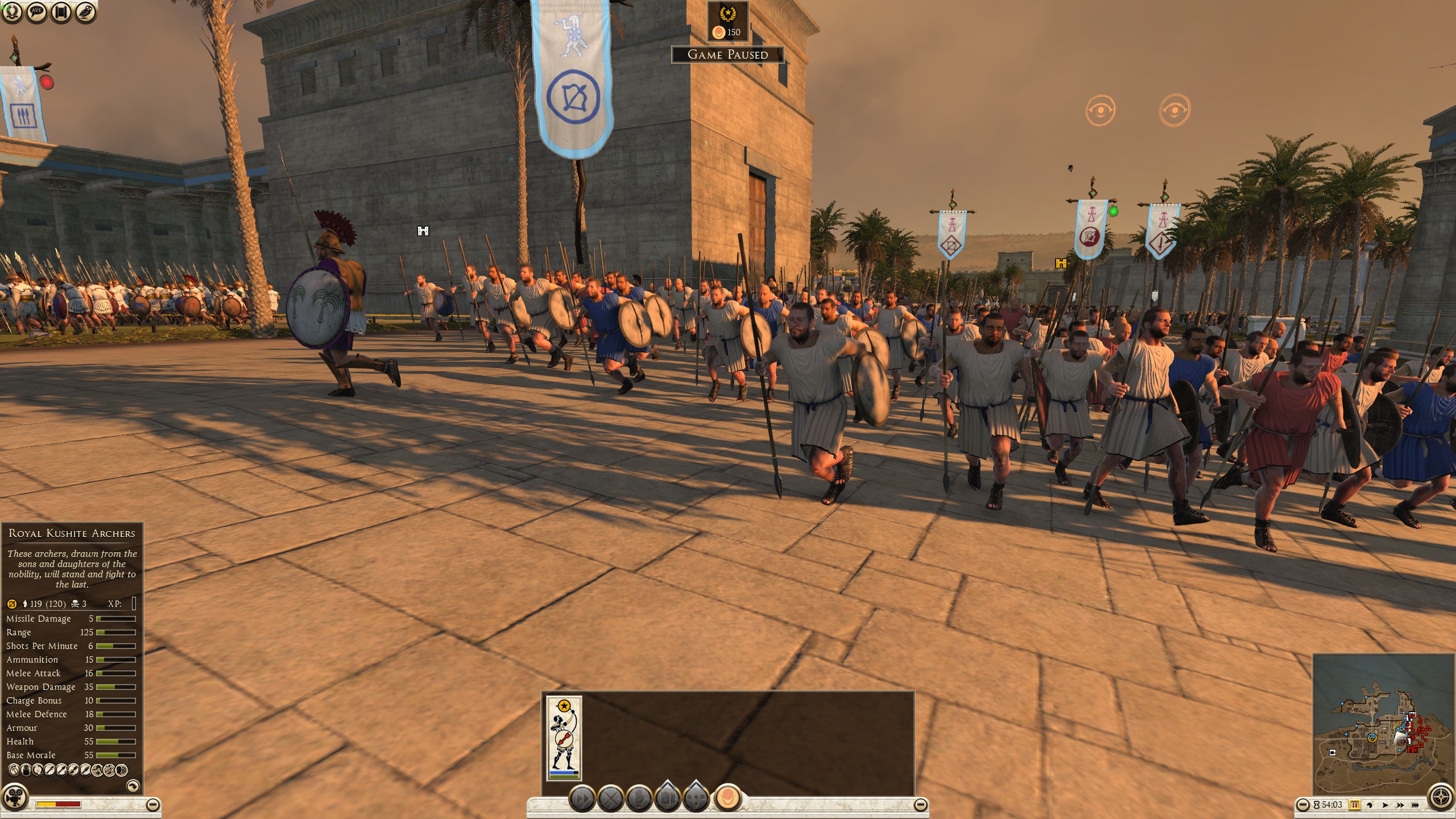
Interestingly, some peltasts and spearmen actually cross roles. This can be so extreme that there is a real question of whether they are actually the reverse. For example, Heavy Numidian Skirmishers from Masaesyli are so good in melee that they could potentially be referred to as light melee infantry while Thureos Spears are so good at range, that they could be referred to as heavy skirmishers.
Unit types, and their Uses cont.
- Mounted Units (Cavalry, Chariots, and Elephants)
- Artillery
Mounted Units
These units are generally designed for hit and run and charge tactics. Each type does better against something else. All of them are weak to spearmen, pikemen, and to a lesser extent, hoplites.
Shock Cavalry- Made up of traditional horse cavalry, shock cavalry specialize in charging into the enemy, disengaging, and charging again. They are usually quite pricy, but good charges into the backs of infantry, or into valuable targets like archers and artillery can change the course of the game. However, if kept in prolong combat, they will lose against inferior melee cavalry and many types of melee and spear infantry. These shock cav often don't have shields, making up for this with very high armor. They are also surprisingly slow, being outpaced by most other mounted units thanks to their weight.
Melee Cavalry- Made up of horses, and rarely, camels. These units usually have lighter armor, and a lower charge bonus than shock cav, but come equipped with shields and better combat statistics. They are also faster than shock cavalry. These melee cavalry are designed to maneuver around the city and outside the walls, trying to find good value. They are better at prolonged fighting, and attacking other cavalry than shock. They make short work of enemy light units as well. However, the charge of the shock cavalry is simple on a completely different level. Essentially, use Melee cav against enemy cav, light infantry, archers, and artillery, and use shock cavalry against enemy heavy infantry, archers, and artillery.
Don't be afraid to take risks using your melee and shock cavalry. Their entire point is to get as much value/kills as possible. If you see an opening to attack critical units, or flank, don't hesitate. Unlike archers or infantry, you can lose your cavalry and stay in the game. Do your best to wreak havoc, rack up kills, and accept that you will eventually lose your cav. Make the best of them.
Missile cavalry- Made up of horses. Generally unused in sieges. These cav have some form of missiles, usually bows, and can quickly maneuver and reposition. Inside the walls however, they are either dispatched by the more powerful archers, or engaged by the enemy melee cavalry. Missile cavalry lose to enemy missile units, as they have less men to fire and a slower reload speed.
Chariots- Exactly what they sound like. Scythe chariots are the most common, while there are also skirmishing/missile chariots. Scythe chariots charge into the enemy and use the dangerous spinning blades attached to their wheels to slice through nearby infantry. To use these, spam click THROUGH a unit of infantry, so the chariots don't get stuck, and get maximum value from their scythes. Skirmishing chariots also charge well, but have a few ranged units that will fire off of the chariot into enemies. They instead lack scythes.
Elephants- Slow and bulky, but have amazing stats in almost every regard. Amazing damage, health, and charge. They are quite expensive. However, they are rarely useful. They can be easily dispatched by ranged fire, pikes, and can even be killed by spears. They also have the major problem of "control". When they take a massive and rapid hit to morale from things like losing a general, or even being hit by fire/whistling arrows they will go "Out of control" in this state, elephants cannot be controlled, charging into any unit they see. They will kill the enemy units, your units, and suicide into pikemen. For a unit whose starting is that price of highly elite infantry or cavalry, and max price is double that, they are incredibly risky. And in the city streets, it is even easier for both attackers and defenders protect themselves from elephants. Bringing elephants especially terrible for your teammates. Not only have you deprived your team of elite units, they also have to watch the map constantly for the status of your elephants to make sure they don't lose control. Don't bring them in a siege, especially on defense.
Artillery-
Fixed- Artillery that is fixed in place, or at least fixed on a point. Attackers can bring much cheaper artillery with the tradeoff of it being unmovable, and the defenders can bring wall artillery for free (on large settlements), which can be placed at certain areas of the walls. Attackers also can mount scorpion towers on their siege towers, which will be revisited later.
As a defender, you can bring wall artillery in the deployables menu in large or extra-large size settlements. This counts as a unit of artillery. It is also free. Do not spend money on artillery as a defender. If you play on a small or medium size settlement, don't bother bringing artillery. If you are on large or XL bring however many units of artillery are allotted in the rules.
Movable- More expensive for its value, but can be used more creatively.
Ballista and onagers are both powerful, and function similarly. Scorpions are incredibly ineffective, even for their price and are basically useless.
Setting up your army, and core concepts (Defense Focused)
To be honest, this has taken much longer than I thought it would, and I am starting to lose my own morale. I was originally planning to make an extensive tutorial, but I have decided to instead make a shorter, more targeted list of errors that I often see new players making.
I recently went back and looked at some of my old replays. I thought I really hadn't improved much, but I was clearly wrong. I adjusted my play style over time, making small corrections which eventually became large. If those reading this continue to play, I would suggest in a while you go back and observe your old replays. In fact, much of this list is mistakes I saw myself making in my old replays.
The Key Issues (beginners make)
- Being the "Last Stand guy"
I love playing defense, and I admit I was at one time this guy. I am sure many beginners reading this have fantasies of roleplaying "300" and holding off overwhelming numbers in your little citadel. The truth is, you are abandoning your teammates, who know it doesn't work.
First off, and what most will hopefully realize; It's boring as hell! What fun is there in sitting inside the little last stand area for an hour? You are making the game frustrating for both the attackers and defenders by refusing to accelerate the pace of the game.
Second, you allow the attackers free reign of the city. It is important that between first contact and the end of the game, the defender keeps reasonable pressure on the attackers. The easiest mistake to make is allowing the attackers to establish a clear, secure area within the city. They can protect their army, keep them close to the frontline, and it gives their archers a proper means to position. It is inevitable that the attackers will establish a line within the city eventually, but you must slow the process.
Third, you abandon your teammates. Your teammates may put up a strong fight, but in many maps it is simply not feasible for an adequate defense to be carried out when a half or third of your total allied army is sitting in the back of the base waiting for the others to die. If you want to play out your fantasy, do it in a custom game!
- Keeping your reserves too far from the frontline
This is different from "Last stand guy," in that it is not a blatant error in perspective, but a mistake that is more subtle and takes some analysis to find in play.
Many new players bring some, or even most of their troops up to the frontline, but keep significant amounts of their reserves deep in the city. While it may seem like this can help with flanking attacks and there is no real harm, it is often inevitable that your lack of rapidly available reserves hinders you by increasing your response time.
Even after hundreds of hours there will still be times in which cavalry that you didn't see will charge the back of your line, and times when your infantry don't hold quite as long as you think they will. In these cases, having your reserves close and ready to respond in moments is vital. Taking just a few extra seconds to respond to the myriad of small crises you will experience in any game will ruin your chances of winning.
- Not coordinating & moving with your team
Your team is vital to winning. Sharing the burden of unit control is crucial to properly controlling your force. Don't think of each player as controlling their own army, think of it as 3 people controlling one army. Coordinating setup, movements, reinforcements etc. will be so helpful. Discord works well for this, but in-game text works too!
Even the best players can't keep track of every situation all the time, and any information that you deem necessary to give will be helpful. Of course this doesn't mean your teammates have to be aware of your every movement. Experienced players won't need you to tell them when you move your unit of egyptian slaves forward 2 steps.
- Being too inflexible (or too flexible)
This basically just means that you need to learn when to retreat, and when to hold. While there is obviously a big game sense/experience factor in this, the easiest way to figure out what you should do is just ask these questions:
- Can I hold this area without losing an unreasonable amount of troops?
- Will I lose an unreasonable amount of troops if i retreat?
- Is the area I'm holding more advantageous than the option I would retreat to?
- Not learning when it is better to fight for the walls, or hold the streets.
This is super simple. Do they have tortoises (large battering rams)?
If not, you can try to hold the walls.
If yes, let them have the walls and hold them in the streets of the city.
In Conclusion
- How to understand the rules of Rome 2
- How to create a decent army
- What all the different units do
- How to not make the most common newbie mistakes
From here, the easiest way to learn the game is play.
Over time you will learn maps, the intricacies of factions and their units, how to create cool armies, and how to not suck.
The last tip I would probably give is to ask people in the lobby for help if you don't know something! Most people will gladly help anyone who is cordial enough to ask!
- The Noob's Guide To: Taking A City Without Going Into "Total War"★ 5 (758)57k views667 ♥4 minUpdated Aug 15, 2021
- Rome 2: Formations (unit control tips)★ 5 (1k)49k views1.5k ♥5 minUpdated Sep 21, 2013
- ROME 2... EMPEROR EDITION. Easy public order and money income guide★ 5 (1.4k)47k views2.9k ♥33 minUpdated Feb 1, 2019
- A Comprehensive Guide to the Power & Politics System★ 5 (575)45k views1.1k ♥13 minUpdated Jul 5, 2018
- The one and only mod list for Rome II★ 5 (649)44k views1.6k ♥7 minUpdated Oct 19, 2023
- Late Republic and Principate Army Composition (Historical)★ 5 (729)30k views1.3k ♥25 min


- Upgrading to PremiumTeam Fortress 2★ 5 (20k)1441k views11k ♥6 minUpdated May 11, 2022
- No More Room in Hell Official ManualNo More Room in Hell★ 5 (2.8k)569k views2.1k ♥29 minUpdated Apr 22, 2019
- NMRiH Community Hosting GuidesNo More Room in Hell★ 5 (526)351k views653 ♥1 minUpdated Aug 10, 2022
- ULTIMATE GUIDE FOR GAME DEV TYCOONGame Dev Tycoon★ 5 (5.8k)326k views10k ♥4 minUpdated 23 Jan, 2014
- How to 'Git Gud' Soon™MORDHAU★ 5 (2k)318k views3k ♥68 minUpdated Nov 16, 2024
- Лучшие кооперативные игры SteamPAYDAY 2★ 5 (1.5k)315k views2.1k ♥56 minRussianUpdated Apr 27, 2025




This guide was created by its original author on the Steam Community. Are you the author and want it removed? Request removal.