Water Sterilizer (10 kg/s)
🔧 How it works
Three reservoirs in chlorine work in rotation:
200s filling - 200s holding (germs die) - 200s draining
Due to the phase shift, the output is a continuous 10 kg/s flow.
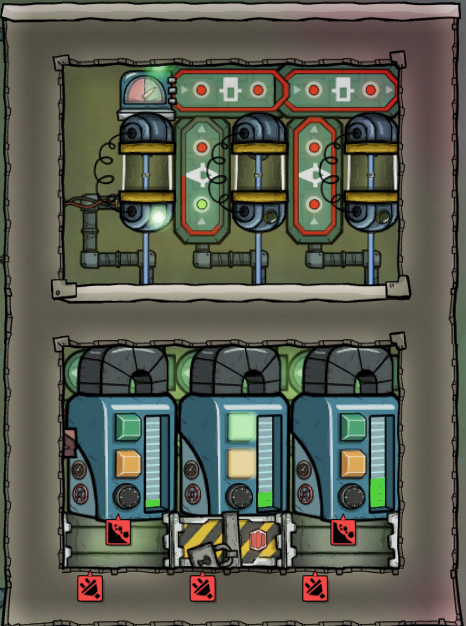
200s filling - 200s holding (germs die) - 200s draining
Due to the phase shift, the output is a continuous 10 kg/s flow.
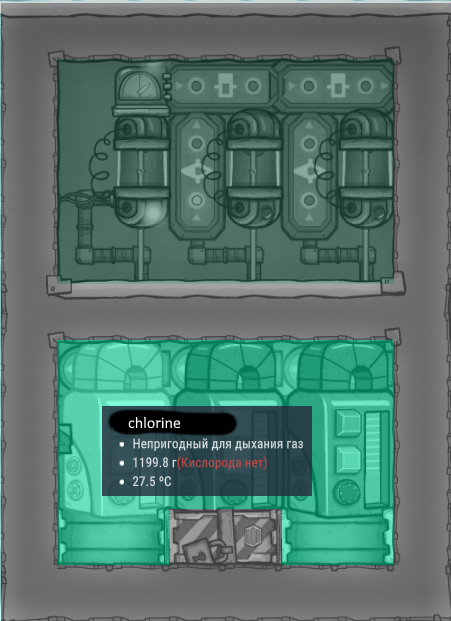
🖼️ Gas environment
Inside the lower sealed room - chlorine.
⏱️️ Logic
Master timer: 200 green / 400 red (600s cycle).
Filters and buffers in the upper room for 200 seconds each
Filters in the lower chamber 199 seconds
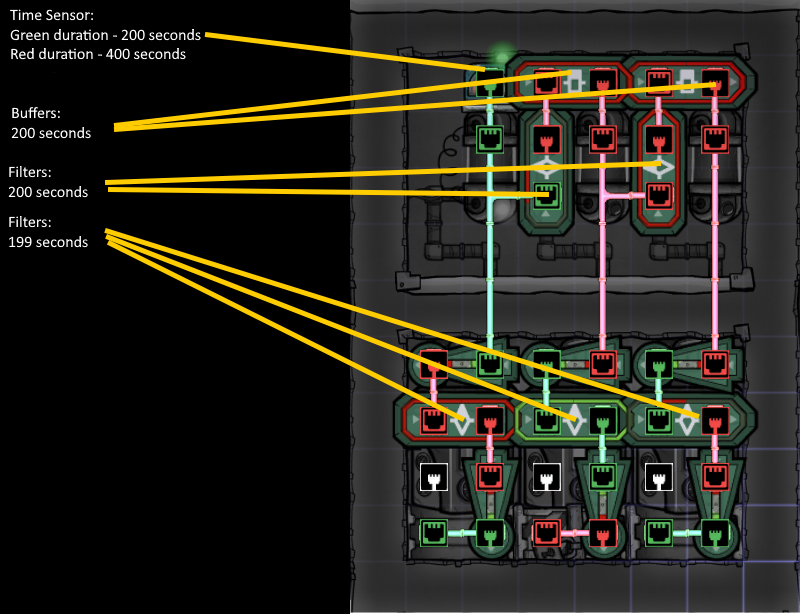
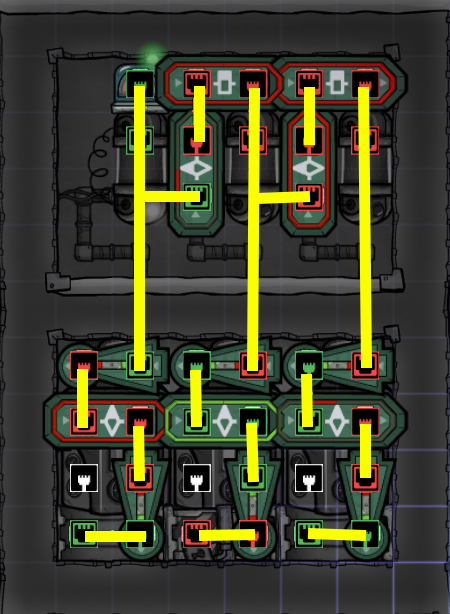
Filters and buffers in the upper room for 200 seconds each
Filters in the lower chamber 199 seconds
🚰 Pipes
Water comes from above, splits above the three shutoffs — so all three receive water instantly with the same delay.
From each shutoff to the reservoir inlet — an 8-cell serpentine pipe.
Why the serpentine: Automatic doors under the reservoirs consume no power but open slowly. The serpentine gives the door time to open so that water packets don't rush straight through the reservoir and out unsterilized.
Clean water output: Pipe lengths from each reservoir to the merge point are equal (red numbers 1–5).
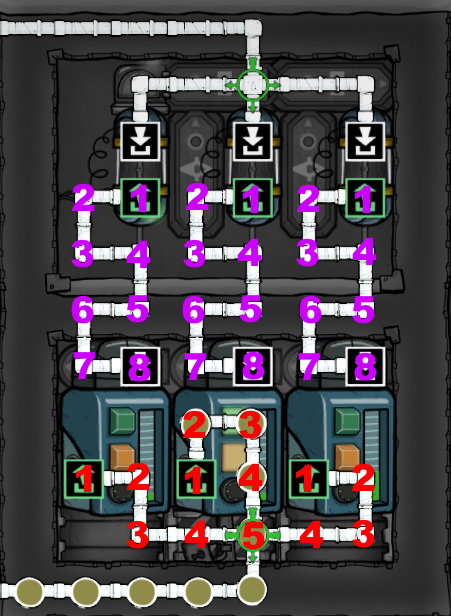
From each shutoff to the reservoir inlet — an 8-cell serpentine pipe.
Why the serpentine: Automatic doors under the reservoirs consume no power but open slowly. The serpentine gives the door time to open so that water packets don't rush straight through the reservoir and out unsterilized.
Clean water output: Pipe lengths from each reservoir to the merge point are equal (red numbers 1–5).
🚪 Doors
A reservoir can output water only if the door under it is closed (floor present).
During fill and hold phases, the door is open.
The door closes when the reservoir is in the drain phase.
Timers + filters + buffers in ONI have slight delays, and the more devices in a chain, the larger the delay.
Therefore, a 199-second filter (instead of 200) is used to control the doors.
The door closes one second early — this fully compensates the delay.
During fill and hold phases, the door is open.
The door closes when the reservoir is in the drain phase.
Timers + filters + buffers in ONI have slight delays, and the more devices in a chain, the larger the delay.
Therefore, a 199-second filter (instead of 200) is used to control the doors.
The door closes one second early — this fully compensates the delay.
⚡ Power
Only the liquid shutoffs consume power (10W each).
Exactly one shutoff operates at any time — constant 10W.
Doors and logic elements consume no power.
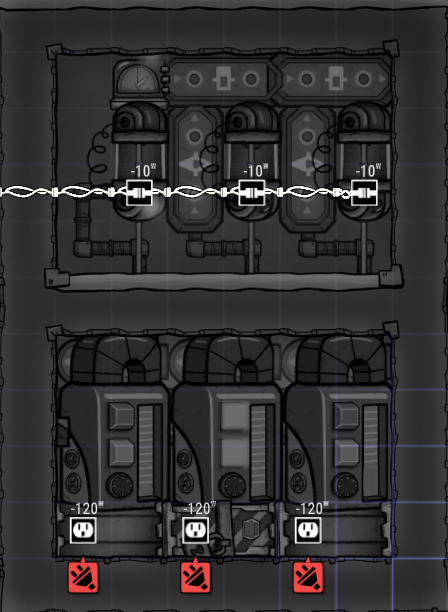
Exactly one shutoff operates at any time — constant 10W.
Doors and logic elements consume no power.
✅ Conclusion
High throughput — 10 kg/s (pipe limit).
Long enough hold time — germs are fully eliminated (tested with a geyser producing 25,000 germs/kg).
Reliable — logic does not depend on reservoir fill levels, so it won't stall if infected water supply is intermittent, and it continues working during power outages for hold and drain phases.
Energy efficient — constant 10W.
Early-game friendly — no plastic required for pipe germ sensors.
Fits into standard floor heights.
Set and forget.
⚠️ Drawbacks
Quite space-hungry, but come on — no maintenance required, build it on the edge of the asteroid.
Input/output pipes fit only into the lower room's floor and the upper room's ceiling — couldn't fully tuck them inside the rooms.
Long enough hold time — germs are fully eliminated (tested with a geyser producing 25,000 germs/kg).
Reliable — logic does not depend on reservoir fill levels, so it won't stall if infected water supply is intermittent, and it continues working during power outages for hold and drain phases.
Energy efficient — constant 10W.
Early-game friendly — no plastic required for pipe germ sensors.
Fits into standard floor heights.
Set and forget.
⚠️ Drawbacks
Quite space-hungry, but come on — no maintenance required, build it on the edge of the asteroid.
Input/output pipes fit only into the lower room's floor and the upper room's ceiling — couldn't fully tuck them inside the rooms.
🙏 Credits
Basic logic (timer carousel) and translation: DeepSeek
Oxygen Not Included community — for guides and discussions that helped understand the mechanics and find ideas.
Oxygen Not Included community — for guides and discussions that helped understand the mechanics and find ideas.
More Oxygen Not Included guides
- ONI - Surviving the Early Game★ 5 (2.4k)83k views6.3k ♥54 minUpdated 6 Aug, 2019
- Useful Construction Patterns★ 5 (1.8k)74k views5.2k ♥66 minUpdated 29 Aug, 2020
- 10* things I wish I knew sooner...★ 5 (754)58k views1k ♥4 minUpdated 6 Oct, 2017
- ONI - Surviving the Mid-Game★ 5 (1.3k)44k views3.8k ♥150 minUpdated 6 Sep, 2019
- Not Quite Beginner's Guide★ 5 (361)32k views1.1k ♥91 minUpdated Mar 26, 2023
- Руководство для начинающих. (ОСНОВЫ)★ 5 (629)32k views1.2k ♥21 minRussianUpdated 20 Apr, 2019





🔥 Popular guides
- Upgrading to PremiumTeam Fortress 2★ 5 (20k)1441k views11k ♥6 minUpdated May 11, 2022
- No More Room in Hell Official ManualNo More Room in Hell★ 5 (2.8k)569k views2.1k ♥29 minUpdated Apr 22, 2019
- NMRiH Community Hosting GuidesNo More Room in Hell★ 5 (526)351k views653 ♥1 minUpdated Aug 10, 2022
- ULTIMATE GUIDE FOR GAME DEV TYCOONGame Dev Tycoon★ 5 (5.8k)326k views10k ♥4 minUpdated 23 Jan, 2014
- How to 'Git Gud' Soon™MORDHAU★ 5 (2k)318k views3k ♥68 minUpdated Nov 16, 2024
- Лучшие кооперативные игры SteamPAYDAY 2★ 5 (1.5k)315k views2.1k ♥56 minRussianUpdated Apr 27, 2025






This guide was created by its original author on the Steam Community. Are you the author and want it removed? Request removal.