Designing an Effective Mass Transit System for Your City
Introduction
Building an effective mass transit system is essential for any city to function. It helps significantly reduce traffic congestion by providing Cims with a viable alternative to driving. This in turn leaves the roads free for those who need to use them, such as emergency vehicles, city services and trucks.
Ideally the system should cover as much of your city as possible, but if you wish you can choose to focus on areas where demand is highest.
To do this, we need to make sure that our system is fast, frequent and convenient. When you are ready, scroll down to the next section.
Recommended items
This is a list of things that i recommend using. They are however not necessary.
https://store.steampowered.com/app/369150/Cities_Skylines__After_Dark/?curator_clanid=6625556
https://store.steampowered.com/app/420610/Cities_Skylines__Snowfall/?curator_clanid=6625556
https://store.steampowered.com/app/547502/Cities_Skylines__Mass_Transit/?curator_clanid=6625556
https://store.steampowered.com/app/1146930/Cities_Skylines__Sunset_Harbor/?curator_clanid=6625556
For choice of bus bay (workshop assets only) or station platform:
https://steamcommunity.com/sharedfiles/filedetails/?id=2862973068
For elevated and underground passenger train stations:
https://steamcommunity.com/sharedfiles/filedetails/?id=515489008
For additional line options:
https://steamcommunity.com/sharedfiles/filedetails/?id=1312767991or
https://steamcommunity.com/sharedfiles/filedetails/?id=928128676
For additional metro options:
https://steamcommunity.com/sharedfiles/filedetails/?id=816260433
For placement of tram station assets:
https://steamcommunity.com/sharedfiles/filedetails/?id=707497031
For creation of ship paths in-game (useful when connecting islands):
https://steamcommunity.com/sharedfiles/filedetails/?id=512314255
For lane and junction management (e.g. ban private vehicles from bus lanes, change bus lane arrows, create cross-platform rail interchanges):
https://steamcommunity.com/sharedfiles/filedetails/?id=1637663252
For additional road options:
https://steamcommunity.com/sharedfiles/filedetails/?id=812125426
For placement of pedestrian crossings away from intersections:
https://steamcommunity.com/sharedfiles/filedetails/?id=427258853
Any mod that allows for single train tracks to be created (good for grade separating rail junctions and cross-platform rail interchanges)
- Any multi-platform train/metro station (i.e. more than 2 platforms). Helps keep your lines separate while still providing interchange between them.
- Any elevated/underground train station
- Any small bus hub
Setting up your network
There are numerous approaches you can take when it comes to creating your network - it is up to you as to which one you choose. Bear in mind that every choice you make will determine the effectiveness of your network, so choose wisely as you want your network to be used.
If you are only building a small town and nothing else, then this section is irrelevant to you, as most likely everyone will be able to get around using buses. However, if you have a large city, or plan on building a large city, the use of more than one mode of public transport is essential to your network functioning as effectively as it can.
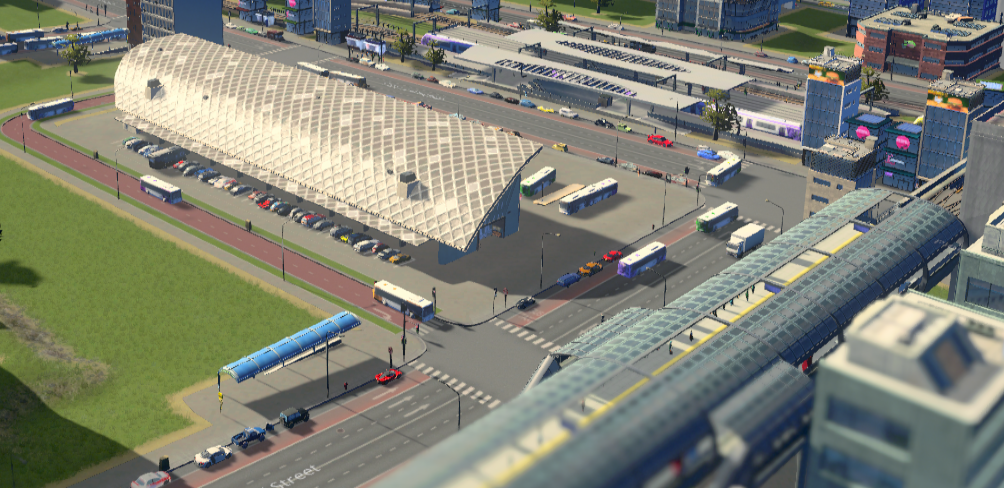
Your Cims will happily take more than one mode of transport to reach their destination. For example, a typical journey may involve taking a bus to the local train station, a passenger train into the centre of the city, transferring to a metro train to reach the banks of the river, then finally taking a tram the last few hundred metres to the destination. The advantage of this is that you don't need routes going from everywhere to everywhere - as long as your Cims can make convenient connections between routes.
- Many more routes are required
- Patronage on individual routes would be extremely low
- Requires many more vehicles to maintain a good frequency. Most vehicles would run close to empty due to lack of demand.
- Travel times can be longer than driving due to the number of stops
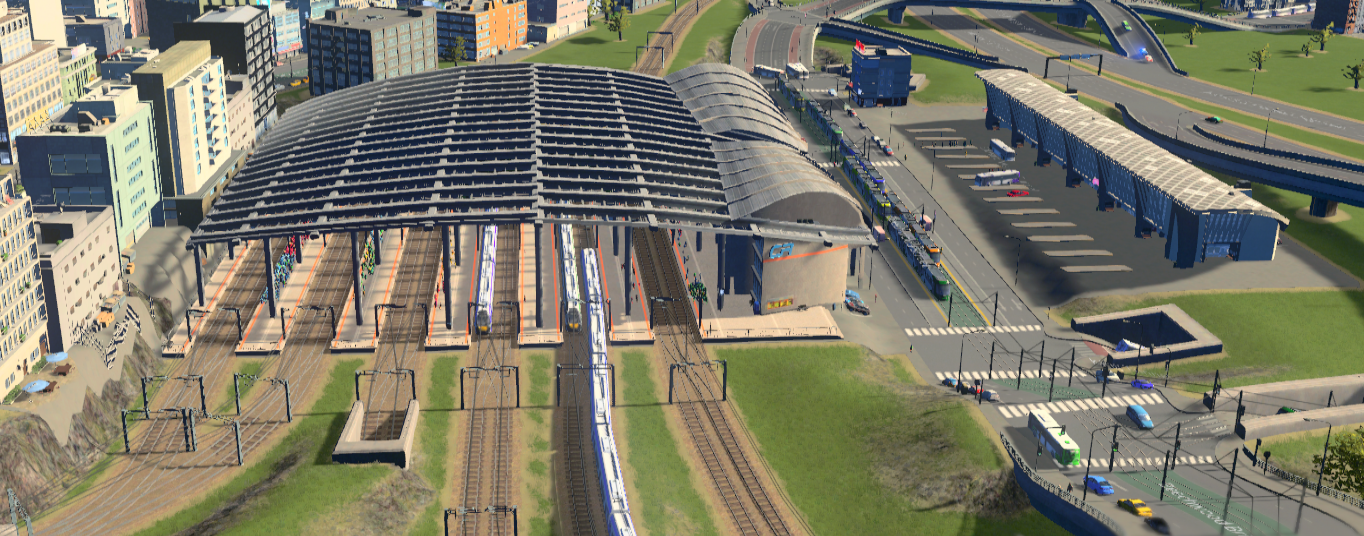
To make your network run as efficiently as possible, it is best to create a series of transport hubs for Cims to change routes. The size of you hubs will depend on the modes of transport and number of routes using them.
The advantages of using this model include:- Minimizes the number of routes required
- Uses a combination of trunk and local routes (see below), which can reduce travel times
- Higher patronage on individual routes, as Cims travel to, from and between hubs
The only disadvantage with this model is that Cims have to change service to reach their destination (though the inconvenience can be minimized with proper planning as discussed below).
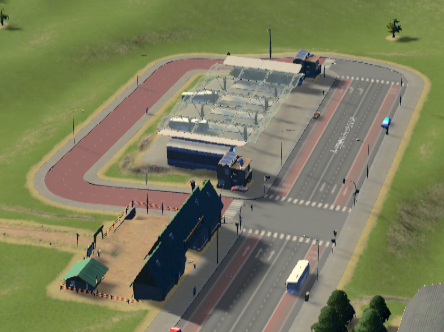
Some hubs will only serve as the terminus for local routes, with a primary purpose of bringing Cims to that particular location. For this purpose a single asset such as a small bus hub will be sufficient.
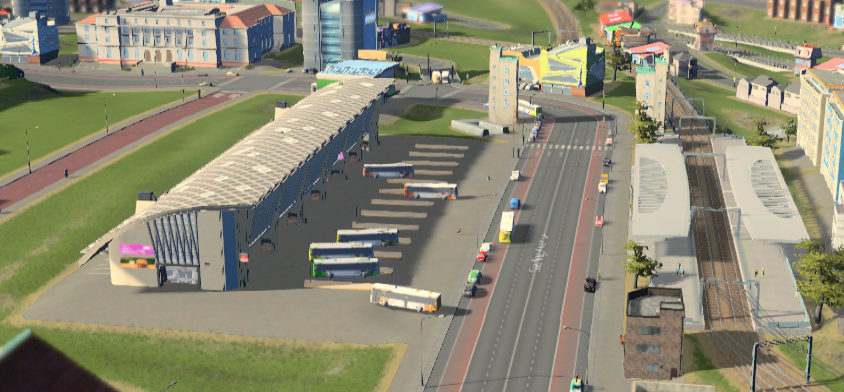
Most hubs, however, will serve as major interchange points between multiple local and trunk routes, as such it will be necessary to place a combination of assets within close proximity of each other (e.g. a large bus station directly across the road from both a train station and a metro station) to make the interchange as convenient as possible.
Trunk routes
These are the routes set up to take Cims between hubs, with minimal stopping in between, allowing services to run at high speeds which reduces travel time. These routes usually have a high passenger load, as such high-capacity modes are best suited to the task. (We will look at the suitability of each mode in the next section.) It's possible to use lower-capacity modes for this task if you wish but you will require significantly more vehicles due to the high demand and potentially lower speed of the vehicles.
Local routes
Local routes can travel between hubs as well, but their primary purpose is to take Cims the last few hundred metres to their destination. As such, these route generally run at lower speeds in order to maximize convenience. (In fact, having local routes run between hubs can offset some of the running costs as patronage is less likely to be skewed toward one end of the route.) For this purpose, low capacity modes of transport are best used on these routes due to the frequent stops. (We will look at route planning in a later section.)
There are several multi-modal hub assets available with the Mass Transit and Sunset Harbor DLCs that you can use as an alternative to placing multiple assets.
Modes of transport
Heavy rail
We will start by looking at high-capacity land transport.
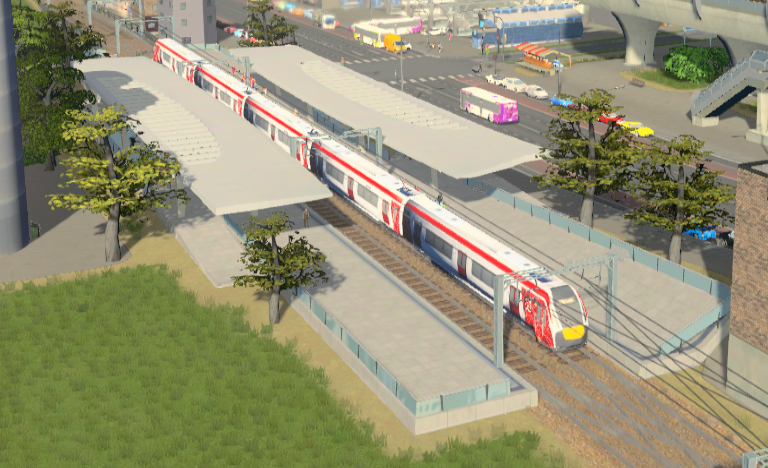
Passenger trains are a fast, high-capacity mode of transport that is ideal for large cities. They can transport large loads long distances in a short amount of time, which makes them ideal for trunk routes between suburbs and towns where the demand is high.
Train lines can be built at ground level, elevated or underground, thereby giving them the ability to avoid crossing roads at-grade. Avoiding level crossings becomes more and more important as your city grows - just like in real life, level crossings in the game can create choke points in the road network, creating congestion and delaying buses, emergency services and the like.
You can also place elevated and underground stations (available on the workshop), but you will need the Extra Train Station Track mod.
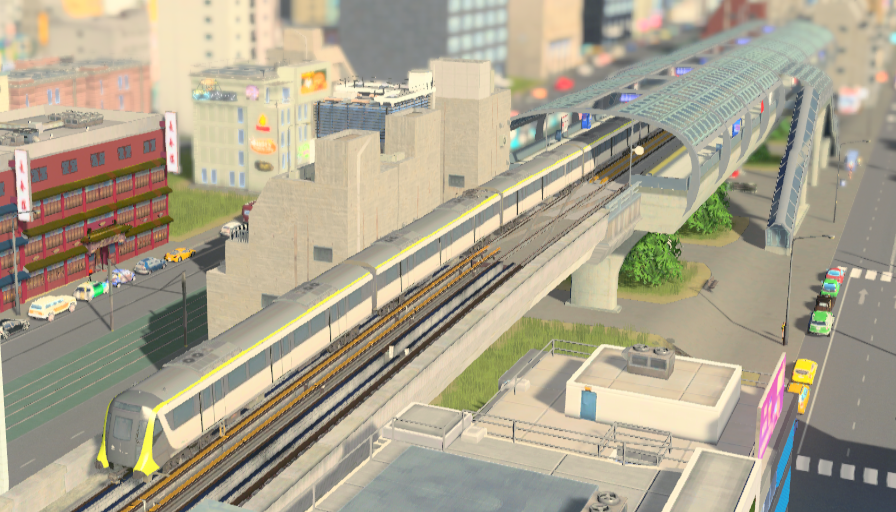
Like trains, but not as fast. Metros are a high-capacity mode of transport that has the advantage of not taking up as much room on the surface, making them suitable for reaching really dense areas of the city where a regular passenger train service cannot reach (but where large numbers of Cims need to go).
Like train lines, metro lines can be built at ground level, elevated or underground, however they cannot intersect with the train system.
Metropolitan Depot
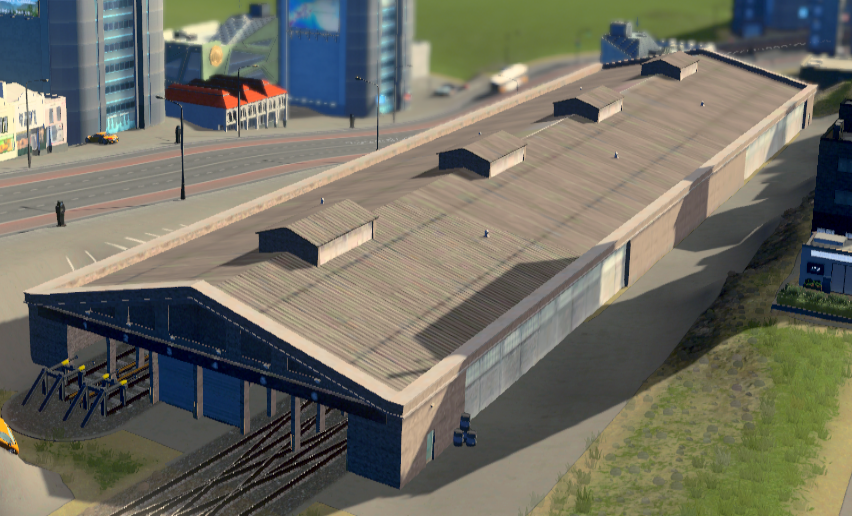
If you use the Metro Overhaul Mod, metro trains will spawn from the depot instead of spawning at a station. Be sure to connect the depot to the station closest to its location on the line(s) you want to spawn trains for, otherwise they will not spawn.
It is also a good idea to keep your intra-city network completely separate from your inter-city and cargo networks, since there will be quite a lot of trains on each depending on demand.
Where there is a junction between two different rail lines, it is a good idea to grade separate the junction, as this avoids trains on the different lines having to cross paths (they don't have to wait for each other to leave the junction). You will need one-way tracks to do this so that trains take the path you want them to take.
The same applies to metro and monorail tracks, however these by their very nature do not intersect with inter-city rail and cargo networks.
Road transport
Next, we will look at low-capacity land transport
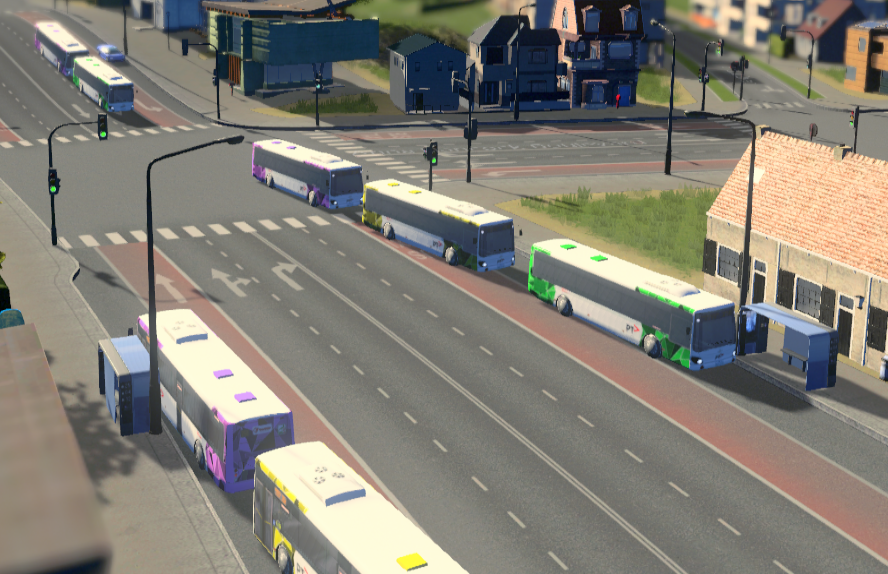
Buses have the biggest advantage of any mode of transport, being that they do not run on rails. Combined with their small size, this means that they can go anywhere in your city provided they remain on land (or at least in a tunnel or on a bridge). Their size also presents a disadvantage - they do not have the capacity to move large numbers. This makes them best suited to last-mile connectivity, that is, bringing Cims from their home, workplace or wherever they might be, to the nearest train/metro station, ferry pier, or bus interchange (for transfer to other bus routes).
Bus depots
To create bus routes, you first have to build a bus depot. While one bus depot will be enough to cover an entire city, we have to remember that buses will take time to get from the depot to their route, so if you have a large city, it may be wise to place more than one depot.
Bus Station/Small Bus Hub
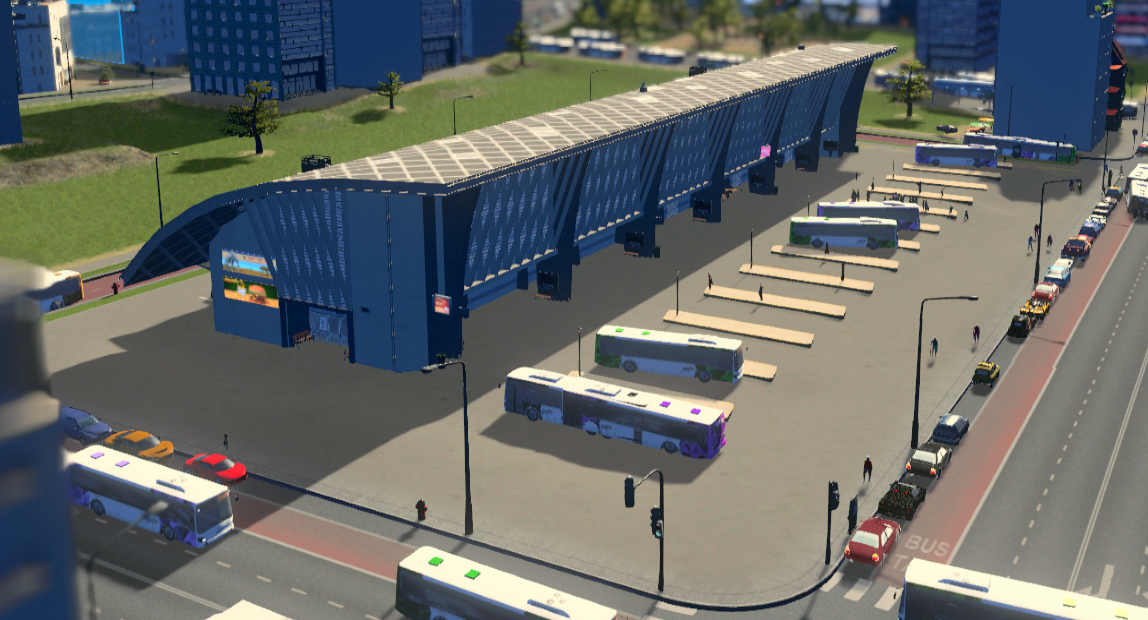
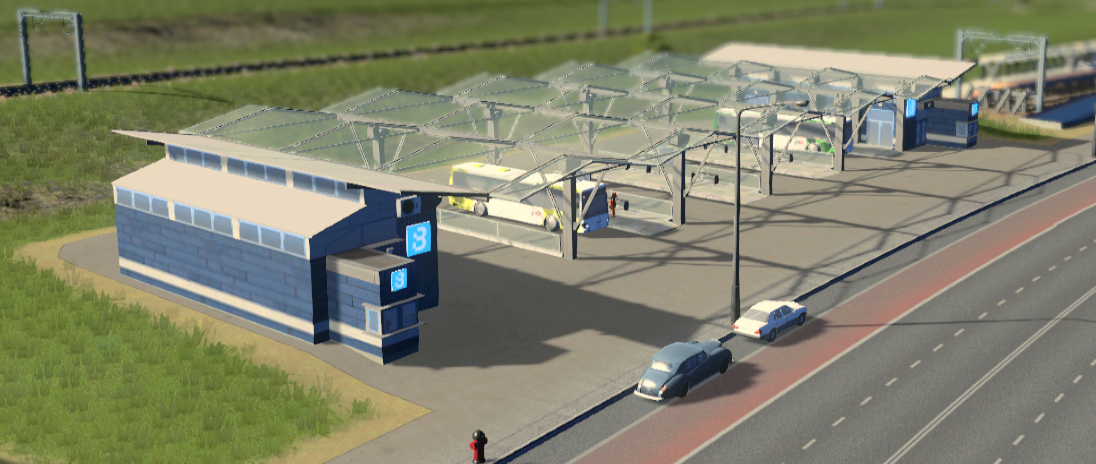
These assets are very useful where multiple bus routes terminate at one location, such as a train station or airport. They act as a hub for these routes, allowing Cims to transfer between routes or other modes of transport while minimising the amount of space taken up on the surface.
The Bus Station is available with the After Dark DLC and there are numerous small bus hubs available on the workshop. There is also a compact bus station available with the Plazas and Promenades DLC.
Light rail/monorail
Thirdly, we will look at medium-capacity land transport.
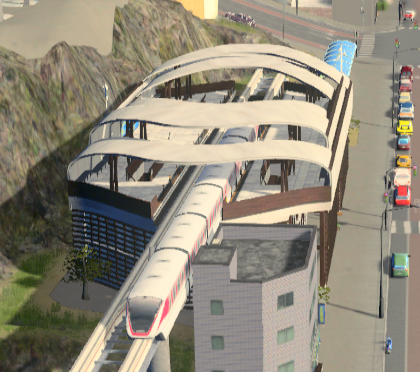
Monorails are a medium-capacity form of transport that remains segregated from the road. They run on both standalone tracks and tracks that run directly above the road. This gives them the advantage of taking even less space on the surface than a metro or passenger train system, at the expense of capacity, while also avoiding traffic on the roads. This makes them ideal for areas that require a rail connection, but do not need the capacity of a metro or regular passenger train.
Monorails are available with the Mass Transit DLC.
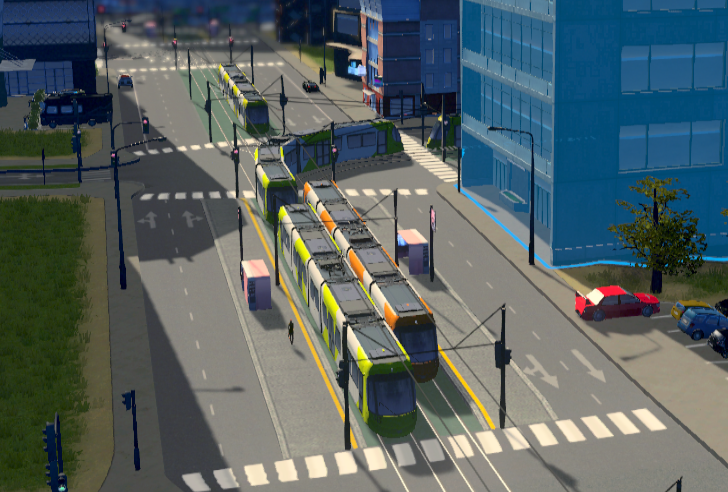
Trams run on rails that are sunken into the surface of the road. Like buses, they provide a form of last-mile connectivity, taking Cims from their home, workplace, or wherever they might be, to the nearest train/metro station or ferry pier. They do however have a significant capacity advantage over buses, making them ideal for bringing passengers to and from the train and metro stations in the densest areas of the city.
Tram tracks can be built as standalone tracks as well as on-street tracks, providing the ability to construct a light rail system at ground level (though you need the Tram Station Track mod to be able to place tram station assets).
When building the tram tracks, bear in mind that trams cannot reverse direction, even if you use double-ended trams on your routes. So make sure there is a loop track at the end of your route for them to turn around.
Tram depots
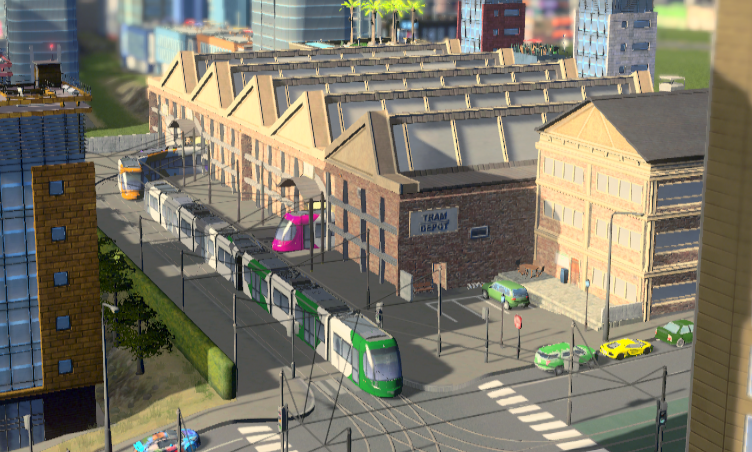
A tram depot is required before you can create tram lines. Depending on the size of your network and the location of your tram routes you may need more than one depot, as not all roads have tram tracks and trams need to be able to reach their routes from the depot.
Trams are available with the Snowfall DLC.
Air and water transport
Next, we will look at transport that doesn't use land.
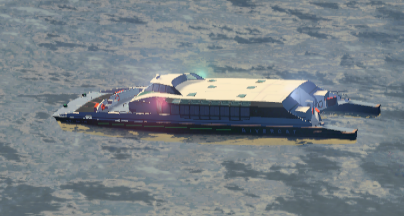
Ferries are a good way of connecting both sides of a river, bay, lake or gulf, or connecting islands to your mainland, without having to build lengthy tunnels or bridges which would be required to connect these same parts of your city using land transport. This allows them to provide shortcuts compared to other land-based routes, and to have a monopoly on some routes, particularly where islands are concerned.
Ferry depot
Before ferry routes can be created, a ferry depot is required. Like a tram or bus depot, ferries will spawn from this building and sail to their routes, so make sure the depot is connected by ferry pathway to all the routes that it will service.
Ferry pathways
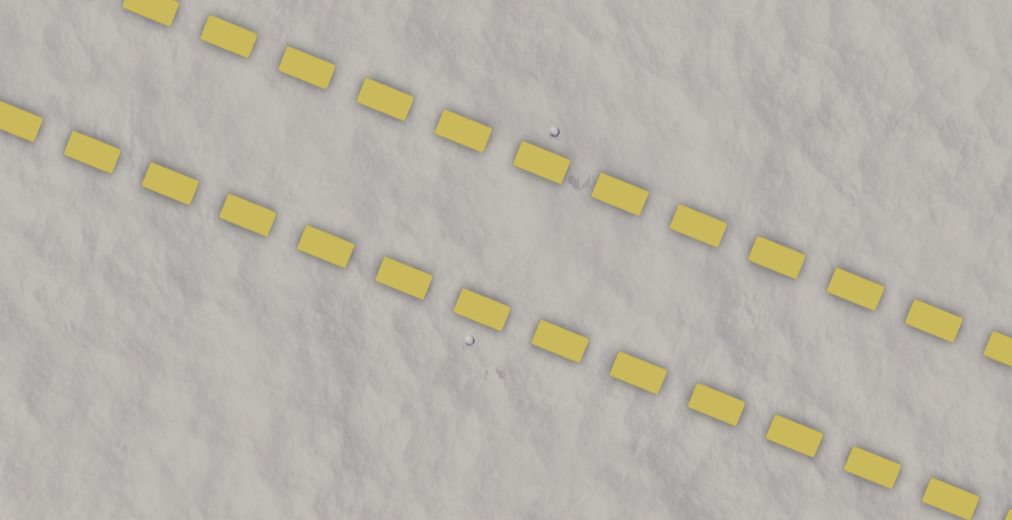
In addition to ferry depots, you also need to create ferry pathways and connect the stops and depot, similar to train tracks. Be mindful of the water depth when building your pathway and be sure to maintain said depth (or deeper) along the ferry route - if the water is too shallow your ferries will run aground.
Ferries and blimps are available with the Mass Transit DLC. Helicopters are available with the Sunset Harbor DLC.
Walkways/pedestrian paths
Finally, we will look at the usefulness of pathways.
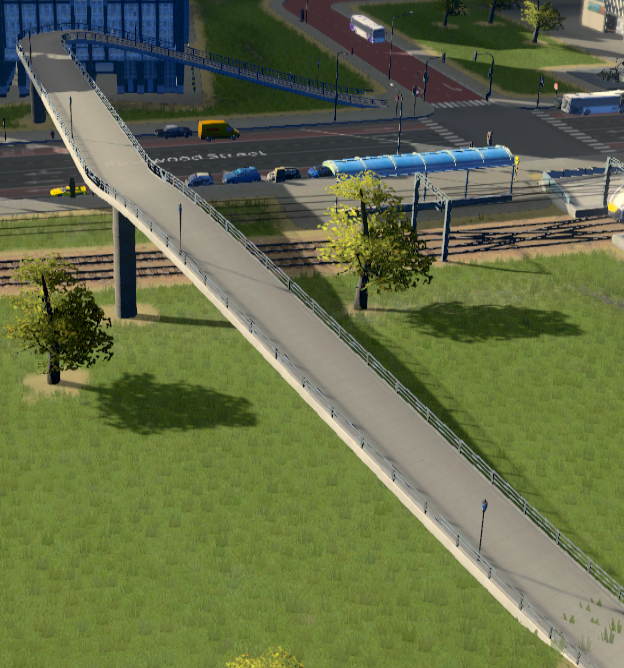
These are the unsung heroes of your mass transit system. They provide a convenient path for your Cims to reach the nearest public transport stop i.e. walking between roads to reach a bus stop, or crossing the railway to reach the station entrance. Placing them is not essential, however it makes life easier for your Cims. See the "Route planning" section for more information.
Route planning
When planning your routes there are several things that need to be considered. In this section we will look at each one.
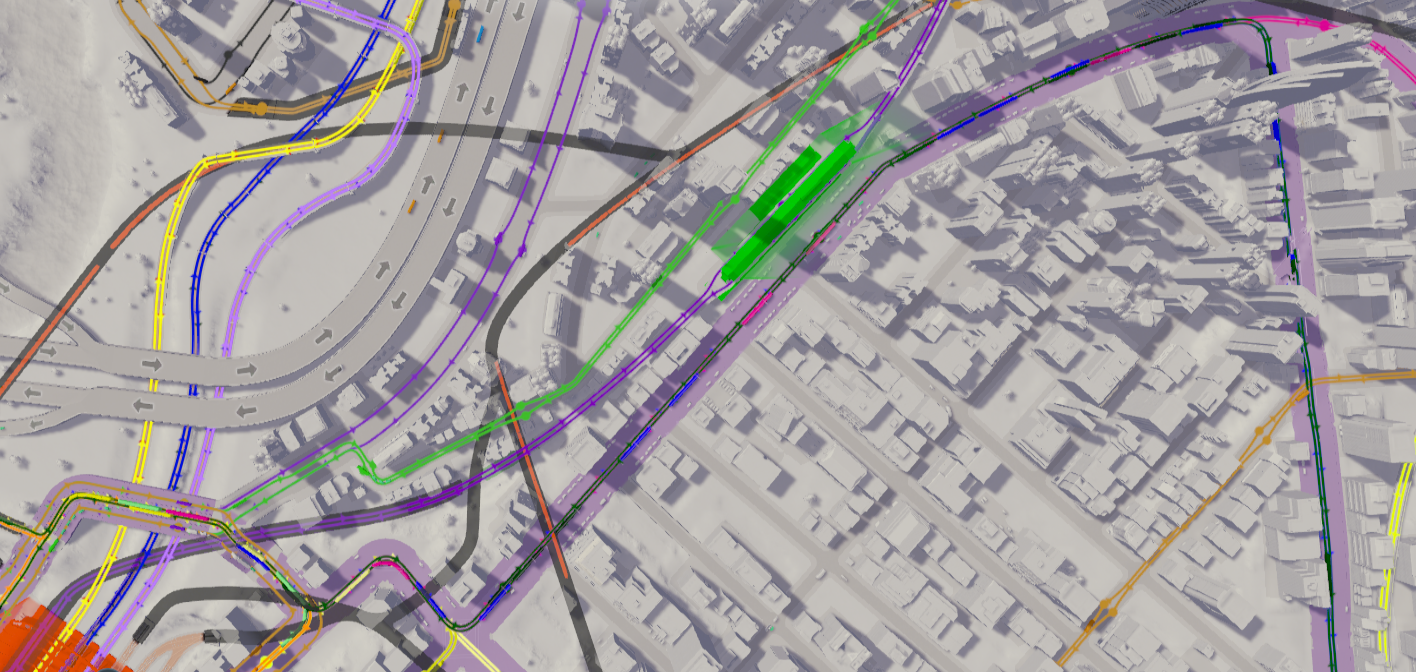
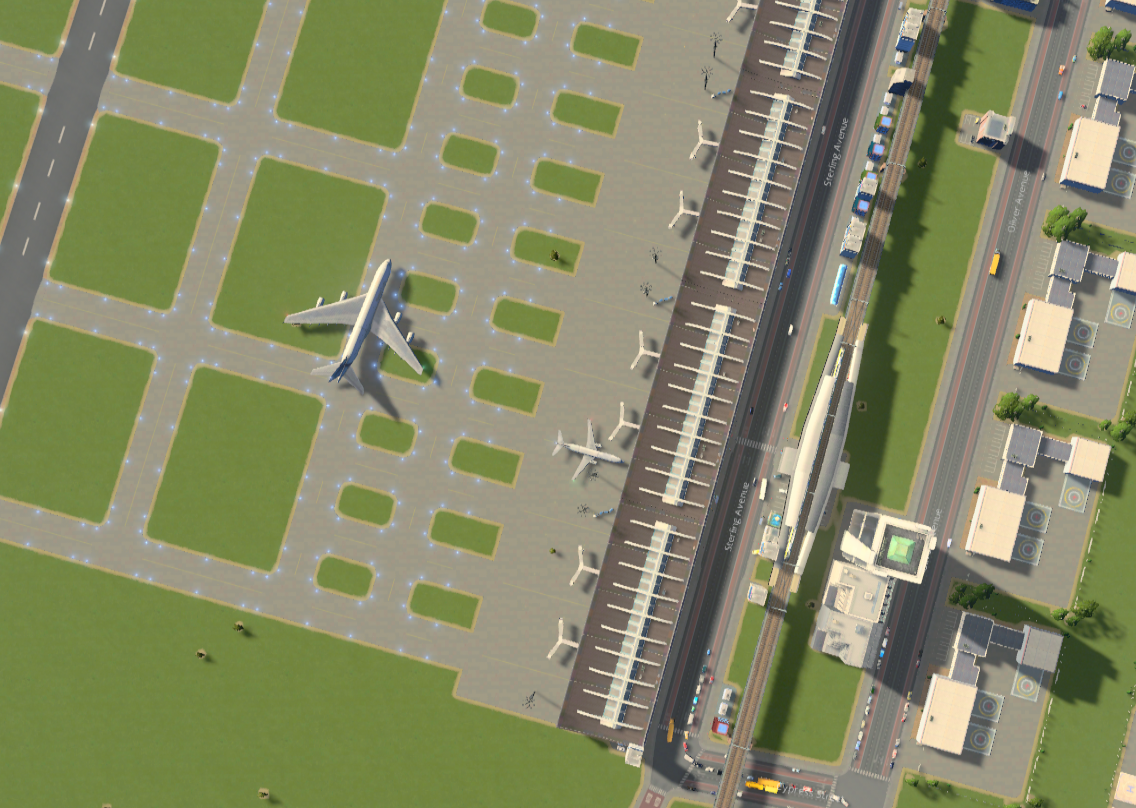
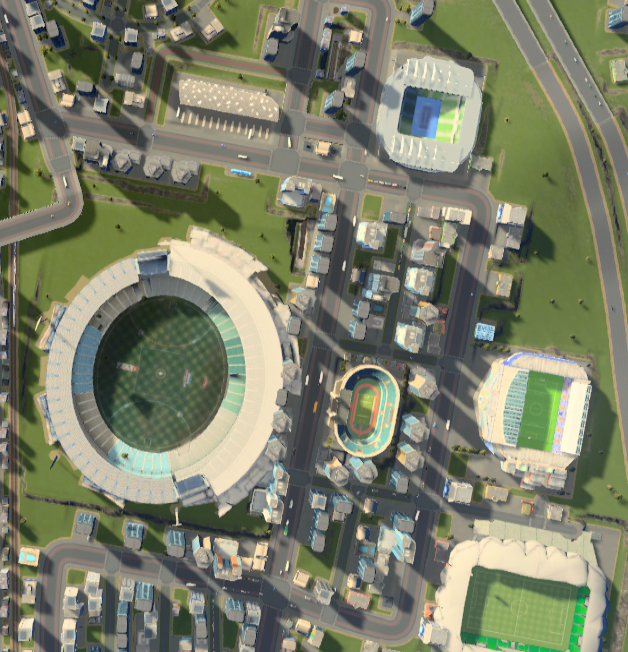
Other big traffic generators can include (but are not limited to) sports and entertainment precincts (which are likely to hold large events):
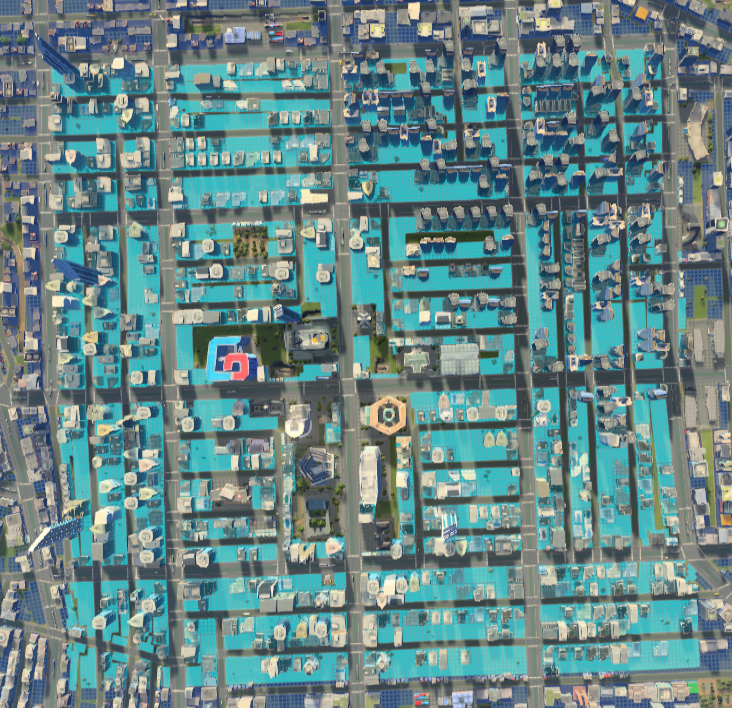
Large office zones (due to the number of workers):
Universities/colleges (due to number of students):
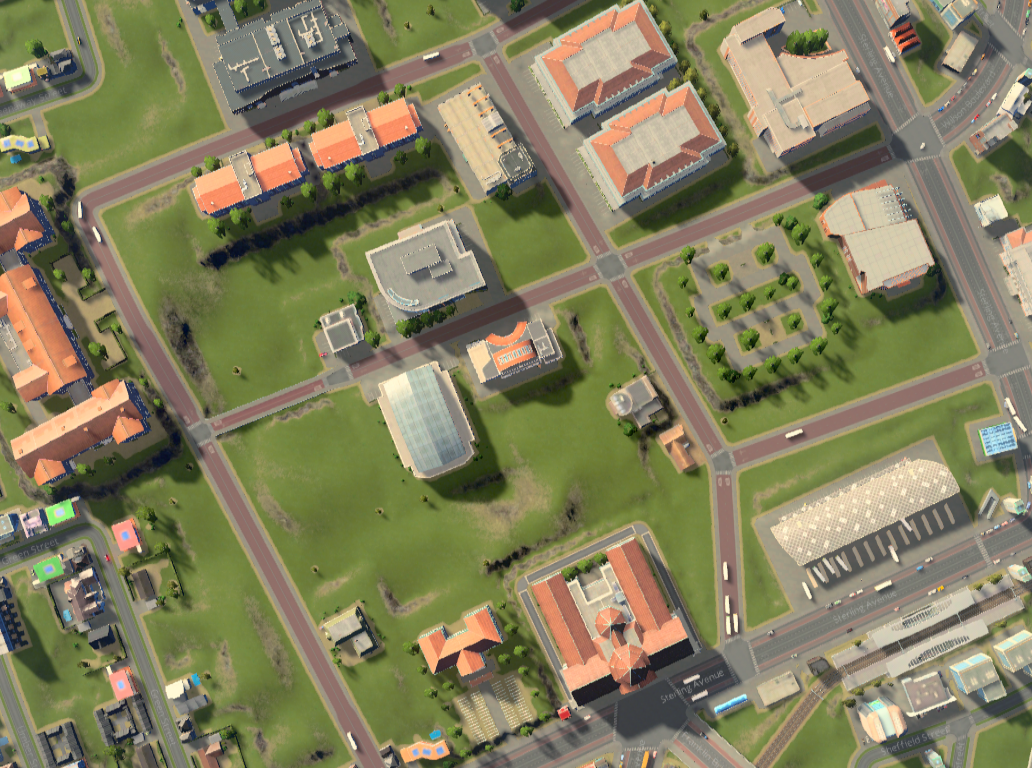
Along with parks and tourist attractions.
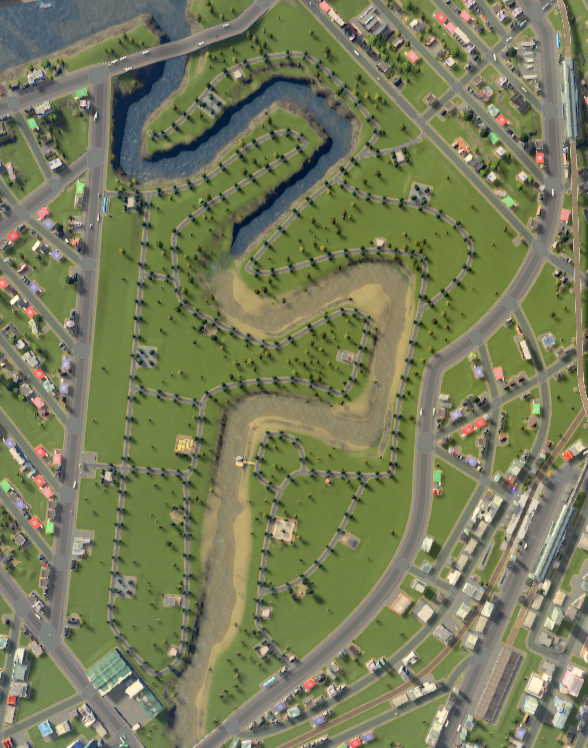
For parks and tourist attractions, the number of visitors is heavily influenced by the ability to get there, so you only need high capacity routes for those if you want a large number of visitors. For large office zones, sports and entertainment precincts and universities/colleges, the reasons stated above heavily influence the amount of traffic they generate. As such a high capacity transit mode will likely be required.
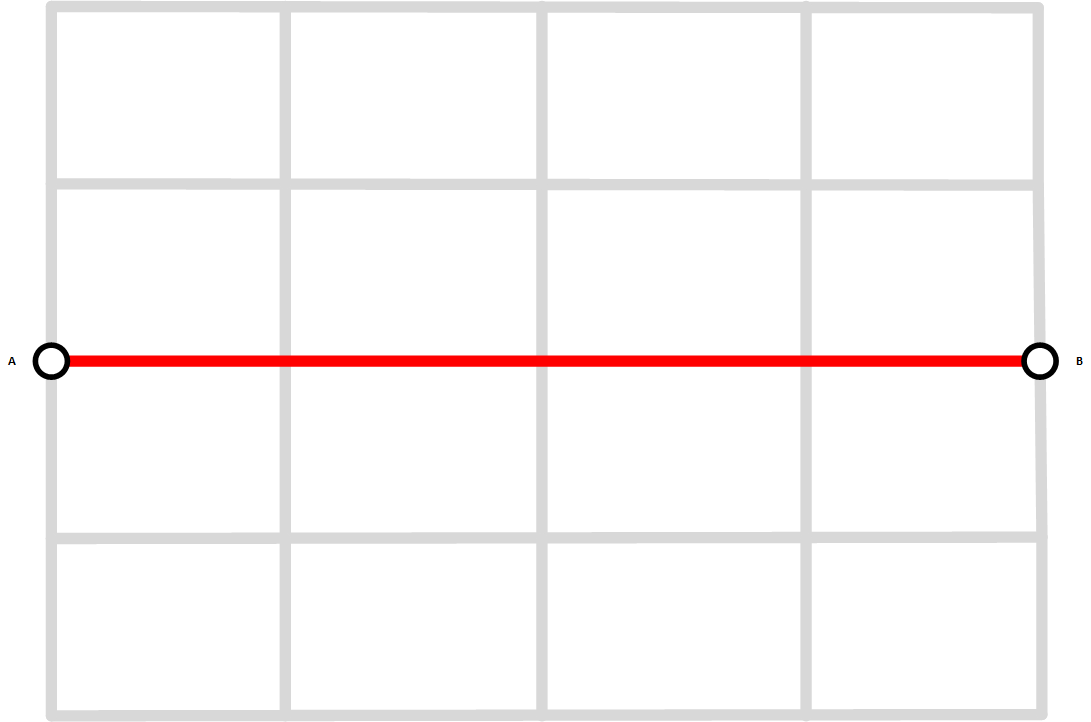
Figure 1: Direct end-to-end route.
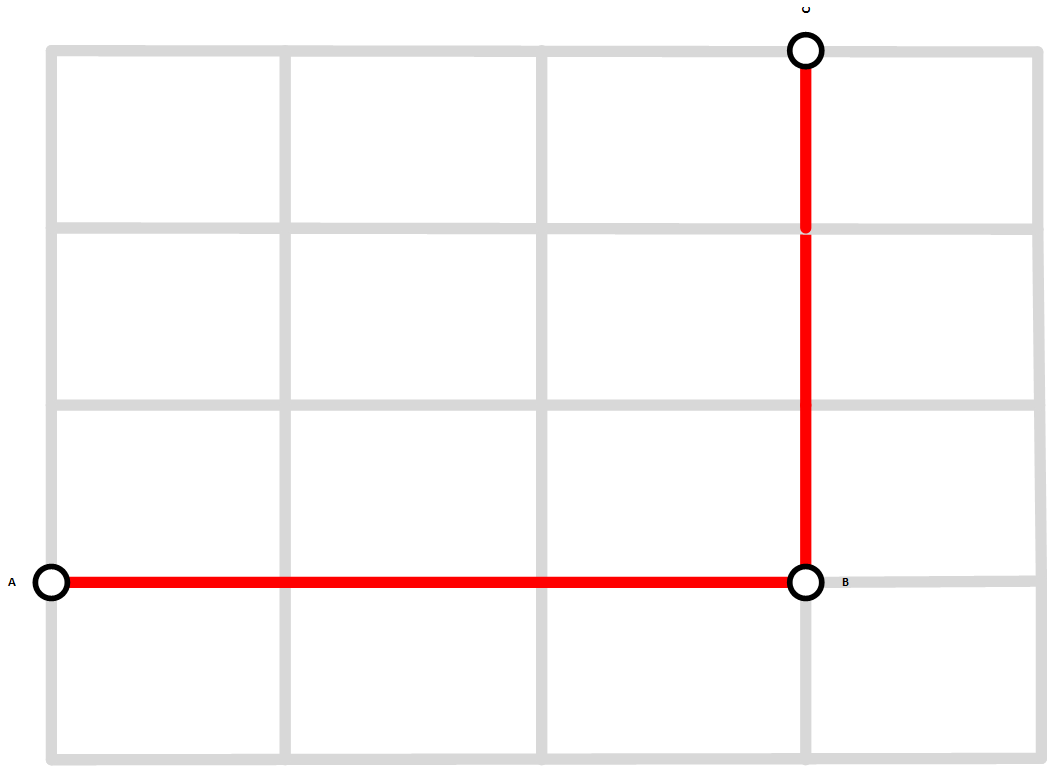
Figure 2: Direct route between major points of interest.
A direct route does not necessarily mean the shortest route from one end to the other (Figure 1). It can deviate to major points of interest (Figure 2). This provides a little flexibility while still maintaining a fast service.
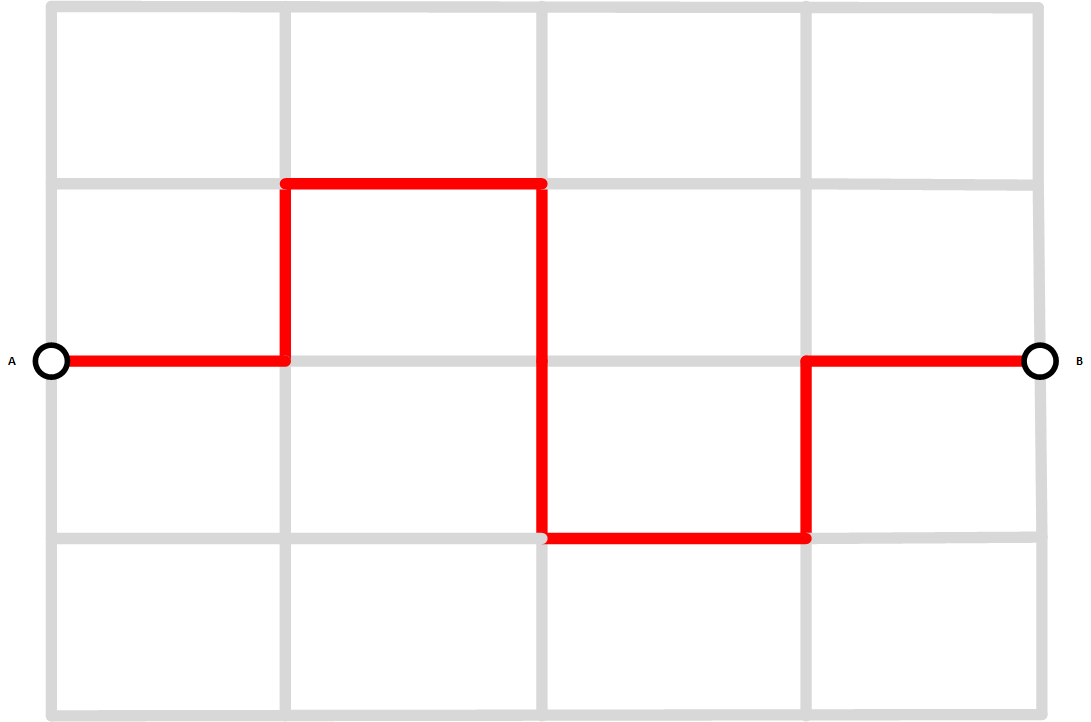
Figure 3: A meandering route providing access to local streets.
To get Cims to use your network, it not only has to be fast, but it also has to be available in a location that is convenient for your Cims to access. While Cims are willing to walk quite far, it does not mean that you should make them walk that far all the time. (In fact, it could affect your performance as it would take longer for them to get to their destination.)
This is where the last-mile connectivity that can only really be provided by trams and buses comes in. Remember that we also need to think about the directness of the network as well. Therefore the most ideal thing to do would be to aim for the best of both worlds: have some routes go direct, plying only the main roads (see above), and have others meander through side streets to provide convenient access to the network in those areas (Figure 3).
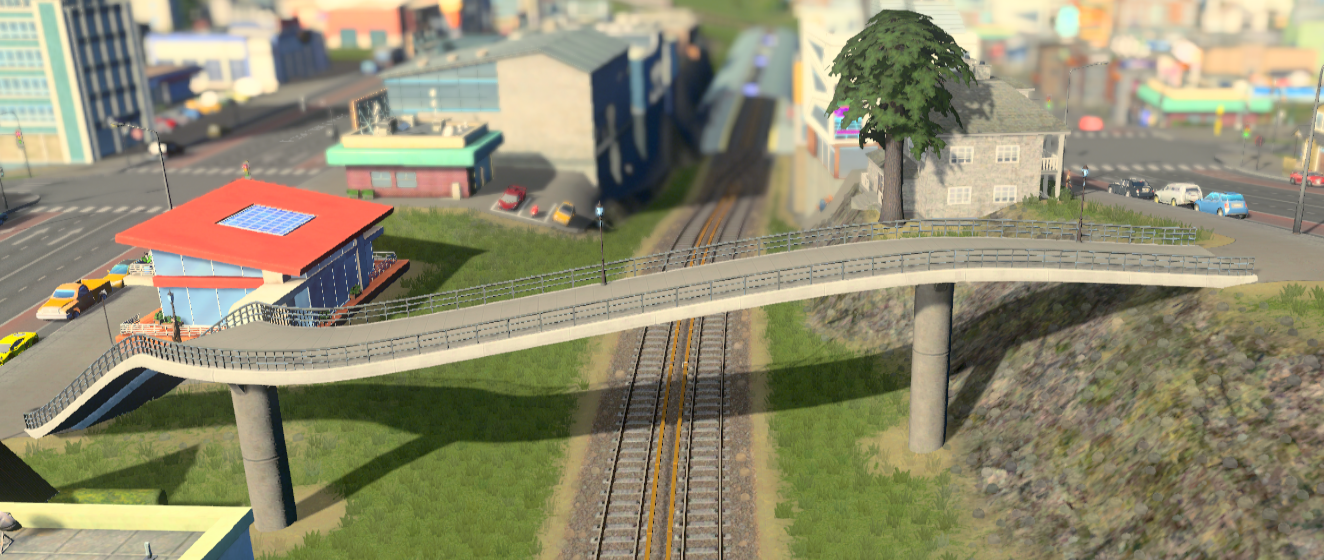
Pedestrian pathways and crossings can also help in this regard, by providing more convenient routes to a public transport stop (such as going across a rail line, cutting through a neighborhood to reach a bus stop), or simply allowing Cims to get to the other side of the road. They can be built as bridges and tunnels, much like a road, however they cannot cross roads at grade (you can use the Crossings mod to build pedestrian crossings).
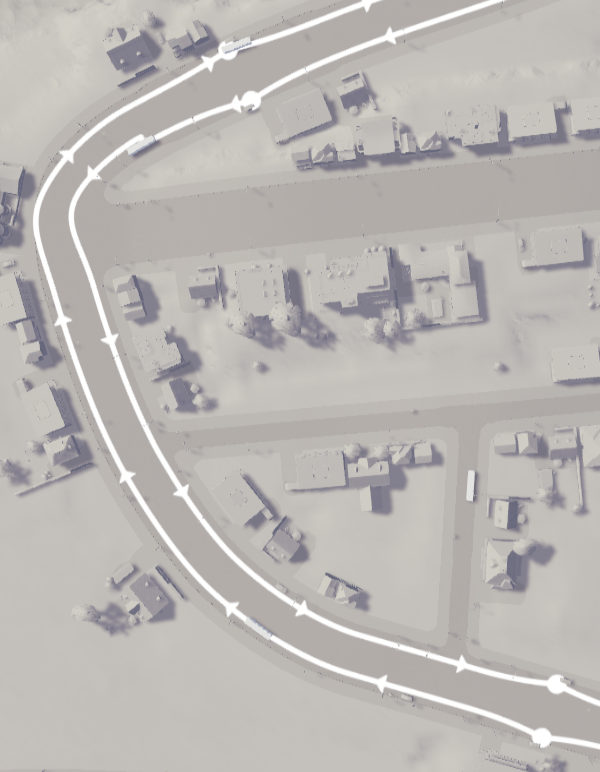
The distance between stops on each route needs to be taken into account to effectively balance speed and convenience. If stops are too close, the service slows down. If they are too far, the service is not convenient.
On trunk routes, service speed is more important than convenience due to the nature of the route. Therefore stops can be spaced very far apart, connecting only major hubs and traffic generators.
On local routes, the last-mile connectivity they provide means that distance between stops becomes more important than speed. Because of this, it is best to place stops close to each other (but not too close) such as at every intersection the route passes through.
Choosing your vehicles
Choosing the right vehicle for your route is just as important as choosing the right mode. You will want to ensure the vehicles on your route are suitable for that route.
Cims will only wait at a public transport stop for a certain amount of time before they get too impatient and drive. Therefore, you need to ensure that you have enough vehicles on each route to avoid keeping Cims waiting for too long. This can be done by using the mod's vehicle unbuncher target value. See the mod's workshop page for further information.
In addition, lower capacity vehicles can be cheaper to operate, but if you need more of them to satisfy the route demand, you could negate any savings.
If you use TM:PE, the speed limits on the road can also affect your travel time. Your vehicle might be capable of 100km/h (~60mph), but your highway is limited to 50km/h (~30mph), you are not using your vehicle to its full potential and could cut the travel time by increasing the speed limit on the highway. This is less relevant in built-up areas where stop spacing is very dense.
Traffic priority
There are two ways of providing traffic priority in your city. Let's take a look at what they are.
A small note on cargo
Cargo ships can be used in a similar way, transporting goods between cargo harbors and hubs within the city. This is great for maps with islands as it facilitates the transfer of goods between the islands and the mainland without having to use bridges and tunnels. If there are not enough ship paths in your map, use the More Network Stuff mod to create them.
Conclusion
- Make use of more than one mode, especially in large cities
- Trains and metros are best used on trunk routes, while buses and trams are best used as feeder services
- Major traffic generators such as airports and harbors should be linked directly to the rail network
- Use a combination of direct and meandering routes
- Ensure adequate stop spacing on your routes to balance the average speed and convenience of each route
- Ensure the vehicles on your route can meet the demand
- Separate your local train network from your intercity and cargo networks. Furthermore, keep your individual lines as separate as possible. Also applies to metro and monorail.
- Ferries are good for connecting islands
- Pedestrian walkways enhance the convenience of the network.
If you have any questions or tips of your own, do not hesitate to comment below.
Good luck and get building!
- The Beginner's Guide to Traffic★ 5 (5.9k)167k views13k ♥27 minUpdated Sep 26, 2015
- HOW TO TRAFFIC★ 5 (3.5k)95k views5.2k ♥33 minUpdated Mar 26, 2017
- 都市天际线模组推荐指南V5.1★ 5 (1.9k)67k views6.5k ♥29 minSimplified ChineseUpdated Dec 26, 2023
- Cities Skylines: An In-Depth Beginner's Guide & Walkthrough★ 5 (926)66k views2.8k ♥37 minUpdated Apr 9, 2015
- Traffic Planning Guide for Realistic Cities★ 5 (1.4k)59k views3.1k ♥30 minUpdated Jul 20, 2017
- Cities Skylines | A Beginner's Guide To Using Mods & Custom Content★ 5 (898)47k views2k ♥28 minUpdated May 21, 2023



- Upgrading to PremiumTeam Fortress 2★ 5 (20k)1441k views11k ♥6 minUpdated May 11, 2022
- No More Room in Hell Official ManualNo More Room in Hell★ 5 (2.8k)569k views2.1k ♥29 minUpdated Apr 22, 2019
- NMRiH Community Hosting GuidesNo More Room in Hell★ 5 (526)351k views653 ♥1 minUpdated Aug 10, 2022
- How to 'Git Gud' Soon™MORDHAU★ 5 (2k)318k views3k ♥68 minUpdated Nov 16, 2024
- Лучшие кооперативные игры SteamPAYDAY 2★ 5 (1.5k)315k views2.1k ♥56 minRussianUpdated Apr 27, 2025
- Desert Eagle Heat Treated | Blue GemCounter-Strike 2★ 5 (1.6k)293k views1.5k ♥2 minUpdated Jan 16



This guide was created by its original author on the Steam Community. Are you the author and want it removed? Request removal.