Nugget to Ace || How to be good at Ace Combat 7 Multiplayer (and singleplayer)!
Episode 01: Energy Management.

Energy management is probably the most crucial skill to have in Ace Combat. Poor management will lead to undesired stalls, being hit by missiles, crashes (into the ground), and being unable to catch enemy targets.
- Holding accelerate
- Diving
- Some weather conditions that push the plane will give you speed if you are going with the currents.
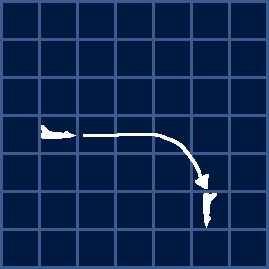
- Holding decelerate
- Adjusting the plane's heading
- Climbing
- Crashing
- Some weather conditions that push the plane will decelerate you if you are not going with the currents
- Performing High-G turns
- Performing Post-Stall maneuvers
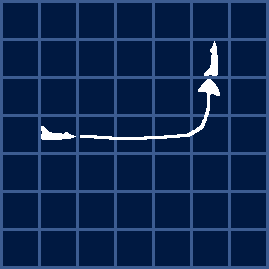
One way you could think of it is like breathing. You always want to be inhaling (accelerating) or exhaling (decelerating).
Energy is also like a currency; you spend it when you perform an attack or take evasive action. Therefore, in order to attack or evade the most effectively, you will need the most energy possible. Make sure to build and save energy whenever you are not spending it, and when you run low on energy, it may be best to switch to gaining energy instead of continuing to attack.
Unless you want to stall or perform a post-stall maneuver, you never want to run out of energy. Doing so will also make you missile, EML, gun, and everything else bait.
You should also be mindful of altitude, as altitude is, in many ways, stored energy. If you have the high ground, a dive will give you an energy advantage over someone climbing to meet you, which means you can perform more evasion and more attacks.
---
If you have any questions about this guide, are looking for someone (or a group) to play with, or want more personal training, please contact me or leave a comment!
Any constructive feedback on the guide is also welcome!
Episode 02: Missile Evasion
###INCOMPLETE!###

Knowing how to evade missiles in Ace Combat is only second in importance to Energy Management, and that is simply because good evasion requires energy management. Being unable to avoid missiles leads to death and frustration.
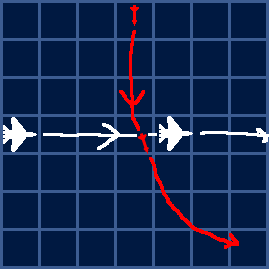
Most missiles will miss when fired perpendicularly to their target. Some will circle back around, but many will run out of fuel first. The exceptions to this are the SASM which will explode near it's target regardless of direction, and when a plane is flying slow enough the missile can compensate for the plane's continuous change in direction. When approaching a plane from behind, the plane has the least amount of movement relative to the missile, making missiles the most effective from behind:
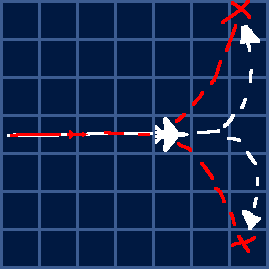
Assuming it is traveling at standard speed, the plane could bank left, right, up, or down, and the missile would start tracking it's shifted movement and have the best odds of still striking it.
When a missile approaches a plane head on, the situation is very similar; however, the distance between each is closing much faster as they are both accelerating towards each other, meaning the missile and plane must both react faster. The other major difference is that if the missile misses the plane, the distance between the two ALSO increases faster. As with before, however, missiles with a longer lifespan (QAAMs) are often still able to double back and catch the player.
It is for these reasons that when evading missiles, the player should aim to be perpendicular to the missile when possible, and when firing missiles, they should aim to be directly behind or head on to their target (The other disadvantage of head on encounters or "jousting" is that the other player may use an EML, their own missiles, or their guns to their advantage).
- Flare usage
- Environment usage
- High-energy evasion
- Low-energy evasion
- Low-to-high energy evasion
- High-to-low energy evasion
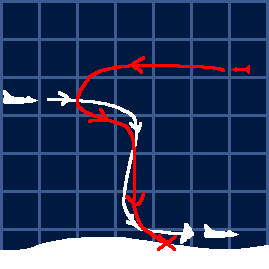
The disadvantages with this are, of course, that it limits your mobility due to risk of crashing and it leaves you no stored altitude energy.
###TO BE FINISHED###
- How to S rank all missions on ACE difficulty - ACE of ACES achievement★ 5 (717)26k views1.6k ♥23 minUpdated May 12, 2019
- Native Flightstick Configuration★ 5 (316)24k views670 ♥8 minUpdated Oct 15, 2025
- Named Aircraft/"Bird of Prey" Guide★ 5 (980)20k views1.9k ♥10 minUpdated Feb 8, 2019
- All Aircraft Skins {Detailed Unlocks}★ 5 (414)19k views873 ♥15 minUpdated Dec 13, 2022
- Quick Guide to Maximum Texture Quality★ 5 (405)19k views721 ♥2 minUpdated Jan 16, 2020
- The ultimate(ish) nugget's guide to Ace Combat 7★ 5 (290)17k views540 ♥27 minUpdated Sep 8, 2022




- Upgrading to PremiumTeam Fortress 2★ 5 (20k)1441k views11k ♥6 minUpdated May 11, 2022
- No More Room in Hell Official ManualNo More Room in Hell★ 5 (2.8k)569k views2.1k ♥29 minUpdated Apr 22, 2019
- NMRiH Community Hosting GuidesNo More Room in Hell★ 5 (526)351k views653 ♥1 minUpdated Aug 10, 2022
- ULTIMATE GUIDE FOR GAME DEV TYCOONGame Dev Tycoon★ 5 (5.8k)326k views10k ♥4 minUpdated 23 Jan, 2014
- How to 'Git Gud' Soon™MORDHAU★ 5 (2k)318k views3k ♥68 minUpdated Nov 16, 2024
- Лучшие кооперативные игры SteamPAYDAY 2★ 5 (1.5k)315k views2.1k ♥56 minRussianUpdated Apr 27, 2025




This guide was created by its original author on the Steam Community. Are you the author and want it removed? Request removal.