On Sea Mines: A Guide to Proper Mine Usage
On Sea Mines: Overview
It is common for many divers to believe mines are the ultimate shark-stopping force of any game, but let me give you a little hint:
Mines are not always ideal.
There, I said it, *gasp*! Now let me tell you why and give some advice as to how to get the most out of your mines, and when you should just stop wasting your money.
Mines are most effective in small enclosed spaces in which sharks have little room to navigate around them. The less space a shark has to go around a mine, the better. Mines are also more effective in darker maps, and less effective in lighter ones. Mines are incredibly ineffective out in the open. Even if you place mines well, if you are not getting any positive effects from using them, stop doing so. Put your money towards better weaponry. Some sharks are just too good at getting rid of mines or avoiding them to spend $600 every time you die to stock up. Want to spend $600 on consumables? Buy a supply kit.
First, some stats and info:
- Mines cost $200
- Each diver can carry 3 mines
- Mines cause a maximum of 500 damage
- Mines can damage and even kill divers
- Mines disable and damage S.T.E.V.E.
- It takes approximately one second after activation for a mine to explode
- Mines explode when shot with any projectile
- Mines explode instantly when made contact with, either by projectile or by shark
- Sharks can set off mines without taking any damage
- Mines blind divers to an area with dust and an outward rush of bubbles
- Mines deafen nearby divers for several seconds
- Mines make noise when placed
- The further a shark or diver is from a mine, the less damage they will take
- Mines can destroy obstacles and walls
- Sharks can get an evolution to highlight mines, but they don't need it to see them
- When affected by an explosion, a shark's camera tilts away, but it does not alter their movements. This can disorient all but the most skilled of sharks.
- Maximum damage is only caused when a shark makes physical contact with a mine
- The brighter and flashier the mine's skin, the easier it is to see
When to Place Your Mines
What Sharks Should I Use Mines Against?
How Many Mines Should I Place?
The Mako and Thresher
Now, even smaller sharks can have trouble clearing away mines in some areas, and if you are getting the kills and not hurting your team… well, good for you, keep it up.
Mines and Your Team
Mines damage EVERYTHING within their radius. Theoretically, it would be possible to kill your entire team with a single mine. I've never seen THAT happen, but I've seen some get pretty close to it.
Detonation Radius and Blast Zone
A skilled shark, shoot, even a mediocre shark can, in a single lunge, enter the detonation zone, set off the mine, and exit the blast area before it blows to avoid all damage. A poorly placed mine will cause more damage to you and your team than the fish in that case. Remember, a mine takes about a second to go off.
Mine Placement
Now that we know all about sea mines, let's finally get to the cause of this guide: placement. Placement is all-important when it comes to stopping predatory fishes, so let's get to the do's and don't's of dropping your bombs! In this section I will have diagrams and pictures of mines in actual levels, as well as theoretical diagrams to help one better understand those testy balls of death!
Honestly, the best possible place to put your mines are in poorly lit hallways. A shark, a diver, even S.T.E.V.E.'s robotic self are put at high risk being in hallways. Hallways are cramped, leaving less maneuvering room for divers, less space to traverse for sharks, and S.T.E.V.E., going right down the center of it, will surely be hit with every lunge. A mine placed near the end of a hall divers are traveling will stop entering sharks and finish off escaping ones. Small halls ensure that a shark MUST pass a mine by, making your chances of an explosive kill much higher than normal. Let's look at examples of mines placed in a hall.
In some maps such as Olmec, Cove, and Devil's Head there are the most lovely corridors in which to place mines, but dang can they be tall! So let's discover what height exactly to put them at. Too low and sharks can lunge over them to safely detonate, too high and the reverse is true. Some halls are tall enough that mines detonation range doesn't even cover them all. A good rule of thumb is this: Assume sharks and divers alike will be traversing close to a tunnel's floor. Vertical thinking can be difficult even for skilled players. Treasure also lies on the floor. Therefore, in those tall tunnels, place some of your mines low, but not all. A sneaky shark may keep high, and an escaping shark lunges in all directions. Or a horribly confused shark.
Either way, be sure to study those fish! You'll want to watch your enemy, pick up on their playing style, and place your mines to accommodate them. Remember, you want to place your mines based on where your enemy WILL be when either entering or escaping.
In shorter (height-wise) hallways, try to place your mines in their center, allowing minimal space to go over or under. Remember, in hallways that tilt to the side, you want to place the mine so the weight (its base) rests more towards the side the hall tilts to in order to center it.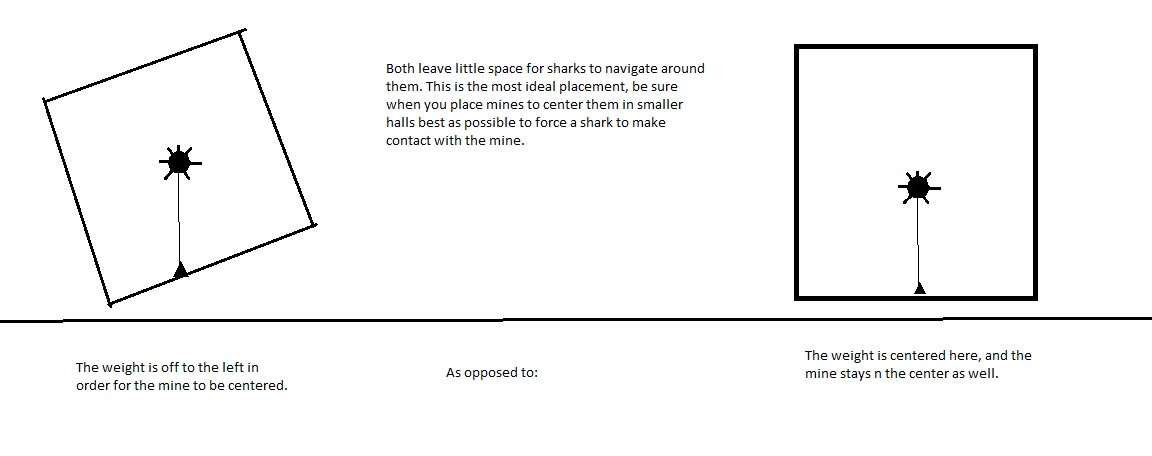
In short (height-wise) enough hallways, mines should be centered between the ceiling and floor. They should also be centered lengthwise down the corridor, and not be in doorways. Mines in doorways are more easily spotted and detonated by sharks.
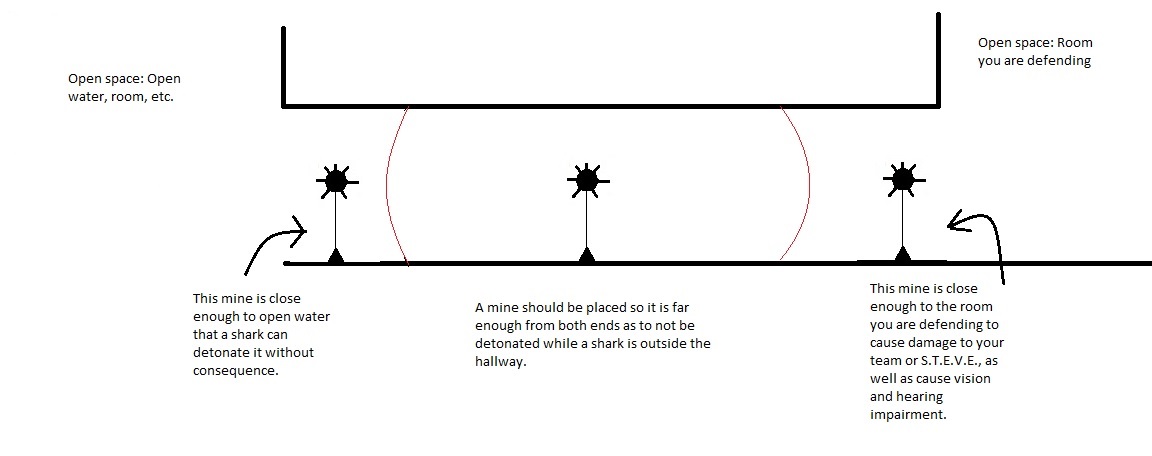
As you can see here, the mine on the left allows a shark to pass its detonation field unscathed. The mine on the right can fill a room with dust and bubbles, making is hard to see to finish a shark that may have survived the mine, or if the mine actually killed it, it may be hard to see a following shark.
Theoretically, the mine in the center is most ideal. It is harder for sharks to spot, cannot be detonated from outside the hall, and will not fill a room with dust. It will however, spray bubbles down the length of the corridor and into the room, but they are not as blinding as dust. It is also less likely to deafen divers to shark movement because it is farther from where they are congregating. Remember that sound localization is important for diver survival. You do yourself no favors by being near explosions, and do your team no credit by deafening them with a carelessly placed mine.
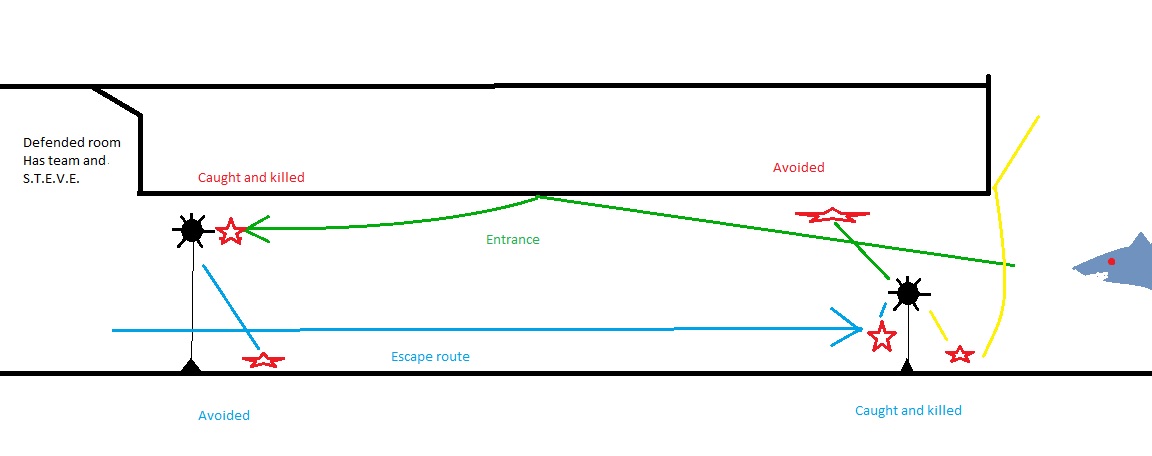
This is overkill, both mines are detonated but only one damages the shark. A hit is gaurunteed, a kill, almost surely.
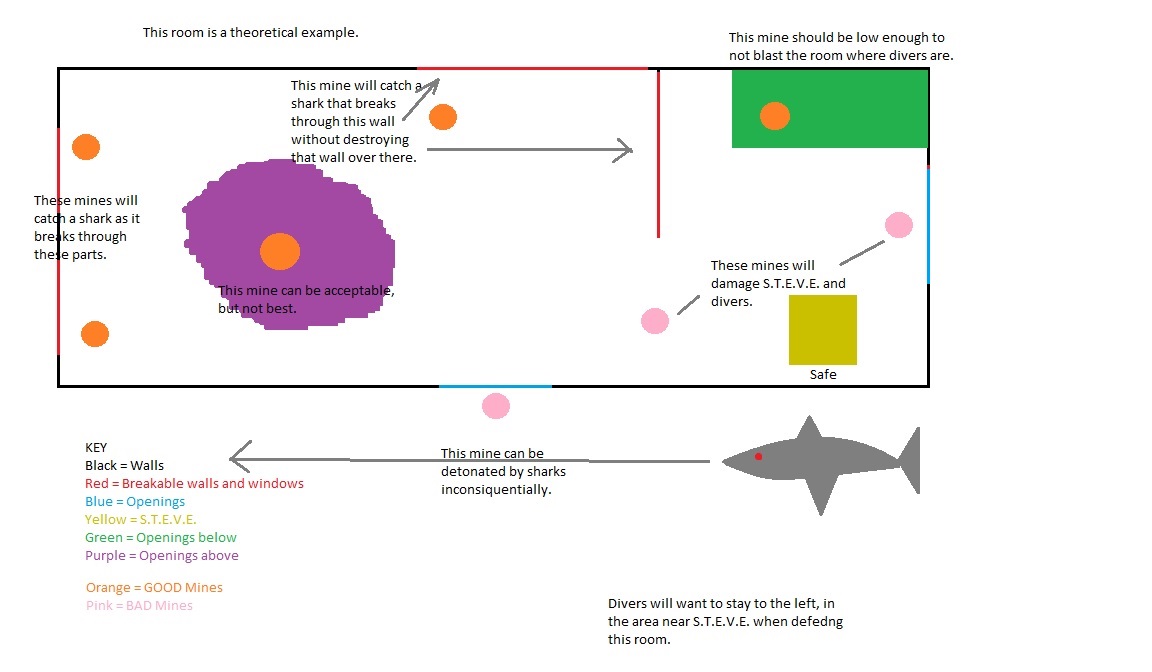
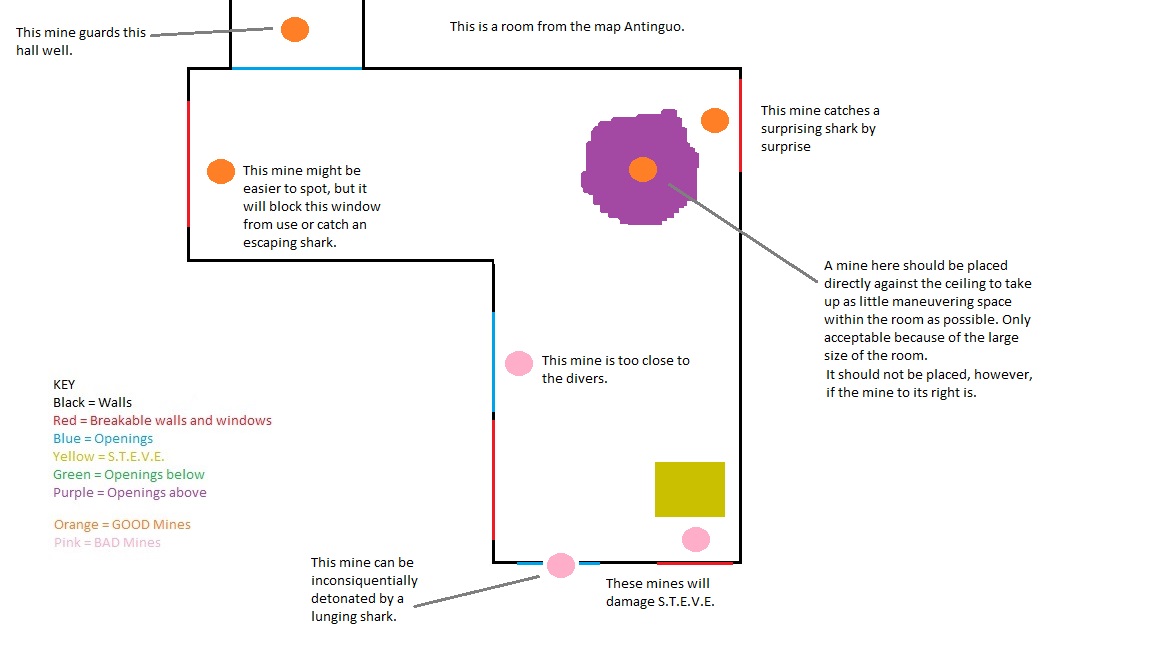
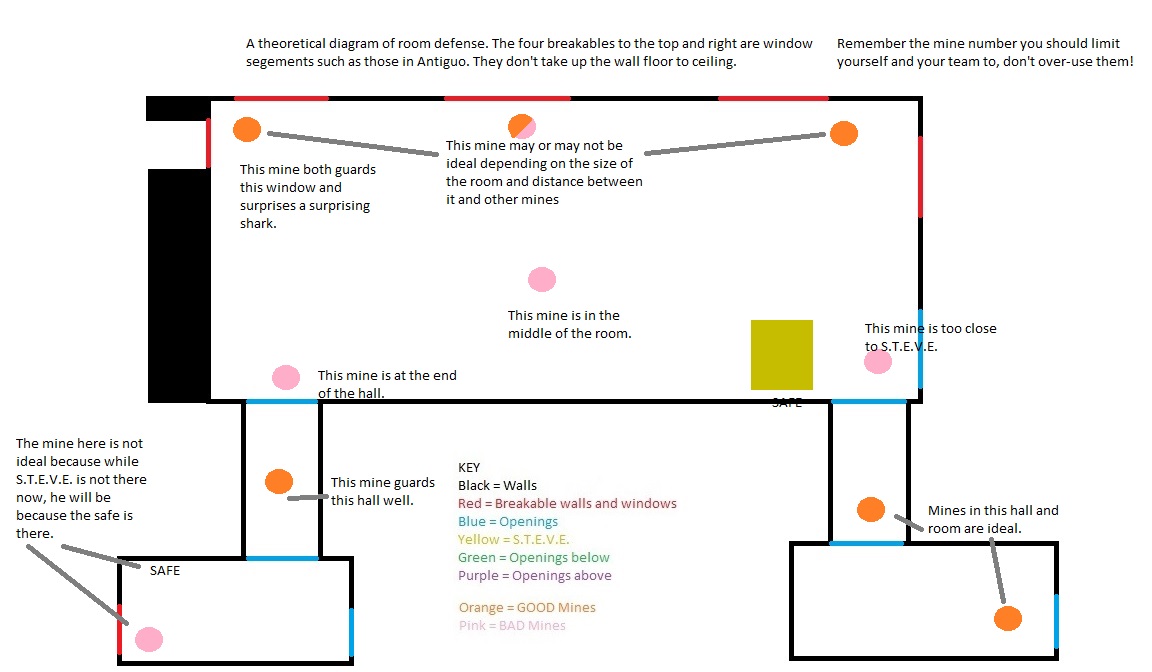
Sometimes, there are too many entrances into a room for divers to keep an eye on them all. This is where mines come in to room defense, as they are powerful defensive tools. The bigger the room, the more mines you can place in it. Never should you place a mine near S.T.E.V.E., you also shouldn't place mines near where your teammates are. When placing mines in a room, keep in mind where a shark will likely be entering, which walls a shark can break, where your teammates will be maneuvering to dodge sharks, and where S.T.E.V.E. is located and where he will be going.
Here are a few (I may add more) diagrams to study which can help you determine where it is best to place mines.
Notes on Specific Maps
Here are a few notes I've taken about each map when it comes to mines. I'll leave determining mine effectiveness to you, dear reader, because every map and shark type is different, and no two players are alike. Some players are easily taken in by mines on even the brightest and most spacious of maps, while others laugh as they detonate mines without consequence in dark cramped spaces and kill people with them.
With spacious rooms, moderate light, and smaller corridors, Antiguo is a mine fun-house. Ineffective outside, mines come into play mostly when moving room to room, and as sharks go to follow, they are surprised with mines not easily spotted. Difficult to see and even more difficult to successfully get around in the halls, divers can make use of them atypically as compared to other maps. Normally, stationary defensive measures, mines come into play more when traveling than they do normally with room defense.
A well lit map, mines can be less-than-ideal outside, but inside with longer corridors and entrances a sufficient distance from S.T.E.V.E., mines can be placed to large effect. Inside the caverns it is dark enough to allow efficient use of mines. In the safe inside the fallen aircraft, however, mines are ineffective due to the open nature of the space and the destructibility of your cover from sharks.

The absolute darkness of cove's cave systems are very ideal for mines.
With Crude's lack of light and oily waters, mines become difficult for even experienced shark eyes to spot, but due to Crude's vast open waters, readily available seals, and cramped rooms, mines may not be the best choice here. There are few places in which mines can be placed to be highly effective in trapping sharks without causing damage to divers or S.T.E.V.E. in most of the rooms. However, in the darkness, mines could even be placed somewhat outside and still be difficult to spot. Just remember that it only takes a shark dying once to a mine for both of them to be wary of future explosive ordinance.
Cramped, difficult to navigate, and nearly lightless, Devil's Head's many tunnels make for very ideal mine usage. Thanks to its darkness, flares come into play very often, and mines do not destroy flares upon detonation, unlike buoys and shark shields. Mines shouldn't be placed within rooms where divers buoys and S.T.E.V.E. are, but rather be in the halls. Behind doors where sharks will be needing to break through or at intersections leading into safe rooms are where mines should be placed. They kill often and hit more. Especially effective against tigers and hammerheads, which are themselves effective in the map, mines can thin out the fish well and buy you time to gather much needed and scattered treasure.

Mines cover floor to ceiling when placed just right. They should be placed at intersections into defended rooms and other tunnels where sharks will be navigating.
As dark as fractured is, it can be difficult to place mines just perfectly, as rooms are big and full of corners, and tunnels are spacious enough to allow a swift shark to pass mines unharmed. I'd advise first finding out what sharks you're up against before considering mines. Mines do however, blend well with the solid metal background, and mines are often felt before they are seen when placed up against breakable doors.
Brightly lit and wide open, mines have proven to be ineffective here time and time again, causing more damage to S.T.E.V.E. and divers than they do to sharks. Mines are easily spotted in the furiously shining map, and a minesweeper evolution is never needed when it comes to experienced sharks, even with teams that spam mines like crazy. Cramped rooms and far too many openings negate the usefulness of mines, and chain reactions are a common occurrence.
With wide open rooms and destructible entrances, sharks can be taken by surprise with mines initially in this map. However, once an entrance is open, it becomes easier for sharks to spot mines. More ideal in some spaces than others, some rooms are smaller than others, allowing less mines to be placed. With Hillside's dark nature and green-tinted waters, mines are harder for sharks to spot, especially in the flurry of an escape. Mines blend in exceptionally well with the dark stone background.
Notes on Specific Maps Cont.
Lots of wide open waters between rooms, treasure in droves, many breakable entrances into rooms, and corridors every which way, mine effectiveness in Olmec can vary based on shark skill. Some places are much more ideal for mine placement then others. Inside the ancient ruins, no light reaches many hallways and flares become important in the darkness. Mines do as well, as they can readily defend entrances or catch a sly escaping shark in some places. In others, rooms are either too cramped or too open for mines to be wholly ideal.
With cramped tunnels and absolutely no light, a well placed mine is often felt before it is seen. Mines are better placed in the tunnels than in the rooms where divers will want to be maneuvering. With seals outside and far away, even non-fatal partial damage from a mine can devastate a shark. Mines are useful against every single type of shark in this map, as they are difficult to avoid. Even with the minesweeper perk, sharks will still find themselves victims of explosive ordinance.

Even when spotted, mines can be difficult for a shark to get around due to Quarry's tight spaces and uneven walls.
This map has varying degrees of light. Outside, and the first safe area is bright enough that any mines are easily spotted and is open enough that they can be detonated with little or no consequence. The second safe area is darker, meaning mines are harder to spot. They should be placed in doorways away from the safe and S.T.E.V.E. as well as your team. The third safe area is another matter. Pitch black darkness disguises mines perfectly. They become very hard for sharks to see, and can be placed low-down because a defending team should be spread out and higher up. Placing mines in the stairwell can kill escaping sharks and prevent them from entering, as the stairwell is not easy to lunge through. Plant growth also disguises mines. In the fourth safe areas, mines can be placed in both hallways to prevent sharks from using them to their advantage, just be sure to not cause a chain reaction!
With cramped rooms and lots of open space between them, mines are not particularly ideal in this map. Especially so when considering the water is bright enough to allow keen eyes to spot them easily. Lots of walls and cover can be destroyed by mines. Cramped rooms means all available space should be left to allow evasive maneuvering. Mines eat up what little space is available to you and your team.
Wide open with absolutely no difficulty for sharks to navigate, mines are less-than-ideal in this map. Moderate light and no tunnels or passages required to move through makes mines somewhat useless in this map. Sharks will have no trouble going right around them, no matter the species. This map is almost without definable rooms too, and what rooms there are have far too many possible entrances for mines to be of use. Detonated mines are highly likely to damage you or your teammates as well.

In the wide open space that is Temple, even a massive amount of mines can prove ineffective.
Final Notes
Well, here we are at the end of the guide, dear reader, I hope you have learned much. I welcome comments and possible additions. I'm working on acquiring software that will allow me to record gameplay to give you live examples in videos of mine placement and counter-mine measures taken by sharks. Remember, the skill ceiling for Depth is incredibly high, and players should always seek to keep learning and improve upon themselves. This guide is in no way the definitive authority on mines or shark capabilities, it is based on personal experience. Every map and shark species differs, as does every diver and shark.
Just know, always rely on your own guns more than mines or your teammate's ability to shoot. (Unless you happen to know your teammate.) If you liked this guide or found it helpful, rate it up! It will ensure more people wil see it. Good fortune to you, and happy fishing!
Thanks to Sinopia for assistance with images!
If you're new to Depth, or are having trouble figuring it out, or maybe even just want to see if you can learn something new, here's a guide for divers to learn the basics, and a few advanced ideas.
http://steamcommunity.com/sharedfiles/filedetails/?id=1299202202&tscn=1518447941
- How to Shark 1.14★ 5 (1k)22k views1.4k ♥119 minUpdated Apr 17, 2023
- Depth - Ultimate Skin Guide [Operation Seafog]★ 5 (432)12k views355 ♥6 minUpdated Oct 19, 2021
- How to Dive 1.06★ 5 (491)12k views658 ♥83 minUpdated Mar 9, 2023
- The Ultimate Depth Shark Guide (updated 10/17/15)★ 5 (220)11k views224 ♥24 minUpdated Oct 23, 2015
- Достижения Depth 100%★ 5 (394)8.6k views226 ♥7 minRussianUpdated Jun 8, 2025
- Achievement guide★ 4 (175)7.4k views151 ♥14 minUpdated Jun 1, 2017




- Upgrading to PremiumTeam Fortress 2★ 5 (20k)1441k views11k ♥6 minUpdated May 11, 2022
- No More Room in Hell Official ManualNo More Room in Hell★ 5 (2.8k)569k views2.1k ♥29 minUpdated Apr 22, 2019
- NMRiH Community Hosting GuidesNo More Room in Hell★ 5 (526)351k views653 ♥1 minUpdated Aug 10, 2022
- ULTIMATE GUIDE FOR GAME DEV TYCOONGame Dev Tycoon★ 5 (5.8k)326k views10k ♥4 minUpdated 23 Jan, 2014
- How to 'Git Gud' Soon™MORDHAU★ 5 (2k)318k views3k ♥68 minUpdated Nov 16, 2024
- Лучшие кооперативные игры SteamPAYDAY 2★ 5 (1.5k)315k views2.1k ♥56 minRussianUpdated Apr 27, 2025




This guide was created by its original author on the Steam Community. Are you the author and want it removed? Request removal.