✅ Phasmophobia Ghost Secert Abilities (No-Evidence)
1. Spirit
2. Wraith
3. Phantom
If a successful photo is taken of a Phantom, the ghost will be invisible in the photo, and the photo will not contain any interference.
Furthermore, if the photo is taken during a ghost event,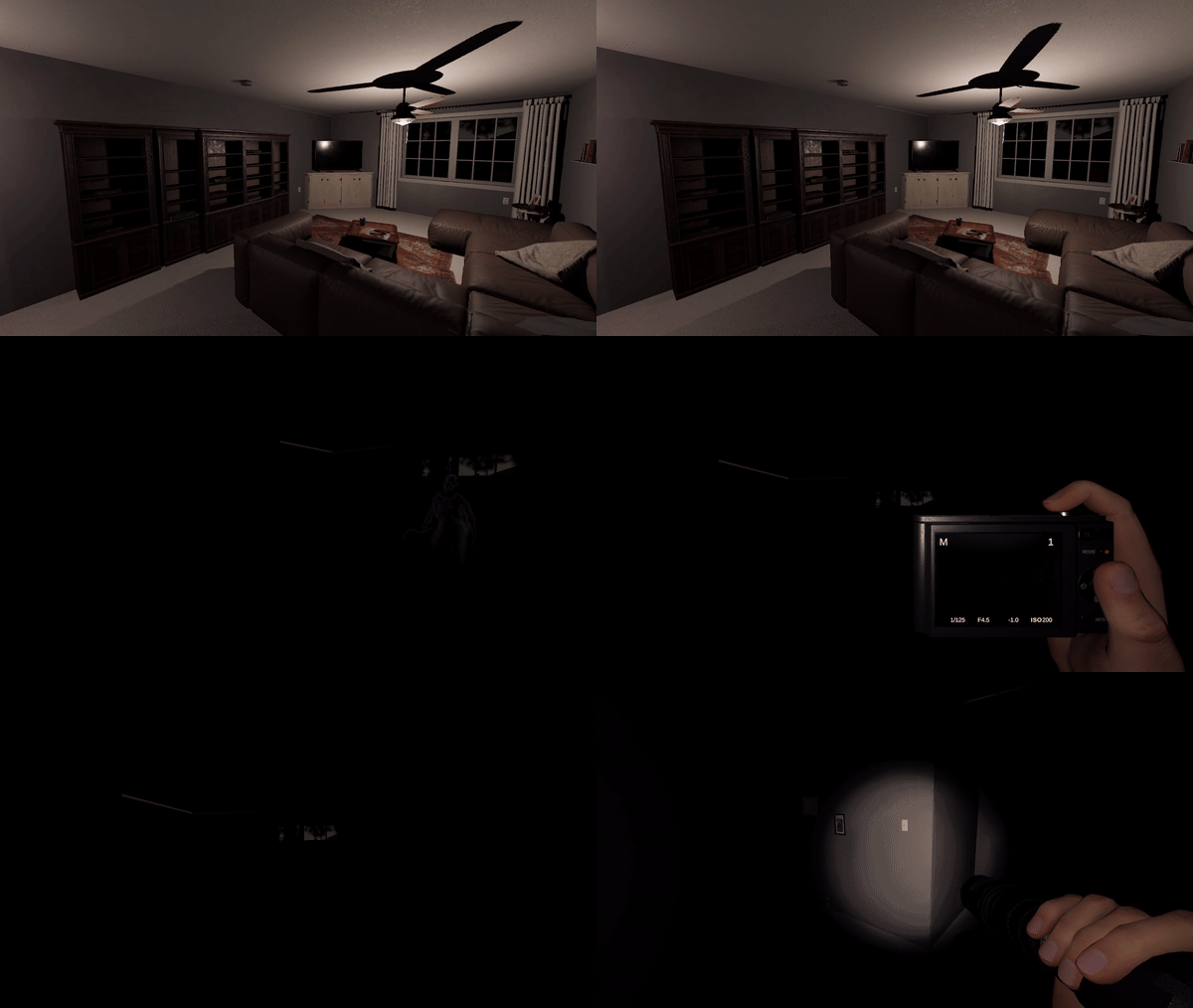
- The ghost will physically disappear
- Electronic equipment will cease to
malfunction - Players will no longer hear their heartbeats
- The event sound will continue to play for the duration of the event
If the photo is taken while the Phantom is in a D.O.T.S state, it will also physically disappear. Hunt will not be affected in any way though.
unlike Wraiths, the Phantom physically walks to that point rather than teleporting, and will set off Motion Sensors and disturb Salt on the way to it.
During a hunt, the Phantom flickers and is on average visible for shorter and invisible for longer compared to most other ghosts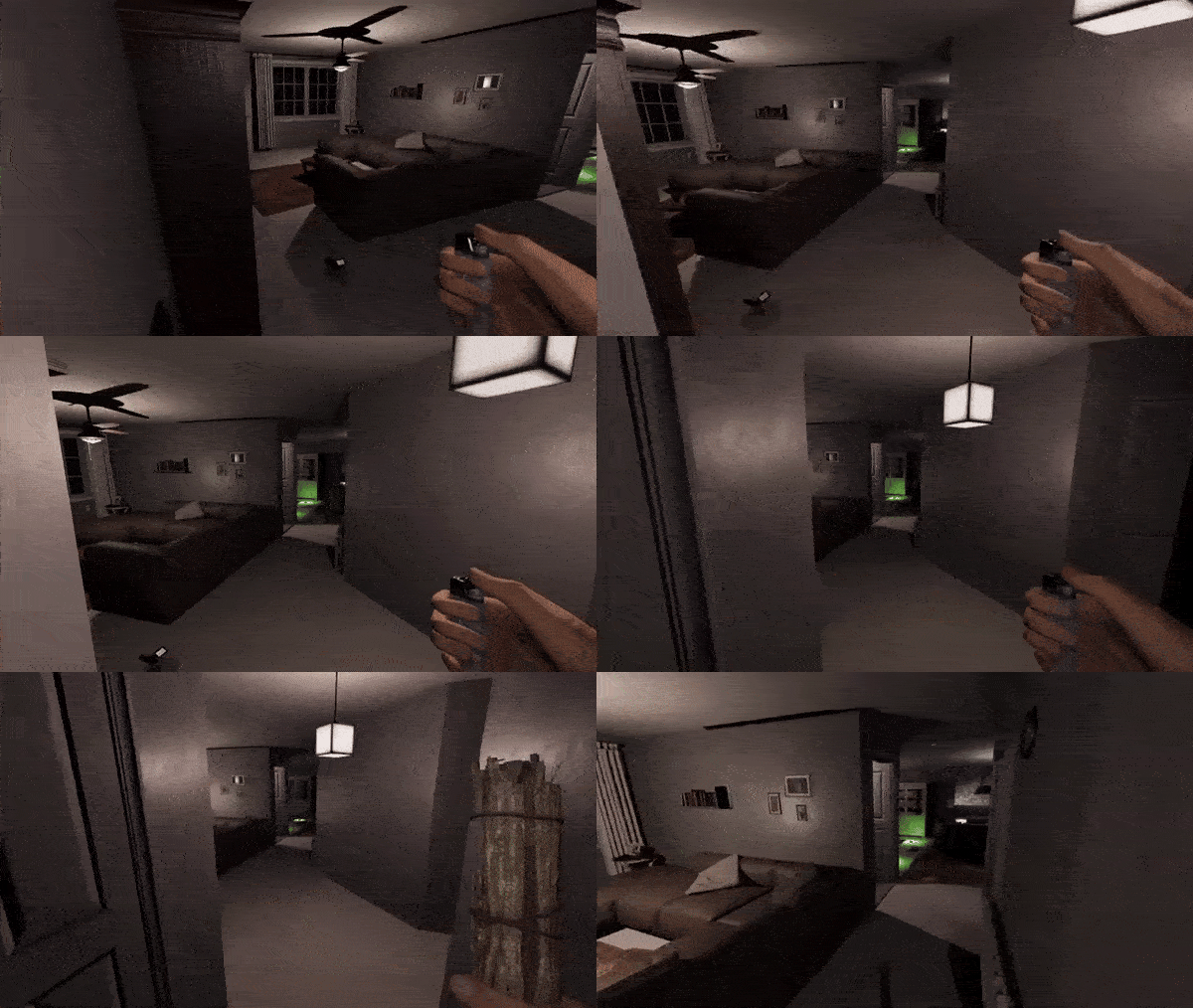
4. Poltergeist
5. Banshee
Banshees are noted for the distinctive screech that they produce on the Parabolic Microphone, as well as their targeting of only one specific player during hunts.
The Banshee cannot change favorite rooms by itself in any difficulty.
6. Jinn
Jinn speed will be fixed at 2.5 m/s(Fast) if it's further than 3 meters from the target, has a line of sight to the target, and the fuse box is on.
As soon as it's within 3 meters it will slow down to normal speed, the same goes if the fuse box is turned off.
7. Mare
Mare Cannot turn lights on. Mares cannot interact with lights to turn them on, and they are more likely to choose turning off lights as an interaction.
The Mare is more likely to roam into an unlit room than a lit one, increasing its chance of changing its favorite room if the current one is lit.
The Mare is more likely to perform light-shattering ghost events, as they disable the lights, making it easier to hunt.
If a player turns on a light within 4 meters of a Mare, it has a small chance of turning the light off immediately. Each light has a 10-second minimum cooldown per player after being turned on or off.
8. Revenant
When a Revenant is roaming, it will move at 1 m/s.
However, Once the Revenant detects a player (either visually or through speech/electronics), it will move at 3 m/s nearly twice the base speed of most other ghosts, and maintain this speed until it reaches the spot where it last detected the player.
Strength: A Revenant will travel at a significantly faster speed when hunting their prey.
Weakness: Hiding from the Revenant will cause it to move very slowly.
9. Shade
On average, the Shade is less likely to perform interactions than other ghosts.
Boring ghost who touches nothing until you leave the area is likely a shade.
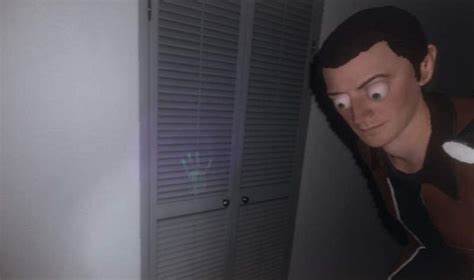
If the ghost is made to appear using a Summoning Circle, a Music Box, or a Monkey Paw, it has a chance of appearing as a black shadow rather than in its full form
If at least one person is in the same room as a Shade, it will be unable to perform interactions or ghost events, or initiate hunts, regardless of average sanity.
10. Demon
The Demon has an ability that allows it to automatically start a hunt, regardless of current average sanity.
Demons have a minimum cooldown of 20 seconds between hunts, instead of the usual 25 seconds.
Smudging a Demon will prevent hunts for only 60 seconds, as opposed to the standard 90 seconds.
As a weakness, the effective range of a crucifix is 50% larger than the standard
Demons fear the Crucifix and will be less aggressive near one.
The Demon has a normal hunt sanity threshold of 70%, instead of the standard 50% (this might not matter in higher difficulties).
11. Yurei
Outside of its ability, the Yurei doesn't have an increased chance to interact with doors.
Its main distinction is its ability to quickly drain sanity.
All players within 7.5 metres of the ghost will have their sanity decreased by 15%. Players outside the investigation area will not be affected by the sanity drain.
All ghosts can shut a door in the same way the Yurei can, however the Yurei may do it more often as it is connected to its sanity drain ability. Tent doors will not fully close, however.
The ghost will randomly select one opened door in its current room and close it fully. This in turn produces two EMF 2 interactions on that door.
The Yurei cannot use its ability if the room it is in has no opened door.
If the ghost moves a door from an open state to a fully closed state WITH a delay in the close sound, it is a Yurei
12. Oni
The Oni is more active, interacting with objects more often, when there are people nearby.
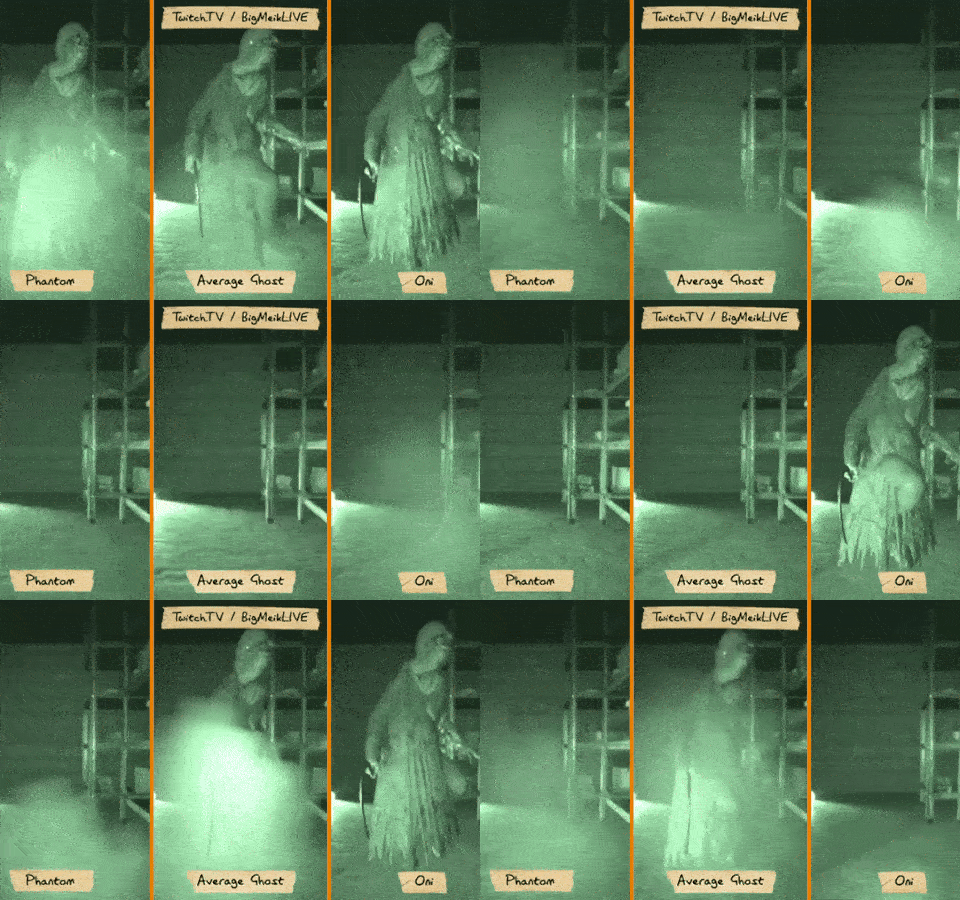
Unlike a Phantom, During a hunt, the Oni flickers and is on average invisible for shorter and visible for longer compared to most other ghosts.
Strength: Oni are more active whilst people are nearby and will drain their sanity faster when manifesting.
The Oni cannot perform the "airball" event, where a fog ball moves toward the player and disappears with a hiss. Chasing events can also trigger a hiss. It prefers to fully manifest rather than appear shadowy or translucent. When colliding with a player during a ghost event, it drains double the sanity (20% instead of 10%).
Weakness: Oni disappear less often while hunting their prey.
13. Yokai
 Voice chat near the Yokai at any sanity will increase its rate of activity.
When a Music Box is used, the Yokai must be closer to the box (within 2.5 metres instead of 5) for it to trigger the ghost event and eventual cursed hunt.
When at least one player uses voice chat in the same room as the Yokai, its hunt sanity threshold is temporarily increased to 80%. Otherwise, it has the standard threshold of 50%.
During hunts, a Yokai can only hear players or sense handheld active electronics that are within 2.5 meters of it. Its line-of-sight is unaffected.
14. Hantu
 The Hantu cannot turn on the Fuse Box, and is also twice as likely to turn off the fuse box.
During a hunt, the Hantu's speed is affected by the temperature of the room that it goes through,Moves faster the colder the area is
When the Hantu's ghost model is visible during a hunt, it will emit freezing breath near its head in any room as long as the breaker is off.
Weakness: Hantus move slower in warmer areas.
15. Goryo
When performing a roam, the Goryo can only perform short roams, rather than either short or long roams.
The Goryo will not leave its favourite room as often as other ghosts and cannot change favourite rooms by itself in any difficulty.
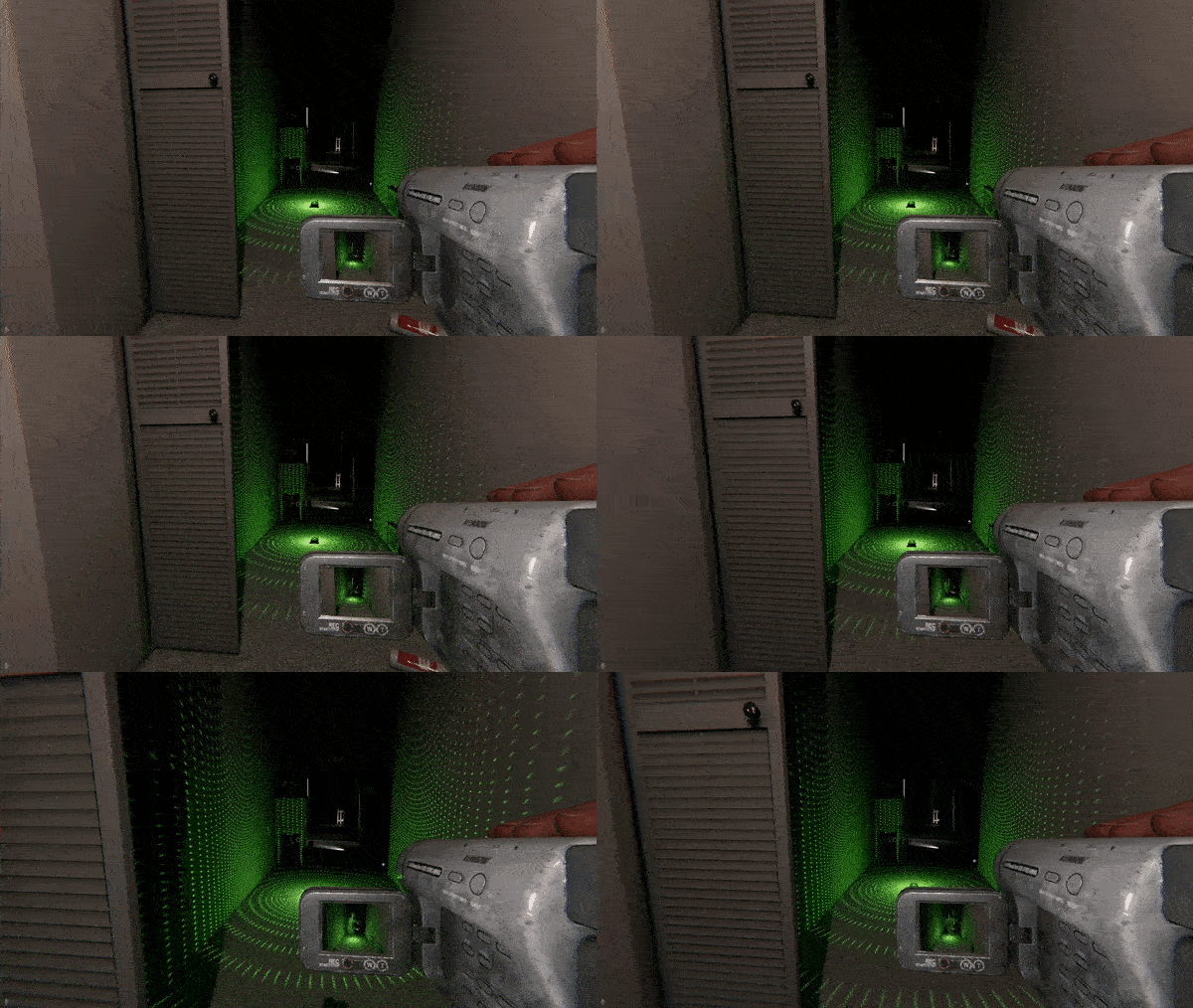
The Goryo will only enter in a D.O.T.S state if no players are in the same room as the ghost. its D.O.T.S silhouette is only visible through a Video Camera, and cannot be seen with the naked eye.
Weakness: They are rarely seen far from their place of death.
16. Myling
 The Myling produces paranormal sounds (that can only be heard through a Parabolic Microphone) more often than other ghosts.
Strength: A Myling is known to be quieter when hunting.
Weakness: Mylings make more frequent paranormal sounds.
When hunting, a Myling's footstep and vocalizations sounds will only be audible to players within 12 meters, instead of the usual 20 meters.
17. Onryo
If the Onryo attempts a hunt within 4 metres of any type of flame, it will blow out the flame instead, this does not restart the hunt cooldown timer.
If both a crucifix and a flame are within range, the flame will take priority over the crucifix for preventing the hunt.
Every third flame that the Onryo blows out will cause it to attempt to initiate a hunt, regardless of current average sanity.
18. The Twins
The Twins is simply one ghost. This means there is no "decoy twin".
Strength: Either Twin can be angered and initiate an attack on their prey.
Weakness: The Twins will often interact with the environment at the same time, two interaction within seconds.
The Twins' primary strength is its ability to misdirect: its core ability can very easily conjure red herring interactions at parts of the map far from the favourite room where it would give evidence
The Twins move at different speeds depending on the hunt's starting location: 1.53 m/s from their current location or 1.87 m/s from the area of their large-radius interaction.
19. Raiju
When a Raiju manifests during a ghost event or hunt, it interferes with electronics up to 15 meters away on the same floor, instead of the usual 10 meters, also affecting global chat.
When at least one piece of active electronic equipment is nearby, the Raiju's hunt sanity threshold is increased to 65%. Otherwise, it has the normal threshold of 50%.
During hunts, a Raiju moves at a fixed speed of 2.5 m/s if within range of active electronic equipment: 6m on small maps, 8m on medium maps, and 10m on large maps. This also applies for items outside the investigation area, but not for items across floors.
Electronics:- Global chat
- Video cameras and Photo Cameras that are thrown on the ground
- Motion sensors, sound sensors, and D.O.T.S. Projectors that are thrown on the ground or held (excluding T1 D.O.T.S., which also needs to be turned off)
- Objects in the inventory (except flashlights that are turned on)
- Any other electrical equipment not brought in from the van (building lights, fuse box, CCTV, fans, etc.)
20. Obake
Each time the Obake interacts with a valid surface, it has a 75% chance of leaving fingerprints, instead of the usual 100%.
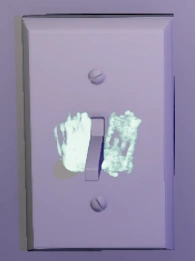
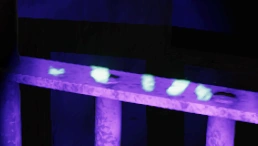
When creating handprints or fingerprints, there is a one-sixth (~16.7%) chance for the Obake to create a unique handprint/fingerprint pattern:- A six-fingered handprint instead of the usual five fingers
- Two fingerprints instead of one on light switches, lamps, and TV remotes.
- Five fingerprints instead of four on keyboards and Prison cell doors.

During a hunt, the Obake will occasionally shapeshift into a different ghost model of the same gender during a flicker. Dead players cannot see this shapeshift.
A shapeshift will always occur on the 12th, 27th, 39th, 54th, 62nd, 80th, 105th, 120th, and 132nd flickers (starting with the first flicker-in) of a hunt.
This means that the first shapeshift will happen approx. 6 - 7 seconds after the grace period ended.
21. The Mimic
- Interaction and ghost event rates and preferences
- Hunt thresholds
- Hunt movement speeds
- Various forms of special abilities (e.g. Poltergeist multithrow, Demon ability hunt)
The Mimic will change the ghost type that it chooses to imitate every 30 seconds to 2 minutes, but cannot change during hunts.
Weaknesses: Will always produce false ghost orbs
22. Moroi
The Moroi has an ability to "curse" a target through the following ways:
- By successfully obtaining a response from the Spirit Box; this will curse the person who "caused" the response, either by asking questions or triggering the failsafe.
- By hearing whispers through the parabolic microphone.
When a player is cursed, their passive sanity drain is doubled, and the light from Firelights will no longer mitigate against sanity loss.
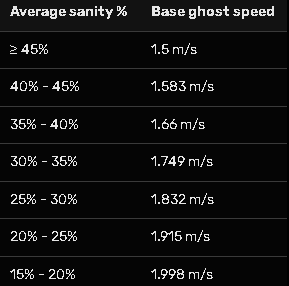
The Moroi's speed is dependent on the average sanity at the beginning of the hunt.
The base speed increases by an average of 0.083 m/s for every 5% average sanity below its average hunt threshold of 50%.
23. Deogen
- Sanity Threshold: Hunts start at 40% sanity instead of the usual 50%.
- Line-of-Sight: Always has line-of-sight with all players; does not roam.
- Targeting: Picks the nearest player by straight-line distance at the hunt's start and occasionally refreshes its target.
- Incense: Can stun the Deogen and force it to change targets after the smudge effect ends.
- Speed Thresholds Based on Distance:
> 6m: Moves at 3 m/s.
2.5–6m: Gradually slows from 3 m/s to 0.4 m/s.
< 2.5m: Moves at 0.4 m/s. - Not Chasing: Maintains current speed or defaults to 1.6 m/s if faster than 3 m/s.
- Visibility During Hunts: Flickers less often and is visible longer than most ghosts.
If the player uses the Spirit Box within 1 meter of the Deogen, there’s a 33% chance for each question to trigger a unique response of heavy bull-like breathing instead of a normal reply.
24. Thaye
- Age Mechanic: The Thaye has an internal "age" parameter that affects its activity.
- Aging Process:
Attempts to age every 1–2 minutes.
Ages if at least one player is in the same room.
Waits 30 seconds to retry if no players are present. - During Hunts: If it ages during a hunt, the age increase applies after the hunt ends.
Strength: Upon entering the location, Thaye will become active, defensive and agile
Weakness: Thaye will weaken over time, making them weaker, slower and less aggressive
The following shows the parameters that are affected by age: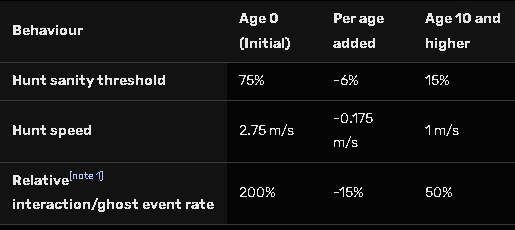
Tips
Playing a no-evidence game in Phasmophobia can be quite challenging, but it’s definitely possible with the right strategy. Here’s a plan you could follow:
- Observe Ghost Behavior: Spend some time observing the ghost’s behavior. Does it interact with the environment frequently? Does it seem to move faster in colder temperatures? Does it seem to respond to your voice from a distance? These behaviors can give you clues about the ghost type.
- Test Ghost Reactions: Try different actions to see how the ghost reacts. For example, try talking near a Yokai to see if it gets angry, or smudge a room to see if a Yurei stays in its room longer. Remember, each ghost has unique reactions to certain actions.
- Use Process of Elimination: As you gather information about the ghost’s behavior, start eliminating ghost types that don’t match. For example, if the ghost doesn’t seem to be affected by smudging, you can probably rule out the Spirit.
4. Safety First: Remember to keep an eye on your sanity levels and hide during hunts. Some ghosts, like the Demon, will hunt more frequently, which can be a clue to their identity.
- Patience is Key: Identifying a ghost without evidence can take time. Be patient, keep observing, and eventually, you’ll gather enough information to make an educated guess..
- How to Talk to Ghosts, What to Say, What Questions to Ask★ 5 (1.9k)81k views3.2k ♥3 minUpdated 12 Jan, 2021
- Особенности призраков или как определить тип на КОШМАРЕ и ВЫШЕ★ 5 (1.2k)50k views2.8k ♥25 minRussianUpdated 25 Mar
- NO EVIDENCE CHALLENGE - Identify the ghost!★ 5 (467)36k views1k ♥42 minUpdated 16 Feb
- Ghost Handbook (Updated!)★ 5 (1.1k)31k views2k ♥12 minUpdated 28 Sep, 2025
- Phasmophobia Alan Wake Guide★ 5 (585)27k views482 ♥10 minUpdated 20 May
- [UPDATED] All Cursed Possessions (All Spawn Locations, Every Map)★ 5 (446)24k views1.3k ♥17 minUpdated 28 Oct, 2023




- Upgrading to PremiumTeam Fortress 2★ 5 (20k)1441k views11k ♥6 minUpdated May 11, 2022
- No More Room in Hell Official ManualNo More Room in Hell★ 5 (2.8k)569k views2.1k ♥29 minUpdated Apr 22, 2019
- NMRiH Community Hosting GuidesNo More Room in Hell★ 5 (526)351k views653 ♥1 minUpdated Aug 10, 2022
- Лучшие кооперативные игры SteamPAYDAY 2★ 5 (1.5k)315k views2.1k ♥56 minRussianUpdated Apr 27, 2025
- Desert Eagle Heat Treated | Blue GemCounter-Strike 2★ 5 (1.6k)292k views1.5k ♥2 minUpdated Jan 16
- Treasure Hunt Puzzle SolutionsTotal War: WARHAMMER II★ 5 (6.9k)281k views15k ♥3 minUpdated Aug 19, 2021




This guide was created by its original author on the Steam Community. Are you the author and want it removed? Request removal.