Civilization VI - Guide for Players New to Deity
Introduction
[Just getting the achievement: If you only want to beat Deity to get the achievement, then play a duel map against Kongo, stay friendly with him, found a religion, and convert his cities until you have over half of them. Done. Usually by the Industrial era. A few other methods are mentioned by contributors in the comments below. But read on if you want to win in a genuine contest!]
Game Settings - Recommendations
Important note: Turning off barbarians won't make the game any easier! Sure, you don't have to worry as much in the beginning, but it will hurt you in four important ways:
- Your units won't have an easy way to get the first promotion. This one is critical to making your units better than the enemy, as the combat strength increase will more than balance out against those fresh units the AI summons.
- You can't ever get the Sanguine Pact. Probably the best of the Societies, eliminated.
- Your Era Score will suffer. Knocking out barbarian camps is easiest way to get era points in the early game; a nearby camp is almost like building a Wonder.
- The AI will thrive. Deity barbarians are tenacious and ruthless, and will relentlessly hound the AI. (This is particularly true on large maps.) With no barbarians, there's nothing to suppress the massive production of AI units.
Choice of Civilization
On the other hand, some leaders/civilizations are pretty twisty, like Gaul, the Maori, or Kongo, as they alter basic principles of the game…these are probably better saved until you’ve refined your style on Deity.
Remember when you’re agonizing over your choice: in general the same strategies apply everywhere because the differences are minor. A Modern Armor army won’t behave much differently for any particular empire…it’ll mostly come down to quantity.
Many guides exist on the various civilization and leader choices. I’d say pick any civilization where you clearly understand the impact of the rule changes on your play style. If you just don’t know, go with Rome 😊
Consider trimming the default number of enemy leaders a bit. If you’re compressed against competitors on multiple sides, they will take all the good land with their free settlers, and then crush you with their free and reduced-price warriors. And they will all target you because you are clearly the weakest at the start. You need at least a few dozen turns of relative freedom to start to close that gap.
Getting Started
We’ll spend a lot time on the start because good decisions made here compound throughout the game. (A good first city is *way* more important than a perfect 7th city.)
- On a river
- On a hill
- On plains
- Near two different luxury resources
- With a mountain nearby
Obviously, you aren’t likely to satisfy all requirements. You might settle for a lake instead of a river (no water mill or flood plains, but a future harbor), or take one luxury if there are multiple bonus resources nearby. You might not have a mountain, so you can plan to settle near one later.
Tundra is dangerous. It’s not only unproductive, but it often extends far from your city, where it will spawn barbarians and blizzards to wreck up your plans. Choose a city near tundra only if the tundra is at the edge of the city’s eventual sprawl and everything else is just perfect.
A *little* desert is okay. It allows several excellent Wonders, and you can always put districts on it if it’s otherwise unproductive.
I have found that with Legendary Starts you often begin near a Natural Wonder (as do your competitors). Some of the wonders provide huge boosts to your chances. The Giant’s Causeway (+5 to all combat units) is so good it’s almost like cheating, but others like the Fountain of Youth or Matterhorn will give you a great start without being terribly unbalanced.
If a luxury happens to be on a plains hills, then settle on it. Typically, don’t do the same for bonus resources, as they’ll seem to disappear without benefit (they don’t really), mainly because the feature (i.e. marsh or forest) is removed, and so the final benefit ends up at the default “2 food, 1 production.” The one notable exception is copper, because you’ll keep the gold bonus.
- Build a scout…they pay for themselves with minor villages (goodie huts) and give you an overview of the surrounding land to plan your next cities. Don’t get too attached…it’s dangerous out there.
- Build several warriors and a slinger or two. You’ll be at war soon with city states or barbarians, and then other empires. You might as well get some experience early, and you’ll need them to guard your settlers. (As you’ll see, I’m not as big a fan of ranged units as others may be, so this is almost the only time I build ranged units aggressively.)
- Build a settler. This should be your build as soon as your city is size two. The AI’s biggest advantage is starting with three settlers, so you need to even this gap quickly. Don’t even *think* about sending it out unaccompanied, as it will get gobbled up by barbarians and your game will be over before it starts.
Yes, it is. You want Stonehenge so you can get religion? Build a Holy Site instead…cheaper, with a lot more benefits. Let the AI fall into building the Wonders at first. They will burn production for marginal benefits while you build military units and settlers to carve out your piece of the world. The only exception is the Temple of Artemis…the 4 food makes up for the land it takes, and the amenities boost can increase production and growth dramatically. But even this one is only good if you have the camps and pastures nearby to take advantage of it. I used to try to build the Pyramids, but the AI now prioritizes it and you will most likely experience the gut-wrenching feeling of having it stolen 2 turns from completion. Oops.
Early Choices - Tuning your Civilization
Getting the first pantheon is a sort of Grail…it is far better than all the others on Deity difficulty, but extremely difficult to get. Religious Settlements gives you a free settler! This is much better than it seems at first glance…you save a huge amount of production (nearly as much as building a wonder), you can build a city 10-20 turns faster, and your opponent doesn’t get the free city. The AI seems to always take this one first, so you’ll probably only see it if you prioritize faith production and have some luck. If you don’t have it as an choice, then choose one befitting your available terrain or resources. If you can’t decide, just take either Fertility Rites (a free builder is a good boost for any civilization) or Divine Spark (extra Great Person points). These may not be the absolute best choices for you, but they’re never wrong, and help break that decision lock.
I (almost) always found a religion. Religions have effects in all other areas of the game, including production, warfare, science, diplomacy, etc. Not having a religion makes you vulnerable to an AI religious victory (rare, but frustrating when they happen), and cuts you out of a number of wonders and founder’s benefits which can be truly game-changing. Even if you never spread the faith outside of your own empire, you’ll add substantial bonuses to your cities which will make them more robust and productive. Faith itself is a key currency in the game, so the more the better. If you think the race for the Great Prophet is overwhelming while trying to scratch out survival on Deity, then play Arabia (you automatically get the last Prophet) or Kongo (can’t found a religion at all).
- Owls of Minerva: If you don’t know which one to take, take the Owls. The free policy cards are always useful, and you’ll dominate the City States with your free envoys (one for each trade route, cumulative). Easy to use and mostly passive.
- Sanguine Pact: My personal favorite; the Vampire unit is a welcome addition in the early game. He (or she) is free and immortal, so can hold back the early tide of angry neighbors. Later, the Vampire Castles add enormous production to your capital based on where you build it; even later, they let your units travel around the map like airports. Of the societies, this one puts the most burden on the player; the Vampire is pretty mediocre unless you actively involve it in wars…it’s as strong as your strongest unit plus a bonus for each unit killed adjacent to it. Later, Vampire Castles should be extremely carefully placed to maximize benefits. With smart management this can be the most robust Society, particularly if you want to build a toweringly tall capital.
- Voidsingers: An early boost to faith (from the monument) helps ensure a pantheon and helps with religion. Later, the faith production boosts culture and science, which you’ll need to keep up with AI production if you’ve built a lot of Holy Sites. Late game cultists are of limited utility in my opinion. Choose this society to boost your early game if you’re centering your game around faith.
- Hermetic Order: Initially my least favorite, these guys are growing on me. This is one place where I always “save scum,” as they are entirely dependent on Ley Lines, an otherwise invisible resource which adds a +2 adjacency bonus to districts. In other words, if you pick this society and have no ley lines, it’s essentially worthless. (I *think* -- based on two or three games --that Legendary Starts tend to place Ley Lines around city start locations.) They tend to come in clusters, though, so if you have a bunch around your starting cities, they can really boost your districts, especially if you’re building away from mountains (which would normally help Campuses and Holy Sites). Later bonuses are also useful, especially in the very late game when you’ve accumulated great people. Pro tip: Anytime you can, build cities directly on the ley lines.
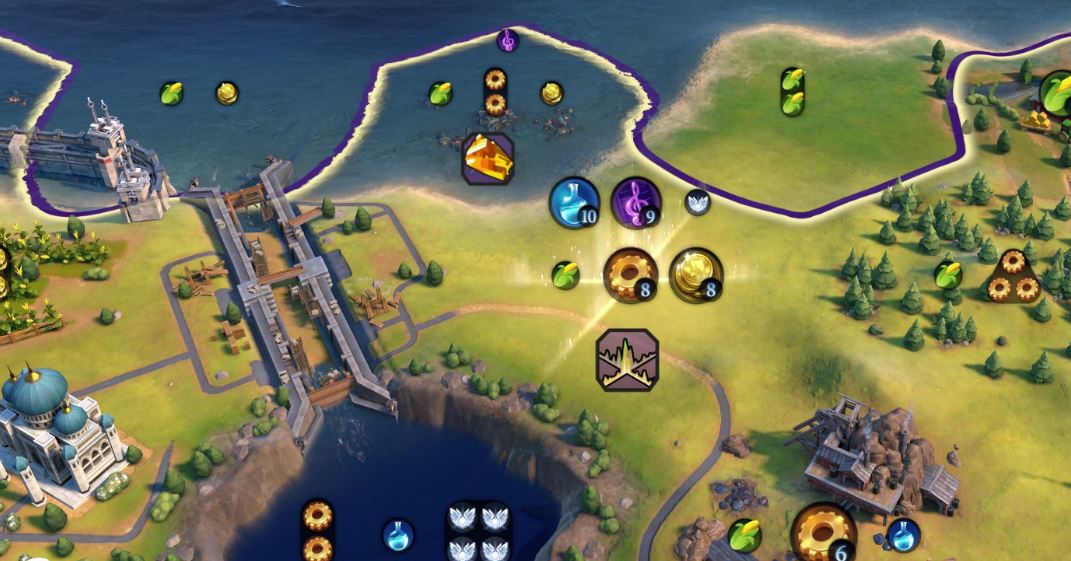
A Ley Line, deep into a Deity game
- Hercules: Yes, he’s tough. He’ll smash his way through just about any enemy, and can hold off an activated barbarian camp on his own (as can a lot of heroes). But equally important is his ability to complete a district instantly. This is a literal godsend for the early struggle…you get a dozen turns of production for free, which can accelerate you towards great people and let your early cities focus on making units.
- Hunahpu & Xbalanque: I may not be able to pronounce their names, but the twins are probably the best heroes overall for the early game. They hit hard, sure, but the real benefit is their “recruitment.” Any unit killed becomes a full-health unit of yours, with all movement restored. Not only does this reverse any assaults on your cities, it provides you with a near-instant army to garrison cities and guard settlers. Those pesky barbarians become loyal citizens instantly.
- King Arthur: If you need to take out a tough enemy early on, he’s your best choice. He is fast and hits hard, but his real benefit is his Accolade. I use it to create ultra-strong Questing Knight units out of my inexpensive scouts, creating an early heavy cavalry strike force. They’re short lived, but working together they can even take out walled cities (like City States), and will stomp other civilization’s non-walled settlements. Tip: King Arthur's accolade works on levied City State units! This way, you can avoid using your permanent units and instead change one temporary unit type into another, better one.
Tip: If you can manage it, build your first hero in a relatively unproductive city. This is because the first hero is absurdly cheap compared to any subsequent ones. By doing this, you can build your second hero much more easily in a production center. Like all things on Deity, this is harder than it sounds because this means you have to wait for a second Holy Site before starting, and sometimes you just need a hero right now!
Early Choices - Governors
The best strategy games are about opportunity cost. Nowhere is this better illustrated than with Governor Titles, which offer great advantages but come in very limited supply. If you’re playing with Secret Societies, then you have even less available governor slots (a fully leveled Society requires four Titles, but you only get one extra for meeting your first Society). Here’s my take on the best use of your first Governor Titles:
- Secret SocietyUse your first title on your Society to start reaping those benefits right away. You may want to save a Title if you have a specific Society in mind…the most difficult to get is probably the Sanguine Pact, as you can’t join them until you clear a barbarian camp, and even then it’s only a 70% chance.
- Magnus“ The King of the Chop/Rush.” If you have a city with a lot of forest, and you want to build things quickly, Magnus is your best choice for first Governor. His ability works as soon as you can cut forests, and gives a much needed bootstrap to all early builds. One more promotion and he can make settlers without the population cost, which is a wonderful talent on long games, where that population point may take 20 turns to replenish. Players new to Deity may be a bit squeamish about wholesale deforestation…my advice is to save that conservationist mentality for the late game. You can always replant the forests then, right?
- LiangThe extra builder charge is quite efficient, with a “buy 3, get one free” effect. You won’t be using builders for awhile (most tile improvements need technologies to unlock), so she may be a better second governor than first. An exception is a promising coastal city…her Fisheries improvement turns starving coastal communities into solid growth machines. She can then move to another city and build Fisheries there, and so on.
- ReynaNone of her abilities are bad, and none are particularly noteworthy. Extra expansion is great, as you can help close gaps in your empire as the borders grow, and you’ll save money from having to buy plots. The Foreign Exchange is potentially an easy source of money, but the game makes it very challenging to tell if foreign routes are passing *through* a city.
- MokshaHis first tier ability is fair, but his second tier “Laying on Hands” is extraordinary. One turn of rest equals full healing for any unit. You’d think Victor would be the best leader for a city on the front lines of a war, but the easy healing makes Moksha the winner. Not a first-line choice, but not bad in the First Conquest Age (my term; see below). He is also the only way to heal religious units other than a holy site.
The Early Game (Ancient through Medieval)
- Exploration is critical here. Push back the darkness, contact tribal villages, and meet your neighbors. Every discovery helps your Era Score, and being the “first” to do anything is usually worth more. Explored areas will show new barbarian encampments, which is critical to the next stage.
- Explore in a spiral around your starting city. Unless you’re butted up against a coast or a map edge, send your warrior (and later, scout) in an expanding spiral around your capital. This allows you to reveal all of the good spots for nearby second cities, and you’ll be closer to your capital in case of emergencies.
- Identify a spot for your second city within the first ten turns.
- Barbarian Camps will appear in explored territory with a notification to you. If the new camp is anywhere near your territory, it is now your top priority. Other schemes can wait; send your melee and ranged units en masse to wipe it out.
- Barbarian Scouts are the most dangerous units in the early game. Once they spot one of your cities they will try to report back, getting an exclamation point over their heads. They will then beeline back to an encampment and that camp will “activate,” spawning up to a dozen units to return to your city and try to conquer it. City States and AI empires may also activate camps, which then somehow decide to hassle you instead.
- Barbarians units don’t heal. Use this to your advantage, because you can attack fortified spearmen even with a minor defeat, then heal, and attack the wounded barbarian again.
- Barbarians can’t conquer your capital. Capitals can’t be razed, and that’s the only form of governance barbarians can do. So don’t worry too much if a wave of barbarians is knocking down the capital city’s health…they can’t finish it off, so just be patient until reinforcements arrive.
- Killing barbarians is good for you. All of your units should cut their teeth on barbarians (and don’t worry about running low; they will just keep spawning). You can get the first level quickly. Additionally, several early science and culture boosts are tied to warfare, and barbarians will suffice nicely. The most important is probably the boost to Archery, which occurs when you kill a unit with a slinger. This is nearly impossible for an unsupported slinger, which is why I advise you NOT to send just one unit after a camp. You’ll need those archers for the next stage of the game.
- Clear every camp you can. If a City State’s units are attacking a camp, send a scout to hang around, then dart in to clear the camp. It can be as much era score as building a wonder, along with some much-needed gold.
- Don’t wait for them to come to you. If you play on easier difficulties, you might be used to sitting in your city and hitting them from relative safety. Instead, fight them in the countryside, away from vulnerable farms and mines. Make them attack across rivers and into fortified positions.
- Attacking City States is mostly for experience. They are all walled on Deity (though oddly, they do not start with walls on Deity team co-op play), so you can’t just send a wave of warriors to take the city. Even heroes generally can’t do it at first. You can probably do it with Arthur and some knighted scouts, but it’ll be a struggle. On the other hand, you can attack the City States to get some free builders, or just to hone your experience past level 1 (barbarians give only a token experience point after the first promotion).
- Diplomacy with AI civilizations is generally pointless. They’re preset not to like you on Deity, so even if you waste money on a delegation they will most likely have a negative attitude. Add to that the secret society penalty (three-quarters of them won’t share your society, and that’s a big hit), and the fact that they are mostly militarily stronger. If you want a friend to trade with, then pick a civilization far from you geographically and give favorable trades to win them over. It won’t last, most likely. Sending an initial delegation is a use of valuable currency that might be better used saving toward a builder or trade unit.
- Aggressive settling is the best way to ensure some breathing room later. Settle as far forward as you can to create a shell of your territory with room to backfill later. If you’re spread thin militarily, then you should be more conservative so you can rescue cities from sudden barbarian appearances. When your settler is selected, target tiles will show loyalty penalties if they are close to enemy civilizations; settle only where there's minimal to no penalty (I’d advise no more than -6 so that you can correct it with a governor.) Settle very closely to City States, as they do not expand much...you'll be able to use more of the land that you would with a major civilization's city.
- Attacking weak AI cities is the biggest hurdle for players new to Deity. If you’ve gotten into bad habits on easier difficulties, you may have too few units, or you may be reluctant to declare war on seemingly friendly neighbors. Squash that thinking! Those little outlying cities are unwalled, usually horning in on good territory you want for yourself, and are essentially a free settler. See warfare tips for how to knock out those pesky settlements.
- Settling pattern helps you interlink your empire for future growth. Cities should be about 4-6 tiles apart (10-12 if you’re trying grab good land for later backfill). Closer cities can better share resources like farms and districts, which boost other farms and districts in neighboring cities. This is often overlooked in easier difficulties, but on Deity it’s critical. Many districts have “reach” between cities for some of their later improvements (factories, stadiums, etc.), so plan accordingly.
- Ring your capital with cities. In other words, make it a priority to secure land in all directions around your capital. It’s likely going to be the most productive city and certainly the most valuable, so having a buffer of smaller cities protects it and lets it focus on big tasks like settlers or wonders.
Classical and Medieval Warfare
This is intimidating on Deity. The AI can crank out units like fast-food hamburgers, and when you click one of your units to estimate how successful they’ll be in an attack on an AI unit, you’re confronted with lots of grim numbers, such as the +4 from difficulty. Enemy cities are even worse, often shooting you as soon as you’re within range, so you have to either retreat or die to get in a shot or two. But fear not! Let’s explore warfare in the Early/Mid-game (archers, crossbowmen, swords, and catapults.)
- - They stack with regular units. I felt pretty silly when first I realized this…battering rams and siege towers can be linked to regular units like swordsmen, and they effectively give a special power to that unit and all other non-cavalry melee units attacking that city. “Units do full damage to cities” is a game-changer.
- - Chaplains aren’t technically support units, but they can stack with support and regular units, and give a huge boost to healing to all adjacent tiles. This extra healing lets you keep your wounded units within strike range of cities without having to move immediately. Just keep fortifying your units, and they’ll heal back most of the damage they take from the city if the gap in strength isn’t too large. The boost is huge…it “acts as a Medic” which is a +20 healing rate. This quintuples the normal rate in enemy territory. (Note that chaplains can’t heal religious units, only military.)
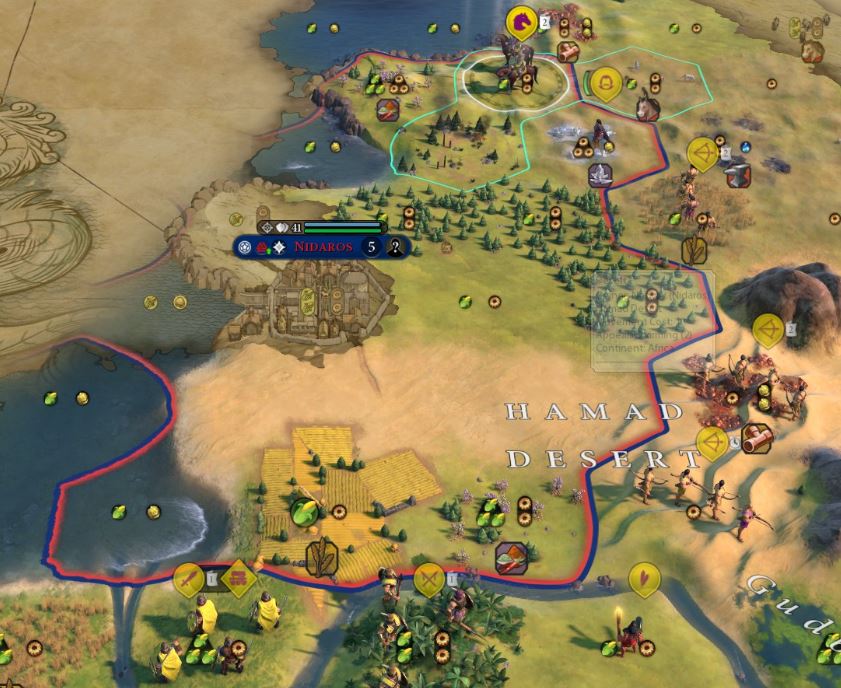
Several points of interest here as I close in on the Viking Capital: 1) Overkill? No such thing. 2) City walls? See the ram with the swordsman...all adjacent units can do major wall damage. 3) Lots of archers? Basically useless; they're here for some free experience. 4) Well-fed vampire and mediocre hero to bolster the attack.
- - Is Victor the Governor? He has an ability which blocks siege altogether. Nothing you can do about it.
- - Is there an open water tile? Melee units’ zones don’t extend to water tiles. You’ll need a ship.
- - Is there a river? Melee units’ zones don’t cross rivers. You’ll need a unit on the far side of the river.
- - Is there an archer in the bunch? Ranged units do provide control of the hex they’re standing on, but have no control over adjacent hexes (unless you choose a dubious promotion for them). You’ll need more units.
- - Flanking and Support are the same in most ways; flanking is for offense, support for defense. Every friendly unit near the target adds a flanking bonus to melee attacks; every friendly unit adjacent to the defender adds a support bonus. Large armies win! Support your front line troops and they will be much harder to kill. Surround a city shoulder to shoulder and do more damage. (Flanking only works for melee attacks, and doesn’t cross rivers.)
- - Terrain can be a major benefit or minor hindrance for a defender. The game calls hills, forest, and jungle “ideal terrain,” and all are +3. (But remember that hills stack with the others.) Swamps and marshes give the defender a -2, and make an ideal target.
- - Injured units need healing. Their effectiveness drops off fast as they take damage, reaching as high as -10. Get them out of the line of fire.
The Middle Game (Late Medieval through Industrial)
You’ve gotten through the barbarians, elbowed neighbors around, and now you’ve got a decent plot of land to call your own. Now what?
- - Specialization allows one city to produce settlers, one to make units, one to work on religion, etc. It’s hard to specialize without enough cities, so find space for new ones. Land that didn’t work before might be better now that you can develop it with your improved technologies. Not every city needs a river in this age. Just make sure you can place an aqueduct…any tile next to both your city and a water source or mountain will work. (Did you know that oases can hook to aqueducts and provide fresh water as well?) Coastal cities are a lot more viable with harbors to boost production and trade.
- - Land is valuable for its own sake. Eventually you’ll need oil, aluminum, and niter that you can’t see on the map at first. The bigger your empire, the more likely you’ll be self-sufficient on these resources later. Oil in particular will make or break your late game.
- Missionaries are fine for early self-conversion, but are easy prey for enemy apostles. Beating an enemy in religious combat is like a double hit of evangelism to every city nearby (it both reduces the target religion and increases your own).
- Apostle promotions are mostly situational, but some are much better than others. Chaplain lets you have a medic LONG before getting the support unit. Take Debater as soon as you see it, and do not use all charges on that apostle! It can be used for the rest of the game to pick off enemy religious units. Heathen Conversion is either useless or absurdly powerful…barbarians tend to be relatively scientifically advanced, so you can instantly double your military power by converting a pile of barbarian muskets or field cannons. In Deity, this can be a way to get units beyond your current technology level.
- - Defining your religious beliefs uses two hard-earned apostles, but it’s worth it. Tip: Before using the apostle to enhance the religion, pick a promotion you wouldn’t otherwise want to use it up (Indulgence Vendor, anyone?) The best beliefs for purely aggressive spread are probably Mosques and Holy Order, because they allow your faith to buy units which are both cheaper and more effective than your opponents.
- - Convert cities in adjacent blocks. This allows your religion to have an increasingly strong wall of faith, making enemy conversion less effective.
- - Prioritize enemy cities with holy sites. Unfortunately, they won’t start building missionaries for your religion (Kongo is the lone exception that I've seen), but conversion at least cuts off the supply of enemy religious units.
- - Heal your units frequently. Damaged units are less effective in combat, less effective at conversion, and vulnerable to being killed (which reverses any positive effect they might have had). You could use gurus, but they are so vulnerable themselves that I usually just move wounded units to holy sites to heal. Trying to stretch a damaged unit is a rookie mistake that you will soon regret…the AI is more competent at religious combat than military combat.
- - Make use of religious combat bonuses. Several policy cards give bonuses; defending on your religion’s ground gives a large boost, and there’s flanking and support bonuses just like in melee combat.
- - Hide like a rat when you need to. The enemy units can’t hit you inside cities and encampments, so hide wounded units there until it’s clear to go back and heal.
- - Don’t fight to the death. If you’re gonna get killed, use that last charge on any nearby city. It won’t be effective, but it’s a whole lot better than hit you’ll take from losing the unit.
- - Inquisitions are very rarely necessary. Inquisitors are strong and cheap, but have no utility outside your borders, and you have to waste an apostle just to have access to them.
- - Finally, make sure you have either Cross-Cultural Dialogue or World Church (these give bonuses to science and culture respectively). Why? You won’t be able to keep up with the AI in both culture and science by building districts, but if you get help from your religion, then you can get a little breathing room in the race to keep up. I favor World Church, because it seems a little easier to keep up in Culture, but either one works.
6. The Second Age of ConquestAs your religion begins to organize, and you’ve built a solid national identity, it’s time to start pushing into enemy territory. (We’re roughly in the Renaissance now, but the oddities of the tech tree make this only marginally important.) You’ve either built, bought, or stolen a decent military; your economy is reasonable, and barbarians are an occasional nuisance. On easier difficulties, you can now “Next Turn” your way to a dull science victory. On Deity, however, the other civilizations will keep even with you in science, and then outbuild you in the Space Race. Or worse, you’ll succumb to their culture. You’ll find any sort of victory you’re pursuing will be augmented by a healthy military attitude. After all, today’s real-life scientific and cultural nations generally have a long history of military assertiveness. Not a coincidence.
- - Have at least two encampments. These are less critical in the early game than barracks were in Civ 5, because they only give a bonus to experience gained, not outright promotions. However, those promotions are important, and you want your units to promote quickly so they survive and thrive in the field. You need two so that you can have one with a stable and one with a barracks. Both should be in high-production cities, preferably paired with an industrial district.
- - Build multiple copies of each unit. Corps and armies are so important that you don’t want to have to wait to make them. See Middle Game tips for properly combining units. Yes, it matters.
- - Razing cities can sometimes be the best option. The AI builds a lot on snow, desert, and volcanic tiles. But how you do it makes a huge difference how much hate you’ll generate. See Middle Game tips.
- - War disrupts the AI priorities. Attacks will cause redirection of resources from Wonders and districts to military units. If you’re careful with your units, this allows you to get a production advantage, and finally start to catch up. Use diplomacy to draw other AIs into fights which break up partnerships between AIs and reduces their income from trade and alliances.
- - Have at least two encampments. These are less critical in the early game than barracks were in Civ 5, because they only give a bonus to experience gained, not outright promotions. However, those promotions are important, and you want your units to promote quickly so they survive and thrive in the field. You need two so that you can have one with a stable and one with a barracks. Both should be in high-production cities, preferably paired with an industrial district.
Middle Game Efficiency Tips
- - Any upgrades from wonders are kept for the combined unit (e.g. Water of Life)
- - The highest promotion level of the two is kept (at least). That unit’s promotions are kept.
- - If the two units have any different promotions (e.g. combining a melee unit with only Battle Cry (Tier 1) with another with only Tortoise (Tier 1) then the resulting unit will get both of them and essentially have an extra promotion.
- - Upkeep cost of the corps is 1.5x, and an army is 2x the base unit. A bargain.
- - Resource upkeep is the same as the base unit. A huge bargain.
- - Combined health is some sort of average of the two (i.e. forming a corps does *not* heal the unit, so be careful).
- - They keep the best “educational” background. So if one unit is a raw recruit but came from an encampment with a military academy, and the other is descended from that first warrior unit who is now a grizzled musketeer, the combined corps will get the experience gain benefit of the academy, but keep the experience of the older unit.
- - Razing immediately generates an enormous permanent penalty in grievances (see Grievances) which can make any future diplomacy harder..."but I really hate that tundra city!"
Fortunately, there's another path:
- - Allow the city to rebel, then retake it, then burn it to the ground. A much better choice. There’s no penalty for razing a free city. Go for it.
- - Four great prophet points per turn is the real prize. Unless you’ve done the near-impossible (and unadvisable) with Stonehenge, then you are unlikely to have a religion by the end of the Ancient Era. You’re essentially guaranteed one if you pick this Dedication.
- - The extra spreads and movements are critical to getting through the “Age of Evangelism” quickly and smoothly. You will grow your religion amazingly quickly.
- - If you’re not in a Golden Age, then Dedications provide no bonuses; they’re just a way of getting into a Golden Age. Even here, it’s hard to beat this one…two points for each city means around ten era score if you just use it on your own cities.
- - If you declare a surprise war, you get a large initial grievance, plus a multiplier for each city you keep afterwards. Makes sense.
- - Formal wars are better, so chose this route if you have no other casus belli.
- - Even if they attack you, you’ll get grievances for taking and keeping their cities.
- - You get a lot of grievances for razing cities. Makes sense, again.
- - If they ask you to keep away from their borders, and you declare war, you still get grievances for keeping troops near the border even while at war. Makes zero sense.
- - If they ask you to stop converting, no matter how you answer you'll get grievances for future conversions (even if you convert a city by killing one their aggressive religious units, or through natural spread of the religion) . Makes little sense to me.
Diplomatic penalties pile up based on grievances, some fair, some not. If you keep one of their cities, even if it was originally a city state that they conquered, you get a permanent penalty. Same with razing cities or converting holy cities. You also get penalties with that civilization’s allies if you occupy any city (yeesh), and more penalties just for having grievances with any other player. You get more penalties with some AIs for building on the coast, or near mountains, or building Wonders.
Bottom line: Don’t worry too much about all this grievance stuff. You’re going to be hated if you do anything other than roll over (and if you do that, you’ll get penalties for being weak 😊 ). Interestingly, one of the best ways to reduce these penalties is simply to wipe out a civilization completely…it eliminates the grievances and penalties associated with that nation completely.
Now, the "workaround" for two of the issues I mentioned above. (I'm not sure if this is supposed to be here, but the developers have had plenty of time to patch it, and haven't, so I'll consider it a tip rather than an exploit...) The other civilizations keep asking me not to convert their cities. No matter what I choose, the grievances are piling up?!?
- There's actually a third option...don't engage with their whining! After all, they'll ask you to stop, then send their apostles straight after your cities. Just ignore these hypocrites (close the window without replying) and you won't get any grievances for your righteous zeal.
The other civilizations want me to move my troops. Even if I go to war, I still get grievances.
What gives?!?
- Once again, don't engage with these guys. To comply, you have to keep your troops two hexes from their borders, without error, for around 30 turns...even if you have open borders!? Ignore this silliness and close the conversation without dignifying it with a reply.
Renaissance and Early Industrial Warfare
True to actual events, this age of warfare is bloody and long, with grinding wars and stalemates. It’s still worth it! If you take a passive approach and stay safely within your borders, you may get so far behind that you lose the Science Victory.
Mid-Game Warfare - FAQs
The Late Game (Late Industrial through Information Age)
I’ll limit myself to a few tips here. If you’ve held on until the Modern Age, and your overall score is the highest in the game, you’ll almost certainly win. Here’s how to make sure:
I don't care about your stupid logic Doc, I love this 007 stuff!
If you want to use spies, I suggest assigning new spies to Siphoning Funds (which has a relative high chance of success) from a smallish city. Smaller cities are less likely to have defensive measures, which you can’t see in the percentages! Do this until you’re promoted to level 2 or 3, then take on other missions depending on the promotions you’ve chosen. This process takes an incredibly long time, so if you’re serious about spying, use policy cards to reduce production costs and operation times.
- - 4 tile diamond? The park must be in a vertical diamond, or it won’t work.
- - Are all tiles Charming or Better? This is often a sticking point, alleviated by the Eiffel Tower. You can also remove nearby mines or jungles to assist.
- - Are all tiles owned by the same city? If not, try to swap them to get the pattern you need.
- - Do I actually own all the cities? If a city is “occupied” during a war, you can’t build a park.
- - Is there an improvement somewhere? The one that’ll slip past you is the Mountain Tunnel.
- - I can build it, but I don’t like the name. You can’t rename a park, but you can change the name of the city which owns the tiles. Then found the park, change it back, and the park will retain the custom name.
Conclusions - Win However You Like
Addendum: Monopolies & Corporations
A quick note on Monopolies & Corporations, which is a game mode added in early 2021. First, I love it! It explores the use of multiple copies of the same luxury, allowing the player to build industries and potentially claim monopolies by getting 60% of the world's supply of the resource. This translates into money, but the effect on gameplay is remarkable for me, as I tend to be much more likely to found or conquer a city rich in luxuries I already have. Is it greed, or just good strategy? I haven't figured it out yet.
Corporations are like industries, except you need to use up a Great Merchant to found them. Generally, this is a good trade off, as the additional resources from the Corporation are impressive. And it's cool to name your own coffee company! Tips:
- Save Great Merchants. Several of the early ones don't give big benefits (some additional gold or a free trade route), but can be stashed for later use as corporate founders, which is a much bigger boost.
- Produce products. Products are built as city projects, and are unlimited (i.e. you can create as many as you can store, which is a lot). Each product can then be moved freely to other cities with stock exchanges or seaports. The bonuses are huge, usually a 30% boost to some sort of production (faith, gold, units, etc.), and up to six can be active in any city (assuming you can get that many merchants).
One negative...at this time, while the AI seems to be able to build industries, I haven't yet encountered an AI corporation. This has the effect of making the game slightly easier, but it doesn't seem to be a particularly dramatic advantage (e.g. the inability of the AI to link support units).
Note that the AI does seem to be able to use these effectively, which is a welcome sign.
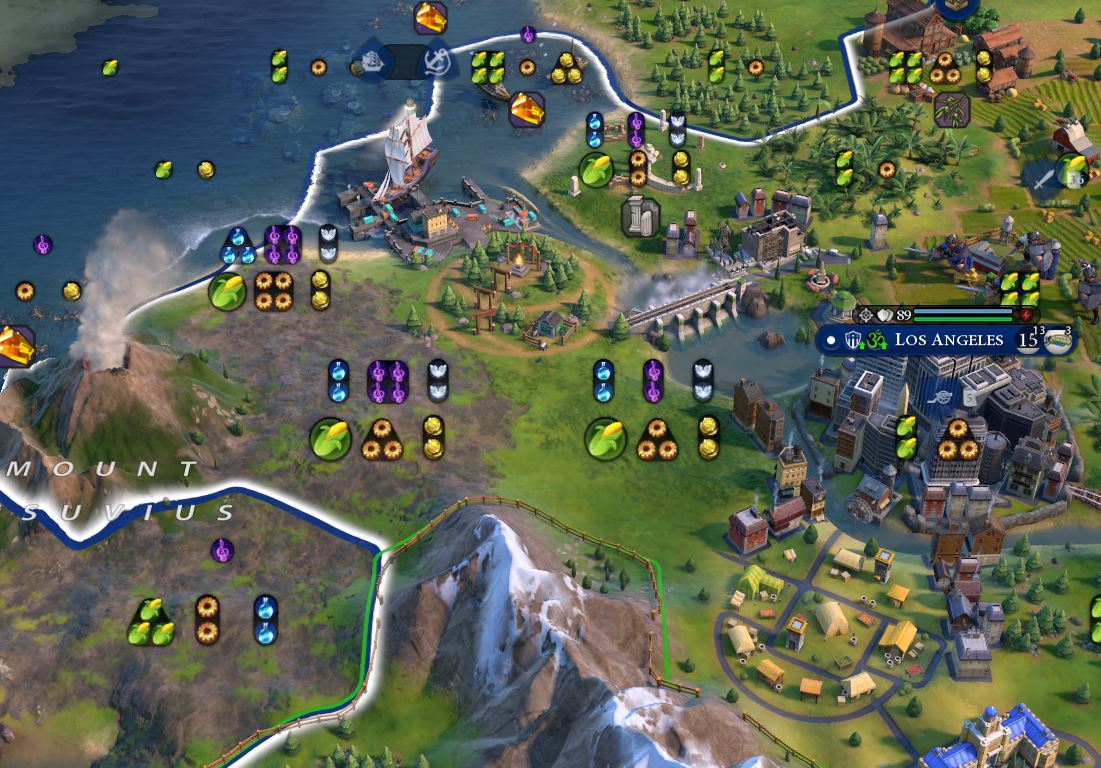
A preserve district near Vesuvius.
Addendum: Barbarian Clans
Barbarian Clans is a game mode added in a February 2021 update. Overall, it's more evolutionary than revolutionary, barely changing the overall game mechanics or strategy, but adding some welcome flavor to the otherwise generic barbarian hordes.
What hasn't changed:
- - Barbarians encampments still spawn with the same frequency on isolated areas of the map.
- - These camps send out scouts, which report back and create waves of troops to come crush your cities.
- - The camps can still be attacked and cleared as before, yielding Era Score in the early game.
What has changed:
- - Each camp has a name, and a bit of character. Some will spawn melee units, some a mixture, and some mounted units.
- - By clicking on the camp name, a limited diplomacy option appears. You can hire the camp to give you a unit such as a barbarian horseman, or swordsman, depending on the era; you can hire them to attack a neighbor, or you can pay "protection" to keep them from attacking your cities.
- - Camps have a progress bar which gradually fills over time, eventually replacing the camp with a City State.
- - Occupying the camp allows you to either raid it for gold (you can do this every 20 turns or so) or clear it for a hefty dose of experience. Raiding it doesn't clear the camp, and sets it back on its quest for City State-hood.
- - The camps can produce civilization specific units (Berserkers, Immortals, etc.), which you can acquire through the "diplomacy" menu.
I can't see any negatives...the changes aren't overly complex, but really give those little camps some character. In one game, I cleared most of the camps like usual, but let one camp sit untouched from the beginning and watched it turn into a City State in the Medieval Era. I like this feature, as it helps replace some of the city states that the AI likes to absorb in the early game, and gives the neutral entities a less static feel. (In a longer game, I discovered three or four City States deep in the Tundra which were very likely evolved barbarian camps.)
A note for fans of the Sanguine Pact...based on several games, you have to actually clear the camp to get an invitation to join the Pact. Raiding for money does not seem to create the opportunity.
Addendum: Zombies
Zombie Defense is a game mode added as part of the last updates of the Season Pass, and may be the last official Civ 6 update.
New rules in this mode:
Zombies
- Zombies will spawn randomly from barbarian encampments, and from sites of prior battles. They will also spawn if a zombie defeats another unit.
- Although they look like barbarian units, they do not pillage, but advance relentlessly toward the nearest non-barbarian unit or city.
- Their strength is related to the number of zombies which have ever been defeated in the world, which puts them on a slow, steady upward progression (called Mutation in-game).
- Zombies can be temporarily converted using City Projects (one from a Holy Site, and a better one later from a Campus). Hunahpú and Xbalanqué can permanently convert zombies to your side (which also gain the Mutation bonus), but these will spawn enemy zombies if you use them to kill units.
Defenses
- You can use Builders (and later Engineers) to build traps and barricades. These can be built in neutral territory, and they damage units passing through them.
- These chain together like the Great Wall to make some impressive structures.
- Interestingly, existing forts (including Wonders like Alhambra and Vampire Castles) get the ability to damage enemies as well with this update.
I was initially excited about this mode, as it adds an interesting twist to the hostility of the world. However, I quickly grew tired of the mode as its main effect seems to be to slow down the game for all players. Zombies never change except to get stronger, and they have no tactics, so walled cities are essentially impenetrable. Because they can spawn at random inside your territory and then move on the same turn, they mean you are always having to rebuild your traders...over, and over, and over again. Your turns take much longer as there is always a zombie or two which you have to strike with city defenses, and your builders are slowed down by having to hide in a city until the zombies are slain. Very early in the game they create some additional challenge to your expansion, but they are basically just a nuisance which never, ever, ever stops.
Building the defenses creates "dead tiles" which are completely unproductive, so they are useless except for very rarely in neutral territory that is beyond a city's working radius. Even then, they are usually a waste of builder's (or engineer's) charges. They do look cool, though, when a city state builds a big wall around itself.
Converting zombies is nearly useless because they can't be used to fight without spawning more zombies. Converting them and then releasing them into a neighbor's territory seems like an interesting strategy, but the AI usually just smashes them the next turn, and since they don't pillage, they can't even affect the economy.
Overall, there are seeds of a good idea here, but the final effect (based on about three Deity games) is simply to distract, delay, and annoy the player (well, this player, at least).
Addendum: New Units & the April 2021 Update
For players buying the game recently, these units won't be new at all, but merely a part of the base game. I added this section because my guide was written before they were built in by the developers, and I'm happy to say that the add a lot to the game without ruining my guide :)
Melee Units: The two melee units, the Man-at-Arms and the Line Infantry, add much-needed bridges between the prior units. The jump between Swordsman and Musketman represented a historical leap of nearly two thousand years, and clearly needed something in between. Similarly, the Line Infantry feels like an appropriate leap before modern infantry. More importantly, it doesn't lock civilizations without the appropriate resources out of the arms race entirely...oil can be hard to come by!
Trebuchet: As those who have read the guide know, I'm not a fan of catapults, as they do little damage, are unwieldy to use, and take forever to move to the front line. The Trebuchet improves on this somewhat by being a bit more resistant to being destroyed by early walled cities. The animation is excellent as well.
At any rate, after another few games on Deity since the April 2021 update, I feel like the new units fit right in to my strategy of using melee and support units in most of the early game. I specifically tried to use the trebuchets after seeing a post below...I was able to use them with some work; I needed an encampment within two tiles of a city, and then it was fairly effective at chipping down the walls of the city. In my games, when I moved it within range of a city outside of an encampment (just like with a catapult) the AI targeted it first which kept me from getting in more than one shot before needing to retreat for healing.
I played with Spain and the Kmer since the update, and they are quite powerful, particularly in my religion-focused strategy. If you use them, play to their strengths and you'll be quite pleased, I think.
The most important update is, of course, the ability of the Scout to pet his dog. :)
- Better Balanced Game (BBG) Full Change Log (v6.0.x)★ 4 (120)62k views293 ♥62 minUpdated 27 Aug, 2025
- 100% achievements guide + tips & tricks (base game + all DLC's, include Gathering Storm)★ 5 (1.5k)57k views3.7k ♥146 minUpdated 4 Jan
- [EN] Early game strategy, or how not to get overwhelmed★ 5 (368)41k views1k ♥15 minUpdated 23 Jul, 2023
- All Victory Conditions and how to reach them!★ 5 (702)40k views1.2k ♥5 minUpdated Jun 17, 2020
- 新手指南 —— 从上手到上瘾! Civi-VI Game Guide★ 5 (1.7k)37k views3.2k ♥3 minSimplified ChineseUpdated 7 Sep, 2022
- Zigzagzigal's Guides - Japan (GS)★ 4 (141)34k views399 ♥67 minUpdated 2 Apr, 2023



- Upgrading to PremiumTeam Fortress 2★ 5 (20k)1441k views11k ♥6 minUpdated May 11, 2022
- No More Room in Hell Official ManualNo More Room in Hell★ 5 (2.8k)569k views2.1k ♥29 minUpdated Apr 22, 2019
- NMRiH Community Hosting GuidesNo More Room in Hell★ 5 (526)351k views653 ♥1 minUpdated Aug 10, 2022
- ULTIMATE GUIDE FOR GAME DEV TYCOONGame Dev Tycoon★ 5 (5.8k)326k views10k ♥4 minUpdated 23 Jan, 2014
- How to 'Git Gud' Soon™MORDHAU★ 5 (2k)318k views3k ♥68 minUpdated Nov 16, 2024
- Лучшие кооперативные игры SteamPAYDAY 2★ 5 (1.5k)315k views2.1k ♥56 minRussianUpdated Apr 27, 2025




This guide was created by its original author on the Steam Community. Are you the author and want it removed? Request removal.