Advanced Algorithmic Exploitation of the Hearts of Iron IV Peace Conference and War Participation Systems
Introduction to the Grand Strategy Diplomatic Framework
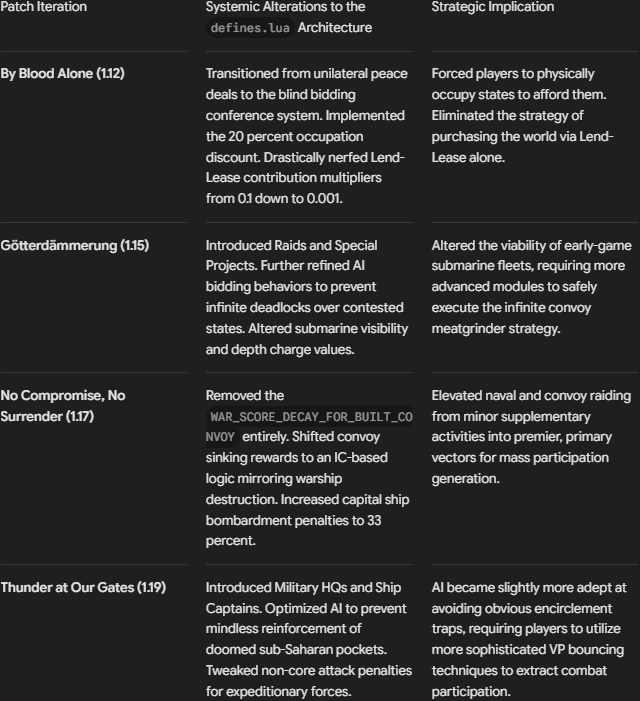
The structural foundations of grand strategy conflict resolution underwent a systemic paradigm shift with the release of the By Blood Alone (BBA) expansion and have been continually refined through subsequent patches up to the Götterdämmerung (1.15), No Compromise, No Surrender (1.17), and Thunder at Our Gates (1.19) updates. The peace conference system transitions the simulation from an operational military wargame into a strictly mathematical bidding environment. During a war, belligerents on both sides accumulate "War Participation" points, which represent their relative algorithmic contribution to their faction's operational success.
Upon the capitulation of the opposing alliance, these accumulated points are translated into a finite, highly contested currency known as "War Score". Because this score is constrained by the total intrinsic value of the defeated nations, participants are forced into a competitive environment against their own allies to secure territorial, economic, and naval assets. For strategists operating as minor nations, or those seeking disproportionate geopolitical gains relative to their actual military footprint, mastering the algorithmic generation of War Participation points is an absolute necessity.
This comprehensive report details the underlying mathematics of the peace conference system and outlines asymmetrical, cost-effective methodologies—colloquially known as "cheese" tactics—to artificially inflate War Participation percentages. By exploiting air warfare attrition, convoy raiding loops, non-lethal land combat grinding, and game-rule parameter manipulations, strategists can dominate the negotiating table regardless of their baseline industrial or demographic capacity. Furthermore, this analysis explores the chronological evolution of these mechanics across recent development cycles, providing a definitive guide to the current optimization landscape.
Upon the capitulation of the opposing alliance, these accumulated points are translated into a finite, highly contested currency known as "War Score". Because this score is constrained by the total intrinsic value of the defeated nations, participants are forced into a competitive environment against their own allies to secure territorial, economic, and naval assets. For strategists operating as minor nations, or those seeking disproportionate geopolitical gains relative to their actual military footprint, mastering the algorithmic generation of War Participation points is an absolute necessity.
This comprehensive report details the underlying mathematics of the peace conference system and outlines asymmetrical, cost-effective methodologies—colloquially known as "cheese" tactics—to artificially inflate War Participation percentages. By exploiting air warfare attrition, convoy raiding loops, non-lethal land combat grinding, and game-rule parameter manipulations, strategists can dominate the negotiating table regardless of their baseline industrial or demographic capacity. Furthermore, this analysis explores the chronological evolution of these mechanics across recent development cycles, providing a definitive guide to the current optimization landscape.
The Architecture of the Peace Conference System
To manipulate the outcome of a peace conference, it is necessary to first deconstruct how the baseline currency is calculated, capped, and distributed among the victors. The system calculates the total available War Score for the victorious faction using a specific mathematical formula dictated by the simulation's internal configuration files.
Calculating Total and Individual War Score Allocations
The total War Score awarded at the peace conference is derived from three primary variables interacting within a rigid multiplier framework. The first variable is the Enemy State Value, representing the aggregated intrinsic value of all states controlled by the defeated enemy at the precise commencement of hostilities. The second is the Peace Score Scale Factor, a constant multiplier hardcoded into the game engine, which currently sits at a fixed value of 1.35. The final variable is the participant's War Participation Percentage, determined by dividing their individual accrued points by the total points generated by their entire alliance.
The fundamental mathematical formula to determine a specific participant's War Score is derived by multiplying the Enemy State Value by the 1.35 constant, and then multiplying that product by the specific country's War Participation Percentage. As a demonstrative example, if the defeated nations possess a combined state value of 1,100, the absolute maximum War Score distributed among all victors will be precisely 1,485. If a primary participant holds a 70 percent War Participation rating, they will enter the conference allocated exactly 1,039.5 War Score, while an ally with 3 percent participation receives merely 44.55.
The fundamental mathematical formula to determine a specific participant's War Score is derived by multiplying the Enemy State Value by the 1.35 constant, and then multiplying that product by the specific country's War Participation Percentage. As a demonstrative example, if the defeated nations possess a combined state value of 1,100, the absolute maximum War Score distributed among all victors will be precisely 1,485. If a primary participant holds a 70 percent War Participation rating, they will enter the conference allocated exactly 1,039.5 War Score, while an ally with 3 percent participation receives merely 44.55.
State Valuation Mechanics
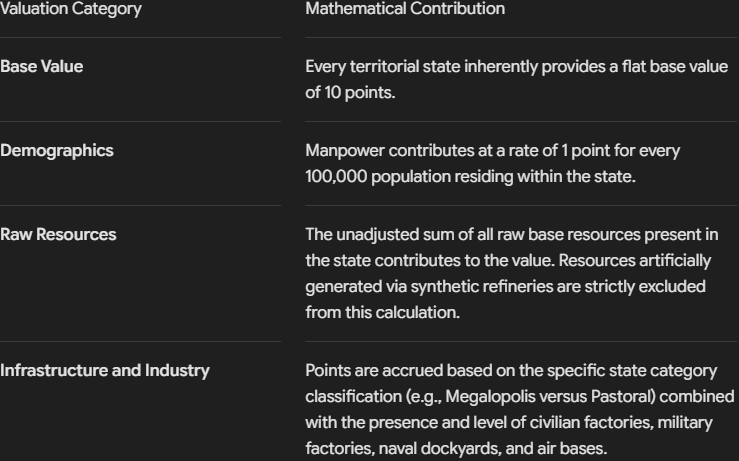
The Enemy State Value is not an arbitrary metric but a precise, compounding calculation of the targeted nation's infrastructure, population, and strategic worth. These values remain static during the actual conference but fluctuate dynamically during the preceding conflict based on infrastructure development.
The Turn-Based Blind Bidding Mechanism
If multiple victors exist within the victorious alliance, the peace conference abandons the unilateral dictated-peace model of older iterations and instead operates iteratively over a series of blind bidding turns. War Score is not granted entirely upfront to prevent immediate monopolization by superpowers. Rather, the allocated score is issued in 20 percent increments distributed across the first five turns of the conference.
To inject systemic equilibrium and prevent hegemonic powers from completely locking out minor participants, the engine implements a "Minimum War Score Per Turn" formula. This algorithmic failsafe calculates 5 percent of the total alliance War Score per turn. Any participant whose 20 percent increment mathematically falls below this 5 percent alliance threshold will have their distribution artificially boosted to meet the minimum, provided they do not exceed their absolute total allocated maximum. This structural quirk allows minor nations with nominal participation to possess disproportionate purchasing power in the opening turn, enabling them to secure highly contested, low-value territories if larger artificial intelligence (AI) allies pass their turn or focus their primary bidding elsewhere.
To inject systemic equilibrium and prevent hegemonic powers from completely locking out minor participants, the engine implements a "Minimum War Score Per Turn" formula. This algorithmic failsafe calculates 5 percent of the total alliance War Score per turn. Any participant whose 20 percent increment mathematically falls below this 5 percent alliance threshold will have their distribution artificially boosted to meet the minimum, provided they do not exceed their absolute total allocated maximum. This structural quirk allows minor nations with nominal participation to possess disproportionate purchasing power in the opening turn, enabling them to secure highly contested, low-value territories if larger artificial intelligence (AI) allies pass their turn or focus their primary bidding elsewhere.
Demand Categorization and the Occupation Multiplier
During a bidding turn, participants act as "Negotiators" to impose demands upon the defeated "Losers," ultimately transferring ownership or benefits to designated "Beneficiaries". The demands available vary wildly depending on the governing ideology of the negotiator. Fascist and Non-Aligned systems heavily prioritize outright territorial annexation, while Democratic systems default toward liberation or forcing ideological government changes, and Communist systems overwhelmingly prioritize establishing subservient puppet regimes.
In addition to territorial transfers, participants can utilize the "Take Navy" mechanic, which allows the victor to demand surviving defeated capital ships, automatically pulling a mathematically proportional number of screening vessels alongside them. Economic demands include Resource Rights, allowing the extraction of materials for five years, and Reparations, which temporarily seizes 50 percent of the state's civilian factories.
A critical mechanic dictating purchasing efficiency is the Occupation Discount. If a participant's armed forces physically occupy a state at the precise moment of enemy capitulation, the algorithm grants a massive 20 percent discount on the War Score cost required to demand that state during the conference. Consequently, physical boots on the ground at the cessation of hostilities exponentially multiply a participant's purchasing power, rendering the strategy of aggressively snaking motorized units into undefended territory highly lucrative. Furthermore, if an allied AI bids on a state simultaneously targeted by the player, the state enters a "Contested" status, resulting in refunded points and an inflated cost in the subsequent turn, which often leads to devastating bidding wars that drain finite resources.
In addition to territorial transfers, participants can utilize the "Take Navy" mechanic, which allows the victor to demand surviving defeated capital ships, automatically pulling a mathematically proportional number of screening vessels alongside them. Economic demands include Resource Rights, allowing the extraction of materials for five years, and Reparations, which temporarily seizes 50 percent of the state's civilian factories.
A critical mechanic dictating purchasing efficiency is the Occupation Discount. If a participant's armed forces physically occupy a state at the precise moment of enemy capitulation, the algorithm grants a massive 20 percent discount on the War Score cost required to demand that state during the conference. Consequently, physical boots on the ground at the cessation of hostilities exponentially multiply a participant's purchasing power, rendering the strategy of aggressively snaking motorized units into undefended territory highly lucrative. Furthermore, if an allied AI bids on a state simultaneously targeted by the player, the state enters a "Contested" status, resulting in refunded points and an inflated cost in the subsequent turn, which often leads to devastating bidding wars that drain finite resources.
The Calculus of War Participation Generation
War Participation dictates the ultimate leverage held at the negotiating table. The percentage is calculated seamlessly by the engine as the specific country's total accumulated points divided by the alliance's combined points. To exploit this system for maximum geopolitical gain, one must deconstruct the precise generation formulas for the eight primary categories of participation: Occupation, Land Combat Damage, Destroyed Enemy Planes, Strategic Bombing, Convoy Raiding, Sunk Enemy Ships, Casualties, and Lend-Lease.
The Mechanics of Occupation Points
Occupation score is generated strictly upon the physical acquisition of an enemy province. The algorithm explicitly prevents participation farming by intentionally losing and recapturing the same province; points are awarded exclusively for first-time captures during the specific conflict.
The formula defining occupation points is calculated as four multiplied by the sum of the victory point value multiplied by 0.2, plus the total state value divided by the number of provinces multiplied by 0.2, plus one. Lake provinces, while actively counted in the denominator for the total number of provinces within the mathematical formula, do not grant any points upon physical capture, making regions with high aquatic terrain density inefficient for occupation farming.
The formula defining occupation points is calculated as four multiplied by the sum of the victory point value multiplied by 0.2, plus the total state value divided by the number of provinces multiplied by 0.2, plus one. Lake provinces, while actively counted in the denominator for the total number of provinces within the mathematical formula, do not grant any points upon physical capture, making regions with high aquatic terrain density inefficient for occupation farming.
Land Combat Damage and the Encirclement Flaw
Land combat constitutes the historical bulk of conventional participation. Points are awarded based on both biological hit point depletion (strength) and industrial equipment destruction. The mathematical formula evaluates the strength damage dealt multiplied by 0.1, combined with the Industrial Capacity (IC) production cost of the destroyed enemy equipment multiplied by 0.08. Crucially, the engine applies a conditional 20 percent multiplier (calculated as 1.2) exclusively if the participant is both the instigating attacker and the ultimate victor of the engagement.
This formula reveals a massive structural flaw regarding operational encirclements. When an enemy division is completely annihilated via an overrun maneuver or by reducing its organization to zero while trapped in a pocket, the engine deletes the remaining personnel strength rather than calculating it as damage dealt. Only the remaining equipment IC is factored into the participation reward. Therefore, executing rapid, tactically brilliant encirclements provides substantially fewer participation points than engaging in prolonged, brutal battles of direct frontal attrition.
This formula reveals a massive structural flaw regarding operational encirclements. When an enemy division is completely annihilated via an overrun maneuver or by reducing its organization to zero while trapped in a pocket, the engine deletes the remaining personnel strength rather than calculating it as damage dealt. Only the remaining equipment IC is factored into the participation reward. Therefore, executing rapid, tactically brilliant encirclements provides substantially fewer participation points than engaging in prolonged, brutal battles of direct frontal attrition.
Strategic Bombing Versus Air Supremacy Destruction
Air warfare provides two distinct avenues for score generation, yet the underlying code treats them with vastly different constraints.
Strategic Bombing is calculated by taking the bombing damage points multiplied by 0.02, and subsequently subtracting a decay factor of 0.1 multiplied by the number of civilian factories still in service multiplied by the number of months passed. Strategic bombing operates as a mathematical trap during major global conflicts because the accumulated score is strictly hard-capped at a maximum of 1,000 points per war. Furthermore, this score actively decays every month based on surviving enemy infrastructure. Investing thousands of industrial units into heavy bombers yields rapidly diminishing returns that simply cannot compete with land or naval operations in a prolonged war.
Conversely, Destroyed Enemy Planes (Air Combat IC Damage) operates entirely without a numerical cap. Every individual point of IC damage inflicted upon enemy aircraft shot down in direct air-to-air combat yields 0.08 participation points. Destroying a late-game fighter wing costing thousands of IC translates to massive, infinitely scaling participation. It must be noted that static anti-air ground emplacements do not contribute to this specific metric; the destruction must be achieved via active fighter interception or air superiority missions executed by the air force.
Strategic Bombing is calculated by taking the bombing damage points multiplied by 0.02, and subsequently subtracting a decay factor of 0.1 multiplied by the number of civilian factories still in service multiplied by the number of months passed. Strategic bombing operates as a mathematical trap during major global conflicts because the accumulated score is strictly hard-capped at a maximum of 1,000 points per war. Furthermore, this score actively decays every month based on surviving enemy infrastructure. Investing thousands of industrial units into heavy bombers yields rapidly diminishing returns that simply cannot compete with land or naval operations in a prolonged war.
Conversely, Destroyed Enemy Planes (Air Combat IC Damage) operates entirely without a numerical cap. Every individual point of IC damage inflicted upon enemy aircraft shot down in direct air-to-air combat yields 0.08 participation points. Destroying a late-game fighter wing costing thousands of IC translates to massive, infinitely scaling participation. It must be noted that static anti-air ground emplacements do not contribute to this specific metric; the destruction must be achieved via active fighter interception or air superiority missions executed by the air force.
Naval Engagements and the Convoy Paradigm Shift
Historically within the game engine, naval actions provided negligible participation points. However, following the systemic overhauls introduced in the No Compromise, No Surrender patch (1.17) and refined in Thunder at Our Gates (1.19), naval warfare was transformed into one of the most lucrative participation generators in the simulation.
The destruction of enemy naval vessels calculates score based on the IC cost of the sunk vessel and the manpower lost. In earlier iterations of the software, the IC multiplier was a mere 0.004, rendering fleet destruction practically useless for conference leverage. However, subsequent patches elevated the defining parameter drastically. The multiplier eventually escalated to 0.1, meaning sinking a capital ship fleet now yields participation points commensurate with grinding down massive infantry army groups.
Similarly, the algorithms governing Convoy Raiding were fundamentally altered. Previously granting a flat nominal point value per convoy with a built-in mathematical decay factor representing enemy shipbuilding efforts, the system was rewritten to remove the decay entirely. Convoy sinking is now tied directly to the IC calculation used for warships, yielding massive returns. Because the AI continuously constructs and fields vulnerable convoys for global trade, supply routing, and troop transport, the oceans present an infinitely renewable resource for participation farming.
The destruction of enemy naval vessels calculates score based on the IC cost of the sunk vessel and the manpower lost. In earlier iterations of the software, the IC multiplier was a mere 0.004, rendering fleet destruction practically useless for conference leverage. However, subsequent patches elevated the defining parameter drastically. The multiplier eventually escalated to 0.1, meaning sinking a capital ship fleet now yields participation points commensurate with grinding down massive infantry army groups.
Similarly, the algorithms governing Convoy Raiding were fundamentally altered. Previously granting a flat nominal point value per convoy with a built-in mathematical decay factor representing enemy shipbuilding efforts, the system was rewritten to remove the decay entirely. Convoy sinking is now tied directly to the IC calculation used for warships, yielding massive returns. Because the AI continuously constructs and fields vulnerable convoys for global trade, supply routing, and troop transport, the oceans present an infinitely renewable resource for participation farming.
The Mathematics of Casualties and Lend-Lease Laundering
Taking biological losses actively rewards participation. For every 1,000 personnel lost, the nation receives 0.5 participation points, a metric that drops to 0.25 points if the nation has already entered a capitulated state. This metric primarily explains why the AI—which frequently launches disastrous, high-attrition frontal assaults across unfavorable terrain—often dominates the final peace conference regardless of actual strategic success. For human players, purposely bleeding manpower is highly inefficient, as inflicting damage rewards roughly fourteen times more points than receiving it.
For industrial powerhouses seeking participation without casualties, the Lend-Lease system provides a passive alternative. Subsidizing allies yields fractional participation calculated by multiplying the IC of equipment sent by 0.003, and subtracting the IC of equipment received multiplied by 0.002. The identical formula applies to fuel shipments, calculated per 100 units of fuel. While heavily nerfed in later expansions, transferring vast stockpiles of surplus aviation fuel or obsolete infantry weaponry to actively fighting allies remains a highly viable passive income stream for nations lacking front-line access.
For industrial powerhouses seeking participation without casualties, the Lend-Lease system provides a passive alternative. Subsidizing allies yields fractional participation calculated by multiplying the IC of equipment sent by 0.003, and subtracting the IC of equipment received multiplied by 0.002. The identical formula applies to fuel shipments, calculated per 100 units of fuel. While heavily nerfed in later expansions, transferring vast stockpiles of surplus aviation fuel or obsolete infantry weaponry to actively fighting allies remains a highly viable passive income stream for nations lacking front-line access.
The Evolution of Algorithmic Constants
The current optimization landscape is the result of continuous developer intervention aimed at curtailing extreme exploitation. Understanding the chronological patch history provides vital context for why certain tactics function today.
Asymmetrical Methodologies: Maximizing War Participation
Understanding the mathematical constants detailed above allows a strategist to exploit specific behavioral flaws in the AI and algorithmic loopholes in point generation. The following asymmetrical methodologies require minimal manpower expenditure while yielding wildly disproportionate War Participation scores, allowing minor nations to rival superpowers.
Strategy 1: The Infinite Convoy Meatgrinder
With the removal of convoy decay penalties and the massive buff to IC-based naval destruction, convoy raiding stands as the premier low-cost strategy for dominating participation metrics. Island nations, or those with highly dispersed colonial empires such as the United Kingdom or Japan, are entirely dependent on maritime logistics and are thus highly vulnerable to this exploit.
Rather than invading and conquering enemy colonies outright, which prematurely terminates the flow of maritime traffic, the strategist must intentionally leave hostile pockets in regions strictly requiring overseas supply, such as North Africa or isolated Pacific atolls. Once isolated, the player deploys massive submarine fleets equipped with advanced snorkels and radar, or land-based Naval Bombers, over the sea zones directly connecting the enemy capital to these stranded pockets.
The AI is programmed with an unbreakable mandate to continuously attempt to resupply its stranded divisions, funneling endless streams of vulnerable convoys into the blockade. Furthermore, when inevitable manpower attrition occurs in these isolated zones, the AI dispatches unprotected troop transports to reinforce them. Sinking these hundreds of convoys and troop transports inflicts massive manpower casualties, yielding 0.004 points per manpower lost, and vast IC destruction at 0.1 points per IC. This perpetual feedback loop frequently eclipses the participation generated by massive, continent-spanning land campaigns.
Strategy 2: High-Agility Air Supremacy Farming
Because the strategic bombing algorithm is hard-capped at 1,000 points and actively decays over time, investing in long-range heavy bombers is a severe miscalculation for participation generation. The true vulnerability lies in the AI's willingness to throw thousands of expensive, easily destroyed aircraft into highly contested airspace.
To execute this strategy, the player must provoke the AI by identifying a high-value air region over an active frontline. If the AI is reluctant to launch its planes, initiating minor strategic bombing or close air support missions will forcefully trigger their hardcoded interception protocols. The player then deploys min-maxed fighter designs prioritizing extreme Agility and Air Attack metrics, utilizing heavy machine guns or cannons combined with top-tier single engines to achieve an overwhelmingly positive kill-to-death ratio.
The attrition cycle that follows is immensely profitable. Every enemy plane destroyed grants 0.08 participation points per unit of IC. A single late-game fighter costs roughly 25 to 30 IC, yielding between 2 and 2.4 participation points per kill. Systematically destroying an AI air force of 5,000 planes generates an uncapped, permanently retained pool of over 10,000 participation points, achieved with near-zero domestic manpower loss.
Strategy 3: The Victory Point Bouncing Grind
The land combat algorithm inherently punishes tactical efficiency. Rapidly encircling and destroying enemy units deprives the player of the points they would have earned from grinding down the unit's hit points linearly, and capturing provinces only grants points the first time they change hands. To circumvent this limitation and extract maximum value from a limited frontline, strategists employ a tactic known as "VP Bouncing."
The execution requires identifying a heavily fortified or highly valued enemy Victory Point or supply hub. The strategist launches a massive, overwhelming attack using high Soft Attack divisions, such as artillery-heavy infantry or soft-attack focused armor configurations. The objective is to inflict maximum strength and equipment damage as rapidly as possible, triggering the conditional 1.2 attacker-winner multiplier.
Crucially, the exact moment the enemy defenders break organization and begin retreating, the strategist must manually halt their own attacking divisions, refusing to step into the empty province. The AI, registering an exposed critical node, will immediately rush fresh, fully equipped divisions into the empty Victory Point to secure the line. Once the AI has re-entrenched, the player simply launches the attack again. This cyclical process converts enemy manpower and industrial capacity directly into participation points without pushing the frontline forward, allowing a minor nation with a small, elite army to vastly out-score a massive allied AI that is merely holding a static line. Furthermore, periodically halting combat allows divisions to reset their experience decay modifiers, ensuring troops remain at maximum veteran status while grinding.
Strategy 4: Proxy War Subsidization (Lend-Lease Laundering)
If operating an industrially dominant nation that wishes to avoid high casualties and direct combat entirely, participation can be purchased directly via the global supply chain. The strategist identifies an allied AI nation actively engaged in a brutal, high-attrition land war, such as the Soviet Union fighting Germany or China fighting Japan.
The player then exports the entirety of their nation's surplus fuel production and obsolete equipment stockpiles to this meatshield ally. Points are generated at a rate of 0.003 per IC and per 100 units of fuel sent. Because the AI will utilize this lent equipment to fight, the player benefits from a profound mathematical double-dip. Not only does the sender gain participation for the act of sending the equipment, but the receiving AI suffers a mathematical penalty to their own participation calculation, deducting 0.002 points per IC or fuel received. This simultaneously inflates the player's score while actively suppressing the ally's score, widening the percentage gap effortlessly and allowing for hostile takeovers of peace conferences without deploying a single soldier.
Strategy 1: The Infinite Convoy Meatgrinder
With the removal of convoy decay penalties and the massive buff to IC-based naval destruction, convoy raiding stands as the premier low-cost strategy for dominating participation metrics. Island nations, or those with highly dispersed colonial empires such as the United Kingdom or Japan, are entirely dependent on maritime logistics and are thus highly vulnerable to this exploit.
Rather than invading and conquering enemy colonies outright, which prematurely terminates the flow of maritime traffic, the strategist must intentionally leave hostile pockets in regions strictly requiring overseas supply, such as North Africa or isolated Pacific atolls. Once isolated, the player deploys massive submarine fleets equipped with advanced snorkels and radar, or land-based Naval Bombers, over the sea zones directly connecting the enemy capital to these stranded pockets.
The AI is programmed with an unbreakable mandate to continuously attempt to resupply its stranded divisions, funneling endless streams of vulnerable convoys into the blockade. Furthermore, when inevitable manpower attrition occurs in these isolated zones, the AI dispatches unprotected troop transports to reinforce them. Sinking these hundreds of convoys and troop transports inflicts massive manpower casualties, yielding 0.004 points per manpower lost, and vast IC destruction at 0.1 points per IC. This perpetual feedback loop frequently eclipses the participation generated by massive, continent-spanning land campaigns.
Strategy 2: High-Agility Air Supremacy Farming
Because the strategic bombing algorithm is hard-capped at 1,000 points and actively decays over time, investing in long-range heavy bombers is a severe miscalculation for participation generation. The true vulnerability lies in the AI's willingness to throw thousands of expensive, easily destroyed aircraft into highly contested airspace.
To execute this strategy, the player must provoke the AI by identifying a high-value air region over an active frontline. If the AI is reluctant to launch its planes, initiating minor strategic bombing or close air support missions will forcefully trigger their hardcoded interception protocols. The player then deploys min-maxed fighter designs prioritizing extreme Agility and Air Attack metrics, utilizing heavy machine guns or cannons combined with top-tier single engines to achieve an overwhelmingly positive kill-to-death ratio.
The attrition cycle that follows is immensely profitable. Every enemy plane destroyed grants 0.08 participation points per unit of IC. A single late-game fighter costs roughly 25 to 30 IC, yielding between 2 and 2.4 participation points per kill. Systematically destroying an AI air force of 5,000 planes generates an uncapped, permanently retained pool of over 10,000 participation points, achieved with near-zero domestic manpower loss.
Strategy 3: The Victory Point Bouncing Grind
The land combat algorithm inherently punishes tactical efficiency. Rapidly encircling and destroying enemy units deprives the player of the points they would have earned from grinding down the unit's hit points linearly, and capturing provinces only grants points the first time they change hands. To circumvent this limitation and extract maximum value from a limited frontline, strategists employ a tactic known as "VP Bouncing."
The execution requires identifying a heavily fortified or highly valued enemy Victory Point or supply hub. The strategist launches a massive, overwhelming attack using high Soft Attack divisions, such as artillery-heavy infantry or soft-attack focused armor configurations. The objective is to inflict maximum strength and equipment damage as rapidly as possible, triggering the conditional 1.2 attacker-winner multiplier.
Crucially, the exact moment the enemy defenders break organization and begin retreating, the strategist must manually halt their own attacking divisions, refusing to step into the empty province. The AI, registering an exposed critical node, will immediately rush fresh, fully equipped divisions into the empty Victory Point to secure the line. Once the AI has re-entrenched, the player simply launches the attack again. This cyclical process converts enemy manpower and industrial capacity directly into participation points without pushing the frontline forward, allowing a minor nation with a small, elite army to vastly out-score a massive allied AI that is merely holding a static line. Furthermore, periodically halting combat allows divisions to reset their experience decay modifiers, ensuring troops remain at maximum veteran status while grinding.
Strategy 4: Proxy War Subsidization (Lend-Lease Laundering)
If operating an industrially dominant nation that wishes to avoid high casualties and direct combat entirely, participation can be purchased directly via the global supply chain. The strategist identifies an allied AI nation actively engaged in a brutal, high-attrition land war, such as the Soviet Union fighting Germany or China fighting Japan.
The player then exports the entirety of their nation's surplus fuel production and obsolete equipment stockpiles to this meatshield ally. Points are generated at a rate of 0.003 per IC and per 100 units of fuel sent. Because the AI will utilize this lent equipment to fight, the player benefits from a profound mathematical double-dip. Not only does the sender gain participation for the act of sending the equipment, but the receiving AI suffers a mathematical penalty to their own participation calculation, deducting 0.002 points per IC or fuel received. This simultaneously inflates the player's score while actively suppressing the ally's score, widening the percentage gap effortlessly and allowing for hostile takeovers of peace conferences without deploying a single soldier.
Geopolitical Pre-Positioning via Volunteer Forces
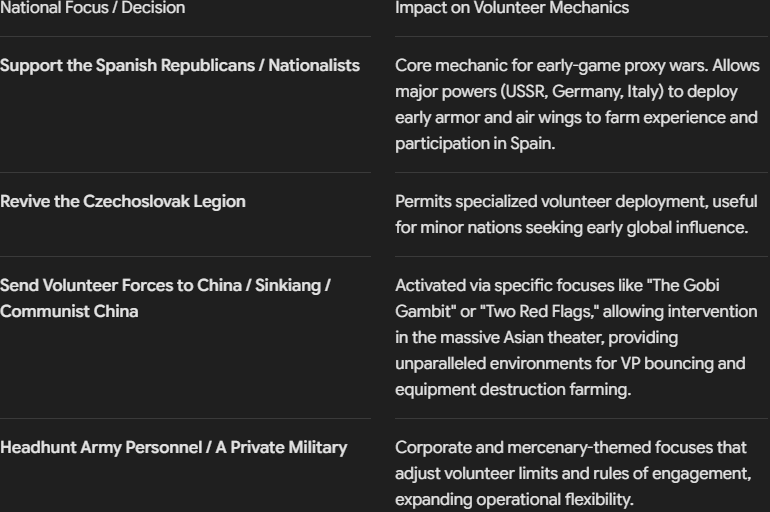
For nations not yet involved in a global conflict, or operating under ideologies that allow early intervention, dispatching volunteer expeditionary forces to regional conflicts provides a dual benefit of participation farming and pre-war military professionalization. The algorithm strictly dictates that the number of volunteer divisions allowed is mathematically capped at one division for every twenty fully deployed domestic divisions, meaning a nation must possess a minimum of thirty active divisions to send even a single volunteer.
Various nations can bypass standard ideological limitations and unlock expanded volunteer capacities through specific National Focus trees.
By utilizing the VP Bouncing tactic within these proxy wars, the resulting Army, Air, and Navy experience gained allows the player to completely overhaul their military doctrines and equipment templates, ensuring absolute superiority prior to the outbreak of major global hostilities.
Various nations can bypass standard ideological limitations and unlock expanded volunteer capacities through specific National Focus trees.
By utilizing the VP Bouncing tactic within these proxy wars, the resulting Army, Air, and Navy experience gained allows the player to completely overhaul their military doctrines and equipment templates, ensuring absolute superiority prior to the outbreak of major global hostilities.
Pre-Game Parameter Exploitation via Custom Rules
For analysts operating outside of strict historical multiplayer constraints, manipulating the Custom Game Rules prior to session initialization provides entirely legal, achievement-compatible avenues to rig the participation distribution algorithms from day one.
The "Faction Members to Faction Leader" parameter is essential for players intending to lead alliances, as it automatically siphons 10 percent of every faction member's hard-earned participation directly to the leader, eliminating the possibility of deadlocks. The "Redistribute Low Scores" rule operates as a vital janitorial function; any AI country finishing with less than 5 percent participation has its entire score zeroed out and proportionally redistributed among nations possessing over 10 percent participation. This concentrates score exclusively among major contributors and eliminates the visual "border gore" caused by irrelevant minor participants demanding single random provinces. Crucially, human players are completely immune to having their score wiped by this low-score rule, ensuring safety even in catastrophic campaigns.
The most potent parameter is the "Puppets to Overlord" rule, which creates massive synergies with the Lend-Lease Laundering tactic. The engine automatically siphons a percentage of a puppet's participation directly to the overlord based on the precise autonomy level of the subject.
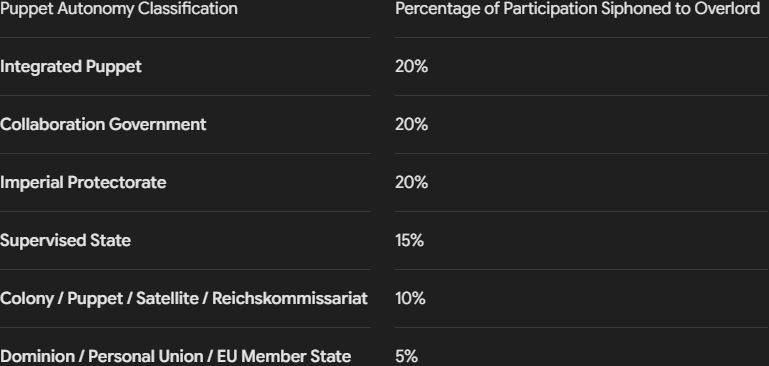
By establishing a Collaboration Government or Integrated Puppet, equipping them via massive Lend-Lease dumps, and allowing their AI to hurl their manpower into the meatgrinder, the overlord passively harvests 20 percent of all generated score while remaining entirely safe behind their own borders.
The "Faction Members to Faction Leader" parameter is essential for players intending to lead alliances, as it automatically siphons 10 percent of every faction member's hard-earned participation directly to the leader, eliminating the possibility of deadlocks. The "Redistribute Low Scores" rule operates as a vital janitorial function; any AI country finishing with less than 5 percent participation has its entire score zeroed out and proportionally redistributed among nations possessing over 10 percent participation. This concentrates score exclusively among major contributors and eliminates the visual "border gore" caused by irrelevant minor participants demanding single random provinces. Crucially, human players are completely immune to having their score wiped by this low-score rule, ensuring safety even in catastrophic campaigns.
The most potent parameter is the "Puppets to Overlord" rule, which creates massive synergies with the Lend-Lease Laundering tactic. The engine automatically siphons a percentage of a puppet's participation directly to the overlord based on the precise autonomy level of the subject.
By establishing a Collaboration Government or Integrated Puppet, equipping them via massive Lend-Lease dumps, and allowing their AI to hurl their manpower into the meatgrinder, the overlord passively harvests 20 percent of all generated score while remaining entirely safe behind their own borders.
Applied Methodology: Advanced Case Studies
The practical application of these mathematical exploits has been heavily documented within the community, particularly concerning the acquisition of difficult achievements where the player controls an industrially starved minor nation.
In the pursuit of the "Hardly Anything Sèvres" achievement, which requires the player to restore the Ottoman Empire and conquer the capitals of major factions, players utilize the blind bidding system's flaws to their advantage. By staging non-aligned coups in the Soviet Union and the United States, the player can invite the resulting rebellions into their faction. By allowing the massively populated AI rebellions to execute the grinding land wars and absorb the casualties, the player can leverage the resulting faction-wide score distribution to secure the necessary capitals in the final conference without having to out-produce the Axis or Allies.
Similarly, the "Siberian Tiger" achievement demands the player form the Siberian State starting as the microscopic nation of Tannu Tuva. Because the player lacks any capacity to out-fight the Soviet Union conventionally, the strategy relies entirely on declaring war precisely when Operation Barbarossa launches, utilizing the occupation discount mechanic. By defensively holding a few key supply hubs along the Trans-Siberian Railway and letting the Soviet AI repeatedly exhaust itself against entrenched positions (a localized form of VP Bouncing), the player can generate a nominal 3 to 5 percent war score. Thanks to the 5 percent Minimum War Score Per Turn rule and the cheapened cost of occupied provinces, this fractional participation is mathematically sufficient to snipe the exact remote provinces required to form Siberia during the opening turns of the peace conference before the German AI can react.
The "Bevrijding" achievement, requiring the Netherlands to capitulate and later liberate itself, showcases the extreme ends of pre-conference manipulation. Players intentionally balkanize the Benelux region, repeatedly swap ideologies from Fascist to Democratic, and drag major powers into isolated, artificial conflicts. By puppeting Germany in a localized, early war and excluding them from the wider global conflict, the player artificially constraints the participants allowed into the final peace conference, guaranteeing absolute dominance over the territorial division regardless of actual participation generated during the wider World War II conflict.
Finally, for "Crusader Kings IV" (requiring Ethiopia to capture Jerusalem), players exploit the By Blood Alone balkanization mechanics. While locked in a defensive grind against Italy, the player takes focuses to shatter their own empire into multiple specialized vassals. These vassals independently generate resources and manpower. By bleeding the Italian AI in the mountains and utilizing the "Puppets to Overlord" participation siphon, Ethiopia generates massive score via defensive casualties and puppet transfers, allowing them to turn the tables and dominate the eventual peace conference without ever launching a massive offensive.
In the pursuit of the "Hardly Anything Sèvres" achievement, which requires the player to restore the Ottoman Empire and conquer the capitals of major factions, players utilize the blind bidding system's flaws to their advantage. By staging non-aligned coups in the Soviet Union and the United States, the player can invite the resulting rebellions into their faction. By allowing the massively populated AI rebellions to execute the grinding land wars and absorb the casualties, the player can leverage the resulting faction-wide score distribution to secure the necessary capitals in the final conference without having to out-produce the Axis or Allies.
Similarly, the "Siberian Tiger" achievement demands the player form the Siberian State starting as the microscopic nation of Tannu Tuva. Because the player lacks any capacity to out-fight the Soviet Union conventionally, the strategy relies entirely on declaring war precisely when Operation Barbarossa launches, utilizing the occupation discount mechanic. By defensively holding a few key supply hubs along the Trans-Siberian Railway and letting the Soviet AI repeatedly exhaust itself against entrenched positions (a localized form of VP Bouncing), the player can generate a nominal 3 to 5 percent war score. Thanks to the 5 percent Minimum War Score Per Turn rule and the cheapened cost of occupied provinces, this fractional participation is mathematically sufficient to snipe the exact remote provinces required to form Siberia during the opening turns of the peace conference before the German AI can react.
The "Bevrijding" achievement, requiring the Netherlands to capitulate and later liberate itself, showcases the extreme ends of pre-conference manipulation. Players intentionally balkanize the Benelux region, repeatedly swap ideologies from Fascist to Democratic, and drag major powers into isolated, artificial conflicts. By puppeting Germany in a localized, early war and excluding them from the wider global conflict, the player artificially constraints the participants allowed into the final peace conference, guaranteeing absolute dominance over the territorial division regardless of actual participation generated during the wider World War II conflict.
Finally, for "Crusader Kings IV" (requiring Ethiopia to capture Jerusalem), players exploit the By Blood Alone balkanization mechanics. While locked in a defensive grind against Italy, the player takes focuses to shatter their own empire into multiple specialized vassals. These vassals independently generate resources and manpower. By bleeding the Italian AI in the mountains and utilizing the "Puppets to Overlord" participation siphon, Ethiopia generates massive score via defensive casualties and puppet transfers, allowing them to turn the tables and dominate the eventual peace conference without ever launching a massive offensive.
Strategic Synthesis at the Negotiating Table
Amassing a high War Participation percentage guarantees a large allocation of the initial War Score, but strategic deployment of that currency during the turn-based conference is what ultimately secures geopolitical hegemony.
The most critical tactical maneuver is leveraging the Occupation Discount. In the closing months of a conflict, players must abandon slow, methodical pushes and instead aggressively snake fast-moving motorized or cavalry divisions into high-value industrial states, such as the Rhineland or the Home Counties. Even if the player did not inflict the majority of the mathematical damage required to capitulate the enemy, holding the physical real estate at the exact hour of capitulation applies the 20 percent cost reduction, effectively stretching a mid-tier participation score into top-tier purchasing power.
Furthermore, strategists must expertly navigate the Contested Demand penalty. If a player possesses a lower participation score, engaging in a direct bidding war with an AI superpower over a core territory is a mathematically guaranteed failure; the AI will effortlessly outbid the player until the player's currency is entirely exhausted. Instead, the optimal route is to immediately pivot demands to uncontested, high-resource colonial states, or to utilize the "Take Navy" mechanic, which the terrestrial-focused AI frequently neglects until the final turns of the conference.
For Democratic or Non-Aligned nations facing exorbitant participation penalties for outright annexation, the puppeting bypass remains the ultimate exploit. Rather than annexing states at a massive premium, the strategist puppets a single, low-value state of the defeated major during the first turn. In subsequent turns, the player utilizes their remaining War Score to funnel the rest of the defeated nation's core territories back into that newly created puppet. Because the engine registers this action as returning core territory to an existing subject, it applies massive cost discounts. Following the conference's conclusion, the player utilizes standard autonomy suppression mechanics, such as massive infrastructure construction and Lend-Lease dumping, to diplomatically annex the puppet, thereby acquiring the entire defeated nation's industrial base for a fraction of the raw annexation cost.
Ultimately, success within the post-By Blood Alone environment is dictated entirely by a cold, algorithmic evaluation of participation metrics. By identifying the mathematical flaws within the defines.lua architecture—such as the infinite convoy meatgrinder, uncapped air supremacy destruction, and the VP bouncing exploit—any nation can dictate the geopolitical future of the globe.
The most critical tactical maneuver is leveraging the Occupation Discount. In the closing months of a conflict, players must abandon slow, methodical pushes and instead aggressively snake fast-moving motorized or cavalry divisions into high-value industrial states, such as the Rhineland or the Home Counties. Even if the player did not inflict the majority of the mathematical damage required to capitulate the enemy, holding the physical real estate at the exact hour of capitulation applies the 20 percent cost reduction, effectively stretching a mid-tier participation score into top-tier purchasing power.
Furthermore, strategists must expertly navigate the Contested Demand penalty. If a player possesses a lower participation score, engaging in a direct bidding war with an AI superpower over a core territory is a mathematically guaranteed failure; the AI will effortlessly outbid the player until the player's currency is entirely exhausted. Instead, the optimal route is to immediately pivot demands to uncontested, high-resource colonial states, or to utilize the "Take Navy" mechanic, which the terrestrial-focused AI frequently neglects until the final turns of the conference.
For Democratic or Non-Aligned nations facing exorbitant participation penalties for outright annexation, the puppeting bypass remains the ultimate exploit. Rather than annexing states at a massive premium, the strategist puppets a single, low-value state of the defeated major during the first turn. In subsequent turns, the player utilizes their remaining War Score to funnel the rest of the defeated nation's core territories back into that newly created puppet. Because the engine registers this action as returning core territory to an existing subject, it applies massive cost discounts. Following the conference's conclusion, the player utilizes standard autonomy suppression mechanics, such as massive infrastructure construction and Lend-Lease dumping, to diplomatically annex the puppet, thereby acquiring the entire defeated nation's industrial base for a fraction of the raw annexation cost.
Ultimately, success within the post-By Blood Alone environment is dictated entirely by a cold, algorithmic evaluation of participation metrics. By identifying the mathematical flaws within the defines.lua architecture—such as the infinite convoy meatgrinder, uncapped air supremacy destruction, and the VP bouncing exploit—any nation can dictate the geopolitical future of the globe.
Mod
More Hearts of Iron IV guides
- Division Templates, Tank Designs, Aircraft Designs, and Metas (Bolivar 1.14+)★ 5 (3k)173k views8.7k ♥29 minUpdated Apr 30, 2025
- The Ultimate Guide to Division Templates, Aircraft and Tank Designs (Updated 15-06-2026)★ 5 (3.3k)134k views11k ♥54 minUpdated Jul 6
- Выполняем достижения в Hearts of Iron 4★ 5 (3.2k)69k views7.9k ♥326 minRussianUpdated Jul 19
- The Ultimate Guide to Navy; Ship Templates and Fleet Composition (Updated 24-3-2026)★ 5 (1.2k)61k views4.9k ♥33 minUpdated May 17
- HOI4. Большой гайд★ 5 (738)58k views2k ♥101 minRussian
- Лучшие шаблоны в HoI IV (1.15v.)★ 5 (612)49k views2.2k ♥6 minRussianUpdated May 20




🔥 Popular guides
- Upgrading to PremiumTeam Fortress 2★ 5 (20k)1441k views11k ♥6 minUpdated May 11, 2022
- No More Room in Hell Official ManualNo More Room in Hell★ 5 (2.8k)569k views2.1k ♥29 minUpdated Apr 22, 2019
- NMRiH Community Hosting GuidesNo More Room in Hell★ 5 (526)351k views653 ♥1 minUpdated Aug 10, 2022
- Лучшие кооперативные игры SteamPAYDAY 2★ 5 (1.5k)315k views2.1k ♥56 minRussianUpdated Apr 27, 2025
- Desert Eagle Heat Treated | Blue GemCounter-Strike 2★ 5 (1.6k)292k views1.5k ♥2 minUpdated Jan 16
- Treasure Hunt Puzzle SolutionsTotal War: WARHAMMER II★ 5 (6.9k)281k views15k ♥3 minUpdated Aug 19, 2021





This guide was created by its original author on the Steam Community. Are you the author and want it removed? Request removal.