Advanced Operational Blueprint: Mitigating the Late-Game Crisis and Forcing Pre-1943 Capitulations in Hearts of Iron IV
The Strategic Imperative of the Pre-1943 Resolution
Within the grand strategy framework of Hearts of Iron IV, the simulation engine heavily penalizes prolonged, attritional conflicts. As the global timeline extends beyond 1943, players invariably encounter the "late-game crisis." This phenomenon is characterized by severe computational lag induced by the unchecked proliferation of artificial intelligence (AI) divisions, complex global naval task force calculations, and the exponential growth of supply network pathfinding. From a purely strategic and operational perspective, late-game warfare devolves into impenetrable stalemates. Frontlines become saturated with highly entrenched infantry, dense anti-air networks negate close air support, and global manpower pools are exhausted through endless, low-impact offensives.
Consequently, mastering the precise mechanics required to force a decisive conclusion to major conflicts by 1941 or 1942 is not merely an optimization strategy; it is a fundamental requirement for maintaining operational momentum and engine stability. Achieving a pre-1943 victory requires a flawless sequence of actions: the mathematical optimization of industrial conversion, the preemptive manipulation of enemy surrender thresholds through covert operations, and the specialized application of breakthrough mechanics.
When conventional land warfare inevitably fails to break deeply fortified lines—such as those encountered in late-game continental pushes, mountainous chokepoints, or island fortress invasions—the strategic integration of airborne operations and the sophisticated Götterdämmerung-era nuclear raid system becomes the ultimate instrument of operational resolution. This comprehensive report details the precise industrial, doctrinal, and tactical methodologies required to bypass the late-game crisis, shatter deadlocked fronts, and force early capitulations.
Consequently, mastering the precise mechanics required to force a decisive conclusion to major conflicts by 1941 or 1942 is not merely an optimization strategy; it is a fundamental requirement for maintaining operational momentum and engine stability. Achieving a pre-1943 victory requires a flawless sequence of actions: the mathematical optimization of industrial conversion, the preemptive manipulation of enemy surrender thresholds through covert operations, and the specialized application of breakthrough mechanics.
When conventional land warfare inevitably fails to break deeply fortified lines—such as those encountered in late-game continental pushes, mountainous chokepoints, or island fortress invasions—the strategic integration of airborne operations and the sophisticated Götterdämmerung-era nuclear raid system becomes the ultimate instrument of operational resolution. This comprehensive report details the precise industrial, doctrinal, and tactical methodologies required to bypass the late-game crisis, shatter deadlocked fronts, and force early capitulations.
Macro-Economic Architecture and Industrial Optimization
The foundation of any rapid victory relies on the precise mathematical timing of industrial conversion. The optimal period for constructing Civilian Factories concludes no later than January 1938. Continuing civilian construction beyond this point represents a strategic miscalculation, as it severely delays the compounding output of Military Factories. Military production requires extensive lead time to stockpile the necessary infantry equipment, support modules, artillery, and aircraft required for a decisive 1940-1941 offensive.
During the initial civilian economic phase, infrastructure development must be maximized in states featuring high construction slot density and abundant raw materials. Infrastructure provides a multiplicative bonus to the construction speed of all subsequent factories built in that state, ensuring that the transition to a war economy yields immediate dividends. Once the transition to military production occurs in early 1938, the allocation of factories must prioritize force multipliers over excessive frontline bloat.
For major powers, securing air superiority is an absolute prerequisite for rapid operational success. It is mathematically established that the continuous production of Fighter aircraft should occupy a significant plurality of military factories, often scaling to 25 to 40 dedicated factories prior to the outbreak of major hostilities. The air war dictates the success of ground operations; possessing absolute air superiority (green air) inflicts a severe debuff on enemy defense and breakthrough stats, scaling up to a -35% penalty, which can be further amplified by specific battlefield support doctrines. Attempting to push a frontline without air superiority results in catastrophic equipment and manpower losses, guaranteeing the onset of the late-game stalemate.
During the initial civilian economic phase, infrastructure development must be maximized in states featuring high construction slot density and abundant raw materials. Infrastructure provides a multiplicative bonus to the construction speed of all subsequent factories built in that state, ensuring that the transition to a war economy yields immediate dividends. Once the transition to military production occurs in early 1938, the allocation of factories must prioritize force multipliers over excessive frontline bloat.
For major powers, securing air superiority is an absolute prerequisite for rapid operational success. It is mathematically established that the continuous production of Fighter aircraft should occupy a significant plurality of military factories, often scaling to 25 to 40 dedicated factories prior to the outbreak of major hostilities. The air war dictates the success of ground operations; possessing absolute air superiority (green air) inflicts a severe debuff on enemy defense and breakthrough stats, scaling up to a -35% penalty, which can be further amplified by specific battlefield support doctrines. Attempting to push a frontline without air superiority results in catastrophic equipment and manpower losses, guaranteeing the onset of the late-game stalemate.
Defending the Line and Bleeding the Adversary
To execute a pre-1943 victory, the military apparatus must be distinctly bifurcated into a low-cost, high-efficiency defensive backbone and a highly concentrated, specialized offensive spearhead. The defensive line exists solely to bleed the enemy of their equipment, organization, and manpower, relying on the AI's predictable tendency to execute futile, sustained assaults against entrenched positions.
The optimal defensive infantry template utilizes a highly efficient, smaller combat width, typically optimized at 16 to 18 width, consisting of 9 or 10 infantry battalions. A defensive division must maximize organization and hit points (HP), which are naturally provided by pure infantry battalions. Support companies are the defining factor in defensive resilience. Engineer Companies are strictly mandatory, providing critical entrenchment bonuses and terrain modifiers that allow infantry to hold against vastly superior numbers. Support Anti-Air is equally critical; not only does it provide sufficient piercing to defeat early-game light tanks, but it fundamentally mitigates the effects of hostile close air support by up to 75% if air superiority is temporarily lost. Finally, Support Artillery provides the necessary soft attack to de-organize attacking infantry before they can leverage their breakthrough stats.
These defensive divisions must be placed strategically behind major geographic barriers, utilizing river lines, forests, or mountain ranges to stack defensive terrain modifiers. Supply hubs along the immediate border should be deliberately destroyed or denied via scorched earth tactics, forcing the enemy to operate under severe attrition penalties while the defending forces benefit from level 4 or 5 railways connected to secure, rear-echelon hubs.
The optimal defensive infantry template utilizes a highly efficient, smaller combat width, typically optimized at 16 to 18 width, consisting of 9 or 10 infantry battalions. A defensive division must maximize organization and hit points (HP), which are naturally provided by pure infantry battalions. Support companies are the defining factor in defensive resilience. Engineer Companies are strictly mandatory, providing critical entrenchment bonuses and terrain modifiers that allow infantry to hold against vastly superior numbers. Support Anti-Air is equally critical; not only does it provide sufficient piercing to defeat early-game light tanks, but it fundamentally mitigates the effects of hostile close air support by up to 75% if air superiority is temporarily lost. Finally, Support Artillery provides the necessary soft attack to de-organize attacking infantry before they can leverage their breakthrough stats.
These defensive divisions must be placed strategically behind major geographic barriers, utilizing river lines, forests, or mountain ranges to stack defensive terrain modifiers. Supply hubs along the immediate border should be deliberately destroyed or denied via scorched earth tactics, forcing the enemy to operate under severe attrition penalties while the defending forces benefit from level 4 or 5 railways connected to secure, rear-echelon hubs.
Designing the Offensive Spearhead
Conversely, offensive divisions must maximize their statistical output per combat width to force rapid battle resolutions. A division with zero breakthrough that wins a combat in 6 hours will take mathematically less damage than a high-breakthrough division that requires 48 hours to dislodge a defender. The objective of an offensive spearhead is to overwhelm the defender's defense stat as quickly as possible, ensuring that every subsequent attack registers as a critical hit against the defender's organization pool.
Medium tank divisions designed at 30 to 35 combat width, integrating motorized or mechanized infantry to maintain division organization above a baseline of 30, are the primary vectors for achieving these rapid resolutions.
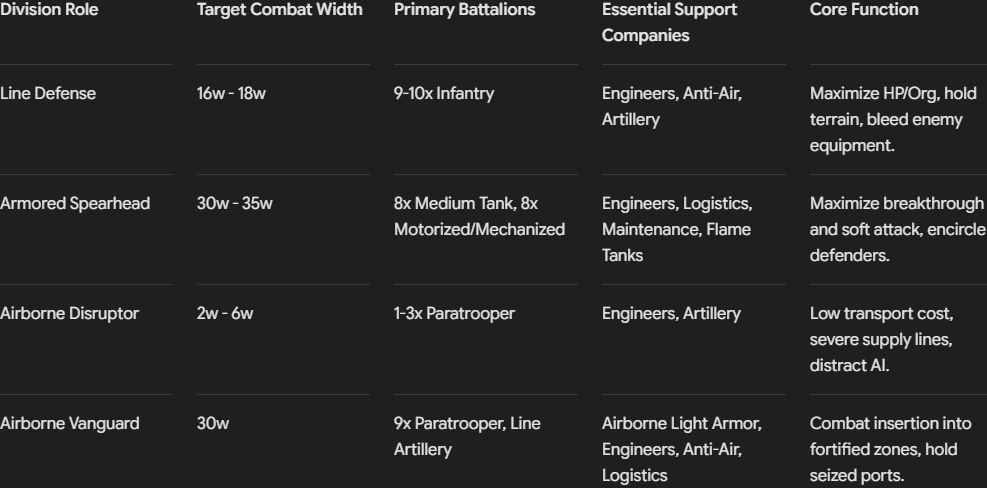
Medium tank divisions designed at 30 to 35 combat width, integrating motorized or mechanized infantry to maintain division organization above a baseline of 30, are the primary vectors for achieving these rapid resolutions.
Subverting the Capitulation Mathematics: Collaboration Governments
The most efficient method to accelerate a war's conclusion is not merely to conquer territory faster, but to fundamentally alter the mathematical threshold at which the enemy nation decides to capitulate. By default, a nation capitulates when it loses control of 80% of its victory points (VP). While certain national spirits, such as France's "Disjointed Government," naturally reduce this threshold, fighting monolithic entities like the Soviet Union or the United States requires marching across vast, low-supply continents to secure that 80% threshold, which is the primary cause of operational exhaustion and late-game lag.
This systemic limitation is circumvented entirely through the strategic application of the intelligence agency. The covert operation "Prepare Collaboration Government" represents the highest return on investment in the game. It requires maintaining a high intelligence network strength (50%), a significant investment of civilian factories, a stockpile of infantry equipment, and 150 days of preparation followed by the execution phase.
Each successful operation yields an immediate increase in local collaboration, up to a maximum of 100%. Most crucially, achieving 100% collaboration reduces the enemy's surrender limit by an absolute 30%. Consequently, a nation that originally required the occupation of 80% of its VPs will capitulate upon losing only 50% of its VPs, effectively cutting the required duration and geographical scope of the war in half.
Furthermore, upon capitulation, the occupying power retains the accumulated compliance. Starting a massive occupation with 100% compliance ensures immediate access to the maximum threshold of local resources, civilian factories, military factories, and a percentage of the capitulated nation's manpower pool. This completely negates the burdensome garrison requirements and resistance mechanics that typically drag down an expanding empire's momentum and drain its infantry equipment stockpiles. When the collaboration exceeds 80%, the occupier can immediately install a Collaboration Government puppet state, which permanently grants 75% of its total civilian and military factories to the overlord without generating the autonomy that standard puppet states do.
This systemic limitation is circumvented entirely through the strategic application of the intelligence agency. The covert operation "Prepare Collaboration Government" represents the highest return on investment in the game. It requires maintaining a high intelligence network strength (50%), a significant investment of civilian factories, a stockpile of infantry equipment, and 150 days of preparation followed by the execution phase.
Each successful operation yields an immediate increase in local collaboration, up to a maximum of 100%. Most crucially, achieving 100% collaboration reduces the enemy's surrender limit by an absolute 30%. Consequently, a nation that originally required the occupation of 80% of its VPs will capitulate upon losing only 50% of its VPs, effectively cutting the required duration and geographical scope of the war in half.
Furthermore, upon capitulation, the occupying power retains the accumulated compliance. Starting a massive occupation with 100% compliance ensures immediate access to the maximum threshold of local resources, civilian factories, military factories, and a percentage of the capitulated nation's manpower pool. This completely negates the burdensome garrison requirements and resistance mechanics that typically drag down an expanding empire's momentum and drain its infantry equipment stockpiles. When the collaboration exceeds 80%, the occupier can immediately install a Collaboration Government puppet state, which permanently grants 75% of its total civilian and military factories to the overlord without generating the autonomy that standard puppet states do.
Vertical Envelopment: Mastering Airborne Operations
When conventional armored spearheads stall against heavily fortified river crossings, mountain ranges, or coastal island fortresses, airborne operations offer the unique ability to bypass the two-dimensional frontline entirely. The utilization of Paratroopers is heavily dependent on precise division design, a deep logistical understanding of transport aviation mechanics, and the integration of highly specialized doctrines.
The design of a paratrooper division dictates its operational role, falling broadly into two distinct categories. The Minimalist Disruptor division is designed with a 2 to 6 combat width, consisting of one to three paratrooper battalions, often accompanied by solely an Engineer or Support Artillery company. The objective of these units is not sustained combat or frontline engagement. Instead, they are dropped en masse across vital railway junctions, supply hubs, and secondary victory points deep behind enemy lines. By severing the logistical tether of the frontline, the enemy's primary divisions suffer immediate out-of-supply penalties, allowing the conventional army to shatter the frontline stalemate. Furthermore, due to transport plane weight calculations—where a standard battalion weighs 0.5 and a support company weighs 0.1—these highly minimized divisions require vastly fewer transport planes to deploy, allowing a minor nation to execute massive airborne disruptions with a limited air force.
Conversely, the Airborne Shock Force is designed for contested drops and immediate offensive action upon landing. These templates incorporate 20 to 30 combat width, utilizing 9 to 10 paratrooper battalions supported by line artillery and a dense array of support companies including Engineers, Support Artillery, Anti-Air, Logistics, and most importantly, Airborne Light Armor.
The design of a paratrooper division dictates its operational role, falling broadly into two distinct categories. The Minimalist Disruptor division is designed with a 2 to 6 combat width, consisting of one to three paratrooper battalions, often accompanied by solely an Engineer or Support Artillery company. The objective of these units is not sustained combat or frontline engagement. Instead, they are dropped en masse across vital railway junctions, supply hubs, and secondary victory points deep behind enemy lines. By severing the logistical tether of the frontline, the enemy's primary divisions suffer immediate out-of-supply penalties, allowing the conventional army to shatter the frontline stalemate. Furthermore, due to transport plane weight calculations—where a standard battalion weighs 0.5 and a support company weighs 0.1—these highly minimized divisions require vastly fewer transport planes to deploy, allowing a minor nation to execute massive airborne disruptions with a limited air force.
Conversely, the Airborne Shock Force is designed for contested drops and immediate offensive action upon landing. These templates incorporate 20 to 30 combat width, utilizing 9 to 10 paratrooper battalions supported by line artillery and a dense array of support companies including Engineers, Support Artillery, Anti-Air, Logistics, and most importantly, Airborne Light Armor.
The Airborne Light Armor Paradigm
The integration of the Airborne Light Armor support company represents a paradigm shift for paratrooper lethality and survivability. This module requires the design of a specialized light tank utilizing a light chassis. To optimize the Airborne Light Tank, the design must prioritize soft attack and breakthrough at the expense of speed and engine power, as the vehicle's speed is entirely irrelevant when utilized as a support company.
An optimal configuration includes a 3-man turret for breakthrough, a close support gun (or a medium howitzer if the specific chassis technology permits), dual heavy machine guns for anti-infantry saturation, wet ammunition storage to guarantee reliability, and basic riveted armor to minimize production costs and resource consumption. Deploying this specialized support company within a 30-width paratrooper division introduces significant armor, hardness, and soft attack stats to the unit, effectively transforming the airborne infantry into a mechanized spearhead capable of holding contested ports against concerted, armored counter-attacks.
An optimal configuration includes a 3-man turret for breakthrough, a close support gun (or a medium howitzer if the specific chassis technology permits), dual heavy machine guns for anti-infantry saturation, wet ammunition storage to guarantee reliability, and basic riveted armor to minimize production costs and resource consumption. Deploying this specialized support company within a 30-width paratrooper division introduces significant armor, hardness, and soft attack stats to the unit, effectively transforming the airborne infantry into a mechanized spearhead capable of holding contested ports against concerted, armored counter-attacks.
Doctrinal Synergy: Elevating the Paratroopers
The Arms Against Tyranny framework introduced a dedicated Special Forces doctrine branch that requires Air Experience to unlock, fundamentally altering how airborne drops influence the operational theater.
Advancing down the Paratrooper tree yields the "Combat Insertion" doctrine, which is arguably the most powerful tactical tool for breaking stalemates. This critical doctrine node applies an immediate, severe organizational reduction to any enemy units stationed in the exact province where the paratroopers land. This specific mechanic permits paratroopers to drop directly onto garrisoned ports, island fortresses, or highly defended victory points, inflicting severe temporary debuffs that allow the airborne infantry to overwhelm entrenched defenders instantly before they can leverage their defensive stats.
Complementing this is the "Reconnaissance and Sabotage" node. Paratroopers dropping into an enemy-controlled state inflict immediate damage to military factories, civilian factories, and infrastructure. This simulates the systemic chaos of a massive airborne landing and prevents the enemy from utilizing local railways to reinforce the breached sector, effectively isolating the defenders and preventing operational reserves from arriving in time to repel the invasion.
Advancing down the Paratrooper tree yields the "Combat Insertion" doctrine, which is arguably the most powerful tactical tool for breaking stalemates. This critical doctrine node applies an immediate, severe organizational reduction to any enemy units stationed in the exact province where the paratroopers land. This specific mechanic permits paratroopers to drop directly onto garrisoned ports, island fortresses, or highly defended victory points, inflicting severe temporary debuffs that allow the airborne infantry to overwhelm entrenched defenders instantly before they can leverage their defensive stats.
Complementing this is the "Reconnaissance and Sabotage" node. Paratroopers dropping into an enemy-controlled state inflict immediate damage to military factories, civilian factories, and infrastructure. This simulates the systemic chaos of a massive airborne landing and prevents the enemy from utilizing local railways to reinforce the breached sector, effectively isolating the defenders and preventing operational reserves from arriving in time to repel the invasion.
Transport Aviation Logistics and Deployment Mathematics
The primary operational bottleneck for airborne operations is the strict, often misunderstood requirement for transport planes. A profound misunderstanding of these mechanics frequently leads to operational failure, where paratroopers sit idle on the runway despite ostensibly having air superiority.
To execute any paradrop order, the originating airbase must contain a minimum baseline of 50 transport planes. This is a hardcoded threshold; possessing 49 planes means no drops can occur, regardless of division size. Beyond this baseline, the exact number of planes required scales linearly with the number of divisions assigned to the specific order. The mathematical base requirement is 45 transport planes per division.
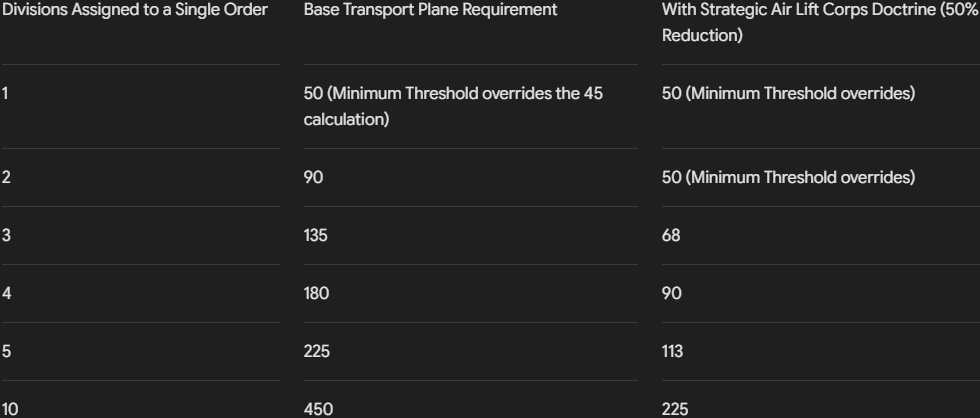
This table illustrates a critical tactical workaround for nations with limited industrial capacity. If a player possesses exactly 50 transport planes, they cannot assign 10 divisions to a single drop order, as that requires 450 planes. However, if the player creates 10 individual drop orders, each containing exactly 1 division, the AI will execute the first drop using the 50 planes, return the planes to base, and subsequently launch the second drop a few in-game hours later. This allows the entire 10-division army to be deployed over a few days using only a fraction of the intended aircraft.
Furthermore, this plane requirement can be permanently mitigated through doctrinal modifiers. The "Glider Planes" technology reduces the requirement slightly, but the "Strategic Air Lift Corps" node in the Special Forces doctrine applies a massive 50% discount to the total transport plane requirement. When these modifiers stack multiplicatively, the cost per division drops dramatically, allowing massive airborne armies to be deployed simultaneously without requiring the player to dedicate dozens of military factories to transport plane production.
Finally, air superiority is the ultimate prerequisite. The execution of a paradrop mandates a minimum of 70% air superiority along the entire flight path, across every intervening air zone. Failure to secure this will result in the transport planes remaining grounded, or worse, if intercepted en route, the catastrophic loss of the transported elite divisions.
To execute any paradrop order, the originating airbase must contain a minimum baseline of 50 transport planes. This is a hardcoded threshold; possessing 49 planes means no drops can occur, regardless of division size. Beyond this baseline, the exact number of planes required scales linearly with the number of divisions assigned to the specific order. The mathematical base requirement is 45 transport planes per division.
This table illustrates a critical tactical workaround for nations with limited industrial capacity. If a player possesses exactly 50 transport planes, they cannot assign 10 divisions to a single drop order, as that requires 450 planes. However, if the player creates 10 individual drop orders, each containing exactly 1 division, the AI will execute the first drop using the 50 planes, return the planes to base, and subsequently launch the second drop a few in-game hours later. This allows the entire 10-division army to be deployed over a few days using only a fraction of the intended aircraft.
Furthermore, this plane requirement can be permanently mitigated through doctrinal modifiers. The "Glider Planes" technology reduces the requirement slightly, but the "Strategic Air Lift Corps" node in the Special Forces doctrine applies a massive 50% discount to the total transport plane requirement. When these modifiers stack multiplicatively, the cost per division drops dramatically, allowing massive airborne armies to be deployed simultaneously without requiring the player to dedicate dozens of military factories to transport plane production.
Finally, air superiority is the ultimate prerequisite. The execution of a paradrop mandates a minimum of 70% air superiority along the entire flight path, across every intervening air zone. Failure to secure this will result in the transport planes remaining grounded, or worse, if intercepted en route, the catastrophic loss of the transported elite divisions.
The Atomic Option: Nuclear Development and Raid Mechanics
If conventional armor and airborne vertical envelopment cannot dislodge an entrenched adversary—particularly in late-game scenarios where nations have stacked 20 heavily equipped divisions on a single fortified mountain tile or a vital strait crossing—the application of nuclear weapons becomes a mandatory tactical requirement. The Götterdämmerung expansion and Patch 1.15 fundamentally overhauled nuclear technology, transitioning it from a simplistic, instantaneous map-click mechanic to a deeply integrated, highly realistic system of Special Projects, Experimental Facilities, and structured Raids.
Scientific Infrastructure and Experimental Facilities
The path to nuclear armament no longer relies solely on passive technology research. It begins with the massive industrial construction of an Advanced Physics Facility. These facilities act as the epicenter for the nation's scientific endeavors and must be intimately connected to the global supply network, meaning they can only be built in provinces adjacent to a high-level supply hub or naval base. Once the physical infrastructure is established, a Scientist must be employed to conduct basic research and oversee the project.
Scientists are recruited using Political Power, with costs scaling sequentially for each hire (25, 50, 75). To expedite the nuclear program and achieve armament by 1942, the player must isolate and recruit a scientist possessing the Nuclear Specialist or Genius trait. These traits provide profound multiplicative bonuses to research speed and daily experience gain. By performing basic research, these scientists generate daily "scientific breakthrough progress" (with a base of 0.28 experience per day, modified by their specific traits and skill level).
Scientists are recruited using Political Power, with costs scaling sequentially for each hire (25, 50, 75). To expedite the nuclear program and achieve armament by 1942, the player must isolate and recruit a scientist possessing the Nuclear Specialist or Genius trait. These traits provide profound multiplicative bonuses to research speed and daily experience gain. By performing basic research, these scientists generate daily "scientific breakthrough progress" (with a base of 0.28 experience per day, modified by their specific traits and skill level).
The Special Project Pathway
Once sufficient breakthrough progress is accumulated through basic research, the player can initiate Special Projects. These projects represent massive industrial and temporal investments, progressing through various prototype iteration phases where random outcomes can either accelerate or hinder development.
The first mandatory step is the Nuclear Reactor Project. This project is the prerequisite to producing fissile material, and its successful completion unlocks the state-level Nuclear Reactor building. Depending on the randomized prototype outcomes during the research phase, the player may unlock standard Nuclear Reactors or advanced Heavy Water Nuclear Reactors, and typically receives one free facility instantly upon project completion in the state where the research was conducted.
The subsequent step is the Nuclear Fission Bomb Project (historically analogous to the Manhattan Project or the Soviet RDS-1). This project translates the output of the reactors into weaponized payloads. Upon completion, the nation is granted its first free nuclear device to conduct an initial test, permanently enabling the stockpiling of atomic weapons.
Reactor output is strictly governed by time and the type of reactor constructed. A standard Nuclear Reactor produces one fission bomb every 852 days (roughly 2.34 years), while a Heavy Water Reactor produces one fission bomb every 1278 days (3.5 years) but is optimized for later thermonuclear payload generation. Therefore, to stockpile a sufficient arsenal for a major late-game offensive, multiple reactors must be constructed immediately upon unlocking the technology.
The first mandatory step is the Nuclear Reactor Project. This project is the prerequisite to producing fissile material, and its successful completion unlocks the state-level Nuclear Reactor building. Depending on the randomized prototype outcomes during the research phase, the player may unlock standard Nuclear Reactors or advanced Heavy Water Nuclear Reactors, and typically receives one free facility instantly upon project completion in the state where the research was conducted.
The subsequent step is the Nuclear Fission Bomb Project (historically analogous to the Manhattan Project or the Soviet RDS-1). This project translates the output of the reactors into weaponized payloads. Upon completion, the nation is granted its first free nuclear device to conduct an initial test, permanently enabling the stockpiling of atomic weapons.
Reactor output is strictly governed by time and the type of reactor constructed. A standard Nuclear Reactor produces one fission bomb every 852 days (roughly 2.34 years), while a Heavy Water Reactor produces one fission bomb every 1278 days (3.5 years) but is optimized for later thermonuclear payload generation. Therefore, to stockpile a sufficient arsenal for a major late-game offensive, multiple reactors must be constructed immediately upon unlocking the technology.
Execution: The Nuclear Raid Mechanic
Prior to Patch 1.15, nuclear deployment was instantaneous upon securing 75% air superiority. Under the new Götterdämmerung paradigm, nuclear deployment is executed exclusively through the strategic Raid interface, located at the bottom-right of the command screen.
A nuclear strike is no longer a spontaneous tactical decision; it is a calculated, highly vulnerable operational raid. The preparation phase for a nuclear raid requires exactly 30 days. During this period, the initiating nation must maintain rigorous air superiority over the target zone, and the target nation is given a window to intercept the bomber or disrupt the raid through high intelligence networks and counter-espionage.
The stakes of this raid are incredibly high. If the raid fails due to enemy fighter interception, insufficient bomber evasion, or lack of escort, the payload is lost, and the launching nation incurs a severe 365-day cooldown penalty before another nuclear raid can be targeted at that specific state. This cooldown effectively neutralizes the nuclear threat in that sector for a full year, completely stalling offensive momentum. Therefore, to ensure raid success, the player must saturate the target air zone with thousands of advanced fighter aircraft to guarantee absolute green air, while simultaneously deploying specialized strategic bombers with maximized evasion, altitude, and defense stats to survive any localized anti-air fire.
A nuclear strike is no longer a spontaneous tactical decision; it is a calculated, highly vulnerable operational raid. The preparation phase for a nuclear raid requires exactly 30 days. During this period, the initiating nation must maintain rigorous air superiority over the target zone, and the target nation is given a window to intercept the bomber or disrupt the raid through high intelligence networks and counter-espionage.
The stakes of this raid are incredibly high. If the raid fails due to enemy fighter interception, insufficient bomber evasion, or lack of escort, the payload is lost, and the launching nation incurs a severe 365-day cooldown penalty before another nuclear raid can be targeted at that specific state. This cooldown effectively neutralizes the nuclear threat in that sector for a full year, completely stalling offensive momentum. Therefore, to ensure raid success, the player must saturate the target air zone with thousands of advanced fighter aircraft to guarantee absolute green air, while simultaneously deploying specialized strategic bombers with maximized evasion, altitude, and defense stats to survive any localized anti-air fire.
The Physics of Destruction: Tactical and Strategic Impacts
When a nuclear raid successfully penetrates enemy airspace and detonates, the localized effects are catastrophic and serve to instantly dissolve any frontline stalemate, regardless of the enemy's entrenchment or defensive stats:
Unit Annihilation: All military divisions stationed within the targeted province suffer a randomized reduction of between 10% and 90% to both their current structural strength (HP) and organization. A heavily entrenched, 40-width division with maximum organization and elite equipment will instantly be reduced to a disorganized, shattered remnant, rendering it completely incapable of defending against even a rudimentary infantry assault.
Infrastructure Eradication: All province-level buildings, most notably land forts, coastal forts, and anti-air installations, are immediately reduced to 0 HP. This instantly breaks the Maginot Line, the Alpine forts, or any late-game defensive bulwark. State and shared buildings, including military factories, civilian factories, and vital supply hubs, suffer massive, randomized HP reductions, plunging the local sector into a severe logistical deficit.
Air Asset Vaporization: If the targeted province contains an operational airbase, all aircraft currently stationed on that tarmac are completely destroyed. This allows a nuclear strike to be used proactively as a preemptive counter-air measure, wiping out the enemy's elite fighter wings and close air support while they are grounded, securing permanent air superiority for the remainder of the campaign.
Psychological Warfare and Capitulation: The controller of the targeted province suffers a direct, immediate penalty to national War Support, scaling up to a 20% loss depending on the infrastructure density and victory point value of the targeted city. Dropping multiple devices on high-value targets can drive a nation's war support to zero, severely impacting their combat effectiveness and accelerating their capitulation.
Advanced research unlocks the Thermonuclear Bomb (Hydrogen Bomb). The area of effect for a thermonuclear device expands from a single province to encompass the entire state. This guarantees the absolute destruction of all units and infrastructure within a massive geographical region. However, due to its indiscriminate blast radius, deploying a thermonuclear device in close proximity to friendly frontlines will result in devastating friendly fire, annihilating the attacker's own divisions just as thoroughly as the enemy's. Thermonuclear devices are therefore reserved for deep strategic strikes against industrial heartlands or unassailable enemy capitals, rather than immediate tactical frontline support.
Unit Annihilation: All military divisions stationed within the targeted province suffer a randomized reduction of between 10% and 90% to both their current structural strength (HP) and organization. A heavily entrenched, 40-width division with maximum organization and elite equipment will instantly be reduced to a disorganized, shattered remnant, rendering it completely incapable of defending against even a rudimentary infantry assault.
Infrastructure Eradication: All province-level buildings, most notably land forts, coastal forts, and anti-air installations, are immediately reduced to 0 HP. This instantly breaks the Maginot Line, the Alpine forts, or any late-game defensive bulwark. State and shared buildings, including military factories, civilian factories, and vital supply hubs, suffer massive, randomized HP reductions, plunging the local sector into a severe logistical deficit.
Air Asset Vaporization: If the targeted province contains an operational airbase, all aircraft currently stationed on that tarmac are completely destroyed. This allows a nuclear strike to be used proactively as a preemptive counter-air measure, wiping out the enemy's elite fighter wings and close air support while they are grounded, securing permanent air superiority for the remainder of the campaign.
Psychological Warfare and Capitulation: The controller of the targeted province suffers a direct, immediate penalty to national War Support, scaling up to a 20% loss depending on the infrastructure density and victory point value of the targeted city. Dropping multiple devices on high-value targets can drive a nation's war support to zero, severely impacting their combat effectiveness and accelerating their capitulation.
Advanced research unlocks the Thermonuclear Bomb (Hydrogen Bomb). The area of effect for a thermonuclear device expands from a single province to encompass the entire state. This guarantees the absolute destruction of all units and infrastructure within a massive geographical region. However, due to its indiscriminate blast radius, deploying a thermonuclear device in close proximity to friendly frontlines will result in devastating friendly fire, annihilating the attacker's own divisions just as thoroughly as the enemy's. Thermonuclear devices are therefore reserved for deep strategic strikes against industrial heartlands or unassailable enemy capitals, rather than immediate tactical frontline support.
Combined Arms Resolution: Breaking the Deadlocked Front
The true mastery of Hearts of Iron IV's advanced mechanics lies in the synchronized application of these disparate systems. When facing the ultimate late-game crisis—such as attempting to breach a fortified mountain pass guarded by 30 divisions, or launching a naval invasion against an island nation saturated with level 10 coastal forts and hundreds of defending battalions—a linear land or amphibious assault will inevitably fail, draining millions of manpower.
The ultimate strategy for breaking an impenetrable, deadlocked front requires the orchestration of the Nuclear-Airborne Vanguard. This operation requires absolute synchronization between the intelligence agency, the air force, the strategic rocket forces, and the elite special forces.
The ultimate strategy for breaking an impenetrable, deadlocked front requires the orchestration of the Nuclear-Airborne Vanguard. This operation requires absolute synchronization between the intelligence agency, the air force, the strategic rocket forces, and the elite special forces.
The Sequence of Operations
Intelligence and Preparation: Months prior to the offensive, the intelligence agency establishes a 100% collaboration government within the target nation, mathematically lowering the enemy's surrender threshold to a highly vulnerable 50%. Simultaneously, the Advanced Physics Facility concludes the Fission Bomb project, successfully stockpiling several tactical nuclear devices.
Airborne Staging: An elite army of 30-width paratroopers, equipped with the specialized Airborne Light Armor module, Support Anti-Air, and Engineers, is staged at a supply-rich airbase within transport range of the target. Transport planes are assigned to the airbase, heavily benefiting from the Strategic Air Lift Corps modifier to ensure logistical capacity is met without draining the industrial base.
The Raid Initiation: A nuclear raid is queued against the critical chokepoint province, targeting the exact tile where the enemy has stacked their impenetrable defense. The 30-day preparation countdown begins.
Air Superiority Saturation: On day 28 of the raid countdown, the entire available air force—comprising thousands of advanced fighter aircraft—is flooded into the target airspace. This secures the absolute air superiority required to protect the strategic bomber carrying the nuclear payload and ensures the raid is not intercepted.
Detonation and Eradication: Upon successful execution of the raid, the nuclear device detonates. The enemy units in the province instantly lose up to 90% of their organization and strength. Simultaneously, the level 10 forts that made the province unassailable are permanently reduced to rubble. The enemy is functionally paralyzed.
The Vertical Strike (Zero Hour): Before the enemy divisions can passively regenerate their organization or cycle in fresh reserves from neighboring tiles, the paradrop order is executed. Utilizing the "Combat Insertion" doctrine, the paratroopers drop directly onto the irradiated province. The residual enemy forces, already reduced to a fraction of their combat effectiveness by the nuclear blast, suffer an additional, severe organization penalty from the combat insertion drop mechanics. The paratroopers, bolstered by their Airborne Light Armor, easily sweep aside the devastated defenders, seizing the province and the local supply hub instantly.
Armored Exploitation: With the unassailable chokepoint breached, the forts destroyed, and a secure bridgehead established by the airborne vanguard, the conventional 35-width medium armor spearheads advance into the newly captured territory. They exploit the massive gap in the enemy line to execute a rapid, deep-battle encirclement, isolating the remaining enemy forces and driving directly toward the VPs. Thanks to the 100% collaboration government previously established, the enemy capitulates rapidly, ending the war and bypassing the late-game crisis entirely.
Airborne Staging: An elite army of 30-width paratroopers, equipped with the specialized Airborne Light Armor module, Support Anti-Air, and Engineers, is staged at a supply-rich airbase within transport range of the target. Transport planes are assigned to the airbase, heavily benefiting from the Strategic Air Lift Corps modifier to ensure logistical capacity is met without draining the industrial base.
The Raid Initiation: A nuclear raid is queued against the critical chokepoint province, targeting the exact tile where the enemy has stacked their impenetrable defense. The 30-day preparation countdown begins.
Air Superiority Saturation: On day 28 of the raid countdown, the entire available air force—comprising thousands of advanced fighter aircraft—is flooded into the target airspace. This secures the absolute air superiority required to protect the strategic bomber carrying the nuclear payload and ensures the raid is not intercepted.
Detonation and Eradication: Upon successful execution of the raid, the nuclear device detonates. The enemy units in the province instantly lose up to 90% of their organization and strength. Simultaneously, the level 10 forts that made the province unassailable are permanently reduced to rubble. The enemy is functionally paralyzed.
The Vertical Strike (Zero Hour): Before the enemy divisions can passively regenerate their organization or cycle in fresh reserves from neighboring tiles, the paradrop order is executed. Utilizing the "Combat Insertion" doctrine, the paratroopers drop directly onto the irradiated province. The residual enemy forces, already reduced to a fraction of their combat effectiveness by the nuclear blast, suffer an additional, severe organization penalty from the combat insertion drop mechanics. The paratroopers, bolstered by their Airborne Light Armor, easily sweep aside the devastated defenders, seizing the province and the local supply hub instantly.
Armored Exploitation: With the unassailable chokepoint breached, the forts destroyed, and a secure bridgehead established by the airborne vanguard, the conventional 35-width medium armor spearheads advance into the newly captured territory. They exploit the massive gap in the enemy line to execute a rapid, deep-battle encirclement, isolating the remaining enemy forces and driving directly toward the VPs. Thanks to the 100% collaboration government previously established, the enemy capitulates rapidly, ending the war and bypassing the late-game crisis entirely.
Mod
More Hearts of Iron IV guides
- Division Templates, Tank Designs, Aircraft Designs, and Metas (Bolivar 1.14+)★ 5 (3k)173k views8.7k ♥29 minUpdated Apr 30, 2025
- The Ultimate Guide to Division Templates, Aircraft and Tank Designs (Updated 15-06-2026)★ 5 (3.3k)134k views11k ♥54 minUpdated Jul 6
- Выполняем достижения в Hearts of Iron 4★ 5 (3.2k)69k views7.9k ♥326 minRussianUpdated Jul 19
- The Ultimate Guide to Navy; Ship Templates and Fleet Composition (Updated 24-3-2026)★ 5 (1.2k)61k views4.9k ♥33 minUpdated May 17
- HOI4. Большой гайд★ 5 (738)58k views2k ♥101 minRussian
- Лучшие шаблоны в HoI IV (1.15v.)★ 5 (612)49k views2.2k ♥6 minRussianUpdated May 20




🔥 Popular guides
- Upgrading to PremiumTeam Fortress 2★ 5 (20k)1441k views11k ♥6 minUpdated May 11, 2022
- No More Room in Hell Official ManualNo More Room in Hell★ 5 (2.8k)569k views2.1k ♥29 minUpdated Apr 22, 2019
- NMRiH Community Hosting GuidesNo More Room in Hell★ 5 (526)351k views653 ♥1 minUpdated Aug 10, 2022
- Лучшие кооперативные игры SteamPAYDAY 2★ 5 (1.5k)315k views2.1k ♥56 minRussianUpdated Apr 27, 2025
- Desert Eagle Heat Treated | Blue GemCounter-Strike 2★ 5 (1.6k)292k views1.5k ♥2 minUpdated Jan 16
- Treasure Hunt Puzzle SolutionsTotal War: WARHAMMER II★ 5 (6.9k)281k views15k ♥3 minUpdated Aug 19, 2021





This guide was created by its original author on the Steam Community. Are you the author and want it removed? Request removal.