HOI4 Navy: Only What You Need to Know - A Comprehensive Analytical Report
HOI4 Navy: Only What You Need to Know - A Comprehensive Analytical Report
The naval mechanics of Hearts of Iron IV are widely considered the most opaque and mathematically unforgiving systems within the simulation. While land and air combat provide continuous feedback loops that allow for incremental adjustments and strategic retreats, naval warfare is profoundly binary. A single disastrous engagement can annihilate years of dockyard output, permanently crippling a nation's capacity to project power, secure vital resources, or launch amphibious invasions. However, beneath the labyrinthine user interface, the extensive technology trees, and the myriad of research modules lies a rigidly deterministic mathematical framework.
This analytical report deconstructs the current global meta-strategy for naval supremacy. By stripping away inefficient historical roleplay and mathematically suboptimal designs, the doctrine of naval dominance can be distilled down to a core set of highly optimized ship templates, precise screening ratios, and efficient production queues. The objective is to provide an exhaustive, expert-level analysis of the mechanics that govern maritime operations, establishing exactly what is required to achieve absolute supremacy against both artificial intelligence and peer adversaries in both single-player and multiplayer environments.
This analytical report deconstructs the current global meta-strategy for naval supremacy. By stripping away inefficient historical roleplay and mathematically suboptimal designs, the doctrine of naval dominance can be distilled down to a core set of highly optimized ship templates, precise screening ratios, and efficient production queues. The objective is to provide an exhaustive, expert-level analysis of the mechanics that govern maritime operations, establishing exactly what is required to achieve absolute supremacy against both artificial intelligence and peer adversaries in both single-player and multiplayer environments.
The Mathematical Framework of Naval Combat
To master naval warfare, one must first abandon the assumption that all ships operate independently or target enemies based on geographical proximity. Naval combat in this simulation is governed by positioning, targeting weights, hit profiles, and the absolute necessity of the screening line. Combat is resolved in distinct rows: the screening line (front), the battle line (middle), and the carrier line (rear).
Screening Efficiency and the Battle Line
The primary function of the screening line, composed of Destroyers (DD) and Light Cruisers (CL), is to absorb light attack damage and physically block torpedoes from reaching the high-value capital ships in the rear. Screening efficiency is the most critical metric in any fleet. A fleet achieves 100% screening efficiency by maintaining a strict ratio of screen ships to capital ships (Heavy Cruisers, Battleships, Super-Heavy Battleships, and Carriers).
The fundamental baseline ratio requires exactly three screens for every one capital ship. As long as this ratio is maintained, capital ships are entirely immune to torpedo attacks, as torpedoes cannot bypass an intact screen, and light guns can only target the first non-empty row. However, mathematical optimization dictates that fleets should never operate at exactly a 3:1 ratio. Combat attrition is inevitable. If a task force enters battle with exactly three screens per capital ship, the loss of a single destroyer instantly degrades screening efficiency, creating porous gaps through which enemy torpedoes will pass, devastating the battle line. Therefore, the optimized "golden ratio" requires a buffer, establishing a baseline of 4 to 6 screens per capital ship.
The fundamental baseline ratio requires exactly three screens for every one capital ship. As long as this ratio is maintained, capital ships are entirely immune to torpedo attacks, as torpedoes cannot bypass an intact screen, and light guns can only target the first non-empty row. However, mathematical optimization dictates that fleets should never operate at exactly a 3:1 ratio. Combat attrition is inevitable. If a task force enters battle with exactly three screens per capital ship, the loss of a single destroyer instantly degrades screening efficiency, creating porous gaps through which enemy torpedoes will pass, devastating the battle line. Therefore, the optimized "golden ratio" requires a buffer, establishing a baseline of 4 to 6 screens per capital ship.
Targeting Weights and Aggro Draw
Ships do not select targets randomly; their targeting algorithms are governed by fixed mathematical weights, which dictate the probability of a specific vessel drawing enemy fire. Understanding these weights allows for the construction of "sponge" vessels designed specifically to absorb enemy fire while the primary damage-dealers remain untouched.
Carriers represent the ultimate strategic asset, but their targeting weights create unique vulnerabilities. Heavy guns assign a targeting weight of 15 to carriers, whereas other capital ships (like Battleships and Heavy Cruisers) possess a targeting weight of 30. This mechanic dictates that battleships act as literal shields for carriers; as long as battleships are present in the battle line, enemy heavy guns will prioritize them at a 2:1 ratio over the carriers.
Conversely, carriers are extreme magnets for naval strike aircraft, possessing an aerial targeting weight of 200 compared to a battleship's 50. This necessitates placing maximum anti-air capabilities on screening vessels and battleships, creating an umbrella of flak to protect the carriers from land-based naval bombers and enemy carrier sorties.
Carriers represent the ultimate strategic asset, but their targeting weights create unique vulnerabilities. Heavy guns assign a targeting weight of 15 to carriers, whereas other capital ships (like Battleships and Heavy Cruisers) possess a targeting weight of 30. This mechanic dictates that battleships act as literal shields for carriers; as long as battleships are present in the battle line, enemy heavy guns will prioritize them at a 2:1 ratio over the carriers.
Conversely, carriers are extreme magnets for naval strike aircraft, possessing an aerial targeting weight of 200 compared to a battleship's 50. This necessitates placing maximum anti-air capabilities on screening vessels and battleships, creating an umbrella of flak to protect the carriers from land-based naval bombers and enemy carrier sorties.
Armor Piercing and Damage Mitigation Calculus
Armor mechanics in naval combat function on a threshold system involving base armor versus weapon piercing values. If a ship's armor exceeds the piercing value of an incoming shell, the shell cannot critically hit, and standard damage is drastically reduced. The mathematics of armor scaling render early-game light cruisers virtually impervious if properly designed.
For example, if a ship possesses 8 armor against an incoming gun with 7 piercing, the damage drops into a lower partial-piercing calculation tier (where piercing is between 75% and 100% of armor), effectively reducing incoming damage by 30%. Crucially, this base armor scales multiplicatively with external modifiers. An admiral's defense skill provides a 5% armor boost per level; therefore, a level 4 defense admiral multiplies the base 8 armor by 1.25, yielding an effective armor of 9.6.
Furthermore, as the ship gains experience (veterancy), these modifiers compound. Training a ship to "Regular" status grants a +6.6% modifier, "Seasoned" grants +13.3%, and "Veteran" grants a +20% modifier. Consequently, a properly armored light cruiser in 1936 can reach over 11.52 effective armor after its first major engagement, rendering it completely immune to the highest light piercing value the artificial intelligence will ever typically field (approximately 10.3). When applying Military Industrial Organization (MIO) upgrades and tech tree advancements, piercing thresholds can become highly contested, such as 8.15 piercing versus 8.4 armor in 1940 scenarios.
For example, if a ship possesses 8 armor against an incoming gun with 7 piercing, the damage drops into a lower partial-piercing calculation tier (where piercing is between 75% and 100% of armor), effectively reducing incoming damage by 30%. Crucially, this base armor scales multiplicatively with external modifiers. An admiral's defense skill provides a 5% armor boost per level; therefore, a level 4 defense admiral multiplies the base 8 armor by 1.25, yielding an effective armor of 9.6.
Furthermore, as the ship gains experience (veterancy), these modifiers compound. Training a ship to "Regular" status grants a +6.6% modifier, "Seasoned" grants +13.3%, and "Veteran" grants a +20% modifier. Consequently, a properly armored light cruiser in 1936 can reach over 11.52 effective armor after its first major engagement, rendering it completely immune to the highest light piercing value the artificial intelligence will ever typically field (approximately 10.3). When applying Military Industrial Organization (MIO) upgrades and tech tree advancements, piercing thresholds can become highly contested, such as 8.15 piercing versus 8.4 armor in 1940 scenarios.
Optimal Ship Architecture and Meta Templates
The prevailing meta discards historical naval builds in favor of hyper-specialized templates. Jack-of-all-trades vessels are mathematically inferior to ships designed to execute exactly one function flawlessly. The total combat power of a fleet can be modeled as damage dealing potential multiplied by damage tanking potential, divided by industrial costs.
The Light Cruiser: The Apex of Surface Warfare
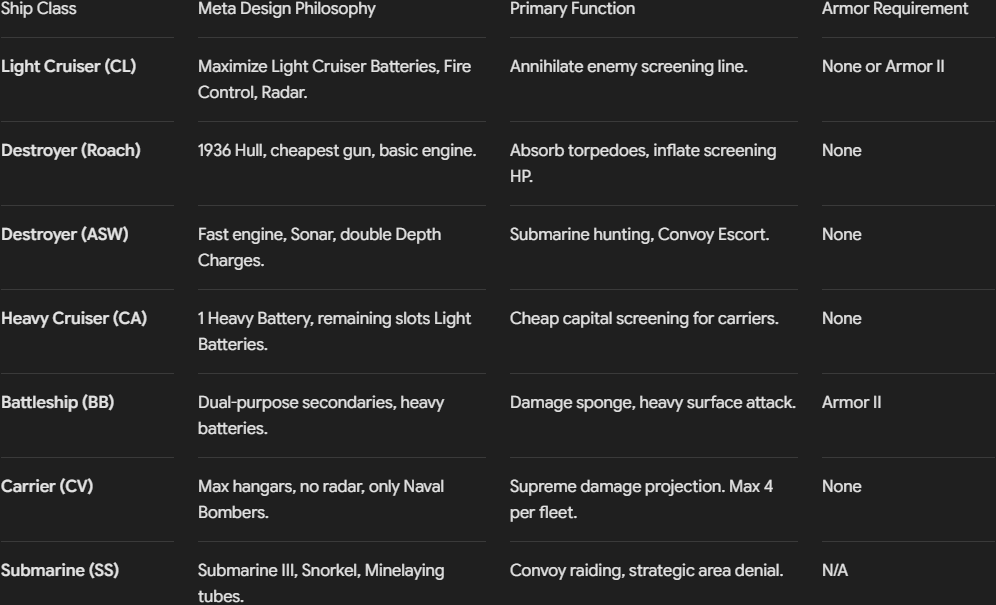
The Light Cruiser (CL) is the most versatile and lethal asset in the surface naval arsenal. Its primary function is to annihilate the enemy screening line using overwhelming Light Attack values. Once the enemy screens are destroyed, the enemy capital ships are exposed to devastating torpedo strikes.
There are two competing macro-level designs for the Light Attack Cruiser:
The Unarmored CL: By omitting armor entirely, the production cost of the ship is reduced by 12.5%. Because the total industrial capacity (IC) costs decrease while firepower remains constant, this increases the offensive potential per unit of IC by 15%. This design relies on high engine speeds and low visibility to evade damage rather than absorbing it, and operates on the philosophy that killing the enemy faster than they can return fire is the ultimate defense.
The Armor II CL: This design utilizes tier 2 armor to capitalize on the partial piercing thresholds discussed previously. Against AI adversaries, an Armor II Light Cruiser packed with Light Cruiser Batteries, an advanced engine, and Fire Control modules will obliterate enemy destroyers while taking negligible damage. Upgrading to Armor III or IV is universally considered a waste of industrial capacity.
Regardless of the armor paradigm chosen, the defining trait of the meta CL is filling every available top slot with Light Cruiser Batteries to maximize Light Attack. A fleet heavily invested in light attack and light piercing acts as a laser-focused entity that systematically deletes the enemy's first row.
There are two competing macro-level designs for the Light Attack Cruiser:
The Unarmored CL: By omitting armor entirely, the production cost of the ship is reduced by 12.5%. Because the total industrial capacity (IC) costs decrease while firepower remains constant, this increases the offensive potential per unit of IC by 15%. This design relies on high engine speeds and low visibility to evade damage rather than absorbing it, and operates on the philosophy that killing the enemy faster than they can return fire is the ultimate defense.
The Armor II CL: This design utilizes tier 2 armor to capitalize on the partial piercing thresholds discussed previously. Against AI adversaries, an Armor II Light Cruiser packed with Light Cruiser Batteries, an advanced engine, and Fire Control modules will obliterate enemy destroyers while taking negligible damage. Upgrading to Armor III or IV is universally considered a waste of industrial capacity.
Regardless of the armor paradigm chosen, the defining trait of the meta CL is filling every available top slot with Light Cruiser Batteries to maximize Light Attack. A fleet heavily invested in light attack and light piercing acts as a laser-focused entity that systematically deletes the enemy's first row.
The Destroyer: Quantity, Screening, and Escort
Destroyers (DD) are the lightest screen ships, boasting low fuel requirements and high evasion. They operate under three entirely separate philosophies based on mission profiles: the ultra-cheap "Roach", the specialized escort, and the torpedo platform.
The Roach Destroyer:
The Roach DD is the purest expression of the screening mechanic. It utilizes the cheapest available early hull (1936), the cheapest tier 1 light gun, the basic engine, and absolutely no other modules. It possesses virtually no combat effectiveness and cannot influence the battle offensively. Its sole purpose is to provide inexpensive Hull HP to satisfy the 4:1 screening ratio and absorb enemy torpedoes meant for capital ships. While some analysts argue that roach destroyers are a redundant waste of resources if a nation already starts with a massive legacy screening fleet, they remain the absolute most IC-efficient method to artificially inflate a strike force's health pool and protect carriers.
The ASW / Escort Destroyer:
Designed specifically to hunt submarines and protect resource trade. This variant utilizes the fastest possible engine, advanced Sonar, and double Depth Charge modules. The primary gun is kept as cheap as possible, and torpedoes are omitted. A dedicated fleet of these assigned to the Convoy Escort mission will completely neutralize artificial intelligence submarine wolfpacks, as depth charges are the only ship-based weapon capable of damaging submerged submarines.
The Torpedo Destroyer:
A late-game variant designed to capitalize on the devastation wrought by Light Cruisers. These are stripped of guns and packed entirely with advanced torpedo tubes. Once the Light Attack Cruisers sink the enemy screens, the Torpedo Destroyers unleash massive, unblockable damage onto the exposed Battleships and Carriers.
The Roach Destroyer:
The Roach DD is the purest expression of the screening mechanic. It utilizes the cheapest available early hull (1936), the cheapest tier 1 light gun, the basic engine, and absolutely no other modules. It possesses virtually no combat effectiveness and cannot influence the battle offensively. Its sole purpose is to provide inexpensive Hull HP to satisfy the 4:1 screening ratio and absorb enemy torpedoes meant for capital ships. While some analysts argue that roach destroyers are a redundant waste of resources if a nation already starts with a massive legacy screening fleet, they remain the absolute most IC-efficient method to artificially inflate a strike force's health pool and protect carriers.
The ASW / Escort Destroyer:
Designed specifically to hunt submarines and protect resource trade. This variant utilizes the fastest possible engine, advanced Sonar, and double Depth Charge modules. The primary gun is kept as cheap as possible, and torpedoes are omitted. A dedicated fleet of these assigned to the Convoy Escort mission will completely neutralize artificial intelligence submarine wolfpacks, as depth charges are the only ship-based weapon capable of damaging submerged submarines.
The Torpedo Destroyer:
A late-game variant designed to capitalize on the devastation wrought by Light Cruisers. These are stripped of guns and packed entirely with advanced torpedo tubes. Once the Light Attack Cruisers sink the enemy screens, the Torpedo Destroyers unleash massive, unblockable damage onto the exposed Battleships and Carriers.
Capital Ships: Heavy Cruisers, Battleships, and Battlecruisers
Capital ships serve primarily as heavy damage dealers and damage sponges for carriers.
The Heavy Cruiser (CA) Loophole:
The meta Heavy Cruiser design exploits a fundamental mechanical loophole in the combat rows. By placing a single basic heavy battery on a cruiser hull, the ship is classified by the engine as a capital ship and is permanently placed in the battle line, safely behind the screens. Because it sits in the rear, it cannot be targeted by enemy light guns or hit by torpedoes (so long as the screens are alive). Therefore, the optimized meta dictates building Heavy Cruisers with zero armor, the absolute cheapest heavy battery, and filling every remaining slot with Light Cruiser batteries. These "fake" capital ships provide the necessary screening ratio required to protect carriers while simultaneously assisting the CLs in shredding enemy destroyers from absolute safety.
The Battleship (BB) and Super-Heavy Battleship (SHBB):
If permitted by the London Naval Treaty, Battleships should be outfitted with Battleship Armor II to mitigate light and heavy gun damage. Secondary slots should utilize Dual-Purpose Secondary Batteries, which provide both surface attack and vital Anti-Air capabilities; this is a 1939 technology that nations like Great Britain, France, the USA, and Japan possess natively. Super-Heavy Battleships require massive special project investments and are highly impractical for rapid mobilization. However, they are the undisputed masters of surface engagements. Their extreme armor completely negates standard battleship piercing, making them the ultimate anchor for a strike force battle line, though they are somewhat inefficient when fighting light-ship-heavy fleets.
The Battlecruiser (BC) Paradigm:
Recent extensive fleet testing (such as a 718,000 IC engagement scenario) has demonstrated that pure Battlecruiser fleets paired with light-attack destroyers can frequently outperform standard Light Cruiser spam in surface-to-surface engagements. Battlecruisers offer an optimal blend of heavy attack and speed. However, they remain highly susceptible to massed naval bombers and Carrier task forces, making them a powerful but statistically volatile centerpiece for a fleet.
The Heavy Cruiser (CA) Loophole:
The meta Heavy Cruiser design exploits a fundamental mechanical loophole in the combat rows. By placing a single basic heavy battery on a cruiser hull, the ship is classified by the engine as a capital ship and is permanently placed in the battle line, safely behind the screens. Because it sits in the rear, it cannot be targeted by enemy light guns or hit by torpedoes (so long as the screens are alive). Therefore, the optimized meta dictates building Heavy Cruisers with zero armor, the absolute cheapest heavy battery, and filling every remaining slot with Light Cruiser batteries. These "fake" capital ships provide the necessary screening ratio required to protect carriers while simultaneously assisting the CLs in shredding enemy destroyers from absolute safety.
The Battleship (BB) and Super-Heavy Battleship (SHBB):
If permitted by the London Naval Treaty, Battleships should be outfitted with Battleship Armor II to mitigate light and heavy gun damage. Secondary slots should utilize Dual-Purpose Secondary Batteries, which provide both surface attack and vital Anti-Air capabilities; this is a 1939 technology that nations like Great Britain, France, the USA, and Japan possess natively. Super-Heavy Battleships require massive special project investments and are highly impractical for rapid mobilization. However, they are the undisputed masters of surface engagements. Their extreme armor completely negates standard battleship piercing, making them the ultimate anchor for a strike force battle line, though they are somewhat inefficient when fighting light-ship-heavy fleets.
The Battlecruiser (BC) Paradigm:
Recent extensive fleet testing (such as a 718,000 IC engagement scenario) has demonstrated that pure Battlecruiser fleets paired with light-attack destroyers can frequently outperform standard Light Cruiser spam in surface-to-surface engagements. Battlecruisers offer an optimal blend of heavy attack and speed. However, they remain highly susceptible to massed naval bombers and Carrier task forces, making them a powerful but statistically volatile centerpiece for a fleet.
Aircraft Carriers: The Supreme Force Multiplier
Aircraft Carriers are definitively the most cost-effective ships in the simulation, provided their mechanics are respected.
The absolute golden rule of carriers is the four-carrier limit per battle. A task force should contain a maximum of four carriers; adding a fifth carrier incurs a massive mechanical over-stacking penalty that severely reduces sortie efficiency, rendering the fifth ship practically useless and a detriment to the fleet's total output.
Carrier design is ruthlessly simple. They do not require armor, radar, or fire control, as these statistics do not impact the aircraft they host. A 1936 Carrier hull with the maximum number of hangar decks, maximized engine speed, and heavy Anti-Air to shoot down enemy naval bombers is optimal. The deck composition for a Strike Force carrier should consist exclusively of Naval Bombers. Equipping planes with Torpedo II (a 1940 technology) effectively quadruples their damage output, turning a four-carrier task force into an inescapable death sentence for any enemy fleet without absolute air superiority.
The absolute golden rule of carriers is the four-carrier limit per battle. A task force should contain a maximum of four carriers; adding a fifth carrier incurs a massive mechanical over-stacking penalty that severely reduces sortie efficiency, rendering the fifth ship practically useless and a detriment to the fleet's total output.
Carrier design is ruthlessly simple. They do not require armor, radar, or fire control, as these statistics do not impact the aircraft they host. A 1936 Carrier hull with the maximum number of hangar decks, maximized engine speed, and heavy Anti-Air to shoot down enemy naval bombers is optimal. The deck composition for a Strike Force carrier should consist exclusively of Naval Bombers. Equipping planes with Torpedo II (a 1940 technology) effectively quadruples their damage output, turning a four-carrier task force into an inescapable death sentence for any enemy fleet without absolute air superiority.
Submarines and Convoys: The Silent Asymmetric Threat
Submarines are highly effective for nations lacking the industrial capacity to contest surface supremacy. The Submarine III hull equipped with a Snorkel module creates a vessel with a visibility profile so low that it becomes functionally invisible to enemy detection. Submarines deployed in wolfpacks of 8 to 20 can strangle enemy supply lines via Convoy Raiding, starving overseas divisions of equipment and fuel. Furthermore, utilizing advanced minelaying submarines to saturation-mine enemy coastlines inflicts massive movement penalties (slowing fleets by up to 80%) and drastically increases the likelihood of enemy ships sinking randomly outside of active combat.
Convoys themselves represent the logistical lifeblood of a nation. They are mostly unarmed, possessing only a negligible 0.25 Light Gun with a piercing value of 1, and 0.1 Anti-Air. They cannot be directly controlled, do not consume fuel, do not utilize hulls or modules, and are kept in an abstract reserve when not actively transporting troops, resources, or lend-lease equipment. When damaged in battle, convoys do not require dockyard repairs; if they survive the engagement, they immediately return to perfect condition.
Convoys themselves represent the logistical lifeblood of a nation. They are mostly unarmed, possessing only a negligible 0.25 Light Gun with a piercing value of 1, and 0.1 Anti-Air. They cannot be directly controlled, do not consume fuel, do not utilize hulls or modules, and are kept in an abstract reserve when not actively transporting troops, resources, or lend-lease equipment. When damaged in battle, convoys do not require dockyard repairs; if they survive the engagement, they immediately return to perfect condition.
Task Force Composition and Operational Parameters
Constructing perfect ships is irrelevant if they are organized inefficiently. Admirals can command up to 10 task forces, and these task forces must be divided strictly by their intended mission profile and assigned specific sea zones.
The Separation of Patrol and Strike Force
The most common operational error is placing an entire death-stack fleet on the "Patrol" mission. This rapidly depletes national fuel reserves and exposes valuable capital ships to unnecessary submarine attrition and land-based naval bomber strikes.
The meta dictates a strict division of labor:
The Spotting Patrol: A dedicated task force consisting of 1 to 3 highly specialized ships. Spotting patrols should utilize Light Cruisers equipped with seaplane catapults, radar, and sonar, with their engagement rules set to "Never Engage" or "Do Not Engage". Their high speed allows them to outrun threats while passively accumulating spotting data on enemy fleets. They burn minimal fuel while actively searching the sea tile. Land-based radar and scout airplanes significantly boost their effectiveness. A single cheap submarine set to "always engage" was an old meta tactic to reveal enemy forces for land-based bombers, but surface patrols are vastly superior.
The Strike Force: The main battle fleet containing all carriers, battleships, and the bulk of the screening line. The Strike Force sits idle in a naval base, consuming absolutely zero fuel while passively projecting naval superiority. The moment the Spotting Patrol detects an enemy fleet and achieves a 100% detection threshold, the Strike Force immediately launches from the port, intercepts the target, and forces a decisive engagement.
The meta dictates a strict division of labor:
The Spotting Patrol: A dedicated task force consisting of 1 to 3 highly specialized ships. Spotting patrols should utilize Light Cruisers equipped with seaplane catapults, radar, and sonar, with their engagement rules set to "Never Engage" or "Do Not Engage". Their high speed allows them to outrun threats while passively accumulating spotting data on enemy fleets. They burn minimal fuel while actively searching the sea tile. Land-based radar and scout airplanes significantly boost their effectiveness. A single cheap submarine set to "always engage" was an old meta tactic to reveal enemy forces for land-based bombers, but surface patrols are vastly superior.
The Strike Force: The main battle fleet containing all carriers, battleships, and the bulk of the screening line. The Strike Force sits idle in a naval base, consuming absolutely zero fuel while passively projecting naval superiority. The moment the Spotting Patrol detects an enemy fleet and achieves a 100% detection threshold, the Strike Force immediately launches from the port, intercepts the target, and forces a decisive engagement.
The Golden Ratios for Strike Forces
A properly balanced Strike Force relies on the mathematical ratios previously discussed. To guarantee screening efficiency against devastating torpedo strikes, the following proportions must be adhered to at a minimum speed of 20 knots:
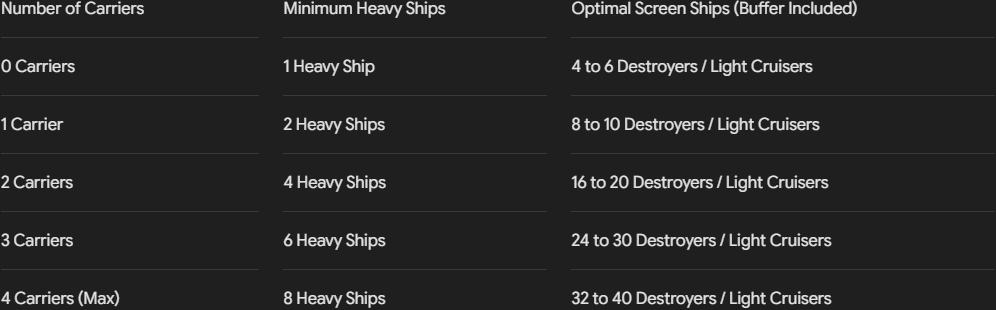
If a nation's naval production cannot meet the 4-to-1 screening threshold to protect its capital ships, the Strike Force must absolutely not be deployed. Deploying an unscreened fleet guarantees the rapid loss of capital ships to enemy torpedo destroyers.
Furthermore, to create absolute naval supremacy in major engagements, "Death Stacking" is highly recommended. Combining the entirety of a nation's heavy assets into a single monolithic Strike Force of approximately 80 to 100 ships guarantees overwhelming local superiority. The minor positioning penalties incurred by a massive fleet are vastly outweighed by the sheer concentration of firepower.
If a nation's naval production cannot meet the 4-to-1 screening threshold to protect its capital ships, the Strike Force must absolutely not be deployed. Deploying an unscreened fleet guarantees the rapid loss of capital ships to enemy torpedo destroyers.
Furthermore, to create absolute naval supremacy in major engagements, "Death Stacking" is highly recommended. Combining the entirety of a nation's heavy assets into a single monolithic Strike Force of approximately 80 to 100 ships guarantees overwhelming local superiority. The minor positioning penalties incurred by a massive fleet are vastly outweighed by the sheer concentration of firepower.
Specialized Naval Missions
Beyond standard surface engagements, fleets must be tasked with specific operational directives to control the logistical flow of the war.
Convoy Escort: Task forces assigned to Convoy Escort actively defend trade routes and troop transports. Critically, this mission generates the highest amount of Naval Supremacy of any operational posture.
Convoy Raiding: Utilized primarily by submarine wolfpacks to interdict enemy supply lines. This lowers enemy naval dominance and physically destroys the convoys necessary to sustain overseas garrisons.
Naval Invasion Support: A fleet assigned to this mission remains in port until an amphibious invasion is launched. It then escorts the vulnerable troop convoys to their destination and assumes a "Hold" posture off the coast, providing devastating Shore Bombardment penalties to enemy land defenders. However, this mission provides less baseline naval supremacy than Convoy Escort.
Minelaying and Minesweeping: Specialized destroyers or submarines passively deploy or clear contact mines. A fleet of merely 5 destroyers with a single sweeper kit can passively clear up to 3 sea zones.
Convoy Escort: Task forces assigned to Convoy Escort actively defend trade routes and troop transports. Critically, this mission generates the highest amount of Naval Supremacy of any operational posture.
Convoy Raiding: Utilized primarily by submarine wolfpacks to interdict enemy supply lines. This lowers enemy naval dominance and physically destroys the convoys necessary to sustain overseas garrisons.
Naval Invasion Support: A fleet assigned to this mission remains in port until an amphibious invasion is launched. It then escorts the vulnerable troop convoys to their destination and assumes a "Hold" posture off the coast, providing devastating Shore Bombardment penalties to enemy land defenders. However, this mission provides less baseline naval supremacy than Convoy Escort.
Minelaying and Minesweeping: Specialized destroyers or submarines passively deploy or clear contact mines. A fleet of merely 5 destroyers with a single sweeper kit can passively clear up to 3 sea zones.
Industrial Logistics: Production, Refitting, and Training
The economic management of the navy is strictly constrained by dockyard limits. A maximum of 5 naval dockyards can be assigned to the construction of a single Capital Ship, while 10 dockyards can be assigned to a Screen Ship or Submarine, and 15 to Convoys. A single dockyard outputs exactly 2.5 production per day. The formula for ship production time is the total cost of the design divided by the quantity of dedicated naval yards multiplied by 2.5. Because large capital ships take years to complete (often requiring projections out to 1941 or 1942 for modern classes), dockyard allocation must be meticulously planned well before the outbreak of global hostilities.
The Economics of Refitting
Refitting existing legacy ships is significantly faster and cheaper than constructing new vessels from scratch, making it an essential strategy for major naval powers like the United States and the United Kingdom, who start with massive but obsolete fleets.
However, refitting is governed by strict cost-efficiency rules:
Never Refit Armor or Engines: Altering the armor tier or engine module of an existing ship essentially requires rebuilding the vessel's hull from the ground up, making the industrial cost nearly equivalent to building a brand new ship.
Always Refit Fire Control and Radar: Upgrading Fire Control modules increases a ship's base hit chance from a baseline of 10% up to 12.5%, 15%, and finally 17.5% with Fire Control III. This is a massive, highly cost-effective upgrade that dramatically enhances the lethality of a legacy strike fleet. Refitting empty top slots with additional light batteries or anti-air is also highly recommended.
It is imperative that all refitting operations are scheduled to conclude prior to the outbreak of war, ensuring the fleet is not caught helpless in drydock during the opening salvos of a conflict.
However, refitting is governed by strict cost-efficiency rules:
Never Refit Armor or Engines: Altering the armor tier or engine module of an existing ship essentially requires rebuilding the vessel's hull from the ground up, making the industrial cost nearly equivalent to building a brand new ship.
Always Refit Fire Control and Radar: Upgrading Fire Control modules increases a ship's base hit chance from a baseline of 10% up to 12.5%, 15%, and finally 17.5% with Fire Control III. This is a massive, highly cost-effective upgrade that dramatically enhances the lethality of a legacy strike fleet. Refitting empty top slots with additional light batteries or anti-air is also highly recommended.
It is imperative that all refitting operations are scheduled to conclude prior to the outbreak of war, ensuring the fleet is not caught helpless in drydock during the opening salvos of a conflict.
Ship Training, Experience Farming, and General Traits
Newly constructed ships spawn with a "Green" experience level, burdening them with severe negative combat modifiers. Sending green ships into combat is a mathematically unsound decision that artificially lowers the fleet's effective hit points and damage output.
To rectify this, newly launched ships must be assigned to the "Naval Exercises" mission. Exercising consumes fuel but rapidly elevates the crew to "Regular" status, removing the negative combat modifiers and replacing them with positive buffs. Exercising also generates Naval XP, which is vital for unlocking naval doctrines, upgrading ship designer modules, and modifying templates. If fuel is critically low, exercising submarine fleets is recommended, as they utilize very little fuel but still generate XP.
A critical logistical technique is to set the fleet's repair priority to "Auto Detach" while exercising. This ensures that any ship taking accidental damage during training will automatically separate from the fleet, return to port for repairs, and seamlessly rejoin the exercise without interrupting the training of the broader task force.
When managing the wider war effort, it should be noted that experience gain for generals and admirals is determined on a per-division or per-task-force basis. For land commanders, experience is gained for every division under command that qualifies based on its line battalion ratio; similarly, admirals gain specific traits (like Minelayer, Minesweeper, or the extremely valuable "Bold" trait) based on the specific actions and compositions of the task forces they lead.
To rectify this, newly launched ships must be assigned to the "Naval Exercises" mission. Exercising consumes fuel but rapidly elevates the crew to "Regular" status, removing the negative combat modifiers and replacing them with positive buffs. Exercising also generates Naval XP, which is vital for unlocking naval doctrines, upgrading ship designer modules, and modifying templates. If fuel is critically low, exercising submarine fleets is recommended, as they utilize very little fuel but still generate XP.
A critical logistical technique is to set the fleet's repair priority to "Auto Detach" while exercising. This ensures that any ship taking accidental damage during training will automatically separate from the fleet, return to port for repairs, and seamlessly rejoin the exercise without interrupting the training of the broader task force.
When managing the wider war effort, it should be noted that experience gain for generals and admirals is determined on a per-division or per-task-force basis. For land commanders, experience is gained for every division under command that qualifies based on its line battalion ratio; similarly, admirals gain specific traits (like Minelayer, Minesweeper, or the extremely valuable "Bold" trait) based on the specific actions and compositions of the task forces they lead.
Naval Invasions, Convoys, and The Intelligence War
Naval Supremacy is an abstract mechanical metric required to launch amphibious invasions. A nation must achieve greater than 50% naval supremacy in all consecutive sea zones connecting the invasion origin port to the destination.
Executing the Naval Invasion
If a player is struggling to hit the 50% threshold to launch a naval invasion, the optimal maneuver is to temporarily assign the massive Strike Force death-stack to the Convoy Escort mission across the required zones, as this mission mathematically projects the highest supremacy.
Crucially, it is vital to understand that 50% supremacy only needs to be achieved for a single hour to initiate the invasion sequence. Once the invasion troops launch and enter the water, supremacy can be lost without halting the invasion's progress. However, the convoys themselves remain highly vulnerable to interception if undefended, necessitating Air Superiority and Close Air Support (CAS) to protect the invasion force and beat back land defenders.
For the actual landing force, meta divisions frequently consist of 30-36 width marines supported by artillery, field hospitals, and either pioneers or highly specialized armored reconnaissance (such as high-breakthrough light tanks or medium flame tanks) to overcome the inherent offensive weakness of infantry. A common operational strategy for island nations (like Cuba) involves splitting the invasion force—sending 6 divisions to the capital (Havana) and 6 to another port—to guarantee at least one successful landing that can subsequently support the other via ground assault, often utilizing the "Force Attack" command to guarantee a foothold.
Crucially, it is vital to understand that 50% supremacy only needs to be achieved for a single hour to initiate the invasion sequence. Once the invasion troops launch and enter the water, supremacy can be lost without halting the invasion's progress. However, the convoys themselves remain highly vulnerable to interception if undefended, necessitating Air Superiority and Close Air Support (CAS) to protect the invasion force and beat back land defenders.
For the actual landing force, meta divisions frequently consist of 30-36 width marines supported by artillery, field hospitals, and either pioneers or highly specialized armored reconnaissance (such as high-breakthrough light tanks or medium flame tanks) to overcome the inherent offensive weakness of infantry. A common operational strategy for island nations (like Cuba) involves splitting the invasion force—sending 6 divisions to the capital (Havana) and 6 to another port—to guarantee at least one successful landing that can subsequently support the other via ground assault, often utilizing the "Force Attack" command to guarantee a foothold.
Maximizing Naval Intelligence
A fleet's combat effectiveness, positioning penalties, and spotting capabilities are heavily dictated by its Naval Intel relative to the enemy. A fleet with higher intelligence gains significant combat bonuses and encounters enemy forces under far more favorable mathematical conditions.
Naval Intel is passively accrued through a nation's ruling ideology and trade laws, but must be actively escalated through external espionage vectors. Methods to artificially spike Naval Intel include:
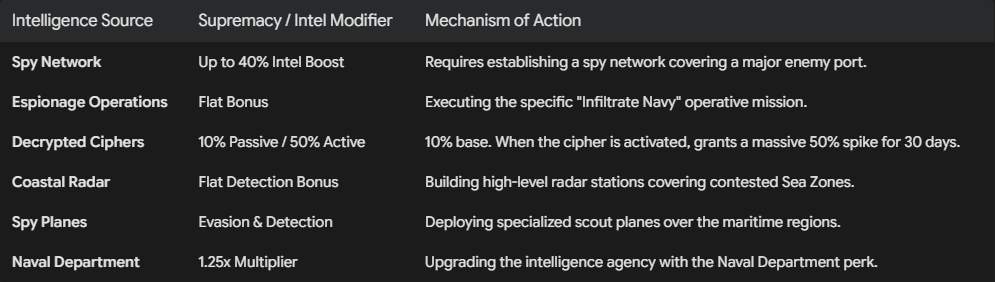
Furthermore, achieving absolute Air Superiority over a naval zone using land-based fighters provides an enormous intrinsic boost to ship spotting, practically guaranteeing the detection of enemy strike forces while simultaneously neutralizing the threat of enemy naval bombers.
Naval Intel is passively accrued through a nation's ruling ideology and trade laws, but must be actively escalated through external espionage vectors. Methods to artificially spike Naval Intel include:
Furthermore, achieving absolute Air Superiority over a naval zone using land-based fighters provides an enormous intrinsic boost to ship spotting, practically guaranteeing the detection of enemy strike forces while simultaneously neutralizing the threat of enemy naval bombers.
Geopolitics, Doctrines, and Nation-Specific Metas
The selection of a Naval Doctrine tree dictates the overarching philosophy of a nation's maritime strategy and provides powerful statistical multipliers that must align with specific fleet compositions.
Fleet in Being
The "Fleet in Being" doctrine is mathematically designed for nations possessing massive starting legacy navies and immense industrial capacity, such as the United Kingdom, Italy, and to some extent, the United States. This tree focuses heavily on maximizing the organizational strength, anti-air capabilities, and raw damage output of Battleships and Heavy Cruisers. It provides substantial bonuses to Strike Force coordination and anti-submarine escorts. If a strategic plan relies on creating a virtually unsinkable wall of armored behemoths supported by a vast screening line of destroyers to project absolute dominance, Fleet in Being mathematically optimizes that approach.
Trade Interdiction and Asymmetric Warfare
"Trade Interdiction" is universally considered the strongest doctrine for minor nations, or major powers operating on a massive naval deficit (such as the German Reich). This doctrine is uniquely powerful because it offers extreme surface visibility reductions for both submarines and light surface vessels.
In a combat simulation where survival relies on avoiding heavy caliber fire, visibility reduction is arguably the most potent defensive statistic. A Light Cruiser spam fleet utilizing Trade Interdiction (a strategy often referred to as the Jeune École approach) becomes terrifyingly difficult for enemy heavy guns to track and hit. Additionally, this doctrine maximizes the lethality of submarine wolfpacks, providing sub-branches for "Wolfpacks" (tying up supply lines), "Capital Hunters" (targeting enemy battleships), and "Coastal Minelaying".
For Germany specifically, pursuing a Trade Interdiction strategy synergizes well with their technology focus. Germany can research advanced submarine tech, transport ships, contact mines, and minelaying submarines rapidly, augmenting their weak starting surface fleet. Germany also benefits from political focus paths like the "Reorganize Secret Services" sub-branch (unlocked via the La Résistance DLC), which mitigates intelligence penalties and provides specialized operatives, further enhancing their asymmetric warfare capabilities.
In a combat simulation where survival relies on avoiding heavy caliber fire, visibility reduction is arguably the most potent defensive statistic. A Light Cruiser spam fleet utilizing Trade Interdiction (a strategy often referred to as the Jeune École approach) becomes terrifyingly difficult for enemy heavy guns to track and hit. Additionally, this doctrine maximizes the lethality of submarine wolfpacks, providing sub-branches for "Wolfpacks" (tying up supply lines), "Capital Hunters" (targeting enemy battleships), and "Coastal Minelaying".
For Germany specifically, pursuing a Trade Interdiction strategy synergizes well with their technology focus. Germany can research advanced submarine tech, transport ships, contact mines, and minelaying submarines rapidly, augmenting their weak starting surface fleet. Germany also benefits from political focus paths like the "Reorganize Secret Services" sub-branch (unlocked via the La Résistance DLC), which mitigates intelligence penalties and provides specialized operatives, further enhancing their asymmetric warfare capabilities.
Base Strike
The "Base Strike" doctrine is tailored entirely for powers heavily invested in Aircraft Carriers, namely Japan and the United States. This tree amplifies carrier sortie efficiency, increases the targeting capabilities of carrier-based naval bombers, and provides critical bonuses to base strike operations. If the strategic intent is to sink the enemy battle line from beyond the visual horizon using Torpedo II naval bombers, Base Strike provides the necessary mathematical multipliers to ensure those strikes are devastating.
For a nation like the United States, utilizing the Base Strike doctrine is part of a grander strategic build. An optimized US strategy involves heavily fortifying the Pacific theater prior to conflict: constructing maximum level infrastructure, radar, level 4 airfields, and maximum level ports on the island of Guam, while simultaneously building multiple level 2 ports in Mindanao (Philippines). Furthermore, the US can exploit specialized Special Projects by assigning Robert H. Goddard to Aerodynamics to rush Radar and Helicopters, and William Francis Gibbs to Naval Engineering to secure Proximity Fuzes, granting them an overwhelming technological advantage in fleet engagements.
For a nation like the United States, utilizing the Base Strike doctrine is part of a grander strategic build. An optimized US strategy involves heavily fortifying the Pacific theater prior to conflict: constructing maximum level infrastructure, radar, level 4 airfields, and maximum level ports on the island of Guam, while simultaneously building multiple level 2 ports in Mindanao (Philippines). Furthermore, the US can exploit specialized Special Projects by assigning Robert H. Goddard to Aerodynamics to rush Radar and Helicopters, and William Francis Gibbs to Naval Engineering to secure Proximity Fuzes, granting them an overwhelming technological advantage in fleet engagements.
Naval Designer Companies
When constructing new vessels, assigning the correct Naval Designer Company before laying down the hull provides permanent, baked-in statistical bonuses. Extensive testing reveals that for heavy capital ships (BBs and SHBBs), the Atlantic Fleet Designer is mathematically superior to all alternatives. The Atlantic Fleet Designer provides critical bonuses to base Armor and Heavy Attack values. While the Coastal Defense Fleet designer offers a flat reduction in production costs, the statistical superiority granted by the Atlantic Fleet Designer results in a ship that performs exponentially better per IC spent over the course of multiple engagements.
The Impact of Geography and Weather
Naval combat does not occur in a vacuum; environmental factors deeply influence the outcome of engagements. Deep ocean tiles behave differently than fjords, archipelagos, or shallow seas. Submarines, for instance, are highly effective in deep water where their visibility remains naturally low, but they suffer massive penalties to detection and evasion when forced to operate in shallow coastal waters.
Weather is equally decisive. Engaging an enemy fleet during a violent storm drastically reduces the hit profile of naval bombers, carrier sorties, and surface targeting. If a Strike Force relies entirely on its 4 Aircraft Carriers to deal damage, forcing an engagement during poor weather neutralizes the fleet's primary weapon system. The meta strictly requires setting engagements to occur during optimal weather windows when air assets can operate at 100% efficiency, effectively meaning fleets should avoid regions experiencing heavy storms unless absolutely necessary for survival.
Weather is equally decisive. Engaging an enemy fleet during a violent storm drastically reduces the hit profile of naval bombers, carrier sorties, and surface targeting. If a Strike Force relies entirely on its 4 Aircraft Carriers to deal damage, forcing an engagement during poor weather neutralizes the fleet's primary weapon system. The meta strictly requires setting engagements to occur during optimal weather windows when air assets can operate at 100% efficiency, effectively meaning fleets should avoid regions experiencing heavy storms unless absolutely necessary for survival.
Final Strategic Imperatives
To summarize the absolute mathematical necessities required for naval domination in Hearts of Iron IV:
Do not overcomplicate ship designs. A ship should do exactly one thing. Light Cruisers should stack only light attack to melt screens. Carriers should carry only naval bombers to destroy capitals. Roach Destroyers exist solely to die in place of capital ships.
Strictly enforce the 4:1 Ratio. Never send a capital ship into contested waters without at least 4 screening ships (Destroyers or Light Cruisers) to absorb torpedoes. If the ratio drops below 3:1, the capital ships are mathematically condemned.
Divide Intel from Firepower. Never use the Strike Force to search for the enemy. Use hyper-fast, low-cost, radar-equipped cruisers or destroyers on the "Patrol" mission (set to Never Engage) to spot the enemy. Keep the massive Strike Force safely in port to conserve fuel until the target is locked and verified.
Air Power is Sea Power. A fleet without air cover is a sunken fleet. Always ensure exactly 4 Carriers are present in the Strike Force (never 5), and maintain land-based fighter superiority over the contested sea zones to provide spotting intel and defend against enemy naval bombers.
Refit Smartly, Train Always. Never refit armor or engines, as it wastes IC. Always refit Fire Control, Radar, and Anti-Air to drastically increase the lethality of older vessels. Never deploy green ships; exercise them to "Regular" status to eliminate negative combat modifiers.
By adhering strictly to these mathematical thresholds, logistical divisions, and specialized templates, any nation—regardless of its starting industrial capacity or geographical constraints—can dismantle the artificial intelligence's navies and establish total, unassailable control over the global oceans.
Do not overcomplicate ship designs. A ship should do exactly one thing. Light Cruisers should stack only light attack to melt screens. Carriers should carry only naval bombers to destroy capitals. Roach Destroyers exist solely to die in place of capital ships.
Strictly enforce the 4:1 Ratio. Never send a capital ship into contested waters without at least 4 screening ships (Destroyers or Light Cruisers) to absorb torpedoes. If the ratio drops below 3:1, the capital ships are mathematically condemned.
Divide Intel from Firepower. Never use the Strike Force to search for the enemy. Use hyper-fast, low-cost, radar-equipped cruisers or destroyers on the "Patrol" mission (set to Never Engage) to spot the enemy. Keep the massive Strike Force safely in port to conserve fuel until the target is locked and verified.
Air Power is Sea Power. A fleet without air cover is a sunken fleet. Always ensure exactly 4 Carriers are present in the Strike Force (never 5), and maintain land-based fighter superiority over the contested sea zones to provide spotting intel and defend against enemy naval bombers.
Refit Smartly, Train Always. Never refit armor or engines, as it wastes IC. Always refit Fire Control, Radar, and Anti-Air to drastically increase the lethality of older vessels. Never deploy green ships; exercise them to "Regular" status to eliminate negative combat modifiers.
By adhering strictly to these mathematical thresholds, logistical divisions, and specialized templates, any nation—regardless of its starting industrial capacity or geographical constraints—can dismantle the artificial intelligence's navies and establish total, unassailable control over the global oceans.
Mod
More Hearts of Iron IV guides
- Division Templates, Tank Designs, Aircraft Designs, and Metas (Bolivar 1.14+)★ 5 (3k)173k views8.7k ♥29 minUpdated Apr 30, 2025
- The Ultimate Guide to Division Templates, Aircraft and Tank Designs (Updated 15-06-2026)★ 5 (3.3k)134k views11k ♥54 minUpdated Jul 6
- Выполняем достижения в Hearts of Iron 4★ 5 (3.2k)69k views7.9k ♥326 minRussianUpdated Jul 19
- The Ultimate Guide to Navy; Ship Templates and Fleet Composition (Updated 24-3-2026)★ 5 (1.2k)61k views4.9k ♥33 minUpdated May 17
- HOI4. Большой гайд★ 5 (738)58k views2k ♥101 minRussian
- Лучшие шаблоны в HoI IV (1.15v.)★ 5 (612)49k views2.2k ♥6 minRussianUpdated May 20




🔥 Popular guides
- Upgrading to PremiumTeam Fortress 2★ 5 (20k)1441k views11k ♥6 minUpdated May 11, 2022
- No More Room in Hell Official ManualNo More Room in Hell★ 5 (2.8k)569k views2.1k ♥29 minUpdated Apr 22, 2019
- NMRiH Community Hosting GuidesNo More Room in Hell★ 5 (526)351k views653 ♥1 minUpdated Aug 10, 2022
- Лучшие кооперативные игры SteamPAYDAY 2★ 5 (1.5k)315k views2.1k ♥56 minRussianUpdated Apr 27, 2025
- Desert Eagle Heat Treated | Blue GemCounter-Strike 2★ 5 (1.6k)292k views1.5k ♥2 minUpdated Jan 16
- Treasure Hunt Puzzle SolutionsTotal War: WARHAMMER II★ 5 (6.9k)281k views15k ♥3 minUpdated Aug 19, 2021



This guide was created by its original author on the Steam Community. Are you the author and want it removed? Request removal.