Non Aligned Finland (Defense - Winter War (1936-1941))
-
A Few Words Before Start
- The historical background presented is provided for illustrative purposes.
- The article does not suggest the best solution. This is only my suggestion.
- Before you can walkthrough the game based on the article, please read it in its entirety.
Campaign Overview
The objective of this campaign is to defend Finland's independence during the Winter War. The game starts in 1936 with Historical AI Focuses enabled.
This guide is based on remaining neutral throughout the campaign and not joining any faction. Due to Finland's limited manpower, success depends on careful preparation: developing the country's infrastructure and industry, as well as properly training and deploying the available army before the war with the Soviet Union begins.
This guide is based on remaining neutral throughout the campaign and not joining any faction. Due to Finland's limited manpower, success depends on careful preparation: developing the country's infrastructure and industry, as well as properly training and deploying the available army before the war with the Soviet Union begins.
Historical Background
On 6 December 1917, Finland declared its independence from Russia. A year later, the country adopted a new constitution, establishing Finland as a republic. The Finnish-Soviet clashes that took place during the Russian Civil War ended with the Treaty of Tartu, signed on 14 October 1920, which defined the border between the two nations.
Between 1921 and 1922, tensions flared once again as fighting broke out over East Karelia. Although Finland supported the Karelian uprising, the rebels were ultimately unable to defeat Soviet forces, and Finnish assistance was eventually withdrawn. The conflict officially ended with the signing of a peace agreement in Moscow on 1 June 1922.
In 1932, Finland and the Soviet Union signed a 10-year Non-Aggression Pact, which was later extended until the end of 1945. Despite the agreement, relations between the two countries remained strained. In 1938, the Soviet Union proposed a mutual defense alliance along with territorial concessions from Finland, but the Finnish government rejected these demands. A year later, Finland also declined Germany's proposal for a non-aggression treaty.
In the autumn of 1939, the Soviet Union renewed its territorial demands, requesting parts of Finnish territory. After Finland refused, the Soviet government renounced the Non-Aggression Pact. On 30 November 1939, the Red Army invaded Finland, marking the beginning of the Winter War. Despite being heavily outnumbered, Finland mounted a determined defense against one of the largest military powers in the world.
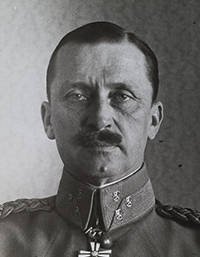
Pictured: Carl Gustaf Emil Mannerheim, Commander-in-Chief of the Finnish Defence Forces during the Winter War.
Introduction
Location
Finland is a Northern European country bordered by Sweden to the west, Norway to the north, and the Soviet Union to the east. The Finnish-Soviet border stretches across 18 provinces. Finland has access to both the Upper Baltic Sea and the Barents Sea through the province of Petsamo.
The country is well known for its thousands of lakes, which play an important role in defensive warfare. The capital, Helsinki, is located on the Baltic coast and serves as Finland's largest port.
Forests cover approximately 71% of Finland's territory, making them the dominant terrain type. The remaining land consists of plains (16%), lakes (10%), marshes (2%), hills (0.5%), and urban areas (0.5%). Finland also controls the Åland Islands in the Baltic Sea.
Politics
At the start of the 1936 campaign, Finland is led by Pehr Evind Svinhufvud of the National Coalition Party (Kokoomus), which holds 65% popularity. The remaining political parties are the Patriotic People's Movement (IKL), the Communist Party of Finland (SKP), and the Social Democratic Party of Finland (SDP). The next presidential election takes place in March 1937.
Finland begins the game with 49% Stability and 50% War Support, along with the following national laws:
• Limited Conscription
• Export Focus
• Civilian Economy
The country also starts with the unique national spirit Sisu, representing the Finnish qualities of perseverance, resilience, determination, courage, and the ability to overcome overwhelming adversity.
Economy and Infrastructure
Finland's industry is concentrated almost entirely in the southern part of the country. The primary industrial region is Uusimaa, which contains 2 Military Factories, 1 Civilian Factory, and 1 Naval Dockyard. Another Military Factory is located in Turku. Outside these areas, the country possesses only 7 Civilian Factories spread across the remaining states.
From the start of the game, Finland has access to the 1936 Infantry Equipment technology, represented by the M/39 Ukko-Pekka, as well as Engineer Company I and Recon Company I. The army can also produce artillery and 20 ItK/39 Anti-Air equipment. The navy begins with 1922 Armaments and 1922 Mine Warfare technologies, while logistics rely on Civilian Trains.
Finland's supply network is extremely limited. The railway system consists entirely of Level 1 Railways connected to only a handful of Supply Hubs. Northern Finland is almost completely devoid of supply infrastructure, with the only exception being the Naval Base in Petsamo, which is isolated from the railway network in the south. This weak infrastructure becomes one of Finland's greatest defensive advantages once the Winter War begins.
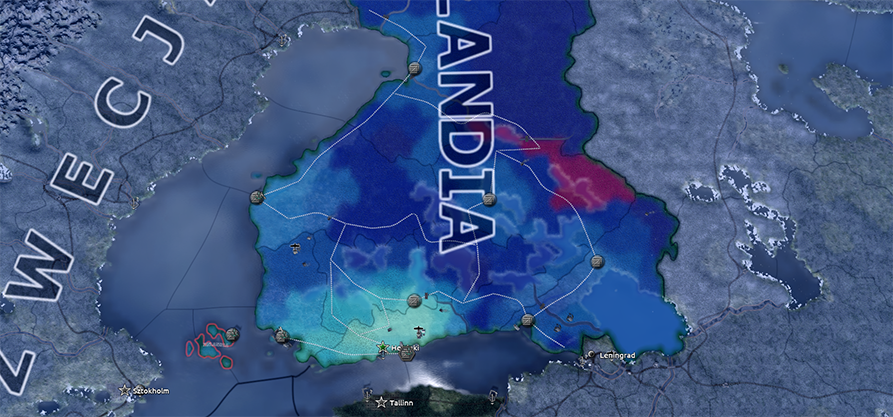
Finland is a Northern European country bordered by Sweden to the west, Norway to the north, and the Soviet Union to the east. The Finnish-Soviet border stretches across 18 provinces. Finland has access to both the Upper Baltic Sea and the Barents Sea through the province of Petsamo.
The country is well known for its thousands of lakes, which play an important role in defensive warfare. The capital, Helsinki, is located on the Baltic coast and serves as Finland's largest port.
Forests cover approximately 71% of Finland's territory, making them the dominant terrain type. The remaining land consists of plains (16%), lakes (10%), marshes (2%), hills (0.5%), and urban areas (0.5%). Finland also controls the Åland Islands in the Baltic Sea.
Politics
At the start of the 1936 campaign, Finland is led by Pehr Evind Svinhufvud of the National Coalition Party (Kokoomus), which holds 65% popularity. The remaining political parties are the Patriotic People's Movement (IKL), the Communist Party of Finland (SKP), and the Social Democratic Party of Finland (SDP). The next presidential election takes place in March 1937.
Finland begins the game with 49% Stability and 50% War Support, along with the following national laws:
• Limited Conscription
• Export Focus
• Civilian Economy
The country also starts with the unique national spirit Sisu, representing the Finnish qualities of perseverance, resilience, determination, courage, and the ability to overcome overwhelming adversity.
Party
National Coalition Party (Kokoomus)
Social Democratic Party of Finland (SDP)
Communist Party of Finland (SKP)
Patriotic People's Movement (IKL)
Ideology
Non-Aligned
Democratic
Communist
Fascist
Popularity
65%
15%
1%
19%
Economy and Infrastructure
Finland's industry is concentrated almost entirely in the southern part of the country. The primary industrial region is Uusimaa, which contains 2 Military Factories, 1 Civilian Factory, and 1 Naval Dockyard. Another Military Factory is located in Turku. Outside these areas, the country possesses only 7 Civilian Factories spread across the remaining states.
From the start of the game, Finland has access to the 1936 Infantry Equipment technology, represented by the M/39 Ukko-Pekka, as well as Engineer Company I and Recon Company I. The army can also produce artillery and 20 ItK/39 Anti-Air equipment. The navy begins with 1922 Armaments and 1922 Mine Warfare technologies, while logistics rely on Civilian Trains.
Finland's supply network is extremely limited. The railway system consists entirely of Level 1 Railways connected to only a handful of Supply Hubs. Northern Finland is almost completely devoid of supply infrastructure, with the only exception being the Naval Base in Petsamo, which is isolated from the railway network in the south. This weak infrastructure becomes one of Finland's greatest defensive advantages once the Winter War begins.
Focus Tree
Stage 1 – Industrial Expansion
Successfully resisting the Soviet Union requires the development of both a strong military and civilian industry. Military Factories will supply the army with weapons and equipment, while Civilian Factories will be essential for constructing the bunker network that will form the backbone of Finland's defensive strategy.
For this reason, the opening phase of the campaign should focus entirely on economic development through the National Focus tree. Building a strong industrial base early will provide the resources needed to prepare for the coming war.
National Focus order:
Increase Military Budget (35d) → Finnish Neutrality (35d) → Suomen Maavoimat (70d) → Outokumpu for Defence Industry (70d) → Enhance Southern Infrastructure (70d) → Industrial Development (70d) → Bank of Aland (70d) → Janiskoski Power Plant (35d)
Completing this sequence takes 455 days. During this period, Finland's presidential election will also take place.
When the "Presidential Term Comes to an End" event appears, select:
"Appoint Kyösti Kallio, he has the support of the centrists and democrats."
⠀⠀⠀⠀⠀⠀⠀⠀⠀⠀⠀⠀⠀⠀⠀⠀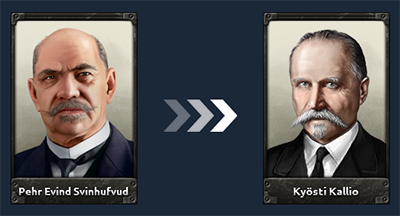
This will make Kyösti Kallio the new President of Finland. Once the industrial expansion is complete, the next priority is stabilizing the country's political situation before the international crisis escalates.
Stage 2 – Political Stabilization
A stable political situation provides valuable national bonuses while preparing Finland for further military expansion. During this stage, World Tension will continue to rise, unlocking additional National Focuses that become available later in the campaign.
National Focus order:
Political Unity (70d) → Align the Agrarian League (35d) → Collaboration with the Left (35d) → The Finnish Swedish People's Party (35d) → National Unity (70d) → Arm the Lotta Svärd (70d) → Railways and Infrastructure (70d) → Union of Finnish Brothers in Arms (70d) → Reach Out to Scandinavia (35d) → Moderate Politics (35d) → Suomen Merivoimat (70d) → Expand Imatra Hydropower Plant (35d)
Completing this stage requires 630 days. During this time, Finland's internal politics will be stabilized, additional infrastructure will be developed, and the groundwork for expanding the armed forces will be completed. By the end of this stage, the increase in World Tension will unlock the next set of important National Focuses.
Stage 3 – Strengthening the Armed Forces
With the economy and political situation secured, the next objective is to maximize Finland's military potential before the outbreak of war. This stage focuses on strengthening the army and obtaining as many combat bonuses as possible, particularly those that improve performance in harsh winter conditions.
National Focus order:
Parmi's Devils (35d) → Coastal Defense (70d) → Repurpose Small Industries (70d) → Extra Refresher Exercises (70d) → Jaeger Movement (70d) → The Cold Front (35d) → Winter Warfare (35d)
Successfully resisting the Soviet Union requires the development of both a strong military and civilian industry. Military Factories will supply the army with weapons and equipment, while Civilian Factories will be essential for constructing the bunker network that will form the backbone of Finland's defensive strategy.
For this reason, the opening phase of the campaign should focus entirely on economic development through the National Focus tree. Building a strong industrial base early will provide the resources needed to prepare for the coming war.
National Focus order:
Increase Military Budget (35d) → Finnish Neutrality (35d) → Suomen Maavoimat (70d) → Outokumpu for Defence Industry (70d) → Enhance Southern Infrastructure (70d) → Industrial Development (70d) → Bank of Aland (70d) → Janiskoski Power Plant (35d)
Completing this sequence takes 455 days. During this period, Finland's presidential election will also take place.
When the "Presidential Term Comes to an End" event appears, select:
"Appoint Kyösti Kallio, he has the support of the centrists and democrats."
⠀⠀⠀⠀⠀⠀⠀⠀⠀⠀⠀⠀⠀⠀⠀⠀
This will make Kyösti Kallio the new President of Finland. Once the industrial expansion is complete, the next priority is stabilizing the country's political situation before the international crisis escalates.
Stage 2 – Political Stabilization
A stable political situation provides valuable national bonuses while preparing Finland for further military expansion. During this stage, World Tension will continue to rise, unlocking additional National Focuses that become available later in the campaign.
National Focus order:
Political Unity (70d) → Align the Agrarian League (35d) → Collaboration with the Left (35d) → The Finnish Swedish People's Party (35d) → National Unity (70d) → Arm the Lotta Svärd (70d) → Railways and Infrastructure (70d) → Union of Finnish Brothers in Arms (70d) → Reach Out to Scandinavia (35d) → Moderate Politics (35d) → Suomen Merivoimat (70d) → Expand Imatra Hydropower Plant (35d)
Completing this stage requires 630 days. During this time, Finland's internal politics will be stabilized, additional infrastructure will be developed, and the groundwork for expanding the armed forces will be completed. By the end of this stage, the increase in World Tension will unlock the next set of important National Focuses.
Stage 3 – Strengthening the Armed Forces
With the economy and political situation secured, the next objective is to maximize Finland's military potential before the outbreak of war. This stage focuses on strengthening the army and obtaining as many combat bonuses as possible, particularly those that improve performance in harsh winter conditions.
National Focus order:
Parmi's Devils (35d) → Coastal Defense (70d) → Repurpose Small Industries (70d) → Extra Refresher Exercises (70d) → Jaeger Movement (70d) → The Cold Front (35d) → Winter Warfare (35d)
Political Power
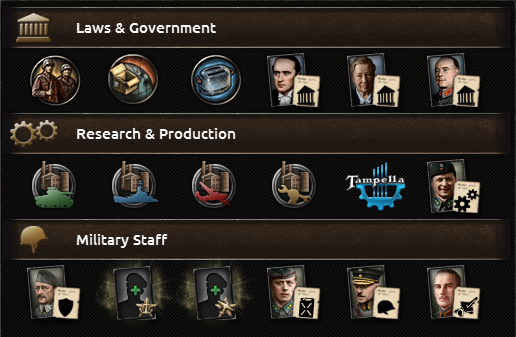
Before the Soviet Union declares war in **1939**, enough Political Power should be accumulated to recruit several key advisors. The recommended Political Advisors are:
⠀⠀⠀⠀⠀⠀
In addition, use Political Power to activate the Ban Fascism and Ban Democratic Parties decisions. These should only be taken once the Stability penalty becomes manageable, ensuring that national Stability remains high while eliminating unnecessary political influence.
- Elias Simojoki (+5% Political Power Gain, +200 Weekly Manpower, +0.05 Daily Fascism Support)
- Miina Sillanpää (+10% Political Power Gain, +10% Stability, +0.05 Daily Democracy Support)
- Aimo Lahti (-10% Lack of Resources Penalty, +5% Factory Output, +15% Equipment Conversion Speed, -10% Equipment Experience Cost)
- Carl Gustaf Mannerheim (+0.4 Army Experience daily, +15% Division Defense)
- Alpo Marttinen (-8% Division Attrition)
- Karl Oesch (+12% Division Recovery Rate)
- Vilho Petter Nenonen (+20% Artillery Attack, +15% Artillery Defense)
⠀⠀⠀⠀⠀⠀
In addition, use Political Power to activate the Ban Fascism and Ban Democratic Parties decisions. These should only be taken once the Stability penalty becomes manageable, ensuring that national Stability remains high while eliminating unnecessary political influence.
Defensive Strategy
The key to successfully defending Finland is making full use of the country's terrain and the Soviet Union's logistical weaknesses. Rather than attempting to defend the entire border, the front line should be built around Supply Hubs, bunkers, and natural terrain obstacles.
Northern Finland has extremely poor infrastructure, causing Soviet divisions to suffer from severe supply shortages as they advance. Finnish troops, on the other hand, will remain within the range of their own supply network, allowing them to maintain combat effectiveness throughout the campaign. Upgrading bunkers to Level 4 further strengthens these defensive positions and makes them significantly harder to break.
Finland's numerous forests and lakes provide another major advantage. By carefully positioning the front line around these natural barriers, the number of directions from which the enemy can attack is greatly reduced. As a result, as few as 13 well-equipped infantry divisions are capable of holding back the vastly larger Soviet Army for an extended period of time.
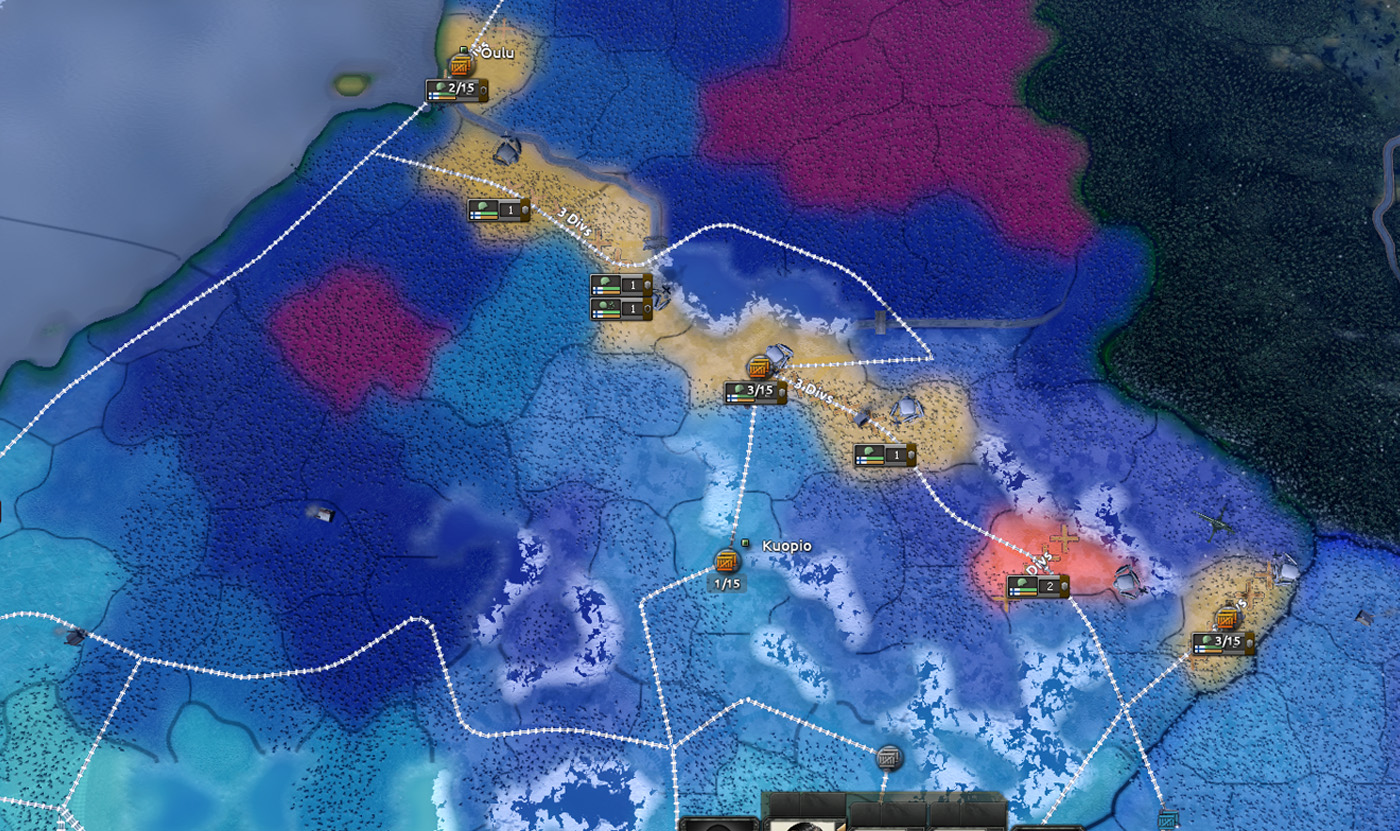
Northern Finland has extremely poor infrastructure, causing Soviet divisions to suffer from severe supply shortages as they advance. Finnish troops, on the other hand, will remain within the range of their own supply network, allowing them to maintain combat effectiveness throughout the campaign. Upgrading bunkers to Level 4 further strengthens these defensive positions and makes them significantly harder to break.
Finland's numerous forests and lakes provide another major advantage. By carefully positioning the front line around these natural barriers, the number of directions from which the enemy can attack is greatly reduced. As a result, as few as 13 well-equipped infantry divisions are capable of holding back the vastly larger Soviet Army for an extended period of time.
Why You Should Release Karelia
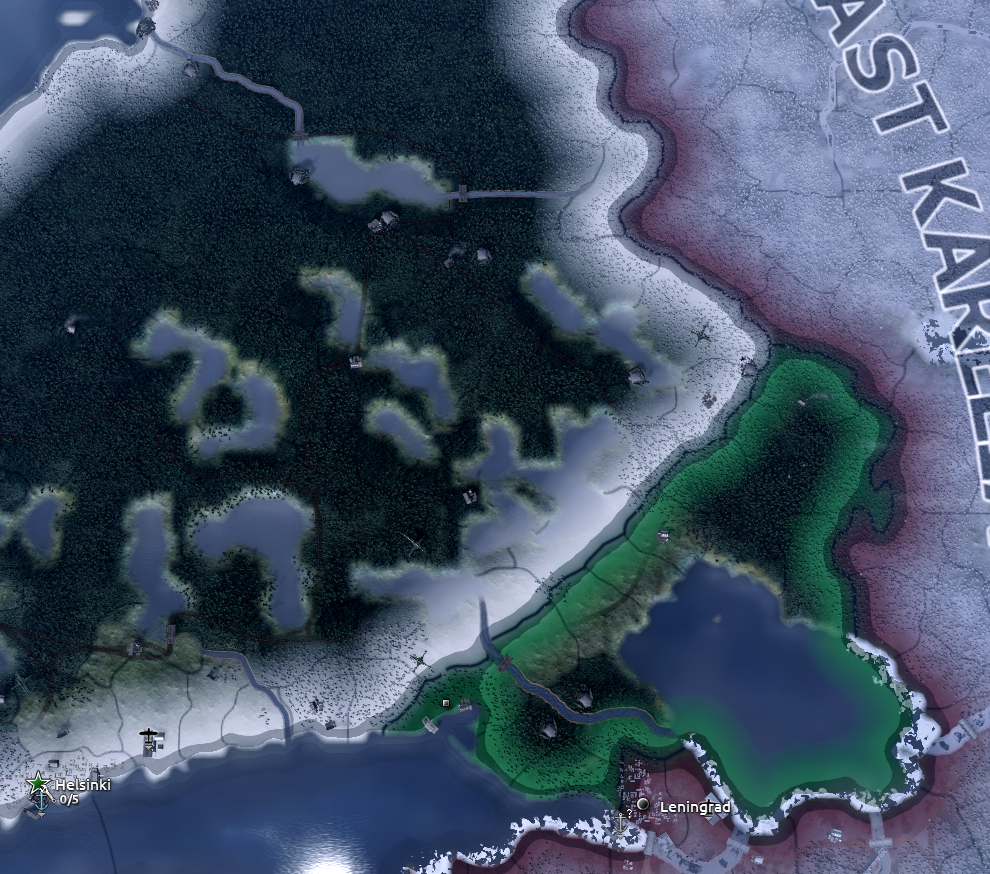 The most difficult section of the front is southeastern Finland. Unlike the northern regions, the Red Army can maintain a reliable supply network here, allowing Soviet divisions to fight at full strength. Defending this area effectively would require a much larger army than Finland can realistically field.
A far more efficient strategy is to release Karelia as a puppet state. This shortens the front line considerably while shifting the responsibility for defending part of the border to your puppet. As a result, Finnish divisions can be concentrated on the most critical defensive positions, making it significantly easier to survive the opening years of the war.
Once the military situation has stabilized, Karelia's autonomy can be gradually reduced until it is possible to reintegrate the territory back into Finland.
Defending Against Naval Invasions
The second greatest threat to Finland, after the land war, is a Soviet naval invasion. Fortunately, these landings can be almost completely neutralized with a simple defensive strategy.
The first step is to use submarines to lay naval mines in the Gulf of Finland. The AI is extremely reluctant to launch naval invasions through heavily mined sea zones, dramatically reducing the likelihood of a successful landing.
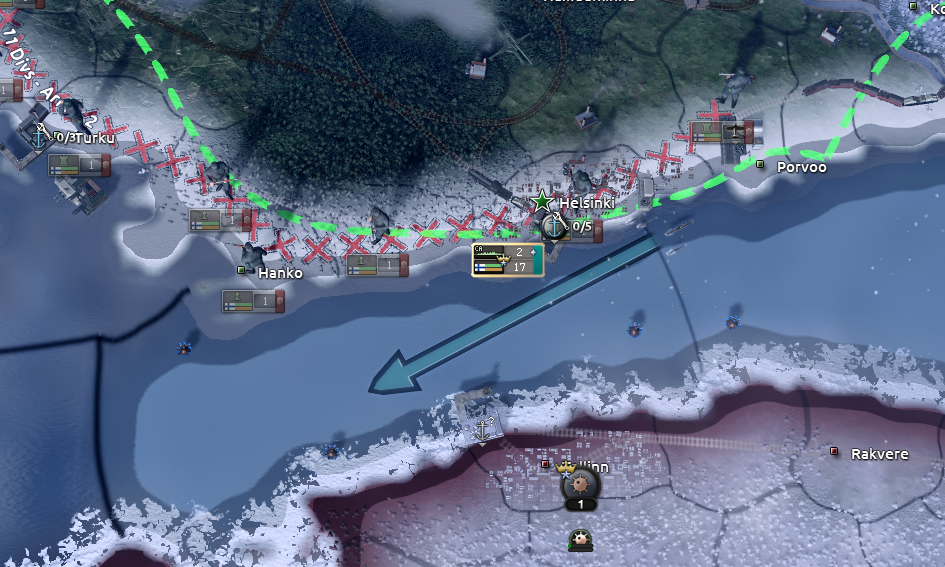 In the event that an invasion does succeed, reserve forces should be ready to respond immediately. The Erillinen Prikaati, available from the start of the game, together with the Rannikkorykmentti, unlocked through the National Focus tree, are ideal for this role.
Deploy these units along the coastline between Porvoo and Vaasa. Their objective is to intercept and eliminate any beachhead before Soviet reinforcements can arrive, preventing the enemy from establishing a permanent foothold on Finnish soil.
The first step is to use submarines to lay naval mines in the Gulf of Finland. The AI is extremely reluctant to launch naval invasions through heavily mined sea zones, dramatically reducing the likelihood of a successful landing.
In the event that an invasion does succeed, reserve forces should be ready to respond immediately. The Erillinen Prikaati, available from the start of the game, together with the Rannikkorykmentti, unlocked through the National Focus tree, are ideal for this role.Deploy these units along the coastline between Porvoo and Vaasa. Their objective is to intercept and eliminate any beachhead before Soviet reinforcements can arrive, preventing the enemy from establishing a permanent foothold on Finnish soil.
Conclusion
Defending Finland during the Winter War is not about matching the Soviet Union in numbers—it's about making the most of every advantage available. By developing a strong industrial base, stabilizing the country's political situation, investing Political Power wisely, and exploiting Finland's unique terrain and logistical advantages, it is possible to stop an enemy that vastly outnumbers your own forces.
This strategy focuses on remaining neutral and surviving without joining any faction. While no guide can account for every possible situation or AI decision, following these recommendations will give Finland the best chance of successfully holding the line against the Soviet Union.
If you found this guide helpful, consider leaving a rating or sharing it with other Hearts of Iron IV players. Good luck, and talvisota ei lopu ilman taistelua — the Winter War is never won without a fight.
This strategy focuses on remaining neutral and surviving without joining any faction. While no guide can account for every possible situation or AI decision, following these recommendations will give Finland the best chance of successfully holding the line against the Soviet Union.
If you found this guide helpful, consider leaving a rating or sharing it with other Hearts of Iron IV players. Good luck, and talvisota ei lopu ilman taistelua — the Winter War is never won without a fight.
Technical game settings
Version of the game: 1.19.2
Uses:
Uses:
- Mode: Regular
- Ironman: Off
- Historical AI: On
- Uses commands: Off
- Mods: Off
- Hearts of Iron IV
- Hearts of Iron IV: Death or Dishonor
- Hearts of Iron IV: Man the Guns
- Hearts of Iron IV: Together for Victory
- Hearts of Iron IV: Waking the Tiger
- Hearts of Iron IV: Arms Against Tyranny
- Hearts of Iron IV: By Blood Alone
- Hearts of Iron IV: Gotterdammerung
- Hearts of Iron IV: La Resistance
- Hearts of Iron IV: No Step Back
More Hearts of Iron IV guides
- Division Templates, Tank Designs, Aircraft Designs, and Metas (Bolivar 1.14+)★ 5 (3k)173k views8.7k ♥29 minUpdated Apr 30, 2025
- The Ultimate Guide to Division Templates, Aircraft and Tank Designs (Updated 15-06-2026)★ 5 (3.3k)134k views11k ♥54 minUpdated Jul 6
- Выполняем достижения в Hearts of Iron 4★ 5 (3.2k)69k views7.9k ♥326 minRussianUpdated Jul 19
- The Ultimate Guide to Navy; Ship Templates and Fleet Composition (Updated 24-3-2026)★ 5 (1.2k)61k views4.9k ♥33 minUpdated May 17
- HOI4. Большой гайд★ 5 (738)58k views2k ♥101 minRussian
- Лучшие шаблоны в HoI IV (1.15v.)★ 5 (612)49k views2.2k ♥6 minRussianUpdated May 20



🔥 Popular guides
- Upgrading to PremiumTeam Fortress 2★ 5 (20k)1441k views11k ♥6 minUpdated May 11, 2022
- No More Room in Hell Official ManualNo More Room in Hell★ 5 (2.8k)569k views2.1k ♥29 minUpdated Apr 22, 2019
- NMRiH Community Hosting GuidesNo More Room in Hell★ 5 (526)351k views653 ♥1 minUpdated Aug 10, 2022
- Лучшие кооперативные игры SteamPAYDAY 2★ 5 (1.5k)315k views2.1k ♥56 minRussianUpdated Apr 27, 2025
- Desert Eagle Heat Treated | Blue GemCounter-Strike 2★ 5 (1.6k)292k views1.5k ♥2 minUpdated Jan 16
- Treasure Hunt Puzzle SolutionsTotal War: WARHAMMER II★ 5 (6.9k)281k views15k ♥3 minUpdated Aug 19, 2021



This guide was created by its original author on the Steam Community. Are you the author and want it removed? Request removal.