𝙳𝚞𝚝𝚌𝚑 𝚅𝚊𝚗 𝚍𝚎𝚛 𝙻𝚒𝚗𝚍𝚎
The Backstory of Dutch Van der Linde
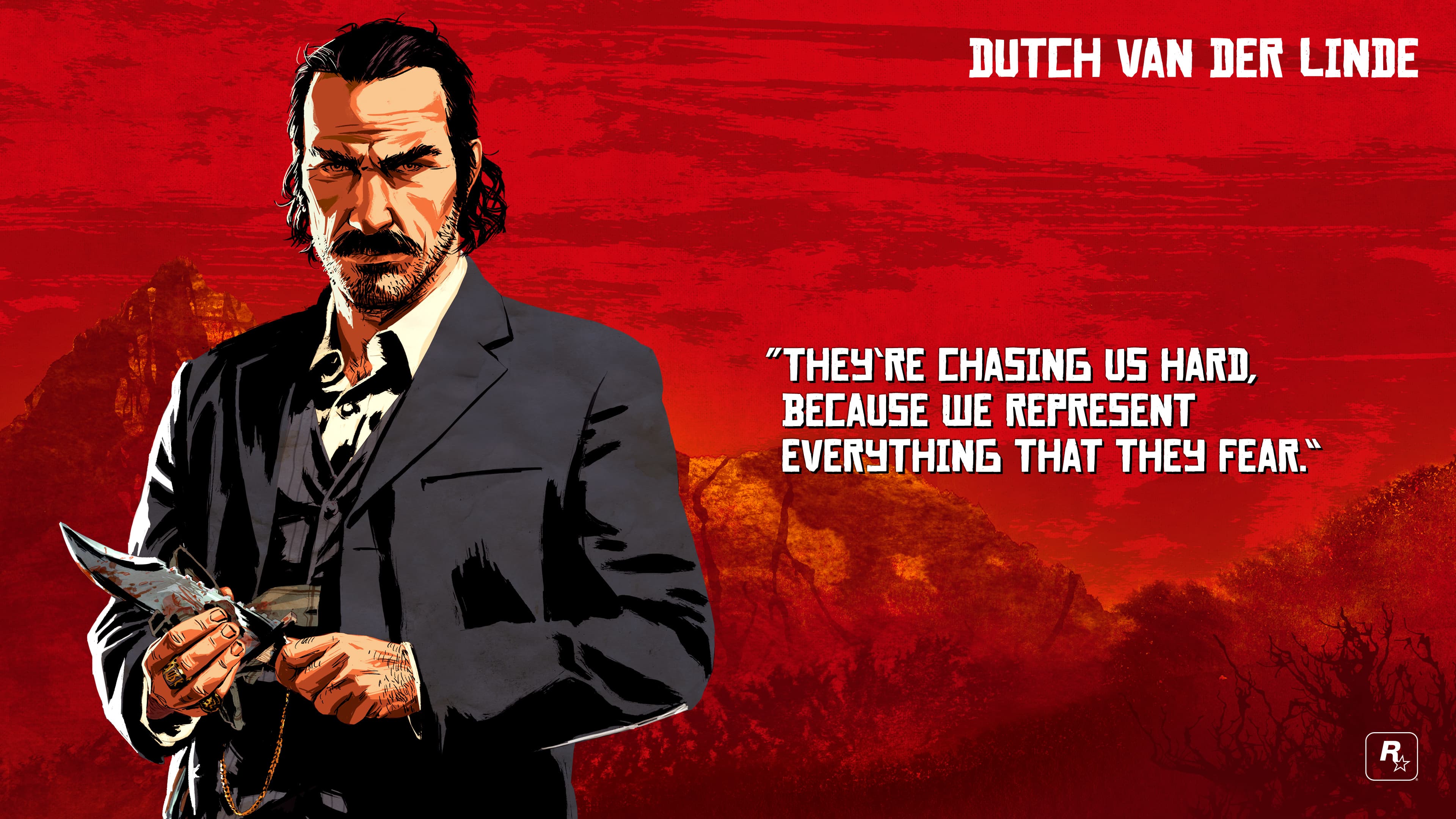
Dutch van der Linde was born in the mid-1850s near Philadelphia to Greta, a woman of English descent, and a father of Dutch ancestry. His father fought for the Union Army during the American Civil War and was killed in battle in Pennsylvania. Dutch’s father’s death left him with a lifelong resentment toward Southerners. As a boy, Dutch was unruly and frequently clashed with his mother, eventually running away at the age of fifteen. His mother later died in 1881 and was buried in Blackwater, though Dutch only learned of her passing years afterward from an uncle.
Growing up without parental guidance, Dutch taught himself and developed the philosophy that would later define him. He placed freedom and independence above all else, ultimately turning to a life of crime to pursue these ideals. In the mid-1870s, he encountered Hosea Matthews on the road to Chicago. Hosea tried to swindle him, only to discover that Dutch had simultaneously stolen from him. Amused by one another’s cleverness, they became partners, founding what would become the Van der Linde gang.
Their first cons together included a scheme in Kettering, Ohio, where they posed as international merchants and tricked twelve townsfolk into buying $300 worth of shares in a fake Portuguese shipping company. The deception was uncovered, and both men were arrested by Sheriff Carmichael. On March 9, 1877, they escaped custody by unknown means, robbing the sheriff as they fled.
That same year, Dutch and Hosea came across a fourteen-year-old orphan named Arthur Morgan. They took him in, teaching him literacy, hunting, fighting, and horsemanship. Arthur became their first protégé, and together the trio formed the core of the gang’s “old guard.” Around this time, Dutch began a relationship with Susan Grimshaw, who also joined the gang, though he later ended things after falling deeply in love with a woman named Annabelle.
During the late 1870s, Dutch recruited Leopold Strauss, an Austrian immigrant who specialized in financial scams. Strauss became the gang’s moneylender and a key contributor to its survival.
In 1885, Dutch saved a twelve-year-old boy named John Marston from a lynching attempt by Illinois homesteaders. Dutch welcomed him into the gang and mentored him as he had Arthur. The two boys grew close like brothers, with Dutch often reading aloud to them from works by writers such as Evelyn Miller and Ralph Waldo Emerson. While much of the philosophy went over their heads, Dutch and Hosea came to see Arthur and John as their favorite “sons.”
In 1887, Dutch led the gang’s first major bank robbery with Hosea and Arthur. At two in the morning, they stormed the banking house of Lee and Hoyt and escaped with $5,000 in gold. Afterward, they distributed money to the poor, imagining themselves as Robin Hood–like figures. From then on, Dutch became a wanted man.
Not long after, Dutch met Colm O’Driscoll, leader of the O’Driscoll Boys. The two formed a tenuous alliance, but Dutch disapproved of Colm’s treatment of his men as expendable, while Colm mocked Dutch’s ideals of building a better world. Their fragile truce collapsed when Dutch killed Colm’s brother, leading Colm to murder Annabelle in revenge. Dutch was left devastated, and the feud between the two gangs became a bloody rivalry lasting years.
Over time, Dutch brought more members into the gang, many of whom saw him as both protector and father figure. Among them was Tilly Jackson, a young girl and former Foreman Brothers gang member, whom Dutch rescued and taught to read. He also recruited Simon Pearson, a former Navy cook whom he saved from debt collectors, assigning him as camp chef. In another instance, Reverend Orville Swanson saved Dutch’s life in an unspecified situation, prompting Dutch to bring him into the group.
Dutch eventually began a romantic relationship with Molly O’Shea, a young Irish noblewoman, who joined the gang and lived with him.
In 1893, Dutch and Hosea encountered Bill Williamson, a drunken veteran who tried to rob them. Having already stolen his ammunition, they laughed off his attempt. Despite his shortcomings, Dutch admired Bill’s loyalty and brought him into the fold.
Two years later, in 1895, Dutch met Javier Escuella, a starving Mexican exile he found stealing chickens. Dutch gave him food and clothes before inducting him into the gang. Javier quickly embraced Dutch’s philosophy and became one of his most devoted followers.
In another encounter, Dutch and Hosea met Sean MacGuire, a cocky Irish outlaw who tried to rob them for Dutch’s pocket watch. Having already emptied his gun, they exposed his ploy and, amused by his boldness, recruited him instead of killing him.
During this period, Dutch styled himself as an idealistic outlaw, presenting the gang as liberators who stole from the wealthy to aid the poor. He envisioned himself as a defender of liberty and a figure embodying the romanticized Wild West, opposing government corruption and corporate greed while punishing cruelty and selfishness. His charisma inspired his followers to believe in his anarchic vision of a “savage utopia,” even as their crimes grew more violent. Yet by the late 1890s, Dutch began to sense that the world was changing, and his dream of freedom was slipping away with the decline of the Old West.
By 1898, the gang had swelled in size and was operating in Montana. After a fire and trouble in the north, they moved south through the Northern Grizzlies, spending a harsh winter in the mountains. For a time, they lived peacefully, with plentiful food, until Dutch scouted land he hoped to purchase for his utopia. Either the opportunity proved unsuitable, or he suspected lawmen were watching, so the gang continued its wandering.
In December 1898, Dutch tried to sell stolen gold at a bar in Crenshaw Hills but nearly lost his life when the deal turned violent. He was saved by Micah Bell, a ruthless outlaw whom Dutch quickly welcomed into the gang. While Dutch valued Micah’s boldness, Hosea and Arthur distrusted him as reckless and argumentative.
By early 1899, the gang had settled near Blackwater, West Elizabeth. Dutch and Micah plotted a risky ferry robbery, even as Arthur and Hosea pursued a more cautious real estate scam. Despite their concerns, Dutch pushed forward with the heist, which netted $150,000 but ended disastrously. Pinkerton agents ambushed the gang during the raid, and Dutch executed a defenseless woman, Heidi McCourt, in the chaos. The massacre forced the gang to abandon Blackwater, fleeing into the Ambarino mountains during a brutal snowstorm. Dutch buried the stolen money before leaving, though its exact location remained hidden. The events deeply shook Hosea, who admitted that his faith in Dutch’s vision had already been fading.
- 100% Achievement Guide for Red Dead Redemption II (including 100% game completion and Red Dead Online)★ 5 (1.9k)61k views4.6k ♥16 minUpdated Apr 12, 2020
- Карты для поиска животных в Red Dead Redemption 2 +Легендарные животные★ 5 (1.2k)52k views3.7k ♥1 minRussianUpdated May 25, 2021
- Полный гайд по испытаниям (Сюжетный режим)★ 5 (1.2k)52k views3.3k ♥33 minRussianUpdated Jun 27, 2020
- Карты сокровищ и тайники★ 5 (1.1k)42k views3.1k ♥7 minRussianUpdated May 17, 2020
- Hunting, Fishing, Perfect Pelts, Legendaries★ 5 (1.5k)39k views3.6k ♥16 minBulgarianUpdated Nov 25, 2025
- Достижения | Коллекции | Рецепты | Советы★ 5 (2.3k)38k views5.2k ♥46 minRussianUpdated Jun 29


- Upgrading to PremiumTeam Fortress 2★ 5 (20k)1441k views11k ♥6 minUpdated May 11, 2022
- No More Room in Hell Official ManualNo More Room in Hell★ 5 (2.8k)569k views2.1k ♥29 minUpdated Apr 22, 2019
- NMRiH Community Hosting GuidesNo More Room in Hell★ 5 (526)351k views653 ♥1 minUpdated Aug 10, 2022
- Лучшие кооперативные игры SteamPAYDAY 2★ 5 (1.5k)315k views2.1k ♥56 minRussianUpdated Apr 27, 2025
- Desert Eagle Heat Treated | Blue GemCounter-Strike 2★ 5 (1.6k)292k views1.5k ♥2 minUpdated Jan 16
- Treasure Hunt Puzzle SolutionsTotal War: WARHAMMER II★ 5 (6.9k)281k views15k ♥3 minUpdated Aug 19, 2021




This guide was created by its original author on the Steam Community. Are you the author and want it removed? Request removal.