The Logistics of Grand Strategy: Optimizing Supply, Air Support, and Division Widths in Hearts of Iron IV
The Logistics of Grand Strategy: Optimizing Supply, Air Support, and Division Widths in Hearts of Iron IV
This comprehensive report provides an expert-level analysis of how to optimize supply hubs and railway networks, sustain active frontlines utilizing the modern transport plane mechanics, and engineer the most effective division combat widths specifically tailored for low-supply theaters. The analysis dissects the underlying mathematical frameworks governing these systems, offering profound insights into how macroeconomic industrial decisions dictate frontline combat efficacy, ensuring that division commanders and theater architects can sustain continuous operations in the harshest global environments.
The Architecture of the Terrestrial Supply System
Divisions will fundamentally attempt to draw from State Supply first. State supply represents a fixed, localized baseline determined by the inherent infrastructure and population of a given region. The formula for State Supply is calculated by taking the state's population in millions multiplied by 0.18, adding 0.30 per level of local infrastructure, and factoring in local victory points, which range from an additional 0.25 supply for a 1-point victory location to 2.70 supply for a 50-point metropolitan center. Because State Supply is drawn before any other source, units stationed in heavily populated, highly developed states—such as those in Western Europe or the Eastern Seaboard of the United States—may occasionally sustain themselves defensively without heavily taxing the broader railway network. However, in desolate theaters such as Sub-Saharan Africa, the Sino-Japanese front, the Amazon, or the Siberian expanses, State Supply is mathematically negligible. In these regions, complete reliance on Hub Supply and, when critical, Aerial Supply is absolutely mandatory for survival.
Railway Networks and Throughput Bottlenecks
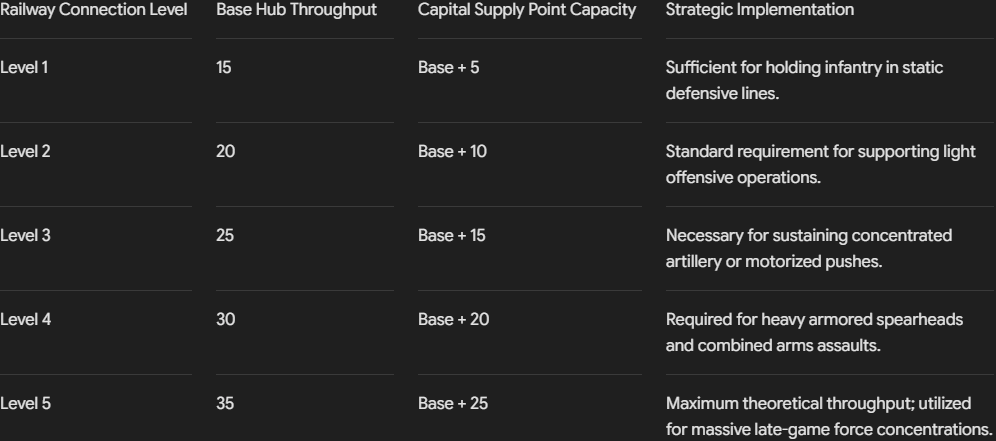
Hub Supply originates at the nation's capital and flows outward through the constructed railway and naval port networks. The absolute efficacy of any given supply hub is entirely dictated by the level of its connection back to the capital. A level-one railway connecting a hub to the capital provides a base supply throughput of 15 points to that hub. Each subsequent upgrade to the railway network increases this capacity by 5 points, capping at a maximum of 35 throughput for a level-five railway.
The most critical principle of railway optimization is the concept of the bottleneck constraint. The total supply throughput delivered to a hub is aggressively limited by the lowest-level railway or port connection anywhere along its path to the capital. Therefore, the optimization of a railway network does not require upgrading every rail line universally across an empire; rather, it demands the surgical, targeted elimination of bottlenecks along primary arterial routes leading to key active frontlines.
Furthermore, the logistical network demands operational rolling stock to function. For every supply point requested by a hub above a baseline of 2, the network requires one active train from the national stockpile. This is mathematically compounded by a distance modifier calculated at 0.03 trains multiplied by the railway distance between the hub and the capital. Over vast transcontinental distances, the train cost required simply to traverse the geographic space can exceed the train cost required to carry the actual supplies. For example, supplying the Far East from Moscow incurs a massive distance-based train penalty, underscoring the industrial burden of waging deep operations in expansive territories.
The Economics of Supply Hubs versus Motorization
When a frontline pushes beyond the effective distribution range of an active supply hub, offensive momentum rapidly deteriorates. Divisions receiving less than 35% of their required supply suffer severe penalties, including a maximum organization cap of 30% and continuous equipment attrition. To remedy this logistical shortfall, strategists frequently face a macroeconomic choice: construct a completely new supply hub near the front, or increase the motorization level of the existing rear-echelon hub.
Constructing a new supply hub requires a staggering 20,000 Industrial Capacity (IC). To contextualize this massive economic burden, a standard Civilian Factory costs exactly 10,800 IC, and a Military Factory costs 7,200 IC. Building a single supply hub incurs an opportunity cost equivalent to nearly three military factories or two civilian factories. In stark contrast, upgrading a railway costs a base of 170 IC, plus 130 IC per current level.
The third-order insight derived from these economic metrics is that manually constructing new supply hubs should be an action of absolute last resort, utilized exclusively in static, long-term defensive lines in completely barren terrain where no infrastructure exists. For offensive operations, it is vastly superior to capture existing enemy hubs and connect them to the domestic rail network. It is vital to note that captured supply hubs and railways require a 10-day conversion period before they become operational for the occupying force. Rapid armored spearheads frequently outrun their supply lines not because they lack theoretical throughput capacity, but because they have captured enemy hubs that are still undergoing this mandatory 10-day infrastructural integration phase.
To bridge the physical gap between a supply hub and the frontline without expending 20,000 IC, the network must be motorized. By default, supply distribution from a hub relies on horse-drawn logistics, indicated by a cavalry icon. By elevating a hub's motorization to the maximum level, its distribution range and throughput efficiency are drastically expanded, requiring the deployment of up to 80 trucks from the national stockpile.
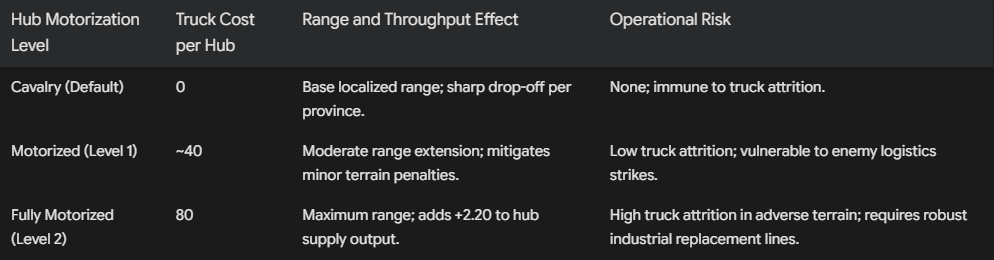
Motorization represents a continuous industrial drain, as active trucks suffer baseline attrition heavily modified by terrain and weather. Supplying troops via trucks in mountainous, jungle, or marshy terrain can increase truck attrition by up to 400%, bleeding a nation's motorized stockpile dry if left unmonitored by the industrial sector. Severe weather conditions, such as deep snow or blizzards, can apply an additional 500% attrition modifier to off-map supply trucks. Nevertheless, dynamically sacrificing trucks to maintain offensive momentum is vastly more cost-effective than sacrificing 20,000 IC on a static hub that the frontline will inevitably advance past within weeks.
Sustaining the Frontline: Aerial Supply and Transport Planes
The Mechanics and Mathematical Realities of Air Supply
In earlier historical iterations of the game's mechanics, transport planes provided immense logistical support, fundamentally breaking the necessity of terrestrial supply lines. However, subsequent adjustments have rigorously rebalanced this mechanic to reflect historical realities. Currently, at 100% mission efficiency, a single transport plane provides exactly 0.2 supply points. Consequently, an entire air wing of 100 transport planes delivers only 20 supply points under perfect operational conditions.
The industrial and political costs of sustaining an active air bridge are severe and must be meticulously calculated. An Inter-War, Basic, or Improved Transport Plane costs exactly 38 IC to produce. Generating an active air wing of 100 planes therefore requires 3,800 IC—a substantial industrial investment that forcibly redirects output away from the production of essential fighters or close air support (CAS) airframes.
Furthermore, executing the Air Supply mission demands a continuous, locking expenditure of Command Power (CP). The mission costs 0.05 CP per active plane, meaning a wing of 100 planes will lock down 5 Command Power for the entire duration of the mission. If a trapped army group requires 100 supply points to survive a deep encirclement, it would mathematically necessitate 500 transport planes operating at perfect efficiency. This massive airlift would lock down 25 Command Power and represent an upfront industrial investment of 19,000 IC.
Because Air Supply is calculated as the absolute final tier in the logistical hierarchy—drawn only after State Supply and Hub Supply are fully exhausted—transport planes are highly efficient when utilized to supplement minor deficits in degraded infrastructure zones. Units will only consume the exact fraction of aerial supply they require to reach equilibrium, meaning transport planes will not wastefully "over-drop" supplies into provinces that are already fully sustained by adjacent railways.
Integration with Operational Pacing and Supply Grace
The strategic application of Air Supply must be understood in tandem with the "Supply Grace" mechanic. Supply Grace defines the chronological window during which a division can operate normally after being severed from its supply network, simulating the consumption of the unit's organic, carried stores. Depending on difficulty settings and specific land doctrines, base Supply Grace typically ranges from 36 to 72 hours.
The third-order insight derived from these combined mechanics is the necessary synchronization of rapid mechanized assaults, the 10-day conversion timer of captured hubs, and Air Supply capabilities. When an armored spearhead aggressively breaches enemy lines and captures a critical railway node, that node remains totally inactive for 10 days. The spearhead's innate Supply Grace will expire in approximately 3 to 4 days, leaving a dangerous 6 to 7-day operational window where the unit will suffer catastrophic out-of-supply attrition. During this period, the division's maximum organization drops to 30%, and its combat effectiveness is effectively neutralized.
By proactively deploying transport planes specifically over the air zone containing the advancing spearhead, the operational commander effectively bridges this 7-day logistical deficit. The aerial supply replenishes the division just enough to prevent the catastrophic decay of organization and equipment until the captured railway hub comes online. Once the terrestrial hub formally activates, the units will automatically default to drawing from the hub, allowing the player to immediately cancel the Air Supply mission and recover the allocated Command Power.
Mission Efficiency and Operational Hazards
The benchmark of 0.2 supply per plane relies entirely on maintaining 100% mission efficiency. Mission efficiency is a highly volatile metric dictated by several localized operational factors:
Air Superiority: If the enemy contests the airspace, transport planes will be intercepted. Due to their complete lack of agility, armor, and armament, transports suffer horrific casualty rates when targeted by enemy fighters. Escort fighters assigned to the air superiority mission are mandatory to protect the 38-IC investment per transport plane.
Meteorological Conditions: Severe weather—such as blizzards, sandstorms, and heavy rain—drastically reduces mission efficiency and increases the mathematical risk of operational accidents during takeoff and landing.
Range Limitations: If the transport wing's range does not geometrically cover the entirety of the assigned strategic region, overall efficiency is proportionally reduced based on the uncovered provinces. Modern transport planes offer up to 1,800 km of range, mitigating this geographic issue in the late game.
Airbase Overcrowding: Operating more planes than the specific airbase's capacity allows will instantly crash mission efficiency, rendering the supply drop functionally useless while continuing to drain fuel and Command Power.
Division Combat Widths for Low-Supply Theaters
The Mathematics of Terrain and Over-Stacking Penalties
Every localized battle possesses a maximum combat width determined by the specific topographical terrain of the defending province. When attacking from a single direction, this base width dictates precisely how many battalions can participate in the active combat phase simultaneously. Attacking from multiple adjacent provinces expands this capacity through a specific flanking width addition.
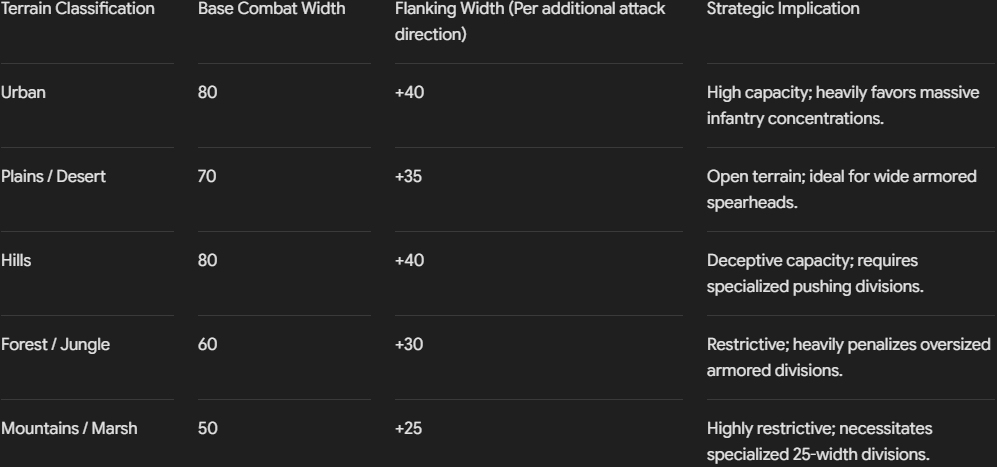
When the combined combat width of all divisions committed to the battle mathematically exceeds the terrain's capacity, the forces suffer a severe over-stacking penalty. The penalty is calculated via the formula: -100% * (Total Width - Battle Width) / Battle Width. The combat engine will refuse to reinforce new divisions from the reserve pool into the active frontline if adding them would cause the localized over-stacking penalty to exceed 33%.
However, rigorous mathematical modeling of the game's actual combat damage output reveals a vital third-order insight: the real effective penalty is roughly equal to the mathematical square of the displayed penalty. Because over-stacking allows more total raw statistics (Soft Attack, Hard Attack, Hit Points) to enter the battlefield, the negative percentage modifier is partially offset by the sheer volume of additional attacks present in the calculation. As a result, slightly over-stacking a tile (e.g., bringing 72 width into a 70-width plain) produces an imperceptible mathematical loss and is often strategically preferable to under-stacking and leaving combat width entirely unused.
Coordination, Initiative, and Engagement Widths
In combat, divisions do not magically apply their damage evenly across all enemy units present on the frontline. Each division utilizes an internal "Engagement Width" equal to exactly twice its own combat width. The division selects enemy targets randomly until it fills this engagement width limitation. If a target does not neatly fit into the remaining engagement width, it is mathematically ignored.
The attacks generated by the division are then divided into two distinct pools: a baseline portion is spread uncoordinatedly among the selected targets, while a specific percentage is focused entirely on a single priority target to maximize organization damage. This focused percentage is dictated by the global "Coordination" stat, which is heavily scaled by the division's specific "Initiative" stat. Initiative is primarily provided by Signal Companies, while Coordination is derived from Radio technologies and specific Land Doctrines.
This targeting algorithm heavily impacts division design philosophy. Very small divisions (e.g., 10-width or 12-width) have inherently low internal Hit Points (HP) and Organization. Because engagement widths allow larger enemy divisions (e.g., 30-width or 35-width) to easily fit multiple small divisions into their targeting calculations, small divisions frequently suffer from massive concentrated fire. Once their low HP is depleted, they rapidly lose organization and shatter, violently reducing the total combat width actively occupying the frontline and triggering a cascading retreat. Therefore, while tiny divisions consume very little supply, they are inherently fragile due to the game's coordination mechanics and should be avoided in active combat zones.
Optimized Division Templates for Low-Supply Regions
Designing divisions for theaters such as North Africa, the Amazon, or the vast steppes of Central Asia requires flawlessly balancing combat width efficiency against localized supply consumption. In these environments, deploying massive 42-width divisions will instantly overwhelm local infrastructure, resulting in attrition that destroys the division's equipment faster than enemy fire.
Based on terrain frequency probability and the updated combat width penalty calculations, the following templates are mathematically optimized for low-supply warfare:
The 15-Width Defensive Backbone (Versatile Holding Infantry)
Combat Width: 15
Battalion Composition: 7 Infantry Battalions, 1 Anti-Air Battalion (or 1 Artillery depending on specific enemy CAS threats).
Support Companies: Engineers, Logistics, Artillery, Anti-Air.
Operational Analysis: The 15-width template is arguably the most mathematically efficient defensive line-holder in the game for low-supply zones. The number 15 divides perfectly into the 60-width capacity of Forests and Jungles (exactly 4 divisions), and the 75-width (50+25) flanking capacity of Mountains. In a 70-width Plains environment, four 15-width divisions equal 60 width, allowing them to fight efficiently without triggering any over-stacking penalties. Because they require very few line battalions, their baseline supply consumption is remarkably low, making them ideal for holding massive frontlines in regions where Hub Supply is virtually non-existent. Furthermore, their relatively low industrial cost allows for massive production runs, ensuring the frontline remains fully saturated.
The 25-Width Mountaineer (Specialized Terrain Assault)
Combat Width: 25
Battalion Composition: 8 Mountaineer Battalions, 3 Artillery Battalions (8/3 configuration).
Support Companies: Rangers, Engineers, Logistics, Artillery, Field Hospital.
Operational Analysis: Mountains and Marshes possess a highly restrictive base combat width of 50. A 25-width division is perfectly tailored for this bottleneck, allowing exactly two divisions to saturate the frontline without wasting a single point of combat width or triggering any over-stacking penalties. To maximize their effectiveness, these divisions should mandatorily employ the Rangers support company. Unlocked via the Special Forces doctrine tree, Rangers function as an upgraded Cavalry Recon unit that provides significant terrain modifiers rather than simple speed bonuses. Depending on specific doctrinal choices, Rangers can provide up to +20% Attack and +10% Movement in Mountains, or +15% Attack in Snow, heavily augmenting the division's lethality in harsh terrain where heavy armor cannot physically operate due to extreme supply and attrition constraints.
The 30-Width to 35-Width Spearhead (Localized Offensive Breakthrough)
Combat Width: 30 to 35
Battalion Composition (30w Motorized/Infantry): 9 Infantry/Motorized Battalions, 4 Artillery Battalions.
Battalion Composition (35w Armor): 8 Medium Tank Battalions, 8 Motorized/Mechanized Battalions, 1 Medium Self-Propelled Artillery (SPG).
Support Companies: Logistics, Engineers, Maintenance, Signal, Medium Flame Tanks.
Operational Analysis: For offensive breakthroughs, relying on 15-width divisions results in excessive casualties due to low base breakthrough stats and low aggregate HP. The 30-width and 35-width templates represent the mathematical sweet spots for offensive operations across varied terrain. A 35-width tank division fits flawlessly into Plains (70 base width, exact fit of 2 divisions) and Hills (80 base width, resulting in a 70/80 slight under-stacking but excellent overall performance).
Because 35-width armored divisions consume massive amounts of supply and fuel, they cannot be deployed continuously across a broad frontline. Instead, they must be highly concentrated using principles similar to the Artificial Intelligence Force Concentration (AIFC) methodology. The player should identify a specific enemy supply hub, concentrate three to four 35-width armored divisions along the single optimal path of least resistance (expressly avoiding river crossings and marshes), and punch a narrow corridor through the enemy lines. This minimizes the logistical footprint while maximizing localized breakthrough potential.
The Critical Role of Support Companies and Doctrines in Low Supply
No division designed for low-supply theaters is complete without the integration of the Logistics Company. By integrating motorized logistics directly into the divisional structure, this support company reduces the overall supply usage of the entire unit by 10% at its base 1936 level, scaling up to an exceptional 30% reduction with 1942 technology. This multiplicative reduction allows a 35-width armored spearhead to operate effectively in terrain that would normally starve a much smaller force. Because Logistics Companies require trucks and motorized equipment, the maintenance of the national motorized stockpile remains paramount to preserving these bonuses.
Similarly, the Maintenance Company is vital for expensive armored divisions operating in low-infrastructure zones. Maintenance companies add a flat percentage bonus to the division's equipment reliability, significantly reducing the equipment lost to environmental attrition when operating outside of optimal supply range. For example, elevating a tank's reliability from 80% to 100% via a maintenance company effectively nullifies non-combat equipment loss, preserving vital industrial output.
Furthermore, for nations fighting prolonged conflicts in shattered infrastructure—such as the Soviet Union, China, or forces engaged in the Pacific Theater—the Mass Assault land doctrine provides unrivaled logistical resilience. The doctrine tree offers a passive -10% reduction to "Out of Supply" penalties and explicitly increases the base Supply Grace by an additional 48 hours. This enables deep encirclements and aggressive maneuvers far beyond the railhead.
More importantly, specific branches of the Mass Assault doctrine reduce the base combat width of standard infantry battalions by 0.4 (from 2.0 down to 1.6). This highly specific modifier allows the division designer to pack 25% more infantry battalions into the exact same combat width constraint. This dramatically inflates the HP, Organization, and Defense of a standard 15-width or 30-width division without mathematically altering its footprint on the battlefield, making it a premier choice for low-supply, infantry-heavy operations.
Strategic Synthesis and Operational Implementation
Mastery of Hearts of Iron IV's land warfare is ultimately a mastery of its logistics engine. The successful execution of a grand campaign does not rely merely on deploying the most heavily armed divisions, but on flawlessly aligning the macroeconomic industrial output of the nation with the grim microeconomic reality of the active frontline.
The optimization loop requires three integrated, continuous actions from the theater commander:
Infrastructural Dominance and Motorization: Acknowledge the 20,000 IC cost of a brand new supply hub as economically prohibitive. Instead, redirect industrial capacity toward expanding the railway network (specifically targeting and eliminating level-one and level-two bottlenecks) and heavily utilizing the motorization function of existing hubs, spending trucks rather than IC. The operational goal should always be the rapid capture and integration of enemy hubs, actively planning around the 10-day conversion delay as an inescapable strategic reality.
The Tactical Air Bridge: During the critical 10-day integration phase of a newly captured hub, or when an armored thrust exhausts its innate 36-to-72 hour Supply Grace, deploy 100-plane wings of Transport Aircraft to the specific air zone. Accept the 5 Command Power penalty per wing as a necessary investment to stave off catastrophic out-of-supply attrition. Ensure absolute air superiority to protect the 38-IC investment per plane, and immediately cancel the mission once the terrestrial hub activates to refund the Command Power.
Dynamic Width Calibration: Discard monolithic, outdated division templates. Utilize the highly efficient 15-width holding infantry to defend vast, barren frontlines without taxing the fragile Hub Supply network. Utilize 25-width Mountaineers equipped with Ranger support to surgically break mountainous choke points, and strictly concentrate 30-to-35 width armored spearheads equipped with Logistics and Maintenance Companies for localized breakthrough strikes exclusively along railway corridors.
By intertwining these three mechanical pillars, a commander transcends basic tactical maneuvering. Implementing this logistical framework ensures that forces remain constantly supplied, organically resilient to terrain penalties, and perpetually capable of sustained offensive momentum across any theater of war, no matter how desolate the geography.
Mod
- Division Templates, Tank Designs, Aircraft Designs, and Metas (Bolivar 1.14+)★ 5 (3k)173k views8.7k ♥29 minUpdated Apr 30, 2025
- The Ultimate Guide to Division Templates, Aircraft and Tank Designs (Updated 15-06-2026)★ 5 (3.3k)134k views11k ♥54 minUpdated Jul 6
- Выполняем достижения в Hearts of Iron 4★ 5 (3.2k)69k views7.9k ♥326 minRussianUpdated Jul 19
- The Ultimate Guide to Navy; Ship Templates and Fleet Composition (Updated 24-3-2026)★ 5 (1.2k)61k views4.9k ♥33 minUpdated May 17
- HOI4. Большой гайд★ 5 (738)58k views2k ♥101 minRussian
- Лучшие шаблоны в HoI IV (1.15v.)★ 5 (612)49k views2.2k ♥6 minRussianUpdated May 20




- Upgrading to PremiumTeam Fortress 2★ 5 (20k)1441k views11k ♥6 minUpdated May 11, 2022
- No More Room in Hell Official ManualNo More Room in Hell★ 5 (2.8k)569k views2.1k ♥29 minUpdated Apr 22, 2019
- NMRiH Community Hosting GuidesNo More Room in Hell★ 5 (526)351k views653 ♥1 minUpdated Aug 10, 2022
- Лучшие кооперативные игры SteamPAYDAY 2★ 5 (1.5k)315k views2.1k ♥56 minRussianUpdated Apr 27, 2025
- Desert Eagle Heat Treated | Blue GemCounter-Strike 2★ 5 (1.6k)292k views1.5k ♥2 minUpdated Jan 16
- Treasure Hunt Puzzle SolutionsTotal War: WARHAMMER II★ 5 (6.9k)281k views15k ♥3 minUpdated Aug 19, 2021






This guide was created by its original author on the Steam Community. Are you the author and want it removed? Request removal.