MICAH IS NOT A TRAITOR
First
From the very prologue, the game aggressively pushes the idea onto us that Micah is a liar and a traitor. And at the end of the game, Agent Milton himself confirms what we already knew. That's it, the masks are off, case closed.
Except the question of who was leaking information to the lawmen before the Blackwater massacre remains unanswered. Wait, but Milton claimed that Micah only started working for the Pinkertons after returning from Guarma. See, I just can't ignore the evidence pointing to the fact that there was a rat among the outlaws even before the Blackwater ferry robbery, and certainly long before Guarma.
Sure, we could turn a blind eye to these kinds of writing inconsistencies, but what if all of this is a hint at something much deeper? And honestly, what role do the hats actually play here? Let's break it down. Gameplay mechanics drop some pretty heavy hints about Micah Bell having his own twisted code of honor. For instance, look at the rewards after completing missions with him.
For saving him from the jail, he gifts us a fairly valuable item—the second holster. And in the bank stagecoach robbery quest, when there’s no real traitor around, everything goes smoothly, except for the O'Driscolls crashing the party. You could say this is the first serious money for both the gang and Arthur personally. So, why am I so fixated on these white hats? The thing is, according to western tropes from the 1920s and 30s, only the good guys wore them. And the game strictly follows this rule. Lawmen always wear white hats, while the O'Driscolls always wear black.
Of course, this detail could be interpreted as a hint that Micah is indeed working for the law, but if we believe Milton, Bell was sporting that white hat long before he ever met the Pinkertons. By the way, at the beginning of the game, Micah actually made some clumsy attempts to befriend Arthur and even called him "brother" a few times. How sincere that was is a big question, of course. However, the biggest contradiction reveals itself in the epilogue. We learn that for six whole years on the run, the person right by Dutch's side was none other than Micah. Not Javier, not Bill, but the main ♥♥♥♥♥♥♥♥♥♥♥♥♥ rat. Given that the law was hunting specifically for Dutch and the Blackwater money, there must have been a ton of opportunities for betrayal over those six years. Something just doesn't add up here.
Let’s rewind. Uncle brought a prostitute named Abigail Roberts to the camp. She joined the gang, offering her professional skills. As a result of an affair with John Marston, Abigail got pregnant. He refused to take responsibility for the child, insisting that he wasn't the father at all. Jack was subsequently raised by all the gang members. Jack was a year old when John suddenly took off, cutting all ties with the gang. Arthur was furious at Marston's actions, viewing it as a massive betrayal. Even though about a year later the hapless father did return. Arthur never truly forgave him, while Dutch and the others welcomed John back with open arms. From then on, the rift between the two brothers would only grow steadily over the next few years.
First of all, what does John give us for saving him from prison? Nothing. And yet, that rescue mission was far more complex and dangerous than breaking Micah out. Notice how John doesn't have any personal side quests at all. He doesn't ask Arthur for anything, doesn't go fishing or hunting with him. He won't even show a shred of gratitude for upgrading his tent. It’s as if he couldn't care less about what's happening in the gang anymore. As you might have guessed, you are looking at Suspect Number One. Don't throw tomatoes at me just yet; let me explain. No matter how unexpected this theory might seem, two crucial circumstances align perfectly. First: the lack of an alibi. Literally no one knows where John was missing for that entire year. Moreover, his departure was just as spontaneous as his return.
It turns out one of the reasons to come back could have been a contract with the Pinkertons. Whether he did it voluntarily or under pressure doesn't really matter to us. Second on the list: motive. Although it’s unknown why Marston was caught and what he was blackmailed with, we know the moral turmoil associated with his essentially running away from the camp. If he didn't accept the child and doubted his paternity, it means he knew for a fact that Abigail had slept with someone else—maybe even with multiple men in the gang. It's entirely possible to imagine John's train of thought: he couldn't accept it and believed Abigail should belong to him alone, preferably without the baggage of Jack. And as for their entire past with the gang and those who dared to touch his woman—let it all burn to the ground. How's that for motivation? Next, I will map out the entire timeline of events from John's perspective. So before writing a debunk or your own version in the comments, please read to the end.
Now, to dive down this rabbit hole, we need to roll back the clock to the moment John had just returned to the camp. This is roughly the mid-1890s. The attitude towards him from Dutch and the rest is quite welcoming, and overall, John received a genuinely warm reception. However, Arthur, unlike everyone else, considers him a traitor and says so bluntly. This, by the way, is the first time John is referred to as a traitor. Let’s just make a mental note and try to count how many of these hints pile up across the entire timeline. Shortly after, Micah brings in a plan to rob a ferry carrying money. While the gang learns about the plan, John finds out about Hosea and Arthur's joint hustle, which they'll be doing away from the main chaos, meaning they'll be out of harm's way.
This gives John the chance to sell out the gang to the Pinkertons with a clear conscience. However, as we know, the gang not only escapes but also walks away with $150,000. In Chapter Two, Milton approaches Morgan with an enticing offer. To keep himself safe, the agent arrives while Arthur is peacefully fishing with Jack. In this scenario, the child acts as a guarantee that the conversation won't turn into a shootout. To pick such a perfect moment, Milton had to know about it in advance. Furthermore, it turns out Milton is well-aware of events from 20 years ago—how Arthur joined the gang as a teenager, and how Dutch messed with his head. Details like that could only be pried out of three people who knew Arthur incredibly well and for a very long time: Dutch, Hosea, or John. Next up in the story is the train robbery. Up to this point, Arthur often mocked John for his lack of wits, but here he practically showers him with praise for his ingenuity. It's as if John knows something hidden from Dutch’s other men. During the heist, we hear them expressing surprise at the number of lawmen and how quickly they arrived. For now, either John or Micah could have tipped off the Pinkertons, so let's move on.
Second
After that comes the mission The Sheep and the Goats. Once again, John shows remarkable cleverness. He smoothly strikes a deal with the livestock auctioneer and drags Arthur along to meet Dutch. Marston knows perfectly well that Strauss will be present on site—someone who is useless as a fighter but highly useful as a witness. In this mission, John is captured for the first, but not the last time. And it goes smoothly, right along with Strauss. In the end, the outlaws got off easy. You could even say they got lucky. Well, except for Strauss, because it was his blood that was spilled, forcing them to rush back to camp for medical help. By the way, a bit later we find out that off-screen, John pulled off what was supposedly a suicidal move—he went back to Valentine to collect his share of the money from the auctioneer. Let me remind you: after our visit, the law went into full lockdown and quickly locked the town down. Therefore, making it out alive and well, let alone entirely on your own, would have been practically impossible.
Chapter Three stands out not so much for the fact that Milton visited the camp, but because of the timing. It all went down shortly after Jack was kidnapped. Another coincidence? Or did John actually manage to contact his handlers and outline the problem, hoping for some outside help? What interests me most is the actual cutscene of this event. Watch closely.
Look at this moment when Milton turns to John and asks, "Who are you?"
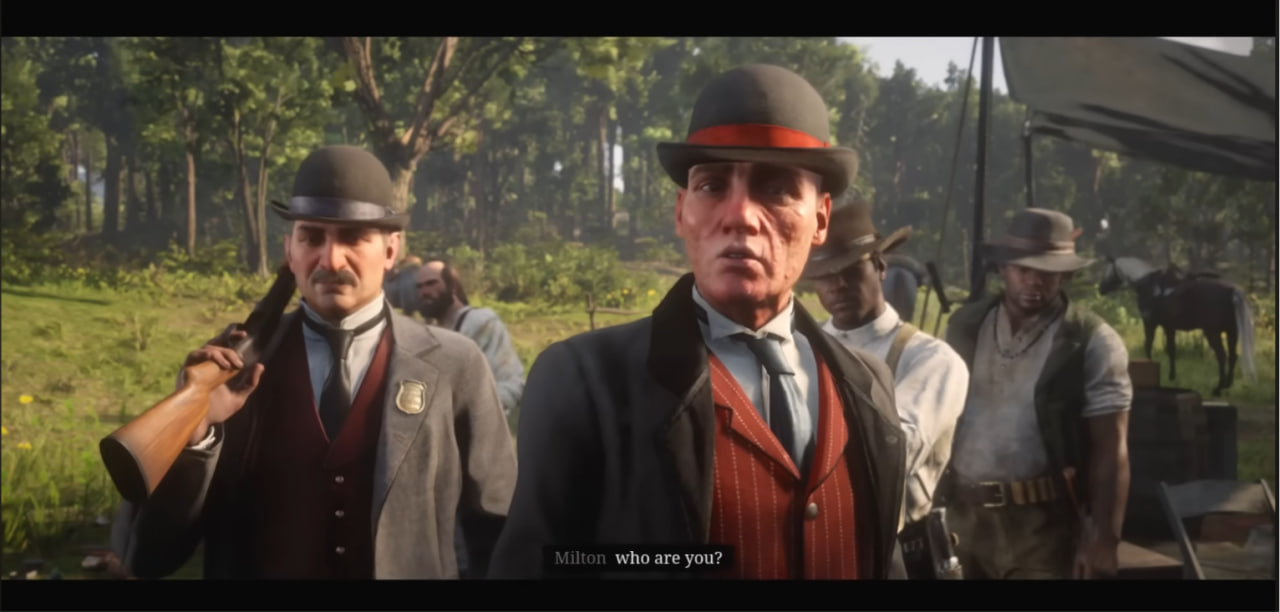
Have you ever wondered why he asked John specifically? Not anyone else, not even Micah, even though if Micah were the real traitor, that would make sense. It's simple: Milton does this purely for show to deflect even the slightest suspicion away from John. Remember, John had already run into the Pinkertons in Valentine, and suddenly the federal agent suffers a sudden bout of amnesia. Convenient. Just claiming you've never laid eyes on one of the gang's co-founders, let alone knowing his name. Just a reminder, this isn't some low-ranking agent speaking; it's Andrew Milton himself, a man fanatically obsessed with hunting down the gang, who knew the tiniest details of Arthur's life. Draw your own conclusions.
As a result of the negotiations, one thing became clear—neither side would compromise. The Pinkertons wouldn't get Dutch, and the gang wouldn't get that long-awaited freedom Dutch had been dreaming about all these years. Milton made it obvious he was shifting to the harshest scenario. If anyone in the gang doubted his words, those doubts vanished instantly with Hosea's death. That’s it, the stakes are raised, the tension is pushed to the limit, but not for John. He just gets arrested, while Abigail vanishes as if by magic. Does Micah care about Abigail? No, unlike John. Either Abigail is incredibly lucky, or she is part of the deal. But let's go back to the outlaws, who in the meantime successfully escaped. Because of this, John isn't let go; he's thrown into prison. And the fact that they don't plan to hang him right after his arrest, as we’ve come to understand, fits perfectly within our theory. If you think I’ve gone too far with the accusations against John, the next hypothesis might just knock some of you out of your chairs, so hold on tight.
Third
So, what if Dutch isn't as crazy as he seems at first glance? Look, I'm not some wild theorist trying to deny his descent into madness entirely, but just hear me out. We already know that the developers at Rockstar Games are famous for their extremely meticulous attention to detail and carefully crafted dialogue. Would they really miss a chance to plant seeds of doubt in the players' minds through a character whose credibility drops over time, both for Arthur and for us? Let's look back at Chapter Five. From constant failures and a head injury, his paranoia continues to progress. And what we saw on Guarma does look like pure insanity. Out of nowhere, Dutch kills an old woman, spouts incoherent nonsense, and discovers new talents on the fly. One minute he understands Spanish, the next he "senses" something—all that’s missing is a third eye opening up. Basically, we are being conditioned to think that Dutch should no longer be listened to. But we should listen to him. His animal instincts have sharpened. He states several times that John is a traitor, bringing up the exact same points I mentioned earlier. About the bank, about Abigail. But by that time, both Arthur and the player firmly believe that Dutch is a psycho and Micah is the rat.
Finally, we move to Beaver Hollow, where we are immediately thrown off by Molly's confession. The tension keeps rising. Then, despite Dutch's explicit orders, we break John out of prison. And if it weren't for us, it's highly likely things might have actually worked out. From this point on, events unfold at breakneck speed. Since John is back in the gang, he doesn't miss the chance to help his buddies with the train robbery. As a result, for some reason, the train doesn't stop in Saint Denis like it was supposed to. But it gets even better because it leads them straight into an ambush. John takes a bullet and falls off the train. Dutch, along with Javier and Bill, ride back to save him, but it turns out they are forced to save themselves from a massive patrol. This is all according to Dutch himself. And I don't think he's lying. Otherwise, how would he explain this to his two companions? They would have lost faith in him instantly.
Long story short, everyone believes John is dead. Meanwhile, the Pinkertons show up at the camp and kidnap Abigail. Abigail again. Why not Tilly, or Mary-Beth, or Grimshaw? It's a rhetorical question at this point. The deal is done, the gang's hideout is compromised, and it will be raided soon. John is officially dead and gets his Abigail, while the Pinkertons get the gang and the key to the money. But things don't go as planned. Arthur and Sadie mess everything up. They go rogue to rescue Abigail. Sadie gets captured, and when Arthur arrives, Milton sees that he is terribly sick and nowhere near as dangerous as he used to be. Why then does Milton tell Arthur about Micah, while making a glaring timeline error? Obviously, he is addressing Abigail, and the mistake is left there for the player so we would definitely catch the writers' hint. Milton knows Abigail will have to be let go, and since she still has to meet up with John, she must not know that almost the entire gang died and Jack went missing because of him. But it turns out Abigail kills Milton, and the whole crew escapes back to camp with the key to the money. John has to come back from the dead yet again.
And look at that—a miracle, another miracle. Not only did he cheat death, but he's also just wounded and wasn't captured. Now John needs to find out where Abigail is and fulfill his end of the bargain—return the money and hand over Dutch. Dutch's surprise is completely understandable; he saw the patrol and saw a wounded John—the man simply stood no chance. Now there's no turning back, and Dutch forces the issue of betrayal. If he had truly abandoned John right in front of Javier and Bill back then, they clearly wouldn't have stood by him without a second thought. And right at the tensest, clearly losing moment for John, the Pinkertons show up out of nowhere—the very ones he brought to the camp. Time for the final chase. John yells that Arthur is his brother, but his actions are anything but brotherly: instead of carrying Arthur or standing back-to-back to shoot it out, he just runs away. Meanwhile, the Pinkertons suddenly lose interest in Arthur. So much so that Micah and Dutch are left with plenty of time for a final showdown and a tragic ending. Maybe it's a plot hole for the sake of drama, but if you look at the timeline, John had plenty of time to save Arthur. As I said before, even six years later, Micah still hadn't turned Dutch in.
Meanwhile, John spends his time traveling the game world, telling everyone and anyone that Arthur saved him. At some point, it starts to feel like he's doing it a bit too obsessively. I think from a gameplay perspective, this was necessary to fuel interest in the remaining quests, after which you can finally find and kill Micah Bell. Rockstar Games know exactly which buttons to press to get the desired reaction out of players. Furthermore, these stories about Arthur the Savior might serve a therapeutic role for John. It's as if Marston is trying to convince himself that he is morally free from his obligations to the Pinkertons and can claim the money with a clean conscience. Except the Pinkertons themselves have a different opinion on the matter. They still need to retrieve the money and catch Dutch. Now, imagine approaching the plot of the first Red Dead Redemption with this exact background. Against this backdrop, John's death feels much more fitting than it did based on the first game alone, where there was little logic outside of Agent Ross's sheer cruelty. But it certainly had redemption.
- 100% Achievement Guide for Red Dead Redemption II (including 100% game completion and Red Dead Online)★ 5 (1.9k)61k views4.6k ♥16 minUpdated Apr 12, 2020
- Карты для поиска животных в Red Dead Redemption 2 +Легендарные животные★ 5 (1.2k)52k views3.7k ♥1 minRussianUpdated May 25, 2021
- Полный гайд по испытаниям (Сюжетный режим)★ 5 (1.2k)52k views3.3k ♥33 minRussianUpdated Jun 27, 2020
- Карты сокровищ и тайники★ 5 (1.1k)42k views3.1k ♥7 minRussianUpdated May 17, 2020
- Hunting, Fishing, Perfect Pelts, Legendaries★ 5 (1.5k)39k views3.6k ♥16 minBulgarianUpdated Nov 25, 2025
- Достижения | Коллекции | Рецепты | Советы★ 5 (2.3k)38k views5.2k ♥46 minRussianUpdated Jun 29


- Upgrading to PremiumTeam Fortress 2★ 5 (20k)1441k views11k ♥6 minUpdated May 11, 2022
- No More Room in Hell Official ManualNo More Room in Hell★ 5 (2.8k)569k views2.1k ♥29 minUpdated Apr 22, 2019
- NMRiH Community Hosting GuidesNo More Room in Hell★ 5 (526)351k views653 ♥1 minUpdated Aug 10, 2022
- Лучшие кооперативные игры SteamPAYDAY 2★ 5 (1.5k)315k views2.1k ♥56 minRussianUpdated Apr 27, 2025
- Desert Eagle Heat Treated | Blue GemCounter-Strike 2★ 5 (1.6k)292k views1.5k ♥2 minUpdated Jan 16
- Treasure Hunt Puzzle SolutionsTotal War: WARHAMMER II★ 5 (6.9k)281k views15k ♥3 minUpdated Aug 19, 2021



This guide was created by its original author on the Steam Community. Are you the author and want it removed? Request removal.