The History of Assassin’s Creed
The Middle East in 1191
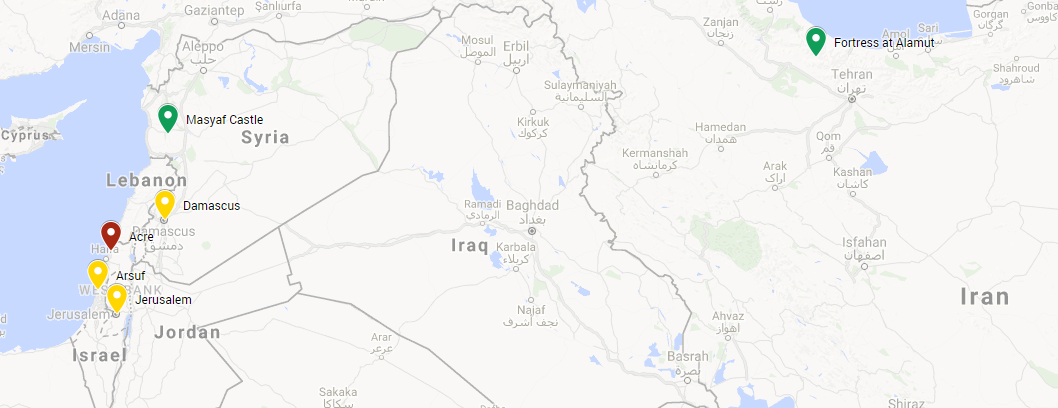 Above: Locations featured in Assassin’s Creed marked on a modern-day map of the Middle East. Green represents Assassin strongholds, red represents cities held by the Crusaders, and yellow represents cities held by the Ayyubids at the beginning of the game’s story. Note that Alamut does not appear in the game but served as the historical headquarters for the Assassin Order and is thus significant to elements of the game’s historical context.
In 1191, the Middle East is wracked by war, specifically the Third Crusade: a campaign by the respective kings of England and France to recapture Jerusalem – a holy city in the Christian religion – after its 1187 capture by Saladin, Sultan of the Ayyubid dynasty. The kicker in terms of Jerusalem is that it was also considered a sacred site in the Islamic and Jewish religions (the three are collectively referred to as the ‘Abrahamic religions’ due to their claimed descent from the ancient Israelites, specifically the biblical figure Abraham). The prevalence of the Abrahamic religions in the middle ages made Jerusalem a cornerstone of both Christian and Muslim culture, and as such, major powers of both religions vied to exert control over it.
To this end, King Henry II of England and King Philip II of France gathered their armies to conquer their way back to controlling the holy city. The influential Holy Roman Emperor Frederick I also led an army across Anatolia (modern-day Turkey) but drowned in hip-deep water en route after having a heart attack and being weighed down by his armour. Shocked and devastated by this massive anticlimax, most of Frederick’s army deserted or committed suicide, and only around 5,000 troops actually arrived in Acre.
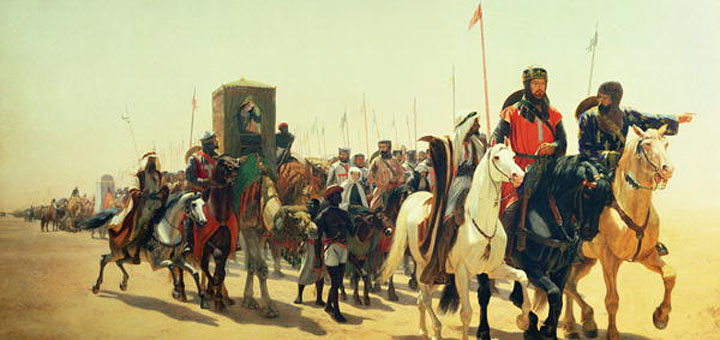 Above: Richard, Coeur De Lion, On His Way To Jerusalem, James William Glass, circa. 1850.
Following the colossal disappointment that was Frederick I, Richard I of England (who succeeded Henry II as King of England after Henry’s death) arrived in Acre in June 1191 and immediately began sieging it, capturing it on July 12 and sending word to Ayubbid Sultan Saladin requesting a face to face meeting. This offer was declined as Saladin did not want to meet with Richard unless a peace treaty was to be signed. Saladin’s brother Al-Adil was sent to negotiate for the release of Acre’s garrison, but Richard executed 2,700 of the prisoners in response to the slow negotiation process (which is strikingly similar to the behaviour of customers at the local Woolworths under similar circumstances). Saladin unhelpfully executed all the Christian prisoners he had thus far captured.
This is about where we come in. The entirety of Assassin’s Creed is set during 1191, and it can be deduced that most of it takes place in August and late July of that year since Acre is clearly under Crusader control and the battle of Arsuf, which took place on September 7th, occurs towards the end of the game. The game as such takes place largely during this period in which Saladin and Richard I both are menacingly measuring their genitals at one another. Richard is prepping to march on the integral port town of Jaffa, Saladin is prepping to attack his army en route, and Altaïr is assassinating historical figures to show off Ubisoft’s exciting new video game circa. 2007. Exciting stuff. The history of the actual Third Crusade (when it’s actually being adhered to) is largely a backdrop to this story, and this guide will go into excruciating detail about the people, factions, and places of the Middle East in this period, so buckle up and get ready for a few thousand words of mouth-watering, reliably referenced history.
Order of Assassins
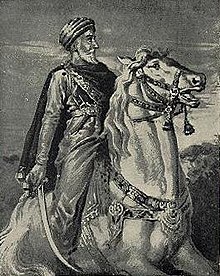 Left: Engraving of Hassan-i Sabbāh, leader of the Nizari Ismailites and founder of the order of Assassins.
The real-life Order of Assassins were an Islamic sect formally known as the Nizari Ismailites. The name derives from the phrase Asāsīyūn, meaning “people who are faithful to the foundation”, which is exactly what I think of when I hear ‘assassin’. The order originates shortly before the First Crusade around 1094, where it was founded by Persian missionary Hassan-i Sabbah, its first Grand Headmaster. Hassan-i Sabbah had accrued a number of followers among the Isma’ili, and formed the Order of Assassins, supposedly for political and personal gain, though his exact motives are unknown. Sabbah headquartered the Assassins at the fortress at Alamut and sent agents into nearby towns to gain support.
Having founded the Order, Sabbah remained at the fortress at Alamut for the rest of his life, which he spent producing religious works and doctrines. The hierarchical structure featured Sabbah as Grand Headmaster at the top and the Lasiqs (or “adherents”) at the bottom. The Lasiqs were also known as “Fida’i” (self-sacrificing agent), as it was they who committed the trademark assassinations, typically being killed themselves in the process.
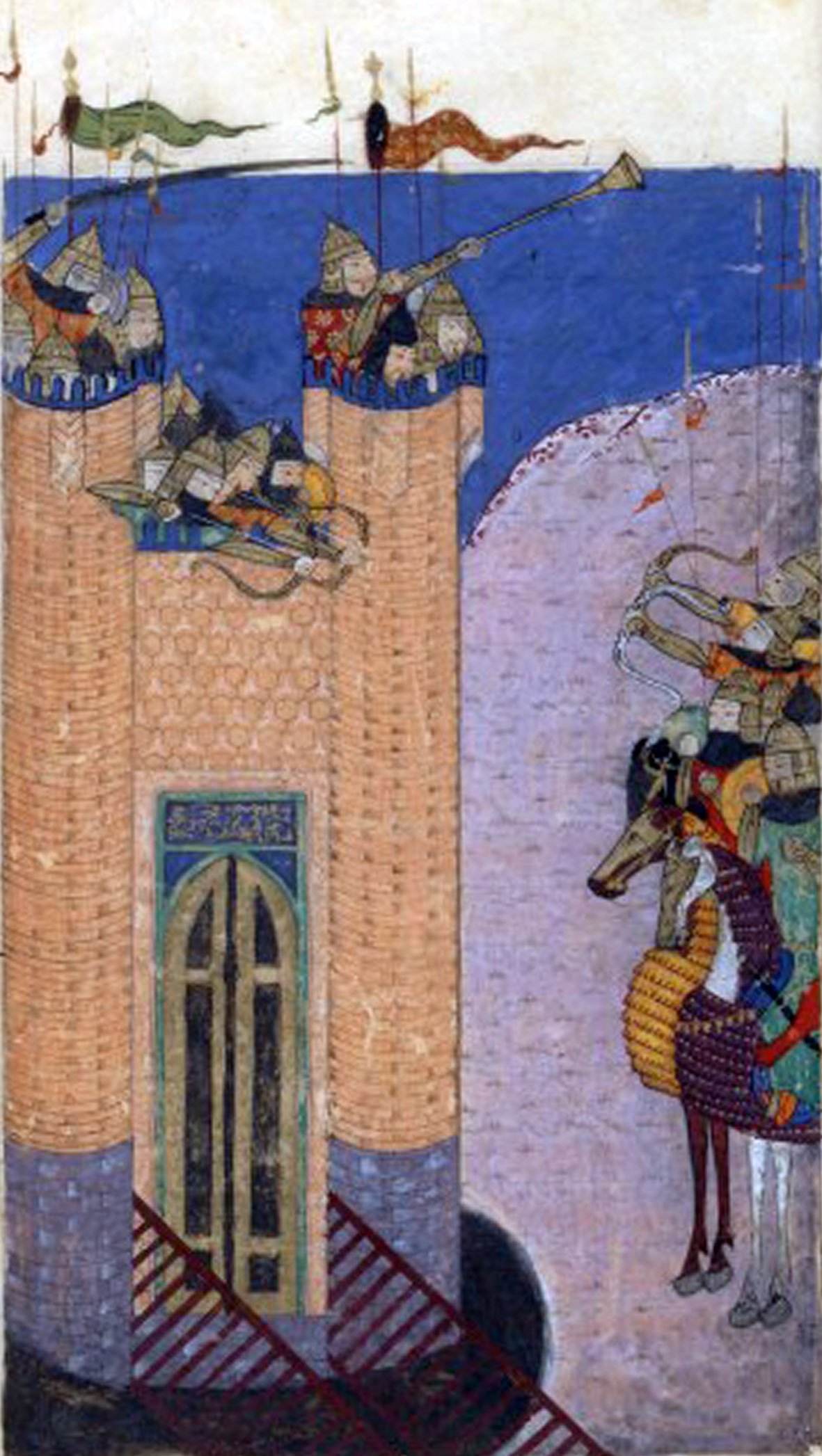 Marco Polo recounts the story of Sabbah as “Old Man of the Mountain”, who used hashish to drug his followers and convince them that he was a wizard of sorts and could usher them to paradise if they followed his commands. This explanation for Sabbah’s adherents’ willingness to go to their deaths has been criticised as Polo was not born until circa. 1254, sometime after the deaths of both Sabbah in 1124 and Rashīd ad-Dīn Sinān, who is typically referred to as the “Old Man of the Mountain” (and appears in Assassin’s Creed as Al Mualim), in 1192. This story is probably also the origin of the myth that the word ‘assassin’ comes from the word ‘hashish’.
The Assassins were destroyed by the Mongol Empire during the invasion of Khwarezm (located in parts in modern day Uzbekistan, Kazakhstan, and Turkmenistan), probably in retaliation for an assassination attempt against Möngke Khan, fourth khagan of the Empire. Mongol assaults against Assassin fortress began in 1253 under Mongol lieutenant Kitbuqa Noyan. On 15 December 1256, the Mongols successfully captured the Assassin headquarters at Alamut. Mamluk Sultan Baibars took over the Syrian branch of Assassins in 1273, and the Mamluks continued using their services until they were crushed in 1275 having briefly retaken Alamut. Remaining Assassins resorted to Taqq’iya (a dissimulation of their beliefs) and dispersed.
The Assassins’ distinctive methods of public assassination made them a significant presence in mediaeval culture, where they were often used as a quintessential placeholder villain. They also appear in many contemporary works, including the 1938 Vladimir Bartol novel Alamut, from which much of Assassin’s Creed’s narrative is derived, including the creed itself: “nothing is absolute reality; all is permitted”.
Rashīd ad-Dīn Sinān (Al Mualim)
Rashīd ad-Dīn Sinān, sometimes called “The Old Man of the Mountain”, was the leader of the Syrian branch of the Assassins. Born between 1131 and 1135 in Basra, Iraq (in what must have been the longest labour ever recorded), Sinān’s incomplete autobiography states that he came to Alamut after an argument with his brothers and received standard Assassin training (which is incidentally how I end most of my arguments). In 1162, Sinān was sent to Syria, where he controlled the districts of Jabal as-Summaq, Maarrat Misrin, and Sarmin out of the Nizari stronghold Masyaf.
Sinān twice ordered unsuccessful assassination attempts against Ayyubid Sultan Saladin, who sieged Masyaf in retaliation in 1176. The siege was supposedly ended when a threatening note was left in Saladin’s tent whilst he slept (which somehow frightened Saladin more than any of the assassination attempts). Saladin thus came to an agreement with Sinān’s Assassins and aligned himself with them against the Crusaders.
In a letter penned in 1193, Sinān takes credit for the ordering the 1191 assassination of Conrad of Montferrat, the new King of Jerusalem. Richard I of England requested that Sinān write the letter to dispel the belief that Richard had ordered the assassination. Sinān died in 1193 at Al-Kahf Castle in Masyaf.
In Assassin’s Creed, Rashīd ad-Dīn Sinān is the leader of the Assassin Brotherhood and is called ‘Al Mualim’ (Arabic for ‘The Mentor’). He plays the role of Altaïr’s teacher, and commands him to assassinate nine targets across the Middle East as redemption for breaking the Assassins’ creed. Unlike the historical figure, this version of Sinān is killed in 1191 by Altaïr after betraying the Assassin Order for the Templars.
Sinān twice ordered unsuccessful assassination attempts against Ayyubid Sultan Saladin, who sieged Masyaf in retaliation in 1176. The siege was supposedly ended when a threatening note was left in Saladin’s tent whilst he slept (which somehow frightened Saladin more than any of the assassination attempts). Saladin thus came to an agreement with Sinān’s Assassins and aligned himself with them against the Crusaders.
In a letter penned in 1193, Sinān takes credit for the ordering the 1191 assassination of Conrad of Montferrat, the new King of Jerusalem. Richard I of England requested that Sinān write the letter to dispel the belief that Richard had ordered the assassination. Sinān died in 1193 at Al-Kahf Castle in Masyaf.
In Assassin’s Creed, Rashīd ad-Dīn Sinān is the leader of the Assassin Brotherhood and is called ‘Al Mualim’ (Arabic for ‘The Mentor’). He plays the role of Altaïr’s teacher, and commands him to assassinate nine targets across the Middle East as redemption for breaking the Assassins’ creed. Unlike the historical figure, this version of Sinān is killed in 1191 by Altaïr after betraying the Assassin Order for the Templars.
Robert IV de Sablé
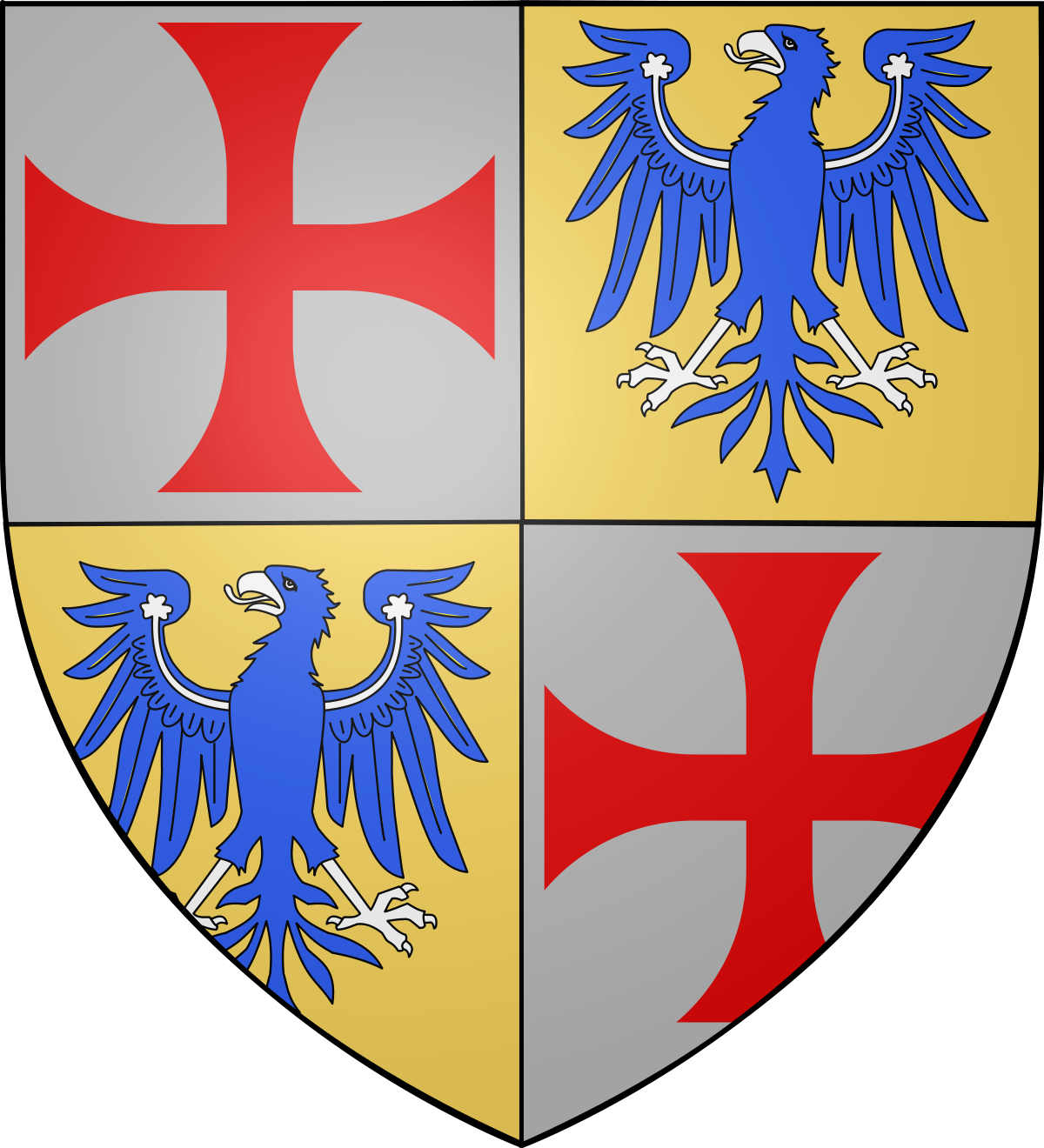 Robert IV de Sablé was the eleventh Grand Master of the Knights Templar from 1191 to 1192. Born in 1150, de Sablé inherited the lordship of lands in the River Sarthe valley in the 1160s and supported Henry the Young King in the Revolt of 1173-1174 against Henry II. Though the revolt was a failure, de Sablé remained in the favour of Henry II’s House of Angevin. De Sablé later led King Richard I’s navy to the Mediterranean during the Third Crusade and was elected Grand Master of the Knights Templar in 1191. Under de Sablé, they successfully laid siege to Acre, and recaptured lost fortresses in the Levant and Eastern Mediterranean. De Sablé’s Templars made up part of Richard I’s force during their decisive victory at the battle of Arsuf.
In late 1191, Richard I sold Cyprus to the Templars, having taken it from Byzantine forces earlier in the year. De Sablé failed to set up a solid base for the Templars on Cyprus, and sold the island to Guy de Lusignan, King of Jerusalem. Robert de Sablé died in 1193 in Arsuf.
In Assassin’s Creed, Robert de Sablé is the central antagonist, and leads the Templars on a quest for the magical Apple of Eden. He is depicted as a manipulative and intelligent individual and is seen unsuccessfully laying siege to Assassin headquarters at Masyaf to retrieve the magical Apple of Eden, and later at the battle of Arsuf, where he is killed in a duel with Altaïr at the behest of Richard I. Historically, de Sablé died in Arsuf in 1193 - not during the 1191 battle.
Acre
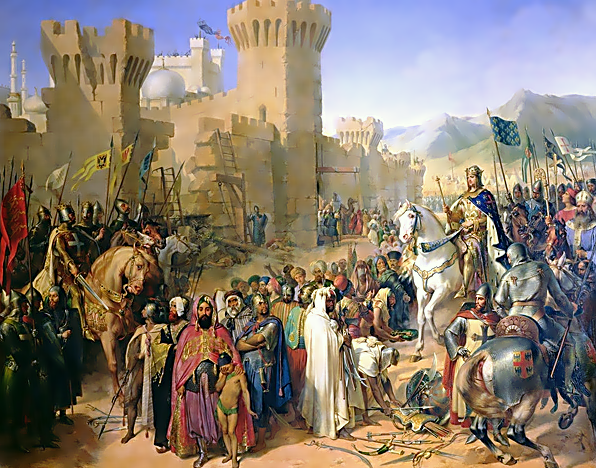 Left: Ptolemais (Acre) given to Philip Augustus 1191, Merry-Joseph Blondel, 1853.
Acre is a city in Israel’s Northern District, on the coast of the Mediterranean Sea. In 1191, a two-year siege conducted by King Guy of Lusignan ended when the forces of the Third Crusade (King Richard I of England and King Philip II of France) came to his aid and the city surrendered.
Assassin’s Creed is set shortly after the end of the siege of Acre, and the city is seen under Crusader control.
Masyaf
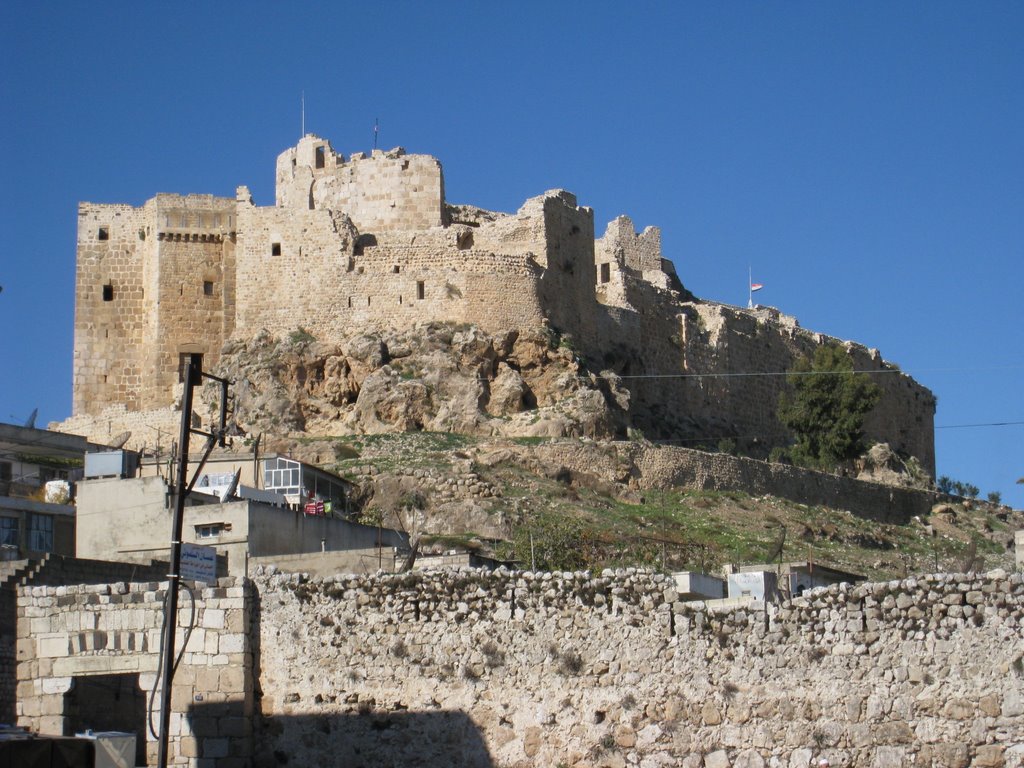 Masyaf is a city in Syria’s Hama Governorate notable for its large mediaeval castle, which served as the Syrian headquarters of the Assassins. Modern-day Masyaf is the administrative centre of the Masyaf District of the Syrian Arab Republic.
In 1099, Masyaf’s fortress was part of Jund Qinnasrin of the Fatimid Caliphate. In this year the Crusaders attempted to control Masyaf and were met with a military campaign conducted by Zahir ad-Din Tughtakin, Seljuk of Damascus, to retain control of the area. Between 1099 and 1127, the Mirdasid dynasty controlled Masyaf, and in 1127 sold it to the Banu Munqidh family of Shaizar.
The Nizari Ismailites (Assassins) seized Masyaf in 1140, settling there after being persecuted throughout Syria. The Ismailis’ effectively created an autonomous territory independent of the Crusader and Muslim states surrounding it. Saladin briefly sieged the city in 1176 but withdrew having come to an agreement with Syrian Assassin leader Rashīd ad-Dīn Sinān to side with them against the Crusaders.
In Assassin’s Creed, Masyaf is the headquarters of the Levantine Assassin Brotherhood and no other branches of the order are mentioned. Rashīd ad-Dīn Sinān appears as the leader of the Assassins, based in the fortress at Masyaf.
Richard I the Lionheart, King of England
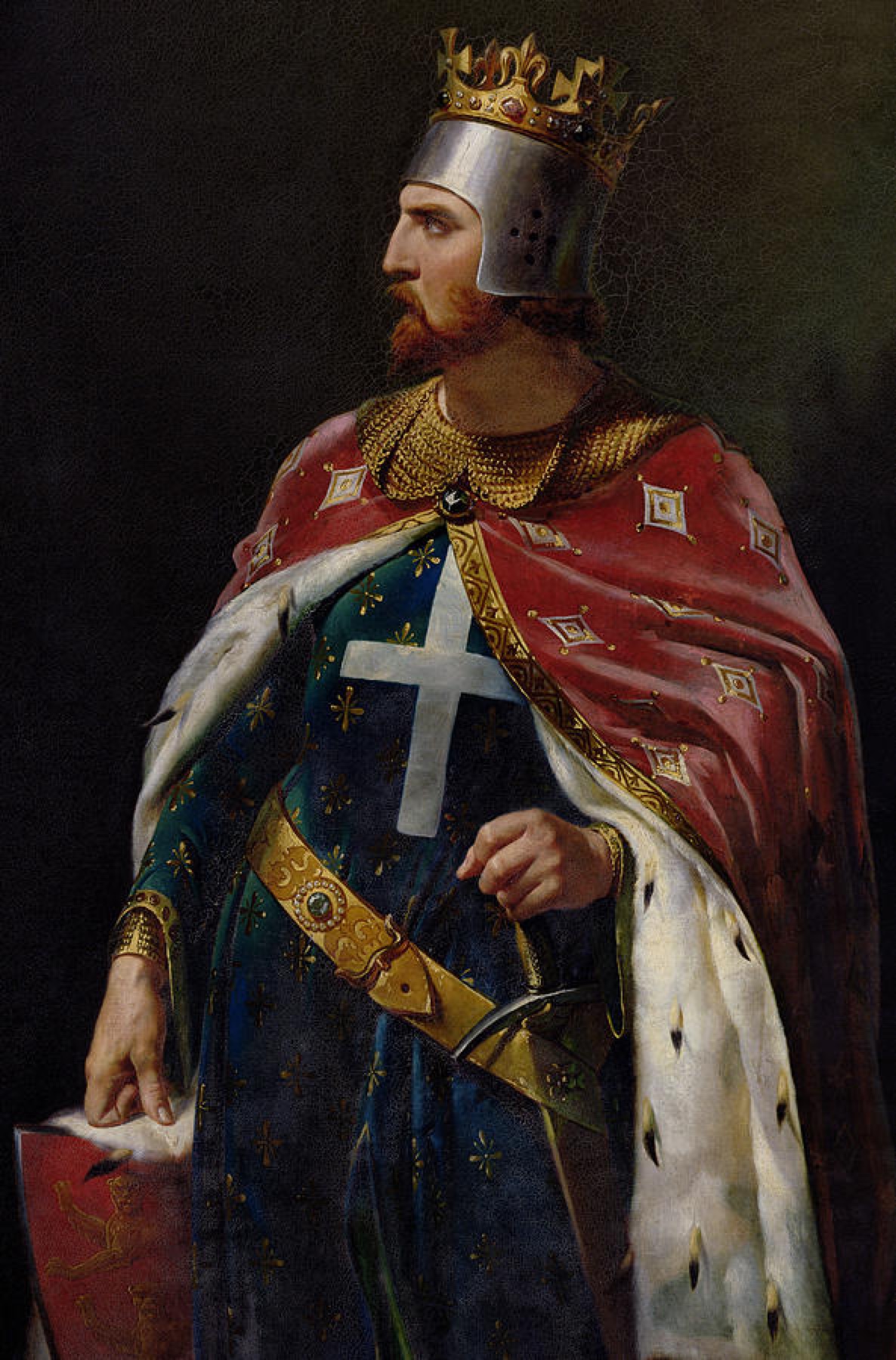 Left: Richard I Cœur de Lion roi d'Angleterre, Merry-Joseph Blondel, 1841.
King of England from 1189 to his death in 1199, Richard I “the Lionheart” took command of his first army at the age of 16, tasked with putting down rebellions against his father (which I hear could easily be a metaphor for puberty, but probably isn’t). Richard was said to have spent as little as six months in England after being crowned, living most of his life in the Duchy of Aquitane in southwest France. In 1169 Richard was betrothed to Alys, Countess of the Vexin, daughter of his father’s rival, Louis VII of France as part of a peace treaty between the two nations. Richard supported Henry the Young King in the Revolt of 1173-74 in (you guessed in) 1173 and 1174 against his father, Henry II. The revolt ultimately failed, though Richard and his brothers were knighted by Louis VII of France and in the end, all of Henry II’s rebellious family members were reconciled (though it’s hard to imagine how this would impact the conversation over dinner).
Richard I was crowned king in 1189 at Westminster Abbey, and the flogging and expulsion of all the Jews who attended the ceremony turned London into one big lynch mob, burning Jewish homes and forcibly baptising several Jews. Richard punished the perpetrators of these riots and allowed Jews to return to their native religions unharmed, setting a generally confusing tone for all those Londoners who I’m sure were only trying to please their new king.
In 1187, after learning of the capture of Jerusalem by Saladin, Richard and Philip II of France agreed to go and crusade together since each was concerned that the other would usurp their territories were they to leave. With a new, 100% trustworthy ally, Richard began demanding massive amounts of money from his officials, allowing them in exchange to retain their posts. Richard I was quoted as saying that he “would have sold London if he could find a buyer” to raise funds for his upcoming Crusade.
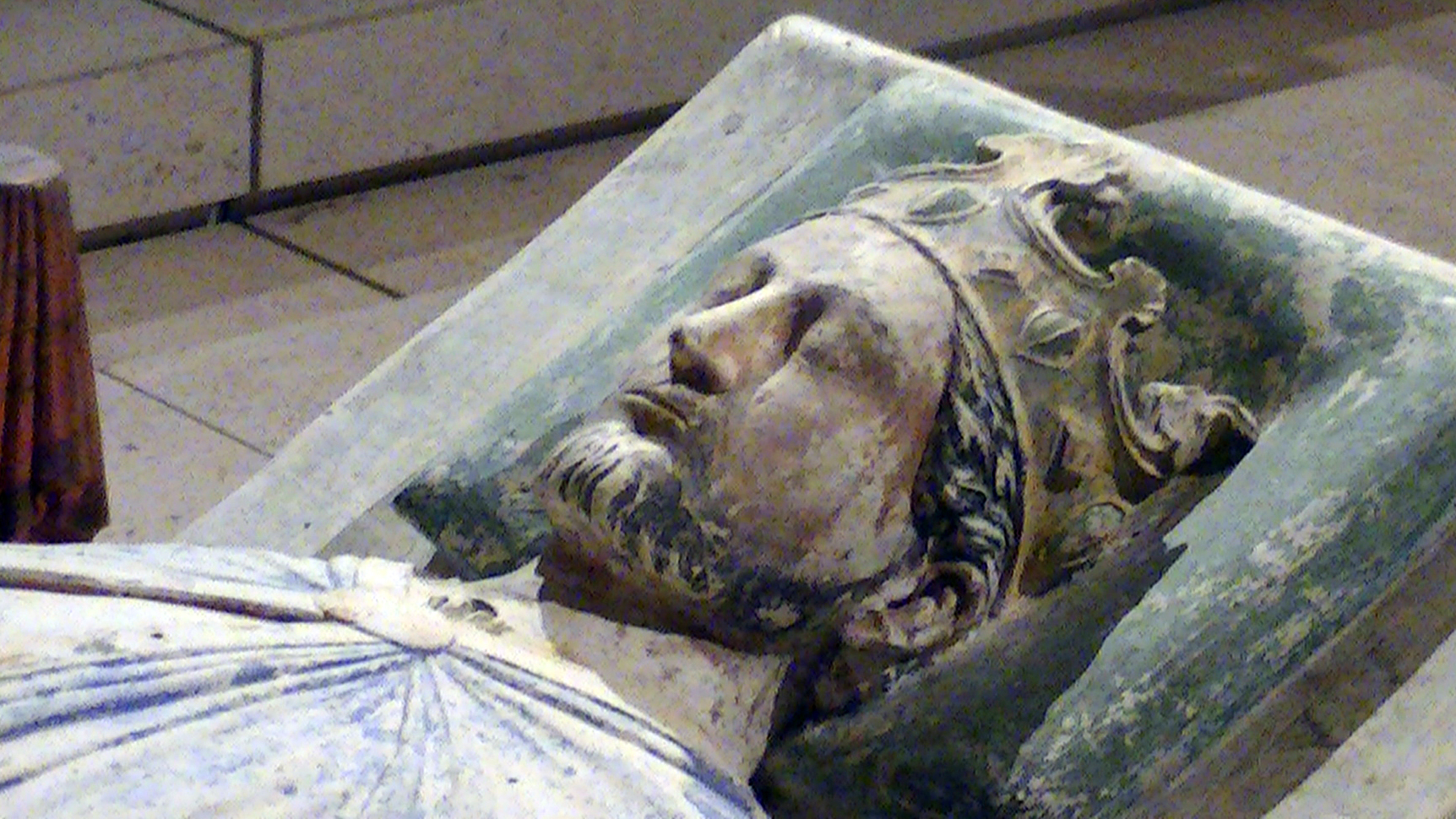 Effigy of Richard I at Fontevraud Abbey, Anjou circa. 1199.
So, Richard and Philip headed off for Jerusalem, stopping to briefly occupy the island of Sicily and conquer the Greek-controlled island of Cyprus, the latter of which they liked so much that it remained a Christian stronghold until the Battle of Lepanto in 1571. Richard also stopped for a quick wedding to Berengaria of Navarre and thus picked up the Kingdom of Navarre as a fief, and I’m sure by this point some of the soldiers started to wonder when they were actually going to get to fight some Muslims.
They soon got the chance, as Richard began siege Acre as soon as he landed in June 1191. Capturing the city a month later, Richard executed 2,700 Muslim prisoners on a hill facing Saladin’s army, presumably to show just how great he was at fighting enemies he’d already captured. In June 1192, the Crusaders got within sight of Jerusalem before having to turn around because they couldn’t stop arguing about what to do next. Richard particularly wanted to invade Egypt to disrupt the base of Saladin’s power, whilst the Duke of Burgundy was presumably getting blue balls and wanted to get straight to the point and actually attack Jerusalem. Unable to reach a decision, the Crusaders (like my girlfriend and I choosing where to have dinner) turned back and returned to the coast.
Shortly after, the Crusaders won the Battle of Jaffa during a period of minor skirmishes with Saladin’s army, eventually growing bored, and Richard, knowing that both Philip and his brother John Lackland were taking advantage of his absence, decided to return to England. In September 1192, Richard and Saladin made a truce whereby Jerusalem would remain under Muslim control under the condition that unarmed Christian pilgrims would be allowed to visit.
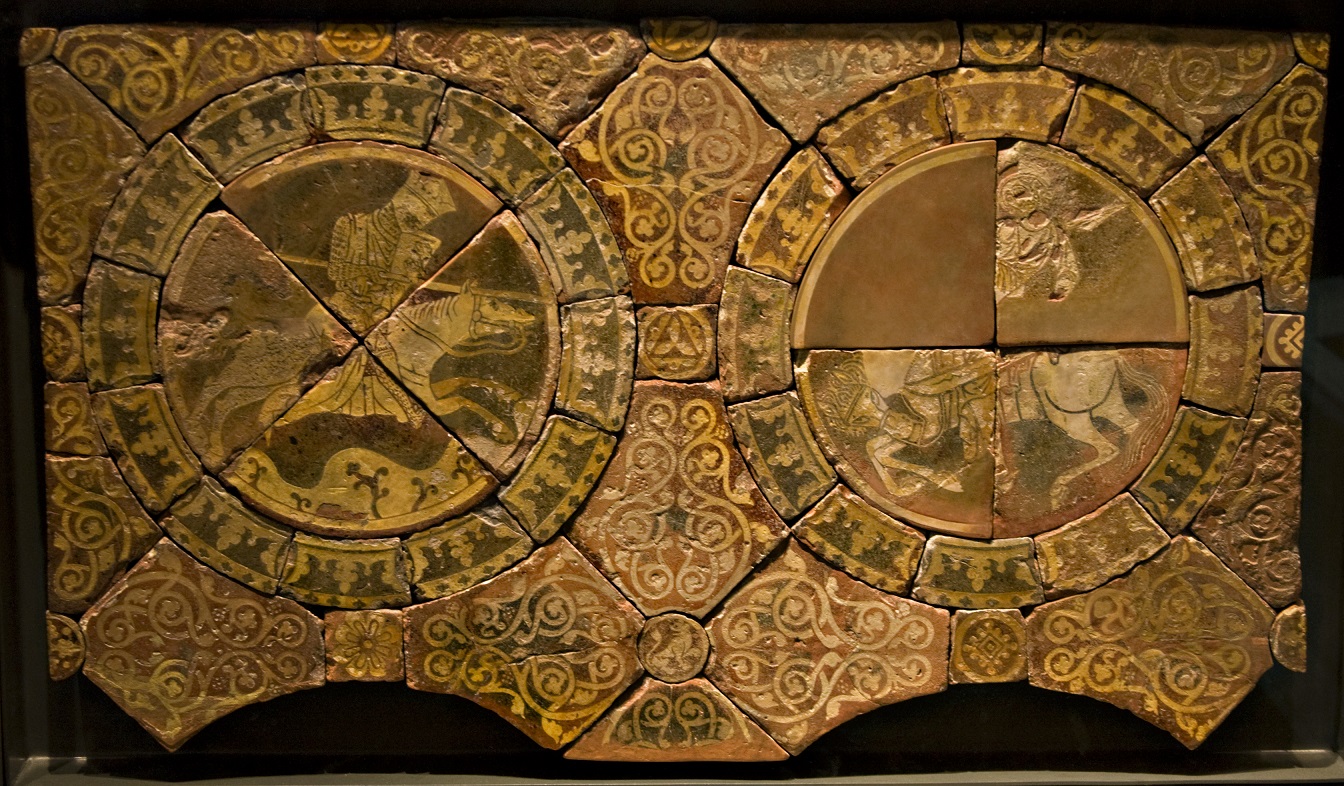 Tiles depicting Richard I (left) and most of Saladin (right), circa. 1250-60.
The long, hard battle for visitation rights over, Richard left for England in October and was shipwrecked twice en route, eventually ending up captured by Leopold V, Duke of Austria, who blamed Richard for the murder of his cousin Conrad of Montferrat (who kind of appears in Assassin’s Creed under the name of his father, William V), who was actually killed by our very own Assassins. As it was illegal at the time to detain a Crusader, Leopold V was excommunicated by Pope Celestine III and Richard was handed over to Henry VI, Holy Roman Emperor ever since Frederick I’s anticlimactic drowning, who was also excommunicated by Pope Celestine III for the same reason as Leopold V. Nevertheless, Henry VI demanded 150,000 marks (100,000 pounds of silver) for Richard’s release, and Richard’s mother began heavily taxing and confiscating money from churches. Philip of France, trustworthy as ever, offered the Emperor 80,000 marks to keep Richard imprisoned until September 1194, to which the Emperor said “why would I do that when I’m getting almost twice that to release him you dumb ♥♥♥♥?” (paraphrased). Richard was released in February 1194.
Richard spent his last years reconquering Normandy, building Château Gaillard overlooking the River Seine, and generally warring with France. In 1199, Richard was suppressing a revolt in Limousin and besieged the tiny Château de Chalus-Chabrol, during which time he was struck in the neck by a crossbow bolt fired from the wall. The wound became gangrenous, and the king died on 6 April 1199 after supposedly having pardoned the crossbowman who had struck him out of mercy (Occitan mercenary warrior Mercadier had the man flayed alive and hanged immediately after Richard’s death anyway). He was succeeded as King of England by his brother John Lackland.
Richard the Lionheart appears only briefly in Assassin’s Creed, during the climactic Battle of Arsuf, though his role is pivotal to the narrative. In the game’s story, Richard is approached by protagonist Altaïr, who accuses Templar Grand Master Robert de Sablé of planning to betray the King. Richard, who is depicted as a deeply religious man, decides to allow God to determine the truth, and orders a duel between Altaïr and de Sablé. After Altaïr successfully defeats and kills the Templar, Richard briefly discusses the concepts of war and peace with Altaïr, who leaves to kill his master, Rashīd ad-Dīn Sinān for his betrayal of the Assassin Order. Richard is depicted with a French accent, which historians believe could be accurate as Richard spent much of his life living in France.
Saladin
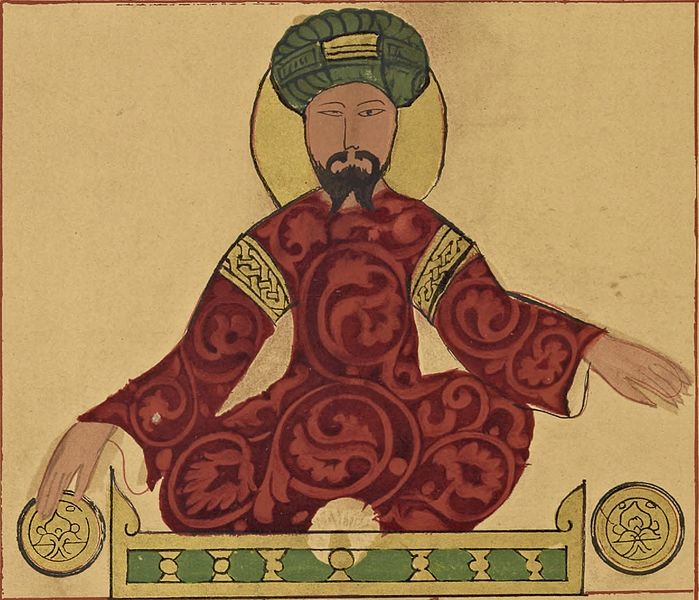 Above: Possible portrait of Saladin by polymath Ismail al-Jazari. To clarify, this is a definite portrait, possibly of Saladin.
An-Nasir Salah ad-Din Yusuf ibn Ayyub was the first sultan of Egypt and Syria. Usually referred to as Saladin, he was born in Tikrit in what is now Iraq and developed a keen interest in religion as a child, supposedly spurred on by the taking of Jerusalem by the Christians in the First Crusade. Trained under his uncle Shīrkūh, a military commander, Saladin’s first military expedition was at the age of 26 when he accompanied Shīrkūh to aid Fatimid vizier Shawar in taking back Egypt from the Banu Ruzzaik tribe in 1164. In 1167, Saladin played a major role in the Battle of al-Babein at Giza, where he commanded the right wing of the Zengid army against the Kingdom of Jerusalem. Arab scholar Ali ibn al-Athir called Saladin and Shīrkūh’s efforts at Giza “one of the most remarkable victories in recorded history”, and the pair moved on to Alexandria, where Shīrkūh withdrew with from Alexandria, leaving Saladin to guard the city.
As a power struggle grew in Egypt, Saladin assassinated Shawar and was inaugurated as vizier in his place on 26 March in 1169. As vizier, he survived an assassination attempt and uprising by the Egyptians. In 1170, was strengthening his hold on Egypt, and launched a campaign against the Crusaders, successfully besieging several strongholds in the area. What followed was a variety of successful conquests by Saladin, leading to the 1187 siege of Tiberias (modern day Israel). Guy of Lusignan tried to break the siege by marching his army to Tiberias to fight Saladin, but his men – demoralised, thirsty, and generally unfit for battle – were crushed at the Battle of Hattin. Saladin captured Guy, and eventually ransomed him to his people in Damascus. Pope Urban III is said to have died of shock upon hearing of this defeat.
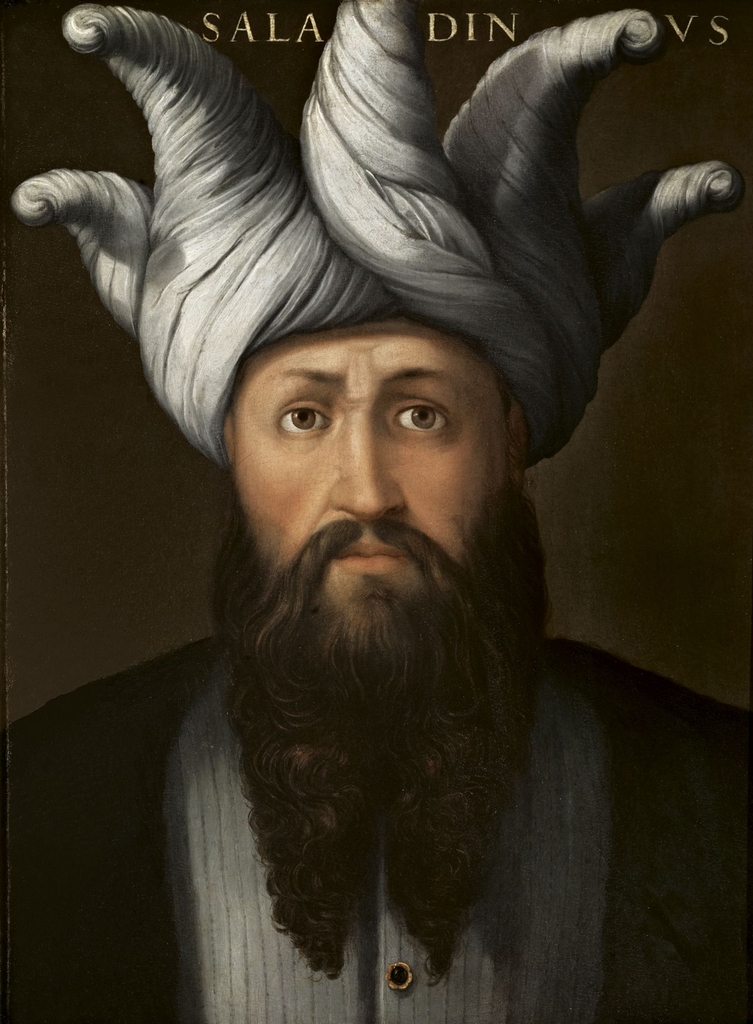 Right: Saladinus, a 1568 depiction of Saladin by Italian Florentine painter Cristofano dell’Altissimo.
By the end of 1187, Saladin had captured Acre and Jerusalem. Urban III was succeeded as Pope by Gregory VIII and a crusade was called for across Europe. The kings of Europe taxed their citizens to fund the venture and marched to take back Jerusalem. The Third Crusade played out as detailed above and Saladin lost the Battle of Arsuf; an important battle. The loss at Arsuf dented Saladin’s reputation and boosted crusader morale. In July 1192 Saladin recaptured the crucial port town of Jaffa but quickly lost it again to a naval attack by Richard I. Saladin attempted to stealthily retake Jaffa but was discovered and lost 700 men in the ensuing battle. This battle ultimately forced Saladin to sign a treaty with Richard I, allowing unarmed Christian pilgrims to enter Jerusalem, which would remain under Muslim control.
Not long after Richard’s return to Europe, Saladin died of fever at Damascus in March 1193. Having given away his vast wealth to his poor citizens, Saladin was buried in a mausoleum outside the Umayyad Mosque of Damascus.
Saladin does not appear in Assassin’s Creed, although the 1176 siege of Masyaf is depicted in the novel Assassin’s Creed: The Secret Crusade (an adaptation of the game including additional backstory by Oliver Bowden). In the novel, Umar Ibn-La’Ahad, father of Altaïr, as the Assassin who left the threatening note in Saladin’s tent. Throughout the game, Saladin is mentioned numerous times due to his deep influence on the events surrounding the game’s narrative.
Garnier de Nablus
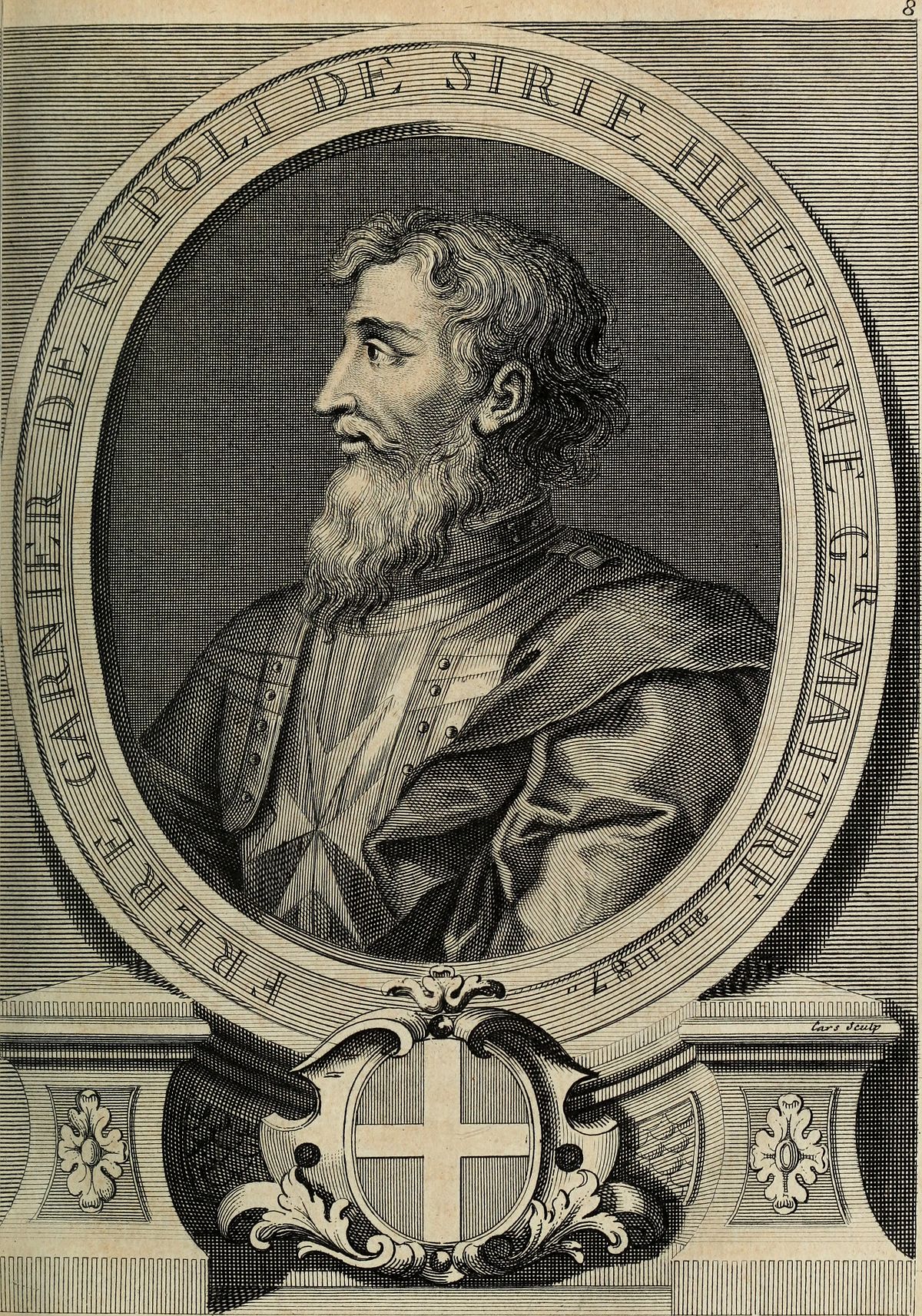 Left: Garnier de Napoli de Sirie, portrait by Jean-François Cars, circa. 1725.
Born in 1147 in the city of Nablus in the Palestine grid (modern day West Bank), Garnier de Nablus was the tenth Grand Master of the Order of Knights of the Hospital of Saint John of Jerusalem, a Catholic military order usually referred to as the Knights Hospitaller. De Nablus held this title from 1190 until his death in 1192, at which point it was passed on to somebody more capable of fulfilling the role.
De Nablus played a major role in the battle of Arsuf, in which Richard I’s forces were attacked by the forces of Saladin. During the battle de Nablus, frustrated by Richard I’s sustained defence and refusal to attack, confronted his king and requested that a cavalry charge be initiated in response to Saladin’s hit-and-run attacks. His requests were refused by the King, and a frustrated de Nablus charged against orders and was joined by the rest of the Knights Hospitaller. Seeing that de Nablus’ had disobeyed his orders, Richard I ordered a full charge against Saladin’s force and ultimately won a decisive victory, inflicting considerable casualties on the Ayubbid army and forcing them to flee. This victory impacted Saladin’s reputation and boosted Crusader morale, allowing Richard I’s forces to go on to take the integral port of Jaffa. Garnier de Nablus died in Acre, Israel on 31 August 1192.
In Assassin’s Creed, de Nablus is depicted as a cruel and sadistic doctor and a secret member of the Knights Templar. Called de Naplouse in-game, he rules the ‘poor district’ of Acre and is based in a hospital there, where he conducts experiments on his patients. In the game, which also depicts the battle of Arsuf, de Nablus is assassinated by Altair in 1191 at his hospital. Despite de Nablus having been in his mid-40s at this time historically, Assassin’s Creed depicts a much older man.
William V the Old, Marquess of Montferrat
 Left: Coat of arms of the William V’s noble house, the House of Aleramici.
Born around 1115, William V was Marquess of Montferrat from circa. 1136 until his death in 1191. Son of Renier I of Montferrat, William V is often referred to as William the Old to differentiate himself from his son William Longsword, Count of Jaffa and Ascalon. This particular William married Judith or Ita von Babenberg in 1133 and had five sons and three daughters.
William V participated in the Second Crusade and fought with Holy Roman Emperor Frederick Barbarossa against the Lombard League, a mediaeval alliance formed to prevent the Kingdom of Italy from becoming a part of the Holy Roman Empire. He was granted the castle of St. Elias (in the modern-day town of Taybeh in the West Bank) in 1183 and was captured by Saladin in the battle of Hattin in 1187. William’s second son, Conrad, arrived at Tyre, Lebanon from Constantinople and commanded the defences during the November 1187 siege of Tyre. Conrad refused to surrender anything in exchange for his father’s life, and was said to have preferred to have killed him personally. William V was released in Tortosa, Syria in 1188 and died in 1191.
If none of this sounds familiar, it’s because Assassin’s Creed’s version of the character is based on William’s son, Conrad. Born in 1136, this version is granted the regency of Acre by King Richard I, but rarely agrees with the King and publicly argues with him at Acre before giving his troops a speech about Richard’s incompetence. Historically, Conrad was murdered by the real-life Order of Assassins.
Ibn Jubayr
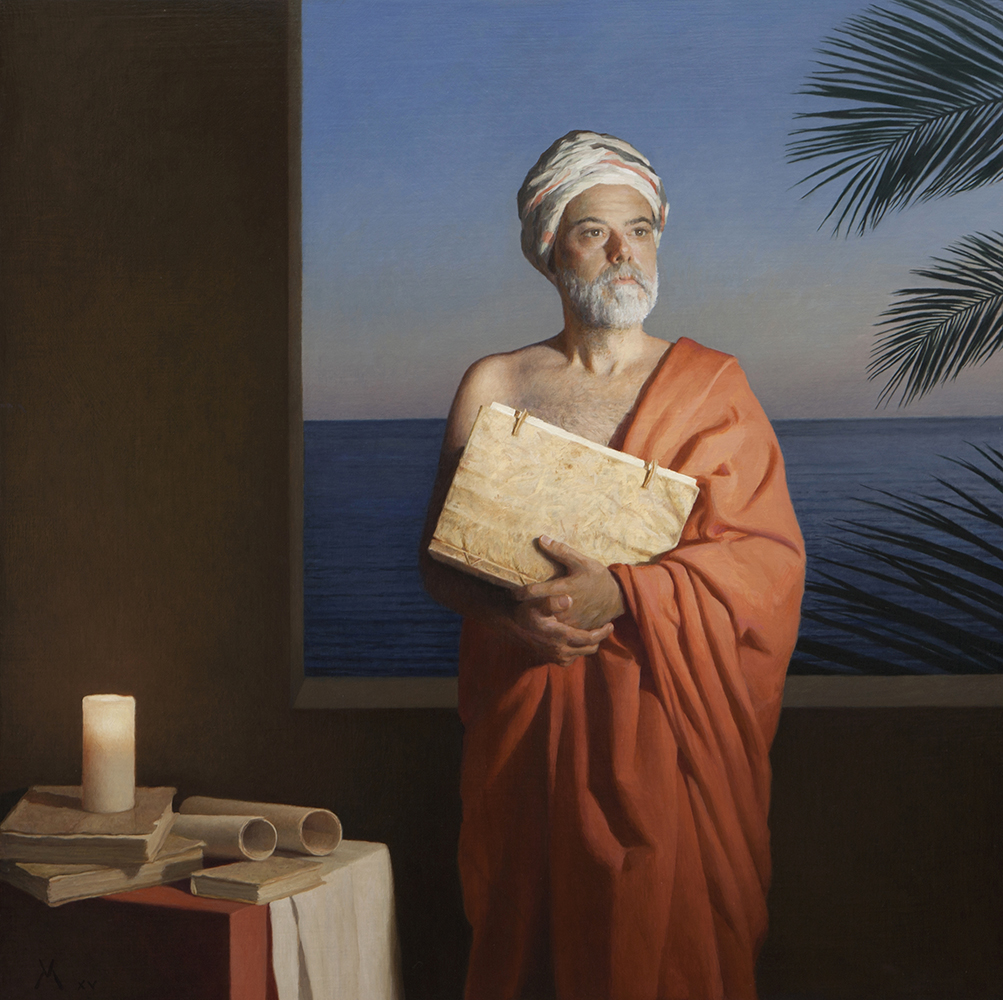 Left: Artist's depiction, Guillermo Muñoz Vera, 1956.
Born in 1145, Ibn Jubayr was an Arab geographer and poet from al-Andalus in modern-day Province of Valencia, Spain. In his youth, Ibn Jubayr was a secretary to the Almohad governor of Granada. Ibn Jubayr explains in his Rihla that he decided to make the duty to Mecca as redemption for his drinking seven cups of wine, though he did this under duress.
First, Ibn Jubayr crossed the Strait of Gibraltar to Ceuta, which was then under Muslim rule. In 1183 he sailed for Alexandria, surviving a severe storm near Sicily. Whilst in Egypt, Ibn Jubayr wrote of the high praise being given to Saladin throughout the land, who he described as being very hospitable even to the lowest class of people, providing daily two thousand loaves of bread. Ibn Jubayr also travelled to Sicily, Medina, Mecca, Damascus, Mosul, Acre, Baghdad, and Basra, documenting his travels in his historically significant and extremely detailed Rihla. Ibn Jubayr died in 1217 during his third trip to Alexandria.
In Assassin’s Creed, Ibn Jubayr appears as Jubair al Hakim, Chief Scholar of Damascus and member of the Knights Templar. Jubair al Hakim is depicted as a ruthless, strong-willed zealot who attempts to burn all written texts in Damascus, believing they caused the city’s people to be be ignorant and to blindly follow the writings. Jubair is a violent man and is shown burning alive a dissident scholar, threatening to do the same to those who oppose him. In the game, Jubair is assassinated in Damascus in 1191, 26 years before his historical death in 1217.
Master Sibrand
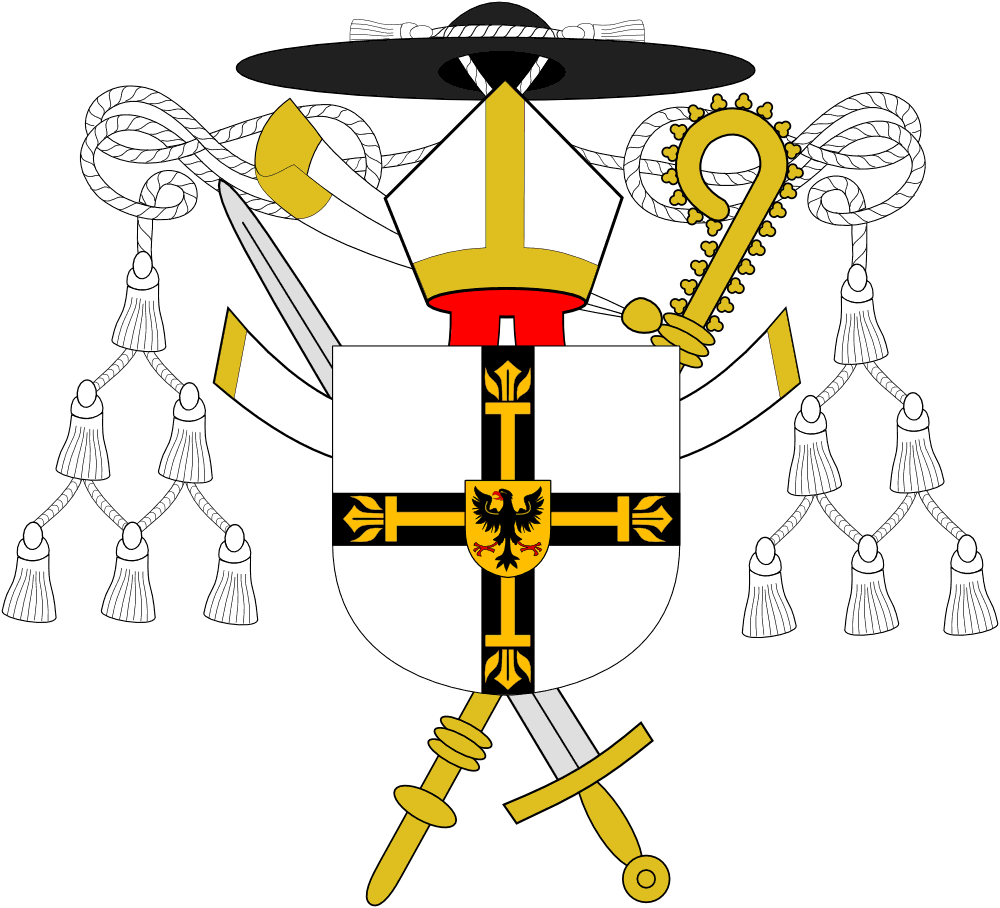 The historical Master Sibrand was the founder of the hospital in Acre, Israel which later became the basis of the Order of Brothers of the German House of Saint Mary in Jerusalem, commonly the Teutonic Order. Born in 1157, Sibrand travelled during the Third Crusade as a follower of Adolf III, Count of Schauenburg and Holstein, and is mentioned as the founder of the hospital in a 1190 document by Guy of Lusignan. The hospital treated German troops during the siege of Acre, and Sibrand was in exchange granted a house in the city. Sibrand died in 1191 in Acre having effectively laid the foundations for the Teutonic Knights, who were given recognition in 1192 and made into a military order in 1198.
In Assassin’s Creed, Sibrand seizes the ports of Damascus, with plans to blockade the surrounding waters and prevent Richard from bringing in more troops through them. Following the deaths of his fellow targets, Sibrand is paranoid, and publicly murders a scholar because he is dressed in white robes similar to those of an Assassin. When defeated, Sibrand reveals that he fears death because he believes the Templar discovery of the Piece of Eden proves that there is no afterlife. Sibrand speaks in a German accent and wears a helm with the horns of a bull.
Bibliography
- Bahā' al-Dīn Ibn Shaddād. (2002). The Rare and Excellent History of Saladin. Ashgate.
- Barber, Malcolm. (1992). The Two Cities: Medieval Europe 1050-1320, 2nd edition, p.125.
- Barber, Malcolm. (2005). La storia dei Templari. Piemme. p.479.
- Broadhurst, Ronald. (1952). The Travels of Ibn Jubayr: being the chronicle of a mediaeval Spanish Moor concerning his journey to the Egypt of Saladin, the holy cities of Arabia, Baghdad the city of the Caliphs, the Latin kingdom of Jerusalem, and the Norman kingdom of Siciliy. London: Cape.
- Burman, Edward. (1987). The Assassins: Holy Killers of Islam. Wellingborough: Crucible. p.70.
- Canduci, Alexander. (2010). Triumph & Tragedy: The Rise and Fall of Rome’s Immortal Emperors. Pier 9.
- Chisholm, Hugh. (1911). “Richard I”. Encyclopaedia Britannica. 23 (11). Cambridge University Press. p.295.
- Comyn, Robert. (1851). History of the Western Empire, from its Restoration by Charlemagne to the Accession of Charles V.
- De Templo, Richard. (c. 1220). Itinerarium Peregrinorum et Gesta Regis Ricardi.
- Eddé, Anne-Marie. (2003). “Assassins”. Encyclopedia of the Middle Ages.
- Eddé, Anne-Marie. (2014). Saladin. Harvard University Press. p.17.
- Flavigny, Bertrand Galimard. (2005). Histoire de l’ordre de Malte. France: Perrin. pp.317-319.
- Flori, Jean. (1999). Richard Couer de Lion: Le roi-chevalier. Paris: Biographie Payot.
- Framptom, John. (1929). The Most Noble and Famous Travels of Marco Polo.
- Gillingham, John. (1978). Richard the Lionheart. London: Weidenfeld & Nicholson. p.187.
- Gillingham, John. (1979). Richard the Lionheart. New York City: Times Books.
- Gillingham, John. (1999). Richard I. Yale University Press. pp.20-21.
- Hodgson, Marshall. (1958). The Venture of Islam: Conscience and History in a World Civilization. Vol. 2. The University of Chicago. p.267.
- Levenson, Jon Douglas. (2012). Inheriting Abraham: The Legacy of the Patriarch in Judaism, Christianity, and Islam. Princeton University Press.
- Lewis, Bernard. (2003). The Assassins: A Radical Sect in Islam. Phoenix.
- Mazzucato, Michele. (2008). Italiani nel Sistema solare.
- Longford, Elizabeth. (1989). The Oxford Book of Royal Anecdotes. Oxford University Press.
- Nowell, Charles. (1947). ‘The Old Man of the Mountain’. Speculum. 22 (4).
- Oman, Charles William Chadwick. (1924). War, Technology and Society in the Middle East. p.317-318.
- Pellat, Charles. (1986). “Ibn Djubayr”. Encyclopedia of Islam. 3 (2). Leiden: Brill. p.755.
- Pringle, Denys. (2009). The Churches of the Crusader Kingdom of Jerusalem: A Corpus: L-Z. 2. Cambridge University Press. p.132.
- Šārôn, Moše. (1997). Corpus Inscriptonum Arabicarum Palaestinae (CIAP): A. Volume one. Brill. p.26.
- Strehlke, E. (ed.) (1869) Tabulae Ordinis Theutonici : ex tabularii regii Berolinensis codice potissimum. Berlin, Kingdom of Prussia: Weidmanns.
- Turner, Ralph., Heiser, Richard. (2000). The Reign of Richard Lionheart, Ruler of the Angevin empire, 1189-1199. Harlow: Longman.
- Verbruggen, J.F. (1997). The Art of Warfare in Western Europe During the Middle Ages: From the Eighth Century to 1340. Woodbridge: Boydell & Brewer. p.239.
- Wasserman, James. (2001). The Templars and the Assassins: The Militia of Heaven. Simon and Schuster. p.320.
More Assassin's Creed guides
- Русификатор [Полная локализация]★ 5 (1.3k)55k views1.9k ♥1 minRussianUpdated Dec 28, 2023
- Flag & Templar Maps★ 5 (1.5k)32k views2.4k ♥31 minUpdated Mar 30, 2014
- Моды улучшающие графику Assassin's Creed★ 4 (144)18k views299 ♥14 minRussianUpdated Oct 19, 2023
- ASSASSIN'S CREED CONTROLLER FIX [XBOX & PLAYSTATION CONTROLLERS]★ 5 (250)18k views541 ♥2 minUpdated Jan 9, 2025
- Как убрать лаги + Русификатор и Озвучка + Оформление + Геймпад★ 5 (264)15k views599 ♥1 minRussianUpdated Oct 4, 2025
- HOW TO FULL SCREEN★ 5 (524)15k views153 ♥1 minBulgarian





This guide was created by its original author on the Steam Community. Are you the author and want it removed? Request removal.