Weight Tiers & You
What Are Weight Tiers( Introduction)
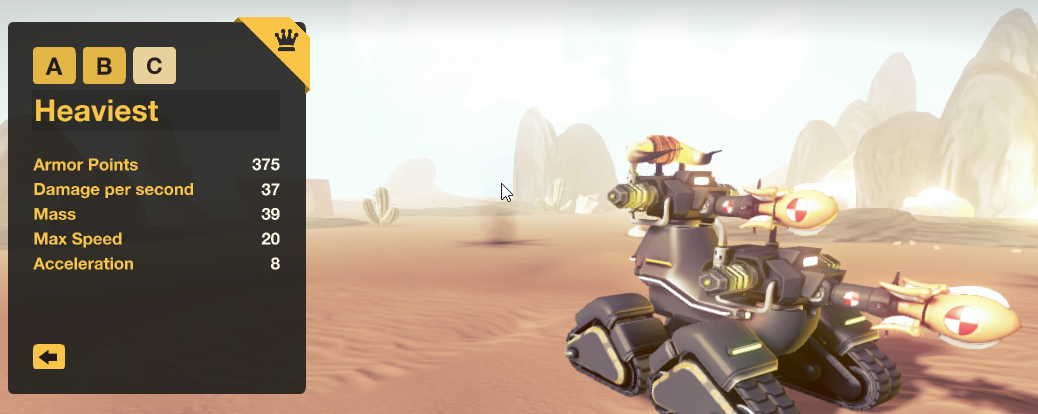
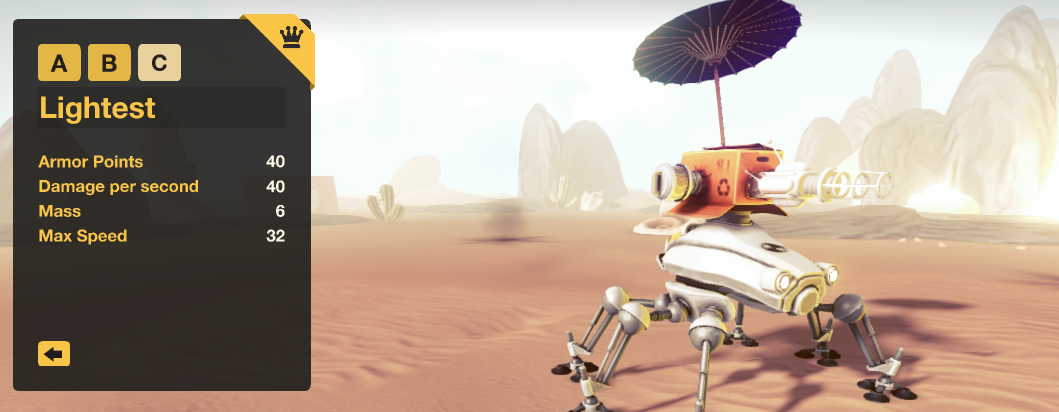
If you have seen me on the forums you may have seen me reference weight tiers a lot. Here is a basic explaination about what they are. Weight tiers aren't a new concept by any means. They've been around since earliest forms of contact sports. Weight is an important factor to the viability of what ever we happen to assess. The term has adapted to games in recent years (example Super Smash Bros) to help figure out advantages. I'm bringing to light the importance of these tiers to this game. It is an important step in the building process to determine what type of tank you want to run.Tanks that are heavier tend to be sturdier and slower. While Lighter builds are more nimble and more frail. There are a few nuances that I do want to mention in the rest of the guide that will make you hopefully a more aware builder.
The important part is that I say weight not mass. While mass is the most important factor of determining the rest of the build, it is the ratio of mass to armor that determines weight. These are general threshholds of speed and health that you should strive to compete with.
In the above pictures I have the lightest possible build and the heaviest possible build. The important step is to have reasonable goals for your tank's armor, speed, and acceleration. Builds are unique and fall anywhere between these extremes. The tiers are just a way to help determine your build's viability. You shouldn't strive to be the lightest without reason likewise being the heaviest will leave you more vulnerable to faster threats and focus fire. Finding the right balance is key.
The 3 major tiers Ive speculated are Lightweight, Heavy, and Mid Tier. Light weight is meant to focus on mobility above all else. It helps a lot to have just enough health to survive an incoming shot. Heavy is the exact opposite. More armor is the way to go. While you may move slower if you have enough armor and dps you can be a potent threat with positioning. Mid tier is focused on being a "generalist." This just means that it's built for most situations. Having the best of both worlds good speed and enough armor not to be 2 shot by common weapons. Mid tier loses out to the excess mobility that lighter builds have and can be out tanked by heavier foes if they have a good position over you.
These tiers are a basic concept around these thresholds.
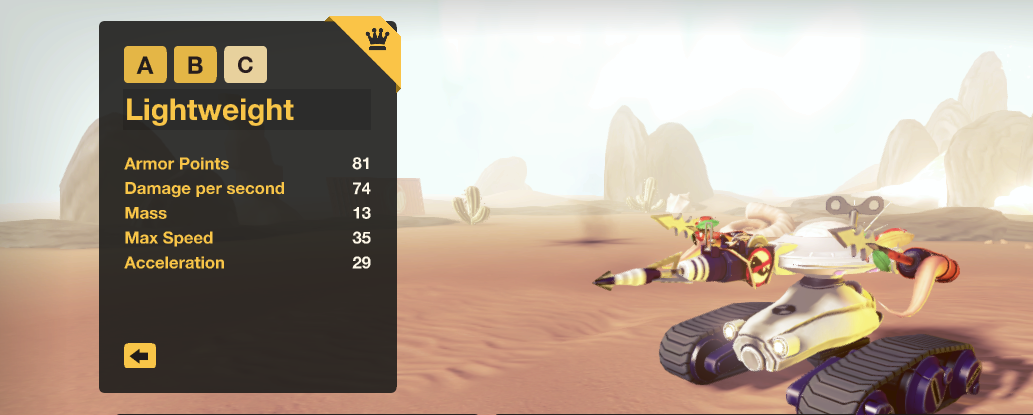
Lightweight: 50 -> 100 armor with a mass less than 15.
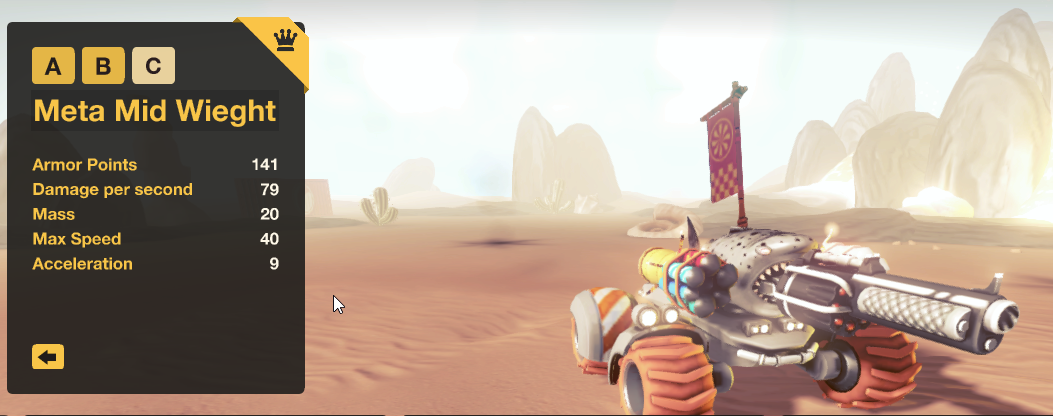
Midweight 150 armor (give or take 10) with a mass less than 20 but more than 15 (in most cases.)
Heavy 200+ with a Mass over 20.
Obviously there is gray area between the tiers. These are just meant to be "goals" how close you can get to those goals will prove effective to matching a tier. If you have the armor of a lightweight tier but the mass of a midweight to heavy weight, the build should be tweaked to either be faster or bulkier to ensure effectiveness. Keep in mind the weight tiers don't account for max speed or acceleration (explaination on that below.)
Speed, Acceleration, and Balance
When I first joined the game I got 1 sentence of advice that I pondered on for a long time.
"Speed is everything."
To an extent I agree. However I think the correct statement is,
"Mobility is everything."
Top speed is SOLEY determined by the propulsion you choose. Sacrificing top speed to increase mobility options (example: legs or hover) is completely viable. The element of suprise and the ability to travel on terrain other tanks can't will give you just enough of an edge to justify the speed loss.
However, It is important to remember your total mass effects your acceleration. Top speed won't be reached fast enough in an emergency. Around turns you lose speed inheritly because you are no longer going full speed straight ahead. This is where acceleration becomes essential. If you acceleration is high enough some tanks can even climb sloped walls without needing legs. Most propulsions (with the exceptions of slimeball and legs) have a mass tolerance as a sort of hidden stat. A propulsion that is lightweight like the gokart may have a high top speed but a very low weight tolerance. Your acceleration will be so low your top speed made no diffrence. Too often I see newer players building elephant on gokart and saying "good enough."
Acceleration also performs different according to the propulsion itself. tracks for example tend to be easier to stop and rotate than wheels. While hover parts will continue to slide in the direction it was thrusting initially for a few seconds. having a higher acceleration on them will make them drastically easier to control as you can quickly regain lost speed. Wheels are nice as they can maintain good top speeds while being able to turn without losing much momentum. Likewise they have an easier time bouncing off ramps.
*What does this have to do with the weight tiers though!?*
Naturally the heavier something is the more it loses acceleration. Using the wrong propulsion can really hinder the usage of the tier you're trying to compete with. Minimizing mass when possible will ALWAYS be in your best interest when possible. A midweight won't out maneuver a light weight build easily as they have less mass hindering their movements.
Legs are an interesting exception as they have no acceleration. However, the more mass you have on those legs the slower they will go. Even though the flea can have a top speed of 32 on paper. on the actual building process you quickly learn how much parts weigh you down. bringing you down to the same speed if not lower than even the beetle legs. Assuming you use heavy parts. This is a suprisingly common mistake I see.
Slime ball is where things get complicated. Unlike the legs it doesn't lose speed with the extra mass, but like the legs it has no acceleration. So clearly there has to be a downside right? well there are 2 things that keep this thing from outclassing most builds.
1.) control
2.) balance
Which brings me to the next important part about mass. The overall balance of the tank. The slime ball does apply the mass to the propulsion causing the heavier parts on top to sway and tilt across it's surface. Even sitting still you will be tilted backward if you're too top heavy. Unfortunatly slimeball isn't the only thing this is important on. As most people who have played more than 10 hours have learned. Flipping over is easier on some builds over others. Say I have the go kart propulsions with the sputnik turret. While on paper the weight works. Acceleration is solid and the top speed is optimized. In game you'll quickly be suprised to start driving just to have the turret lean back and make you do a wheeley down the map. Heavier builds that use appropriate propulsions tend to handle balance much easier. The extra mass keeps them grounded and harder to flip overall. Lightweight builds are very sensitive to additional weight. Sometimes you can get away with a heavier part if it has a more forgiving shape. Slimeball with submarine doesn't tilt nearly as bad others for example. go kart with a ufo turret is very forgiving as well as the disc shape keeps the weight distributed.
Overall when you're thinking about the tier you're aiming for, you want to maximize mobility when possible. Heavier builds gravitate towards beetle legs, mid weight tends to gravitate towards fenders or hover discs, and light weight tends to use flea or any propulsion over 35 speed.
Understanding Weight Ratios
Ratios are the most important part about weight tiering. Having the right amount of armor, speed, and acceleration to justify your total mass. While it sounds like more math it's really simple. I'll give some example of builds that are are suited to the tiers. For each tier you want to have an ideal top speed armor and acceleration.
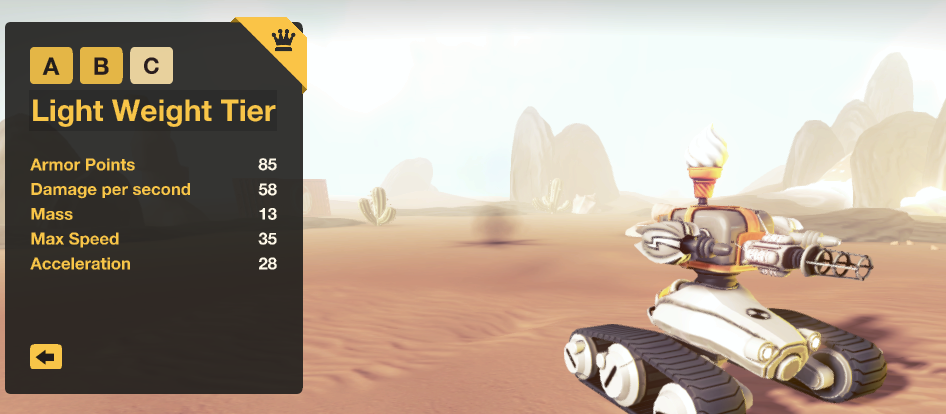 Lightweight tiers want to be over 35 top speed when possible. The flea is a neat exception to this missing out by 3 points but gains strafing and wall climbing.
Armor should be over 69 PREFERABLY! This will keep snipers from one shotting you from full health to 0. Likewise it will make it so your oponents have to hit you at least twice with projectiles. Flea builds are normally a heavy exception as strafing makes you even harder to hit.
Acceleration for lightweight should be no more than the top speed, but less than 10 points from it.
A solid exception from this is the vintage tracks having a great top speed without sacrificing a ton of armor, but loses enough acceleration to be notable.
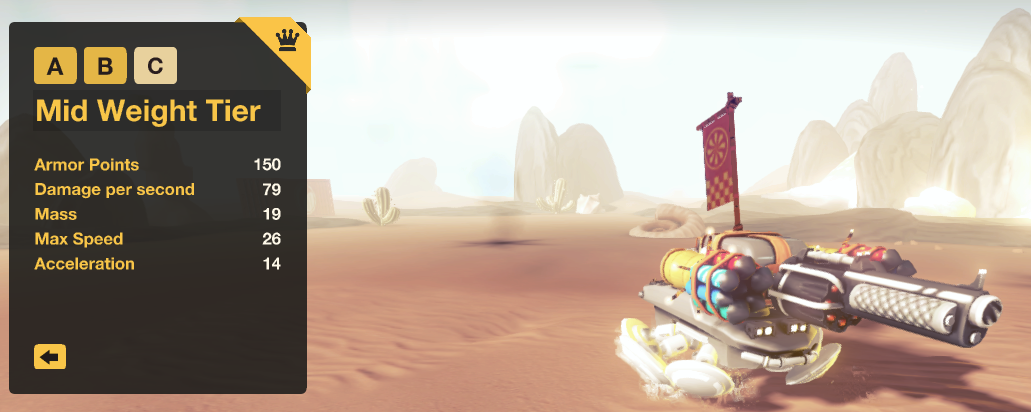 Midweight wants to be over 30 top speed. An interesting exception here is the jack knife treads. Missing the minimum by 4 points of speed while having great weight tolerance and extremely hard to flip.
Armor should be over 150 This puts you in a range of taking 2 sniper desecrator shots and having enough health to take cover. It will also make fighting gatling loadouts much easier as it will buy you enough time for your projectiles to reload.
Acceleration should be no less than a 4th of the max speed (rounded up) A good exception from this is buggy. It has a lower weight tolerance than fenders and loses 5 armor for 5 more top speed. On certain builds the 5 extra speed can help a ton. Specially on open maps like construction or oasis.
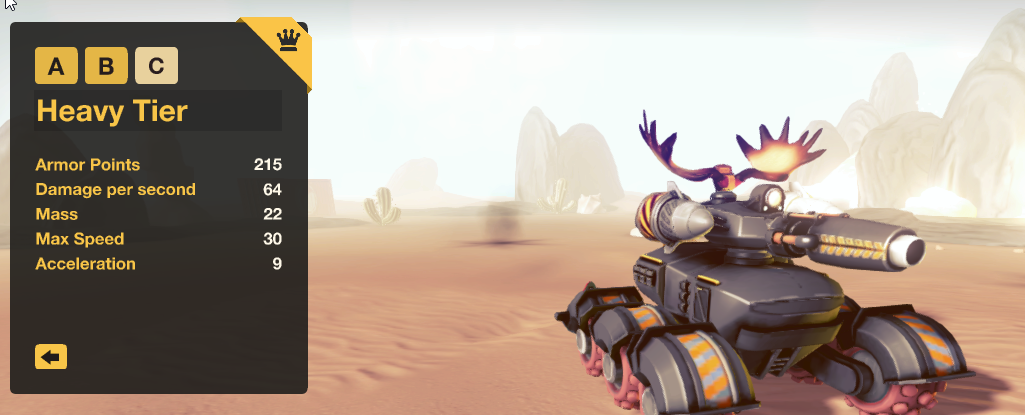 Lastly the heavy tier will be happy with anything over 20. The exception here is the beetle legs for the same reasons as flea. Being on an area other tanks can't easily reach reduces focus fire.
Armor should be over 200. You should be able to survive up to 3 heavy cannon shots (180) but have enough to survive. A good exception to this is using auto repair supports which will help you survive more incoming fire.
Acceleration should be as high as possible. There isn't much room here to work with but at least most heavy propulsions have solid weight tolerance.
These are just examples of the tiers at work. There are more viable and optimized builds than the ones I listed here. This will hopefully give some ideas though of the ideal ratios.
Lightweight tiers want to be over 35 top speed when possible. The flea is a neat exception to this missing out by 3 points but gains strafing and wall climbing.Armor should be over 69 PREFERABLY! This will keep snipers from one shotting you from full health to 0. Likewise it will make it so your oponents have to hit you at least twice with projectiles. Flea builds are normally a heavy exception as strafing makes you even harder to hit.
Acceleration for lightweight should be no more than the top speed, but less than 10 points from it.
A solid exception from this is the vintage tracks having a great top speed without sacrificing a ton of armor, but loses enough acceleration to be notable.
Midweight wants to be over 30 top speed. An interesting exception here is the jack knife treads. Missing the minimum by 4 points of speed while having great weight tolerance and extremely hard to flip.Armor should be over 150 This puts you in a range of taking 2 sniper desecrator shots and having enough health to take cover. It will also make fighting gatling loadouts much easier as it will buy you enough time for your projectiles to reload.
Acceleration should be no less than a 4th of the max speed (rounded up) A good exception from this is buggy. It has a lower weight tolerance than fenders and loses 5 armor for 5 more top speed. On certain builds the 5 extra speed can help a ton. Specially on open maps like construction or oasis.
Lastly the heavy tier will be happy with anything over 20. The exception here is the beetle legs for the same reasons as flea. Being on an area other tanks can't easily reach reduces focus fire. Armor should be over 200. You should be able to survive up to 3 heavy cannon shots (180) but have enough to survive. A good exception to this is using auto repair supports which will help you survive more incoming fire.
Acceleration should be as high as possible. There isn't much room here to work with but at least most heavy propulsions have solid weight tolerance.
These are just examples of the tiers at work. There are more viable and optimized builds than the ones I listed here. This will hopefully give some ideas though of the ideal ratios.
Recoil the Hidden Stat
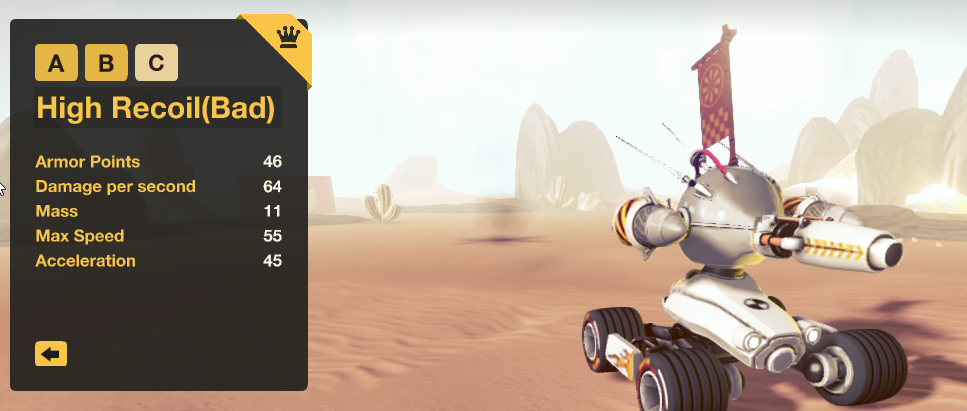 Now this I wanted to keep seperate from the weight tiers themselves but it does have relevance. There is a hidden stat on weapons that cause recoil. Bumble bee missles, heavy cannon, and shotgun (to an extent) are prime examples of high recoil parts that can cause issues in game if not aware of it. While in motion with a mid tier weight tank the recoil is almost always unnoticable. Standing still you will be sent slightly backward, and in the air you will change directions slightly. Lightweight tiers are HEAVILY affected by recoil. It will stop momentum, cause spin outs, and many other issues. There are plenty of low recoil weapons available to lighter builds to keep you guys grounded. Please don't run around with a build like this without practice or awareness of the recoil.
If you want to use high recoil weapons it would be a good idea to go heavier. Luckily heavy builds have almost nothing to worry about.
Armor Boosters and Anti Gravity
Armor boosters and anti gravity units make a great option for tanks to reach the ideal tiers you need.
However, they come at a pricey cost. You lose your dps supports. Using caution when trying to reach a tier is the best approach. If you need to reach a tier consider re-optimizing your build instead and keep the dps.
Armorboosters are always good on heavy wieght tiered tanks. The additional 35 armor per booster can be enough to survive a potential extra shot if need be. On twin hull it's even better as you will have access to your dps option while having the free boost. The assist hull should never ever be used with just armor boosters. At that rate just use elephant. Assist hull has a nice niche for auto repair though. The weight of armor boosters are very hefty. Mid weight builds should exercise caution before equiping them. Sometimes just 1 booster is enough.
Anti gravity units are very nice for making lightweight builds faster. On max speed flea builds they're a requirement. A nice trick is that you can use them to counter a part's mass while maintaining the armor boost. Sometimes it can be just enough to make your acceleration not painful. It's a common sight to see 1 anti grav and a dps support on lightweight to mid weight builds. Heavy builds have almost no use for it though unfortunatly.
Good builds that can use these parts are self sufficient and output enough dps with the weapon alone. Sparing use of these can show great promise.
However, they come at a pricey cost. You lose your dps supports. Using caution when trying to reach a tier is the best approach. If you need to reach a tier consider re-optimizing your build instead and keep the dps.
Armorboosters are always good on heavy wieght tiered tanks. The additional 35 armor per booster can be enough to survive a potential extra shot if need be. On twin hull it's even better as you will have access to your dps option while having the free boost. The assist hull should never ever be used with just armor boosters. At that rate just use elephant. Assist hull has a nice niche for auto repair though. The weight of armor boosters are very hefty. Mid weight builds should exercise caution before equiping them. Sometimes just 1 booster is enough.
Anti gravity units are very nice for making lightweight builds faster. On max speed flea builds they're a requirement. A nice trick is that you can use them to counter a part's mass while maintaining the armor boost. Sometimes it can be just enough to make your acceleration not painful. It's a common sight to see 1 anti grav and a dps support on lightweight to mid weight builds. Heavy builds have almost no use for it though unfortunatly.
Good builds that can use these parts are self sufficient and output enough dps with the weapon alone. Sparing use of these can show great promise.
What Does it Mean For You?
So why bother with all this information. It's not like you're being forced to conform to it, and you're right. The purpose of this guide is just to give an idea of what you should aim to compete with. It's not an exact science and for the most part this game is very well balanced. The tiers should be something in the back of your mind. How many shots can you take from what weapon? How fast do you need to go? These are just questions that should be thought about. While there is no perfect or ideal build there should be a goal to make your tank the best it can be. After all it's your tank. Noone is going to make you change your tank, but some of us will reccomend better choices. Knowing what tier you like makes it easier to determine your loadouts. I like to have mid weight and heavy weight available to me more than lightwieght builds. Some people like lightweight dodgey builds and have 3 of those. Keep your builds interesting and have a new perspective about why some builds are just good.
Closing Notes
Thank you for reading this guide all the way through. Leave questions comments or concerns in the comments below. If you feel like I have some information wrong don't be afraid to let me know. I hope you guys will appreciate having this guide as a sort of reference when making builds. If you'd like feel free to post your builds or what tiers you like to play.
More Gear Up guides
- How to gather system information★ 4 (52)104k views80 ♥1 min
- Top Vehicles (OUTDATED)★ 5 (244)13k views279 ♥8 minUpdated Dec 31, 2019
- THE MOST ULTIMATE TANKS 0.1.1.8 [Updated]★ 4 (96)9.9k views130 ♥4 minUpdated Dec 3, 2018
- Gear Up: Guide to all achievements [RU]★ 4 (73)2.8k views42 ♥6 minRussianUpdated Aug 1, 2020
- GAME TUTORIAL★ 4 (65)2k views60 ♥37 minUpdated Aug 4, 2020
- Weapon Summary [WIP]1.4k views12 ♥2 minUpdated Sep 24, 2015






This guide was created by its original author on the Steam Community. Are you the author and want it removed? Request removal.