Total Domination: A Completionist's House Ruleset for Thoroughly Long and Enjoyable Games
1. Introduction
Welcome! In this, I intend to outline the rule-set that I call "Total Domination". The premise is self-explanatory: Your aim is not just to win, but to Totally Dominate the entirety of the map. What exactly does this entail? Well, a Total Domination must fit the following criteria:
- Total Map Control. I don't just mean all cities, but every single tile on the map must be owned by you or an allied city-state
- All Victories Achieved. You must, over the course of the game, win every single victory condition in the game.
- Full Tech and Social Policy trees. Every single feasible social policy and every single technology must be acquired in order to fulfil this criteria.
- Founder of a Fully Upgraded, Dominant Religion. I.E: You must found a religion, which must have all the beliefs possible, and must be the dominant (Or ideally, the only) religion in every city/city state.
- Full Garrisons. A Land, Air and Sea (when applicable) Military unit must be stationed in every single player-owned city.
- A complete World Congress. Every World Congress proposal must be passed (Bar some exceptions).
- Fully Upgraded Spies. You must own as many spies as you can, and said spies must be rank 3.
- Fully Upgraded Cities, You must have every single possible building in every single possible city, bar only those that cannot be built for reasons explained below.
- All Wonders. You must own, or ideally build, every wonder in the game.
- All Tiles Upgraded. Every tile that can be upgraded, should be upgraded. Yes, even snow tiles.
- Cultural Dominance. Every other civ in the game must be dominated by your own culture, obtained by having a cultural influence of 200% or higher.
- Maximum Themeing bonus. Every Wonder (Both Civ-limited and world-limited) Must be at the maximum possible themeing bonus.
2. Complete Map Control
The first pillar of Total Domination is map control. Simply owning every city is not enough, you must own every tile, and said tiles must be fully upgraded. The upgrade itself is unimportant (As to prevent issues with snow tiles/civ-speficic tile upgrades), only that the tile is built on and said building is fully finished.
As regards to roads, there must be a road connecting all cities/allied city states when possible. This includes cities on the same island, even if said island has no land connection to the capital. After all, how can you expect your citizenry to get around if there's no infrastructure?
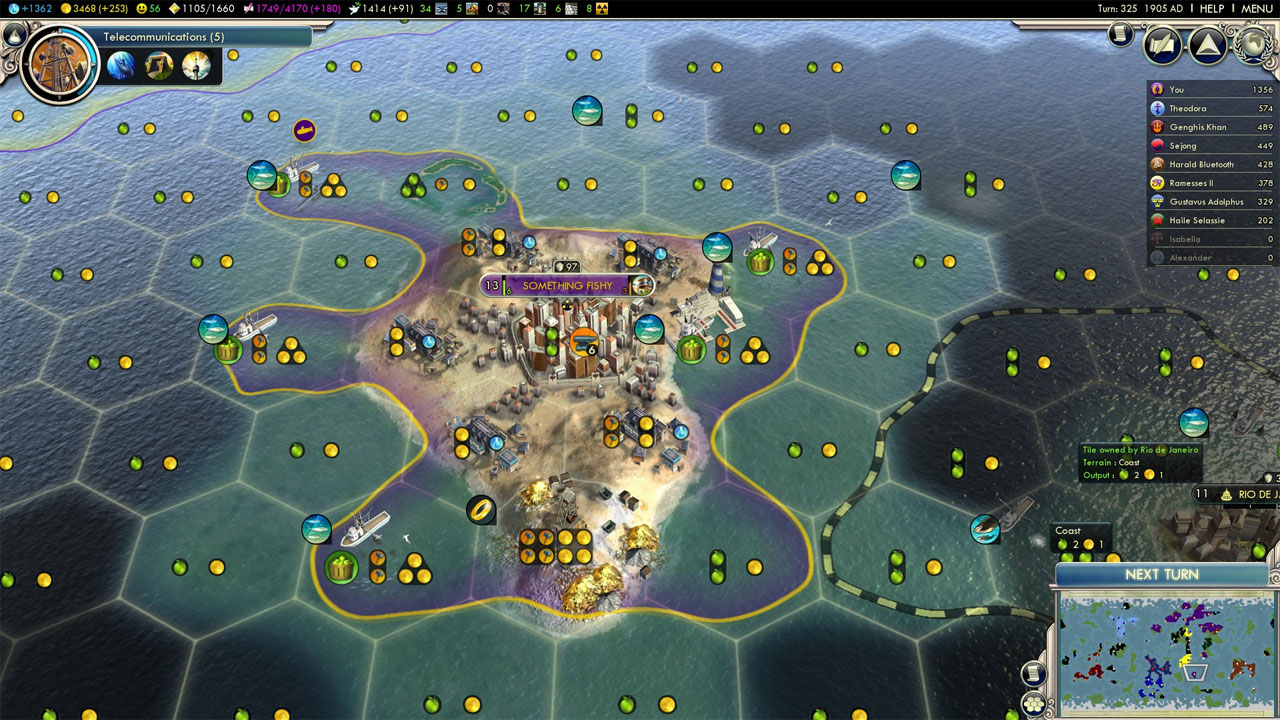 (Example above: A fully-upgraded island city, still lacking the borders mind, but a good example)
To achieve this is no easy feat - cultural expansion must be very high in order to quickly acquire tiles in the fourth and fifth rings, while a strong economy can allow for fast access to the workable tiles.
- 2a: CGC: Culture, Gold and Conquest
Aquiring all of the tiles even on a smaller map may seem a Herculean task, but fret not, for I will outline the strategy I personally employ to achieve such a feat. To do so, we must pay attention to CGC: Culture, Gold and Conquest.
Culture
The only sustainable way to acquire tiles in the fourth and fifth ring of a city (I.E: The ones not workable by the city, but still ownable) is through cultural expansion. These 54 tiles require careful cultural planning to be feasible in a short time, else you'll be waiting hundreds of turns towards the end of the game for your cities to pick up the slack. Focusing on local culture by prioritiising Great Works, culture buildings and cultural social policies is a good start - the faster you get those tiles, the better. However, in order to expedite this, you'll need to take advantage of the second letter:
Gold
All tiles within the first three rings are both available from cultural expansion or purchase, and this purchasing is vital for speed. Buying land can get expensive fast, but it also drastically reduces the net time taken to acquire more land. It's almost always better to buy a tile with gold than it is to wait for a city to expand into it, as that means less time which in turn means faster improvements and greater benefits. Expediting this process allows you to start booming with your cities much faster, making them a much better benefit much faster.
Conquest
Settling your own cities and expanding their borders is all well and good, but said city building is not the best or even the only way to acquire land. Conquest is vital - both in preventing poor AI city placement and in growing your own power. Wise and careful city settling combined with an aggressive military strategy allows you to gain and control land very quickly indeed, and time will not be on your side by the end.
- 2b: City Placement - Controlling the Most With the Least Waste
Keeping your number of cities down is vital to a stable late-game. As that timer ticks on, incrimental decreases to your effectiveness by ever-growing cities will start to haemmorage your economy. Without minimising your cities, you may well find yourself without enough economy to finish the game!
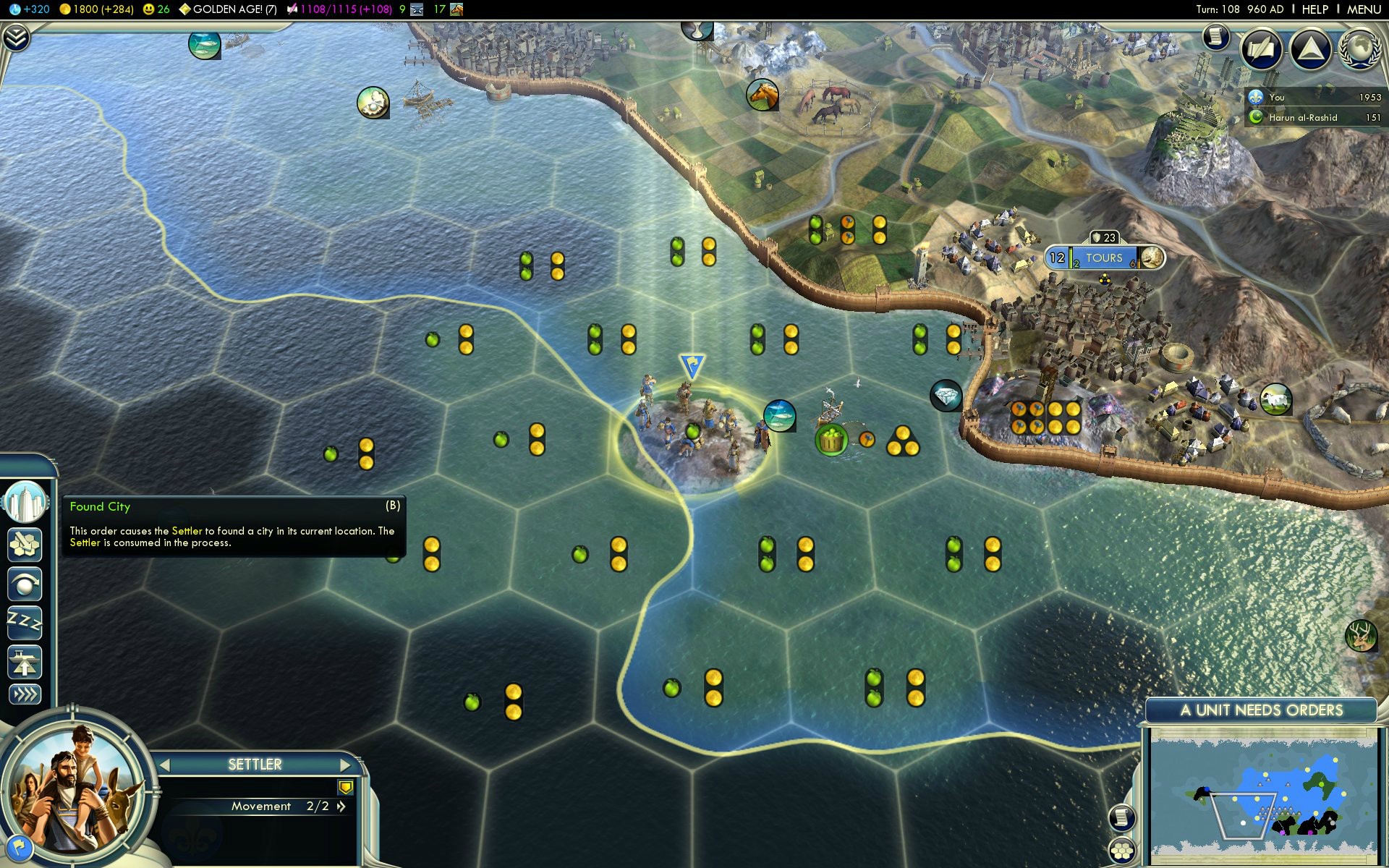
This illustrates what we want to avoid at all costs: Two tile spaced cities. Cities this close don't just control the least land between them, but in addition to this they massively reduce the effectiveness of both cities by competing for workable tiles. Both cities will suffer as a consequence, so whatever you do: DON'T DO THIS UNLESS YOU HAVE TO
(By "have to", I mean a situation where it's necessary to control all tiles on the map. Ideally, don't put yourself in that position, but if you have to - you have to)
Instead, you want cities that have touching borders, arranged in such a way that at max influence, there is no dead space. To do this as best I can, I try to settle cities like so:- Take any max radius city (5 tiles in all six directions)
- Count six tiles out from the corner of the hexagon of claimed space (Starting on an unclaimed tile)
- Settle the city on the sixth tile. This ensures maximum coverage with no dead space.
This maximises city control, While this does leave a large number of spaces controlled but unworkable, this is the only way to keep city numbers down without causing too much lag/too many economic problems down the line. Bear in mind that the AI does not follow this rule, so limiting their spread ASAP is the best plan.
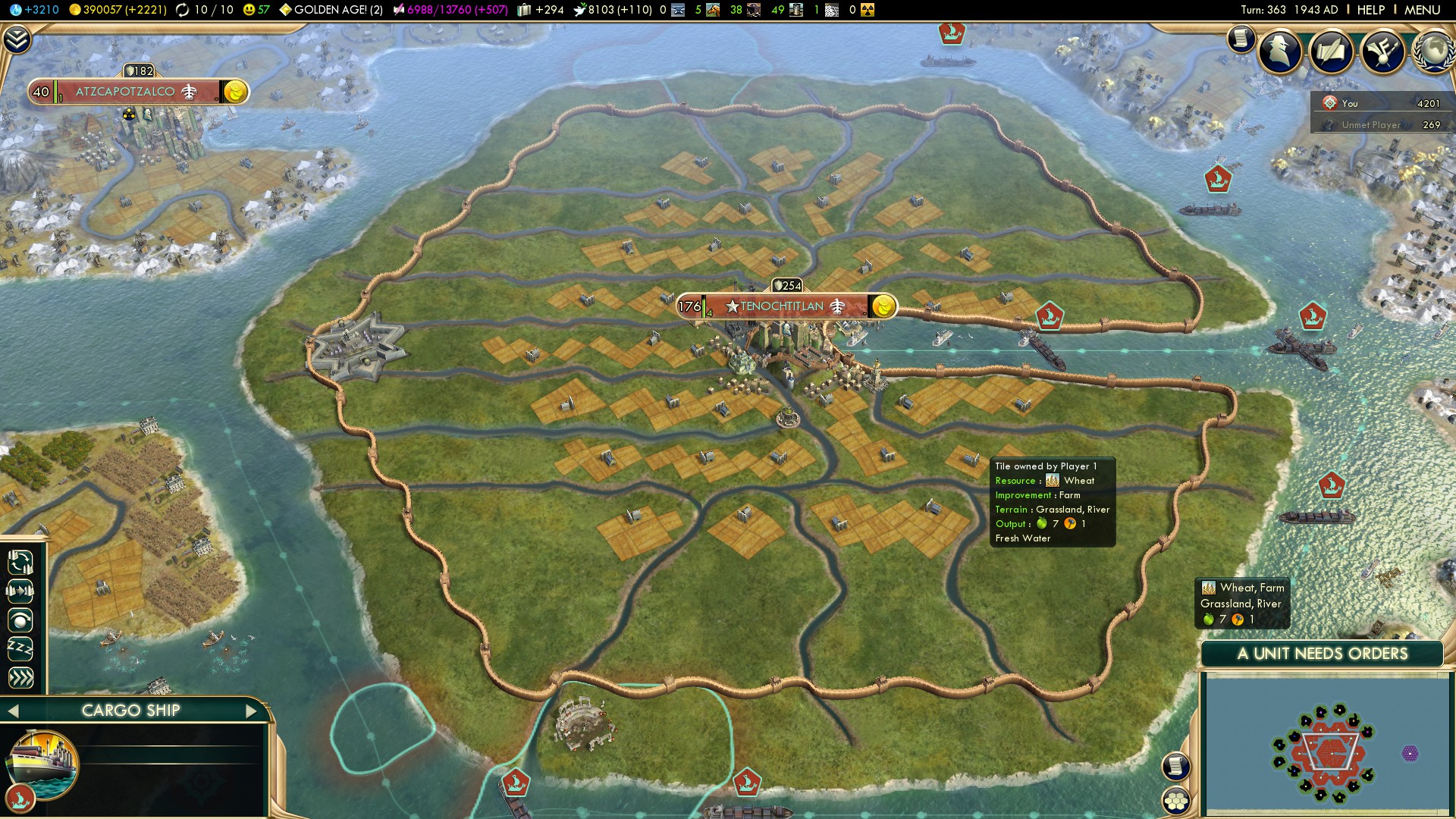 (The Great Wall wonder in this picture indicates the maximum reach of a single city, for reference)
- 2c: Improving Your Improvements
In order to attain our goal of improving all our tiles, we'll need a fair few workers and to focus on building improvements quickly and efficiently.
The Great Pyramid and the Liberty tree will assist us in this. With the free workers and worker speed boosts, we'll be excellently set to improve all our tiles. In terms of what improvements to put on what tiles, that's largely a matter of personal preference. Farms, lumber camps, mines or others are all equally valid (Though not equally good), and can be used whenever you so choose. What matters is improving the tiles, not what they're improved with.
That being said, don't forget to take advantage of unique improvements and religion boosts either. Efficiency is key after all - remember that this type of game tends to go wide before going tall, focus on growth and then switch to economy and production once you've got a good spread.
- 2d: To Conquer or To Not To Conquer
Diplomacy
- Permanent trade partners
- Less Pressure on own resources
- Allies in future conflicts
- Exclusive resources and bonuses
Conquest
- Complete border control
- More thematically appropriate for some civs
- Powerful tempo-swing and/or strategic foothold
- Faster booming
Ultimately, my choice will depend on the civ i'm playing at the time. However, if you're having difficulty, I suggest diplomacy rather than conquest. Boring, but effective.
3. Five Victories, One Game
You may think that it's impossible to obtain every victory condition in one game, and you'd be half right. If approached carefully and with some extrapolation, winning by every means in one game is possible, but you will need to go about it in a semi-specific order.
Science
You must win a Science victory first. This is due to the fact that it is impossible to construct SS Parts with the game having already been won, and as such, you have to do the Science victory first in order to be able to do it at all.
Culture
Culture must be done before Domination in order to be feasible, since otherwise there are no civs with which to gain 200% influence with. Ultimately though, this is often done naturally over the course of a game and doesn't usually require specific attention (Save for sometimes staving off a full conquest until that 200% is reached).
Diplomatic
I usually get this before Culture, but in anti City-State games it can be just before the Domination portion. To win this, you need only be elected the World Congress Leader. There's nothing to say that you have, mind, but you'll know if you've done it or not. The vote is very frequent later in the game, so passing this criterion is easily done. Just be careful not to do it before winning by Science!
Military
Finally, we finish off with the Military victory. Doing it this way results in our second victory screen, and is the perfect ending point to our run. Ideally, having everything else completed before getting this (Bar the improvement of the last tiles/building the garrison and buildings of the last capital) leaves the run on a nice ending. Plus, you kinda need them around to influence so taking them out before winning that part is a bad move.
Time/Score
Given how hard it is to accurately estimate the length of a Total Domination game, and how unlikely it is you'll be done in 500 turns, Time victory should be turned off. Also, by virtue of all the other Total Domination factors, you'll have the top score.
- 3a. Influencing Enemies and Stunning Friends
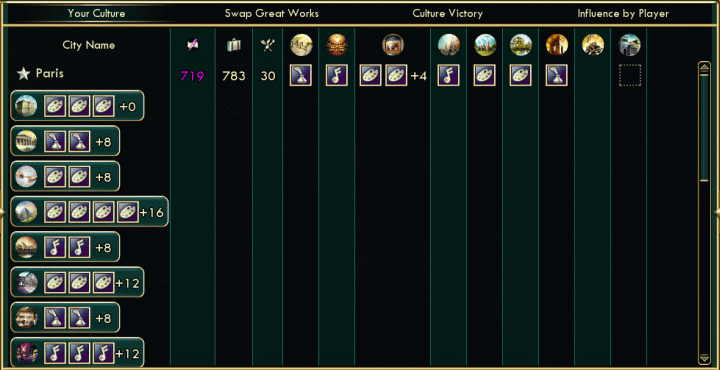
Maxing out the Themeing bonus on a wonder is pretty self-explanatory. Simply activate the themeing bonus by filling the slots with the specified pieces, and then adopt the entire Aesthetics Social Policy tree in order to maximise said bonus. The French get an additional bonus on top of this, but that isn't considered necessary to win the challenge (Except when you're playing as the French, of course).
You do NOT need to maximise the bonus in any non-wonder building (I.E Museums).
Doing this should very quickly lead you to dominant culture in the world, but if you're still lagging behind, make use of Great Musicians. Once you've used up all the great works you can, Great Musicians can quickly swing even the most dissident of civs into your cultural line. Remember, however, that the toursim generated by a Great Musician is equal to 10x the amount of Tourism your civ was producing AT THE TIME OF AQUISITION. It is a fixed value, and cannot change or be changed, save for modifiers to net amount of tourism offered such as open borders.
- 3b World Conga-Ress
The World Congress proposals must all be passed in order to classify as a Total Domination. As such, it's worth beelining towards Printing ASAP to get them passed sooner rather than later. However, some policies do not need to be enacted for Total Domination. These are as follows:
- Embargoes: Embargoes do not need to be passed, due to the fact said policies are moot when the civ embargoed no longer exists. The same arguement could be made towards Dominant Social status, but an embargo doesn't stay in effect when a civ is destroyed - Dominant Social status persists, however. City-State embargo is a grey area, but i advise against passing it due to the obvious loss it will create for you (unless you're killing them all of course)
- Ban Luxury: Banning luxuries would very quickly disintegrate your empire's happiness, making Total Dominations much, much harder (if even possible). As such, luxury banning is not required.
- Nuclear Non-Proliferation: More of a grey area than a straight "Not required". Nuclear weapons can be a very useful tie-breaker in the late game, no nukes means much harder conquests. Ultimately however, it's a matter of personal preference.
- Standing Army Tax: Again, similar to Ban Luxury/Embargoes, this would be too self-destructive when paired with active garrisons. You can pass it anyways if you like, but it'll likely cripple you.
Everything else should be passed in a Total Domination game. Given the number of proposals, this will take a while, which is why i suggest beelining Printing ASAP.
4. Finishing Off
With the lion's share now discussed, it's time to cover the last few bits left to consider a game a "Total Domination". Most of these are pretty self-explanatory, hence why they've been saved till last.
- All Techs/Social Policies. You should easily have all techs shortly after (if not before) winning a Science victory, so that's basically automatic. All social policies, however, is much more time-consuming. Keep your number of cities low, try not to found any before adopting the culture penalty reduction policy in the Liberty tree, and churn out that culture like no tomorrow. You'll get there eventually.
- World Religion. This one is pretty quick, just convert all the cities on the map to your faith. With enemy faith centres, it's often best to use Great Prophets/Inquisitors to stem the spread of their faith.
- Garrisons. Just put a (fully upgraded) Land, Air and (when appropriate) Sea unit in every city you own. Fully-upgraded meaning the end of their respective chain of units (I.E: Bazooka, Jet Fighter, Destroyer etc.). Scouts are a grey area for this, as they can be upgraded through ruins, but not otherwise, so I suggest not using them.
- Spies. The best way to accomplish this is to build the National Intelligence Agency in a weak city, trade it to the AI, and then build another. This will get two extra spies and make every spy, present and future, rank 3. Easy.
- Wonders. This is also pretty straightforward. To prevent headaches, wonders that CANNOT be built in a game do not count against this total (I.E: If nobody goes Freedom, the Statue of Liberty doesn't need to be built, if there's no water then the Sydney Opera House, Great Lighthouse, Colossus don't need to be built etc.). If, however, an AI adopts an Ideology that is different to yours, then that respective wonder MUST be built by the AI to satisfy the criteria.
- Buildings. Just build everything you can in every city. If you run out of strategic resources to build said buildings/units, then skip over them. It wouldn't be very fair to punish the player for unfortunate map generation.
5. Conclusion
I hope you all manage to build empires that will truly stand the test of time!
Beat Sid Meier's Civilization V's completion?
Flex it — let your friends know you pulled it off.
- Real Populations★ 5 (1.2k)79k views1.2k ♥2 minBulgarianUpdated Aug 31, 2017
- Civ-specific tricks, secrets and clarifications (BNW)★ 5 (1k)53k views2.2k ♥96 minUpdated Jun 30, 2019
- Zigzagzigal's Civ Summaries (BNW)★ 5 (1.5k)49k views3.9k ♥134 minUpdated Jun 30, 2019
- Who to Trust and Who to Avoid in Civ V★ 5 (570)41k views802 ♥12 minUpdated Jul 8, 2016
- How to win the Korea Scenario as Korea on Deity in 16 turns★ 5 (532)41k views828 ♥15 minUpdated Apr 1, 2016
- Civilization V Achievement guide★ 5 (2.4k)39k views4.2k ♥134 minUpdated Jun 13, 2014




- Upgrading to PremiumTeam Fortress 2★ 5 (20k)1441k views11k ♥6 minUpdated May 11, 2022
- No More Room in Hell Official ManualNo More Room in Hell★ 5 (2.8k)569k views2.1k ♥29 minUpdated Apr 22, 2019
- NMRiH Community Hosting GuidesNo More Room in Hell★ 5 (526)351k views653 ♥1 minUpdated Aug 10, 2022
- Лучшие кооперативные игры SteamPAYDAY 2★ 5 (1.5k)315k views2.1k ♥56 minRussianUpdated Apr 27, 2025
- Desert Eagle Heat Treated | Blue GemCounter-Strike 2★ 5 (1.6k)292k views1.5k ♥2 minUpdated Jan 16
- Treasure Hunt Puzzle SolutionsTotal War: WARHAMMER II★ 5 (6.9k)281k views15k ♥3 minUpdated Aug 19, 2021






This guide was created by its original author on the Steam Community. Are you the author and want it removed? Request removal.