Why Can't Anyone Hit Anything? - X4: Foundations Combat Basics
Dealing With Vectors: Like "Rock, Paper, Scissors," But Not.
Here's something I currently have come to understand about vanilla X4 combat: different projectile speeds divide the weapons into a sort of "Rock, Paper, Scissors" tactics.
You might notice that this isn't a straight-up ship class comparison; it's not about ship type versus ship type. Rather, different types of weapons are effective against different kinds of targets depending on their size and maneuverability: slower projectiles come with higher damage, but that does not mean a whole lot if you can't hit the target.
That's because all shots are aimed at the target's current trajectory, and most of the time the target is turning or changing speed, completely invalidating any projectile fired at the old trajectory but too slow to catch part of the target in time.
Weapons like pulse lasers make for an interesting exception: what if your projectiles are moving faster? It definitely makes a difference: faster projectiles will catch targets of changing vectors from further out because the shots are aimed for the center of mass and there will still be a part of that target they will clip in time. (Terran pulse lasers are especially fast, as is the balance for most weapons in the VRO mod.) But you have to get close enough for that to happen and it doesn't take much distance for most projectiles to miss a small, turning target.
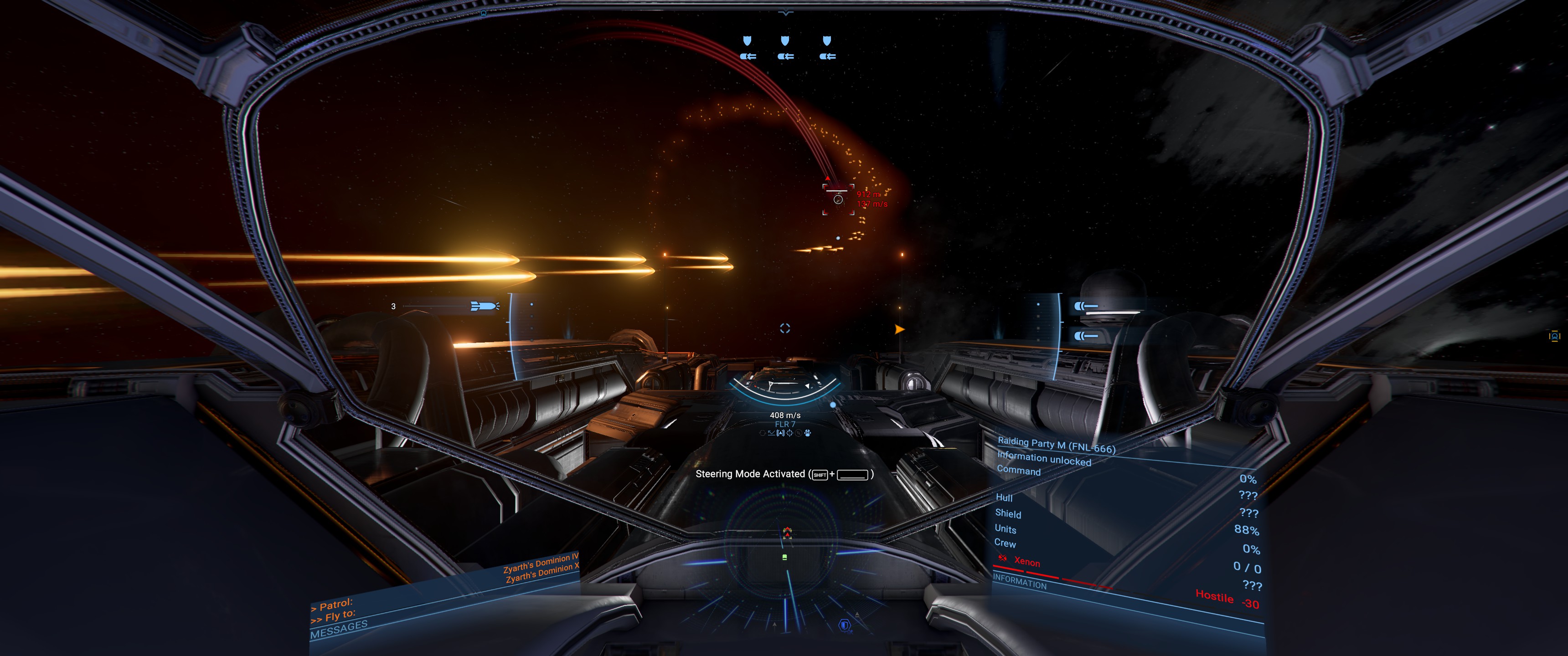 Caption: This Xenon-M S-sized ship is less than 1000 meters away, but this Prometheus' bolt turrets have no chance of touching it while moves this way.
That's why, if you look for it, you will see projectiles missing constantly, uselessly slewing off into space. That phenomenon is really what this guide is all about. Once you understand that a lot of weapons won't hit because the projectile speeds are mismatched with the target's ability to change vector, combat becomes less frustrating and makes more sense.
That's basically the TL;DR right there. But if you want to read more about it, the other sections of this guide talk about the major categories of the ships, what they're good for, and some of the weapons that are effective against them.
I tried not to tell you every little nuance of every possible weapon exploit to be found, because what fun would be that be? Games can be ruined by following guides to tell you how to play. Get out there and experiment!
"Paper" - Small-Sized Combat Craft
Small ships, "paper," can only be reliably hit by beams and light missiles unless you get close enough that turning is not enough to dodge the projectiles.
Of course, if they're charging straight at you or otherwise heading at a constant speed in a straight line, that's another story. Most ships "joust" when attacking. Because the weapons are on the front, how else are you going to do it? So, even against fast ships, slow projectiles will eventually hit them, given the luck of draw of which opponents engage which and who lasts longer. Happens all the time: when you're just out by yourself fighting off Xenon, they're all jousting you, wrecking themselves on your bolt cannon sprays, taking beams ends up foolish when everything is so easy to hit anyway. It feels like taking a knife into a gunfight, the wrong tool for the wrong job.
As it turns out, it's not. When it's 20 on 20, the odds that each firer will be shooting at a target jousting them become much lower, and projectiles become next to useless. You can order whole wings to take enemy fighters on one-by-one, only to miss spectacularly, creating moments of, "Why can't anyone seem to hit anything?!" Try equipping them with some beams or light missiles, and that same battle that would take minutes to resolve now wraps up in seconds. That difference is what this guide is all about.
Though there are a few categories of small, "Paper"-ish combat craft in this game, they generally perform the same in combat.- Scouts are basically Fighters, but they tend to be poorer armed (1-2 small weapons), less shielded (usually only 1 shield generator), and emphasize more speed. Naturally, Scouts are best at scouting, go figure. This doesn't make them bad at fighting: the "Interceptor" class is basically a Scout green lit for fighting. If you're planning on a fighter wing that only needs one weapon per fighter, then this isn't a bad way to go.
- Fighters are the kind of Scouts that are actually intended to fight, so they drop a bit of that speed for more firepower (usually 2 weapons, rarely 3) and increased durability. They pull this off without breaking the bank: weapons are expensive, putting only 2-3 on a fighter isn't putting too many eggs in one basket. These are your basic space grunts, ready to sacrifice themselves stupidly to charging plasma turrets head on.
- Heavy Fighters are when Fighters get serious. Now we've got lots of weapons (4, 5, or even 6), plenty of shielding, and often two or three times the hull points than other ships of the same class. When fighters are on menu and money is no object, Heavy Fighters are your best bet.
Contrary to first impressions, S-class weapons are not that bad! While M-sized weapons mounted on medium-sized ships might be the size of small buildings, the little S-mounted guns on fighters do almost half as much damage. Consequently, "paper" can put out a surprising amount of firepower from a very small package. (No wonder they cost about as much.) Just bear in mind that a lot that time that firepower is going to be pointed away from the target, lining up another joust, unless the target is running away.
"Scissors" - Medium-Sized Combat Craft
Medium ships ("scissors") are torn to shreds by medium-speed projectiles, whose travel time makes it tricky to catch fighters but their DPS is considerably higher. Though some of medium-sized ships (like Corvettes) are very fast, they're big enough and have enough inertia that they can be reliably hit from much further away. Everything from bolt guns to pulse lasers to impulse turrets are bad news for medium-sized ships. "Heavy" missiles can usually catch them too.
With ten times the shielding of Fighters, "Scissors" can soak up a bit more punishment before it matters. With a lot more of that "broadside of a barn" thing going on, medium-sized craft also take several times the shots that would have otherwise missed fighters. This is why medium-sized craft are generally balanced to be roughly as affordable as Fighters despite that immersion-breaking size difference.
The unique defensive properties of "Scissors" puts them right in the middle. Beams don't do enough damage to overcome their shields unless there are a lot. Against slower projectiles, like plasma cannons or capital ship batteries, medium craft are still just nimble enough to evade them most of the time. It's the medium-speed projectiles which will catch M-sized ships most of the time while doing enough damage to overcome their shields.
When evaluating the offensive potential of M-sized ships, you're going to want to pay attention to the front guns. While the L-sized turrets can put out pretty respectable DPS, the M-sized turrets are weak. L-sized ships get a mixture of L-sized and M-sized turrets, but "Scissors" only gets the M-sized turrets. Granted, if you utilize the maneuverability of M-sized ships to take enough M-sized turrets with decent DPS (like flak or shard cannons) to point blank range, you can get results. But that's an example of an effective tactic player pilots will do that NPC pilots won't.
Although these general combat performance factors are in common for all medium-sized combat craft, they vary in three major categories: Corvettes, Frigates, and Gunboats.- Corvettes tend to be fast and have most of their weapons up front. M-sized weapons do approximately 200-250% of the damage of S-sized weapons (those fitted on fighters), so this makes Corvettes highly powerful in player hands. (NPC pilots will tend to waste most of this firepower coming around for another "joust"). They can generally only hold roughly 40 reloads of missiles, although mk2 missile launchers will add slightly more "bonus" capacity than mk1 missile launchers.
- Frigates are uniquely gifted with a small fighter dock and the ability to carry up to two small ships. However, this is a bit of a red herring: the dock is not actually there for fighters, which might as well stay launched most of the time. Instead, it is useful for launching Mk2 Laser Towers, mines, and using Combat Drones. Frigates can carry 100 missiles and have the most cargo of any of the medium-sized combat ships. Frigates are good all-around workhorses.
[Version 7.60 addendum: Currently, combat drones are rather buggy and have a tendency to stall out on the landing pad, making them hard to recommend. It might be good idea to carry no more than five defense drones (a five star pilot's natural upper deployment limit outside of "escort" mode) and load up the rest of your unit capacity with repair drones. This will significantly impact your Frigate crew's hull repair capacity, with each drone's effect stacking additively with no upper limit. A natural benefit of repair drones on Frigates is that never need to be launched; they repair from inside the ship. The hull repair benefit will only affect the Frigate carrying them; Frigates cannot service other ships.]
- Gunboats are like Corvettes that have swapped out their front guns for more turrets. There is a benefit to be had here: the cooldown of forward guns is shared between the entire array, and every ship has the same heat dissipation. Consequently, you don't need more forward guns except for burst damage or weapon variety (missiles have no heat concerns, only reload times). Turrets, on the other hand, each have their own heat dissipation, enough to fire forever. (Though I have encountered some inconsistent results from modding.) So far, Gunboats sound pretty good.
However, in practice, M-sized turrets have been nerfed through the floor. They either have pathetically low DPS or such slow projectile speeds that they're unlikely to hit anything bigger than a "rock" sized target at anything more than point-blank range. Furthermore, turret AI is unreliable: they'll stop firing for reasons known only to them. Aside from the Jian and the Thresher, most Gunboats have no more turrets than a Frigate (and less missile carry capacity besides), so why not just take a Frigate instead? Gunboats are not useless - they're generally cheaper to make and have smaller profiles to hit than Frigates - but you may struggle to find a niche for them.
In general, you can expect "Scissors" to beat "Paper" simply because a single corvette has more of everything a single fighter does. (Take a fighter down at 5km with a set of M-sized Beam Emitter Mk2 and you may never want to go back.) But once numbers get involved, that stops working: a half-dozen Xenon fighters can take down a surprisingly high number of corvettes! What happened? Xenon use impulse projectors, high-damage anti-"Scissor" weaponry.
Then it follows that M-sized combat ships are better against Kha'ak ships because those are predominantly armed with beams and their shields can endure that much better than an S-sized "Paper" ship can. (But not hives because that's too many beams!)
Other uses include keeping a "wrecking crew" of sturdier M-sized ships (like Peregrines or Ospreys) to finish off a "Rock"-sized target after it has been stripped of surface elements. (Exploding capital ship and station modules put out shockwaves that tend to take out "Paper" fighters.) M-sized ships are also an effective counter to all but high levels of laser towers.
"Rock" - Stations, and Large-Sized Craft or Larger
Larger ships and stations, "rock," naturally lack of much maneuverability. Their large size makes slower, more damaging weapons (like plasma and Destroyer batteries) effective against them. (Torpedoes too, but they can be shot down and don't launch very quickly.).
Larger ships can have their surface elements (thrusters, shield generators, and turrets) targeted directly, and should. They can be completely disabled for capture operations. So swarming them with a bunch of "paper" fighters is not such a bad idea. When paper covers rock, this little "rock, paper, scissors" analogy comes together. When ordered to attack capital ships, smaller craft will deliberately prioritize disabling their surface elements first.
However, larger ships have constantly regenerating shields. Smaller ship shields stop regenerating awhile after hit, these do not. The same weapons you would use against "scissors" and "paper" targets won't do enough damage to overwhelm those shields unless used in very large numbers. Consequently, large ships are pretty much invulnerable to anything but a coordinated attack (or the batteries on other large combat ships).
Having a large ship is both a blessing and a curse. Sure, you're invulnerable to all but a coordinated attack or another large ship. But they're slow and ponderous, even exploiting travel drive with a Terran combat engine-equipped modified destroyer is a far cry from the freedom to explore the universe felt with a fighter or corvette. Chances are, you're going to want to delegate control of these ships to a subordinate. Preferably, while watching from another sector, where "low attention" simulation is less likely to cause them to bug out. Yet, when an NPC captain spontaneously decides today is a good day to die to a graviton turret, you're sure to feel the loss of a large ship all the more.
There's a few other things to know about large ships, such as the need to carry cargo drones (if you plan to do any trading) repair drones (if you plan to service subordinates or restore your surface elements quickly) and service crew (if you want your ship to repair itself at all). Note that, when moving between sectors, larger ships will "jump" between them. With an NPC captain in charge, they will do this automatically. However, your player character does not know how to do this, so you will have to pilot them through the jump gates the old fashioned way. Coming through!
In terms of the tactics to overcome them, "Rocks" include both large and extra large combat ships (Destroyers, Carriers, Battleships, and Auxiliaries) and stations.- Destroyers and Battleships possess the "main batteries" that do high amounts of damage to other large ships and hardened stations. Battleships are relatively-new additions to X4. In a tactical sense, you can think of them as several Destroyers glued together.
Note that version 6.0 of X4: Foundations implements a former community mod that changes battery-possessing ships' "attack" behavior when attacking stations. Now, they will inch forward, barely tapping the station at the maximum range of their batteries. This will mean they get less use out of their turrets. However, considering graviton turrets on Xenon stations would usually come out far better for the trade, this results in far fewer lost capital ships. All ships still have no awareness of the actual range of station guns and will happily wander into the range of them if they're doing something other than a direct attack order against the station.
- Carriers have much heavier shields than Destroyers and (along with Auxiliaries) are the only ships capable of repairing and refitting in the field, albeit of S-sized only. Other L-sized ships can often carry fighters, but what's the point of docking them if you can't repair them? I suppose you can use them as extra cargo, and being docked in internal storage keeps them out of harm's way and prevents them from wandering off. But, for most L-sized ships, those docking bays are only really good for deploying large units like mk2 laser towers. It's Carriers that make real carrier operations possible. They also often come with specialized launch bays for rapidly deploying their fighters. The Boron Guppy is a unique case of a "light carrier" that maintains the relative nimbleness of a Destroyer while still being capable of carrying and servicing 16 small ships.
- Auxiliaries are intended for a "fleet supply" role, with a unique AI behavior setting to match. In addition to what the Carrier can maintain, they can maintain large ships as well! They generally lack the offensive or defensive chops to weather combat directly. That said, you probably shouldn't be sending Carriers into weapon's range either, and the Auxillaries' higher unit caps make for good drone carrier potential.
- Stations are, well, space stations. They're built (and destroyed) section-by-section. Each section has its own hull point counts and (usually) hardpoints to fit with weaponry and shield generators. Pound for pound, stations are easily the most bang for your buck. Want to lock down a jump gate? Use a station. A half-dozen defensive platforms is usually enough firepower to put down anything the Xenon throw at you. Of course, there is a downside: stations can't move. Also, the Xenon build stations, too.
Having realized this, I prefer to swarm "rock" style targets with fighters. If you throw enough of them at a station, the reciprocating fire of defending turrets is spread around enough to result in few losses. Shield-piercing weapons like thermal disintegrators or burst rays can make quick work of defenses. You can also overwhelm the shields of individual surface elements while doing significant damage by deploying torpedoes or heavy missiles. It's a cheap and effective way to bring down a "rock" style starget. (Well, less cheap with torpedoes; those are pricey.)
However, there's a few things to remember when using fighters to take out surface elements like this. First, consider your target: if you encounter a "rock" with predominantly anti-"paper"-type turret defenses, then a change in tactics is necessary, as the attrition to the fighters may prove overwhelming. Second, it is necessary to quickly wipe out drones or other defenders when employing this tactic, as they're often more effective than turrets at taking out attacking fighters. Finally, exploding capital ships or station modules put out powerful shockwaves that are anathema to fighters, so it's best to swap out to more durable ships to finish the job.
That said, the old standby of throwing dozens of destroyers or battleships against a "rock" style target is an X series tradition. Put them on "coordinated attack" against a station and watch the fireworks. It's kind of lazy, unbalanced, and puts a lot of eggs in one basket when the captains enviably make a mistake and blunder into a killbox. But it's certainly a show of power, and what else are you going to do with this ridiculous overkill fleet you buiilt?
"Extra-Paper" - Drones, an Often-Overlooked, Awkward-To-Use Class
[Version 7.60 addendum: Currently, combat drones are rather buggy and have a tendency to stall out on the landing pad, making them hard to recommend. However, the new Xenon H is a specialized drone carrier, and has a different means of retrieving drones (specialized launch tubes) so circumvent this bug.]
Finally, let's talk about Combat Drones, an often-overlooked combat asset.
Combat Drones are basically a smaller scout that can be stored and deployed from inside of a larger ship. Sounds an awful lot like a Fighter on a Carrier (to the point where some of the Fighter subordinate logic seems to be inherited) but Combat Drones are the miniature version of that. So much smaller they can be considered "extra small," and so "extra-papery" for the purpose of considering what kind of weapons will be effective against them.
Drones are armed with a single pulse laser. If you remember what I said earlier about pulse lasers, they're best against "scissors," medium-sized targets, but the projectiles are fast enough to catch "paper" ships at closer ranges. Getting hit with a single drone pulse laser is a mere annoyance. Getting hit with a dozen can tear Gunboats to shreds in no time! See where this is going?
To use them, set a mode on the ship's loadout screen or mini-menu. "Defend" mode will generally only launch up to 5 at a time and only when the thing they are defending is directly under attack. Switch the drone mode to "escort" and it will launch all drones in defense mode while keeping them in a picket around the ship. Like with turrets, unless "armed," the modes do nothing; drones will dock with the ship when disarmed. There is a very real threat of leaving your drones behind, so you need to disarm them and let them dock before moving on. Another way to do this is to use the "recall subordinate" command on the map screen. NPC captains are fairly good at recalling subordinates, but expect this to delay getting underway to the next destination.
(Back when Drones were first introduced, they ran off internal batteries and expired if not retrieved after awhile. I'm not sure if this is still true. However, I've noticed there's a tendency for them to disappear if they haven't docked in a while.)
Drones are awkward to use. Disarm them while they're queued to launch and watch some launch while others are docking. Stupid drones! But what do you expect for something made by societies terrified of adaptive AI? There's a lot of weird little nuances to get used to in using drones, so why bother?
Mostly because drones are great distractions. If you deploy an escort of Combat Drones before engaging several smaller Xenon craft, your chances of survival go way up! The Xenon shoots you, the drone shoots the Xenon, and this causes the drone to aggro them. If you can get an enemy to engage a Combat Drone, hitting them with anything other than a beam takes a very long time. Best of all, if you lose the drone, drones are cheaper than a fine meal to replace!
You can also use drones offensively. "Attack all enemies" mode does not seem to work, but if you can get enemies to hit your ships out while in "escort" mode, the drones will automatically allocate themselves among your attackers. Once launched, drones are treated as part of that "fleet," and can be given fleet orders to attack a target by right-clicking on the drone carrier on the map while you have a target selected. You can only designate one target a time like this, like flying a kite made up of a doom blob of drones!
If the X universe got their drone AIs figured out, Fighters might as well be obsolete, but there are precious few good drone carriers. Most ships are limited by unit capacities or the lack of proper docks. L-sized ships need to take along repair drones and cargo drones, so that leaves little room for Combat Drones. Frigates and Auxiliaries have the right properties to be effective drone carriers. But, when it comes time to upgrade to proper fighters, don't dwell too long on getting that perfect drone carrier, as Fighters are superior to drones in every way except for cost and difficulty to hit.
Putting It All Together: It's All About Weapon Performance
Though I got a little distracted talking about some of the different ship categories, the important thing to consider in this guide is how rapidly-changing target movement vectors will invalidate most projectiles in X4: Foundations. Consider what your targets are using, and match your forces appropriately.
If you are up against a "rock" - a station or a large combat ship - what kind of weapons is it packing? If it is plasma (the typical large hardpoint armament) then your larger ships are in for a slugfest. (Of course, sometimes fighters will perish charging headlong into many slow projectiles because fighters gotta joust.) If it is mostly medium-speed projectiles, a batch of medium-sized ships won't last long. If it is beams, keep your fighters out of it. Regardless, you know that these guys are slow enough that you can finally get some use out of those high-damage, slower projectiles and torpedoes. Better yet, don't destroy them: capture them after disabling their surface elements, but a whole other guide can be written on the capture process.
If you are up against a "scissors" - medium-sized combat ships - how is it armed? Your average Kha'ak Hive Guard favors beams, which are bad news for anyone who relies on evasion to survive, but Xenon P have impulse weaponry, much worse for medium-sized ships. Of course, if you order a Destroyer without an escort to engage a bunch of torpedo boats, you should not be surprised at the repair bill you will get. Regardless, you know that because these targets are too heavily shielded for beams and too maneuverable for plasma, the wide range of medium-speed, moderate DPS projectile weapons or "heavy" missiles are the best at taking them down.
If you are up against a "paper" - small-sized combat ships - how are they outfit? Sure, that sleek Corvette of yours can take down Kha'ak all day along, but then you engage a half-dozen Xenon smaller craft and suddenly you're rudely ejected into space with your fancy ride in pieces: impulse weaponry hurts. Your Destroyer's beefy shields render it generally safe against anything that would be a threat to a smaller ship class, but there's a limit: a huge fighter wing that packs a lot of DPS can probably completely disable your ship! Regardless, because "paper" targets are too small and agile to get hit by most projectiles (unless they are very close to the firer) then you know that the quickest way to take one down is with beams or light missiles.
So, next time you see that everyone can't seem to hit that annoying Xenon M buzzing around until its luck runs out, bear in mind that this is working as intended. In X4: Foundations, combat makes a lot more sense when you use the right weapon for the right job.
- X4 Full Map [Timelines][7.0]★ 5 (579)46k views1.2k ♥1 minUpdated 22 Jun, 2024
- A Guide to Game Starts★ 5 (209)28k views437 ♥27 minUpdated 7 Jan
- X4 Beginner Guide 5.1★ 5 (393)27k views1.2k ♥22 minUpdated 7 Mar, 2023
- All Ownerless Ships in X4: Foundations (9.00 Base Game + All DLCs)★ 5 (453)27k views1.1k ♥10 minUpdated 10 Jun
- X4 Ultimate Weapons Guide. [NOW ON THE WIKI]★ 5 (343)23k views768 ♥104 minUpdated 8 Jul, 2024
- X4 sector map★ 4 (146)22k views207 ♥1 minUpdated 6 Dec, 2018


- Upgrading to PremiumTeam Fortress 2★ 5 (20k)1441k views11k ♥6 minUpdated May 11, 2022
- No More Room in Hell Official ManualNo More Room in Hell★ 5 (2.8k)569k views2.1k ♥29 minUpdated Apr 22, 2019
- NMRiH Community Hosting GuidesNo More Room in Hell★ 5 (526)351k views653 ♥1 minUpdated Aug 10, 2022
- ULTIMATE GUIDE FOR GAME DEV TYCOONGame Dev Tycoon★ 5 (5.8k)326k views10k ♥4 minUpdated 23 Jan, 2014
- How to 'Git Gud' Soon™MORDHAU★ 5 (2k)318k views3k ♥68 minUpdated Nov 16, 2024
- Лучшие кооперативные игры SteamPAYDAY 2★ 5 (1.5k)315k views2.1k ♥56 minRussianUpdated Apr 27, 2025




This guide was created by its original author on the Steam Community. Are you the author and want it removed? Request removal.