Quick Farming Guide for b42.17
Preparation
Hi, hello.
Preparation:
It's a good idea to gather seedpacks you find around, even if you won't carry them, read the backs of the packs, character will remember information about the plant. -Assuming they won't die.-
Also trowels, hoes and shovels needed for preparing the land. You can go for a shovel or a spade because those are also useful for basekeeping.
Fertilizer is not needed but good to have.
Scythe is great for basekeeping, it can quickly cut grass in 4x4 area, you can also use it for animalcare.
Repellents and spraying equipment can be ignored if you place your crops right.
Choosing Seeds:
Generally you can divide plants by high water requirement and low water requirement. If you are planning to never leave your base no need to care about this.
Yet if you regularly go to expeditions, high requirement plants will have you tracking rain cycles and having to cut trips short to return base and check on plants.
Here are the plants I look for:
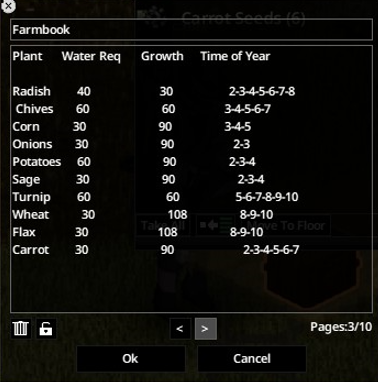
Anything with more than 30 water requirement and long time to grow I ignore.
Potatoes are exception cause they are very filling and last longer (Except for harvest.)
Wheat is also a good choice but unless you alter settings, by the time wheat is ready to harvest, you might be done with the game.
Radishes can be planted almost entire year and grow very fast so they are my favourite.
Choosing Location
Choosing Location:
Obviously, setting up base near a river or lake is a good idea.
There are also rare wells you can find in wilderness but they are too deep in wilderness it's hard to carry supplies there.
Alternatively, you can ignore water sources and choose to rely entirely on rain.
Animal feeding troughs are lightweight so you can set up 2-3 of them purely to use as raincatchers.
While gathering those, if it's too heavy, use "equip secondary" option to lower the encumbrance.
Also look for buildings and side buildings you can use as barns, Church in Dallas Lake is my preferred spot for this reason.
Or you can simply set up base in an already existing farm.
Zombies will trample crops and scare your animals so you better have fences or walls.
Tents, tables, naturally generated rocks and furniture also counts as fences so you can do use those without leveling carpentry.
Or use metal troughs as both fences and raincatchers at same time.
Agriculture
Planting:
There are diseases your plants can get, and they spread to other plants, so it's a good idea to put tile space between crops.
Once ready to plant, right click the seed pack and choose show recipes for all your plant knowledge.
Generally, good month of plants is the first month you can plant them, poor month is the last possible month you can plant.
Also, if you don't have a freezer or reliable way of preserving food, don't plant all crops at once.
Or use fertilizer on only half of them.
Otherwise all crops will be ready to harvest at same time and some will rot.
Planting in second half of the month is better for plant's health cause lunar phases affect it.
Watering:
Each plant has a minimum water requirement. Once it gets lower than that plants lose health.
If it gets too low, plant dies.
Using pots and bottles is too tidious. Instead get yourself a bucket or better a water jug from offices or government buildings.
(New update increased water capacity of some containers so those also work if you can't find a jug.)
Compost and Fertilizer:
These speed up time it takes plant to grow with each use.
Fertilizer is a more potent compost, it can also kill your crops.
So don't use fertilizer in seedling plants and almost ready for harvest plants.
Also water them afterwards like real farmers do to prevent burning.
Compost is safer to use, not wasted if used in almost ready crops and weaker but you can make your own.
Harvest:
Once a crop is ready to harvest, it can rot in a few days or 1 irl hour.
So it's a good idea to stay in your base during those times to babysit your plants.
Harvested plants last longer as items than their in ground version.
Cows and Sheep
Or... You can ignore all of that, not care about any farming and use animals instead.
Animals:
A single cow or a few sheep can cover all your food and water requirements, without you ever needing to worry about farming, ever.
They also need food and water however.
For Water:
Simply put some troughs to for rain, or set up your zone near a water tile.
For Food:
You can cut grass and dry it for hay or use grass right away.
Milking:
Animal can become ready to be milked after you find it, or you need a bull and wait for breeding.
Cows can breed all year around and Sheep only does so in autumn and winter.
Important Tips
-Animals you find in wild will often die from thirst instead of starvation. It's a good idea to check up and give water to animals you want to bring to your base later on.
-I highly recommend using throughseasons mod to lower month lengths.
In vanilla average time to grow a crop can range between 20 to 50 in real life hours without the fast forwarding or sleeping.
Also turn off seasonal crops and set day length to 30 mins if you don't want to wait for that.
-Auto-drink works on milk-water mixture.
-Not milking animals for a while stops them from producing milk.
-Plants like Garlic that take too long to grow and have high water requirements are not worth the effort.
-You can rely entirely rely on a single crop (Radishes for example) for your food supply, supplementing it with scavenged food or hunted game.
-Potatoes and wheat can be used as seeds. (Also sweet potatoes, corn and others.)
-You will be done with the game by the time it takes for a self-sufficient farm or a decently sized herd. So it's a valid option to find a holstein cow and forget about rest.
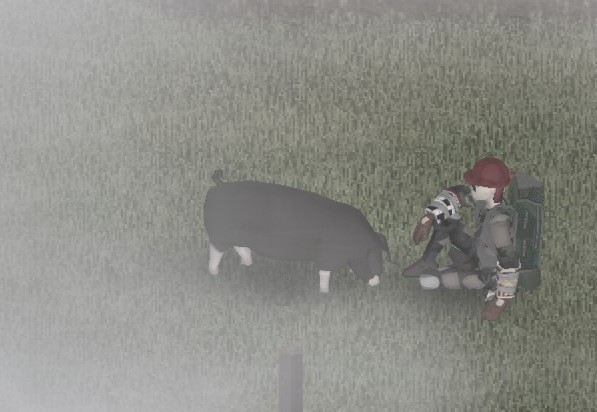
-I named this piggy Peabody.
- Modding Policy★ 5 (397)133k views208 ♥9 minUpdated Nov 8, 2022
- 80 tips and tricks for Project Zomboid (If you have over 100 hours in this game some of these will probably be new to you too)★ 5 (1.6k)82k views3.1k ♥28 minUpdated Aug 29, 2021
- Топ 100 лучших модов на "project zomboid"★ 5 (415)68k views1.1k ♥10 minRussianUpdated Jul 28, 2024
- [B41] Лучшие места для базы★ 5 (477)61k views1.3k ♥6 minRussianUpdated Nov 30, 2025
- Первая помощь ❤★ 5 (628)49k views1.4k ♥5 minRussianUpdated Jan 20, 2025
- The Basics of Base Building★ 5 (704)48k views1.5k ♥17 minUpdated Dec 24, 2021





- Upgrading to PremiumTeam Fortress 2★ 5 (20k)1441k views11k ♥6 minUpdated May 11, 2022
- No More Room in Hell Official ManualNo More Room in Hell★ 5 (2.8k)569k views2.1k ♥29 minUpdated Apr 22, 2019
- NMRiH Community Hosting GuidesNo More Room in Hell★ 5 (526)351k views653 ♥1 minUpdated Aug 10, 2022
- ULTIMATE GUIDE FOR GAME DEV TYCOONGame Dev Tycoon★ 5 (5.8k)326k views10k ♥4 minUpdated 23 Jan, 2014
- How to 'Git Gud' Soon™MORDHAU★ 5 (2k)318k views3k ♥68 minUpdated Nov 16, 2024
- Лучшие кооперативные игры SteamPAYDAY 2★ 5 (1.5k)315k views2.1k ♥56 minRussianUpdated Apr 27, 2025




This guide was created by its original author on the Steam Community. Are you the author and want it removed? Request removal.