Game Mechanics Guide
Attributes
- +2.5 Health per every point above 50
- +0.05 Health regeneration per every point above 50
- +0.4 Defensive Ability per point
Cunning
- Roughly +1% physical damage per 2.45 points
- Roughly +1% pierce damage per 2.45 points
- Roughly +1% duration damage (only bleed and trauma) per 2.15 points
- +0.4 Offensive Ability per point
Spirit
- Roughly +1% magic (includes fire, cold, lightning, acid, vitality, aether, chaos) damage per 2.15 points
- Roughly +1% magic duration damage (burn, frostburn, electrocute, poison) damage per 2.00 points
- +2 Energy per every point above 50
- +0.009 base energy regeneration and +0.25% energy regeneration per point
Cross-table of damage types
 Fire
Fire Cold
Cold Lightning
 Poison & Acid
 Pierce
 Bleeding
 Vitality
 Aether
 Chaos
Chaos- Modifiers that improve "instant" damage types won't improve corresponding "duration" types, and vice versa. For example, +%fire damage won't increase your burn damage.Percentage damage modifiers stack additively with damage bonuses from attributes, so +50% "magic" damage from Spirit and +50% fire damage from gear means +100% fire damage. This provides us with an easy way to compare gear - when only fire damage is concerned, +10% fire damage will be equal to 30 Spirit.
- Every type of damage listed in the table above has a Retaliation counterpart. Retaliation damage is only improved by modifiers that expressively state that they improve Retaliation damage, e.g. +%Fire Retaliation on one of Demolitionist's skills. "Core" damage modifiers won't improve the retaliation subtype, neither would any of relevant attributes (Cunning, Spirit).
Offensive and Defensive Ability
Grim Dawn runs a classic system where chance to hit depends on difference between attacker's Attack Rating (in this game - Offensive Ability) and receiver's Defense Rating (in this game - Defensive Ability). What's not exactly common is that:
- if you chance to hit is below 70%, you do reduced damage even if you hit
- this is applied to skills and spells as well as normal attacks
- critical hit chance is also 100% dependant on difference between attacker's OA and receiver's DA
- critical damage modifier also heavily depends on this.
Equality of attacker's OA and receiver's DA results in a 90% chance to hit and 0% chance to crit.
- Once chance to hit exceeds 85%, a character would be able to do critical damage. There are five tiers of critical multipliers: 1.10x, 1.20x, 1.30x, 1.50x and 2.0x. If your listed* critical chance is below 10% you would only be able to do x1.10 critical hits. Breaking a limit of 10% won't just turn your critical hits into 1.20x ones, more like you would still get majority of 1.10x and sometimes 1.20x. More in the following table:
- * Why mentioning 'listed' is somewhat important is because in-game tooltip lies to you about your critical chance if your chance to hit is maxed at 100%. Let's say the game tells you that your chance to hit is 100% and chance to crit is 40%. What it actually means is you have 69.2% chance to do normal damage (meaning your actual crit chance is down to 30.8%), 7.7% chance to do a 1.10x critical hit, 7.7% chance to do a 1.20x critical hit, 7.7% chance to do a 1.30x critical hit and 7.7% chance to do a 1.50x critical hit.
If you want a more in-depth look on how the game converts OA/DA into chance to hit / crit, then you can check this[www.grimdawn.com]. It is not very useful to character optimization though.
If you can't crit an enemy at all then this modifier is useless to you.
Armor
In Grim Dawn, armor is not a cumulative stat, since the game utilizes locational damage. Meaning, if an enemy shoots you in the feet, only your feet armor matters.
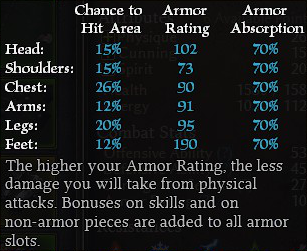
As said on the screenshot above, all flat sources on non-armor slots are applied to every piece. This includes skills, rings, amulets, medals and notably belts.
Armor reduces incoming physical damage by formulae70% Armor Absorbtion means that your effective armor is 70% of the normal value.
- +%Armor will increase your Armor Rating of every armor slot.
- +%Armor Absorbtion will increase your Armor Absorbtion, but the modifier is actually multiplicative, not additive. +10% Armor Absorbtion means 70% * 1.1 = 77%.
Shields
- Chance to block
- Amount of damage blocked
Incoming damage will be reduced by this amount if block is successful. - Recovery time
This is basically the shield block cooldown. Shield can only block once during this time interval. This means that shield efficiency is dependant on how often do you receive damage. - Damage
As of now shield damage is seldom used. I'm aware of only two skills that use shield damage instead of main hand one - Blitz and Force Wave.
Related modifiers:
- +% Shield Block Chance
This modifier stacks additively with base chance to block - +% Shield Damage Blocked
- -X% Shield Recovery Time
DoTs can be blocked, but the block occurs only on initial application.
Weapon Pool System
When it comes to procs Grim Dawn has a rather peculiar system. In most ARPGs procs are independant, so if you, have a 20% chance to do a scissor attack and a 20% chance to do a barrel roll, then there would be an overlap when both trigger, and the game would have to decide what to do with that. This is not the case for Grim Dawn.
To clarify, there are two kinds of procs in Grim Dawn - those that chance attack animation, and those that do not. We're talking about the former here, which includes weapon techniques like Zolhan's, Markovian's Advantage, Dual Wield procs, and some other stuff; full list later. Those that are not on the list work independantly of weapon techniques.
So how does Weapon Pool System works?
Let's say you don't have any procs, so it's 100% chance to do a default attack. Let's interpret it like that: roll a number between 1 and 100, and numbers from 1 to 100 would mean a basic attack.
Now, add a 20% chance to use a Zolhan's Technique. We interpret it like that: roll a number between 1 and 100, 1-20 would mean Zolhan's Technique proc, and 21-100 would mean a default attack.
Finally, add a 20% chance to use a Markovian's Advantage. Now we got two procs. And in this case the game works like that: 1-20 would mean Zolhan's Technique proc, 21-40 would mean Markovian's Advantage proc, and 41-100 would mean a default attack. It's the key difference - if inpedendant procs would have interfered with each other, then in Grim Dawn weapon procs work together to eliminate default attack by gradually filling up it's quota.
An important conclusion is that you could easily eliminate default attacks altogether. This will happen when your accumulated chance to proc a weapon skill reach 100%.
When your accumulated chance to proc a weapon skill exceeds 100% procs will start to interfere with each other. The game resolves the 'above 100%' issue by increasing the upper limit on a roll accordingly. Let's say you've got:- Belgothian's Shears, 20% chance;
- Amarasta's Quick Cut, 20% chance;
- Whirling Death, 20% chance;
- Execution, 20% chance;
- Markovian's Advantage, 25% chance;
- Zolhan's Technique, 25% chance.
Which leads to the practical advice to not exceed a 100% limit. Let's say among your procs there's one you treasure much more than others (*cough* Execution *cough*). In that case going above 100% limit would simply reduce the chance of this desired proc to be chosen from the pool of weapon skills.
Sources:
Dev post #1[www.grimdawn.com]
Dev post #2[www.grimdawn.com]
Post explaining WPS in detail[www.grimdawn.com]
Table of item modifiers: Local/Global
Local modifiers only affect the item they placed on. Global modifiers are wholistic - they affect the character instead of the item, and through that affect other items as well.
For example, a +10 chaos damage modifier on your weapon will affect only said weapon's damage, while +%attack speed will affect both weapons if you're dual wielding.
Resistance Reduction
Based on this post[www.grimdawn.com]. I myself haven't conducted any tests on the issue.
The are three kinds of resistance reduction modifiers:- Flat reduction (x Reduced Target's Resistance);
- Found on: Plaguebearer's prefix, of the Wastes suffix, Adept's/Master's Spellblade, Oblivion relic, some item-given abilities (mostly those that buff you instead of debuffing the enemy), also Mark of Dreeg component.
- Multiple sources of this type do not stack, as well as doesn't stack with itself. In the case of multiple sources the strongest will take effect.
- Directly substracted from resistance.
- Found on: Plaguebearer's prefix, of the Wastes suffix, Adept's/Master's Spellblade, Oblivion relic, some item-given abilities (mostly those that buff you instead of debuffing the enemy), also Mark of Dreeg component.
- Negative percentage reduction (-% Resistance);
- Mainly found on mastery skills, like Curse of Frailty, Night's Chill, Olexra's Flash Freeze, as well as plenty of mid- and endgame item skills like Flash Freeze (from Frozen Core and Chillsurge Ring), Unmake (Tome of Names), Warpfire (Warpfire), etc
- Multiple sources of this type stack. In the case of multiple sources the strongest will take effect.
- Directly substracted from resistance.
- Mainly found on mastery skills, like Curse of Frailty, Night's Chill, Olexra's Flash Freeze, as well as plenty of mid- and endgame item skills like Flash Freeze (from Frozen Core and Chillsurge Ring), Unmake (Tome of Names), Warpfire (Warpfire), etc
- Positive percentage reduction (x% Reduced Target's Resistance)
- Just like flat type, it's mostly found on items or item skills that buff the player. For example, of the Abyss suffix, Symbol of Solael component, Eternal Band, Open Hand of Mercy, Corpse Desecrator, Essense of Ch'thon augment.
- Just like flat type, multiple sources do not stack.
- Multiplicative. Takes effect after two other types. Works different depending on whether the resistance positive or negative:
- Positive: final resistance = resistance* (1 - x%)
- Negative: final resistance = resistance*(1+x%)
- Positive:
- Just like flat type, it's mostly found on items or item skills that buff the player. For example, of the Abyss suffix, Symbol of Solael component, Eternal Band, Open Hand of Mercy, Corpse Desecrator, Essense of Ch'thon augment.
Sources:
15 Reduced Target's Resistance for 5 seconds from Mark of Dreeg
-10% Fire Resistance from Olexra's Flash Freeze Lvl 1
20% chance of 50% Reduced target's Resistance for 5 seconds
Result: 80% - 15 - 10% = 55%, positive. 55%*(1-0.5) = 27.5% final fire resistance.
Sources:
15 Reduced Target's Resistance for 5 seconds from Mark of Dreeg
-100% Fire Resistance from Olexra's Flash Freeze Lvl 12
20% chance of 50% Reduced target's Resistance for 5 seconds
Result: 80% - 15 - 100% = -35%, negative. -35%*(1+0.5) = -52.5 final fire resistance.
Damage Type Conversion
A special type of modifier, could be either gear-based or skill-based. Gear-based modifier will convert physical damage of a weapon it's placed on to another type (if it's not on a weapon/shield it will still be applied to both your main-hand and off-hand, with focuses being exception for obvious reason).
The conversion happens before damage modifiers are applied, so, e.g., if you convert X% of Physical Damage to Fire Damage, +%fire damage and bonus from spirit will be applied, while +%physical damage and bonus from cunning will not.
Different sources of conversion stack additively. I don't know for certain what will happen if you go over 100% (or if it's even possible), but given how weapon pool system works and how developers like weight-based implementations, perhaps it works the same for conversion.
- Class Selection (EN)★ 5 (510)58k views841 ♥9 minUpdated Jul 6, 2017
- Beginner's Guide to Skills★ 5 (1.1k)53k views2.3k ♥167 minUpdated Nov 4, 2021
- Devotion Shrines★ 5 (2.1k)43k views3.7k ♥5 minUpdated Nov 22, 2023
- How to start new games at level 15+★ 4 (161)30k views341 ♥6 minUpdated Jul 6, 2019
- Секретные Локации★ 5 (1.1k)27k views1.9k ♥8 minRussianUpdated Apr 20, 2017
- Lokarr - Secret Quest (AoM)★ 5 (549)26k views1k ♥10 minUpdated Oct 5, 2018




- Upgrading to PremiumTeam Fortress 2★ 5 (20k)1441k views11k ♥6 minUpdated May 11, 2022
- No More Room in Hell Official ManualNo More Room in Hell★ 5 (2.8k)569k views2.1k ♥29 minUpdated Apr 22, 2019
- NMRiH Community Hosting GuidesNo More Room in Hell★ 5 (526)351k views653 ♥1 minUpdated Aug 10, 2022
- Лучшие кооперативные игры SteamPAYDAY 2★ 5 (1.5k)315k views2.1k ♥56 minRussianUpdated Apr 27, 2025
- Desert Eagle Heat Treated | Blue GemCounter-Strike 2★ 5 (1.6k)292k views1.5k ♥2 minUpdated Jan 16
- Treasure Hunt Puzzle SolutionsTotal War: WARHAMMER II★ 5 (6.9k)281k views15k ♥3 minUpdated Aug 19, 2021



This guide was created by its original author on the Steam Community. Are you the author and want it removed? Request removal.