Geothermal Plant - Water Regulated
INTRODUCTION
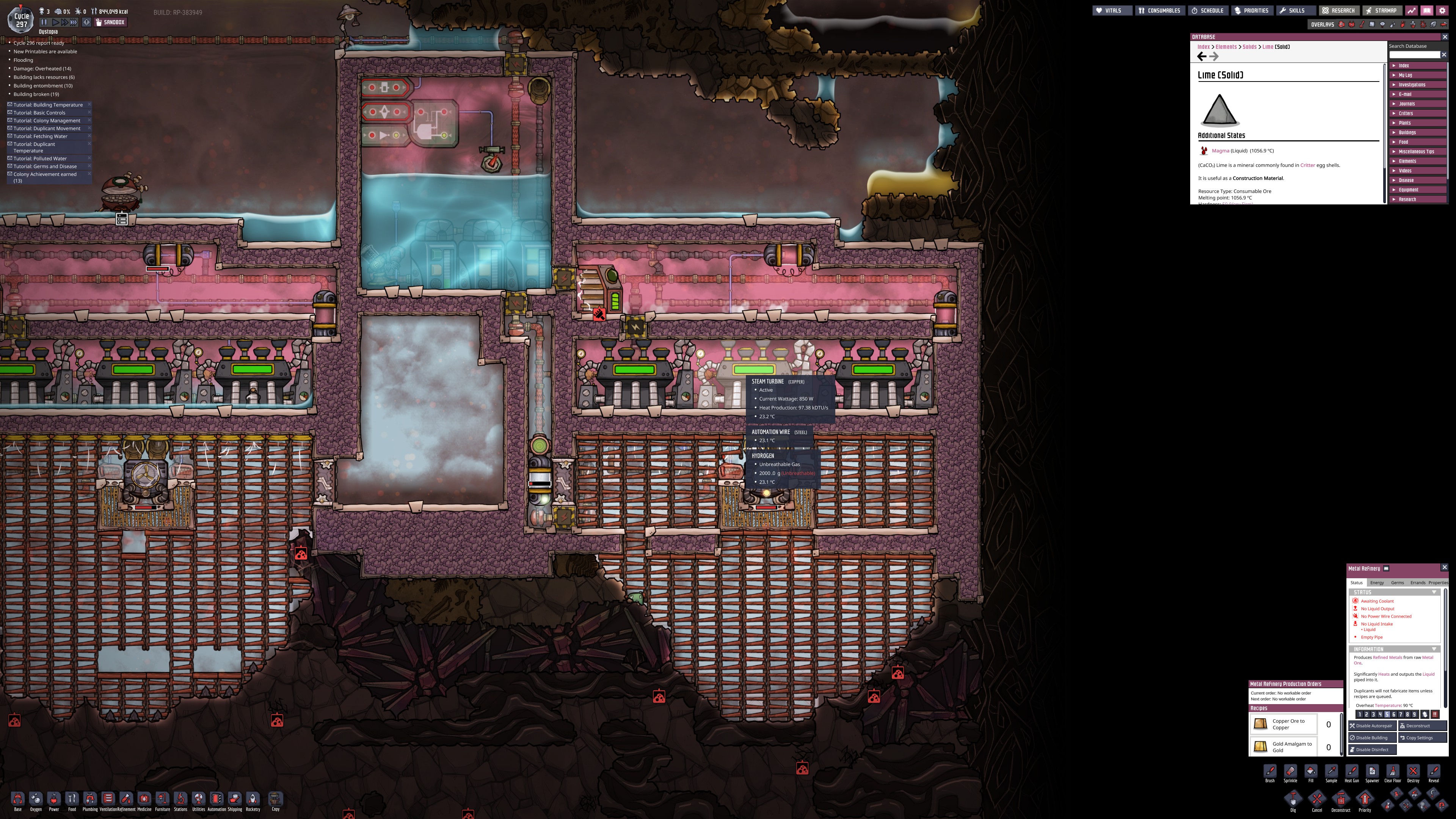 This guide shows how to build water-regulated geothermal plants. It proved to be a MUCH better approach than temperature-regulation based.
Principle is this:
Heat is transferred from the hot tiles to the steam.
Transfer rate is constant.
More steam in the chamber lowers temperature.
Less steam increases temperature.
Steam turbines constantly remove water(steam) from the environment.
We will regulate how much water(steam) goes in to the chamber to regulate the temperature.
And it works wonderfully, far better than I could have hoped/expected.
STEAM TURBINE COOLING
Turbines are submerged in a hydrogen atmosphere as per standard.
WATER TEMPERATURE/PRESSURE REGULATION
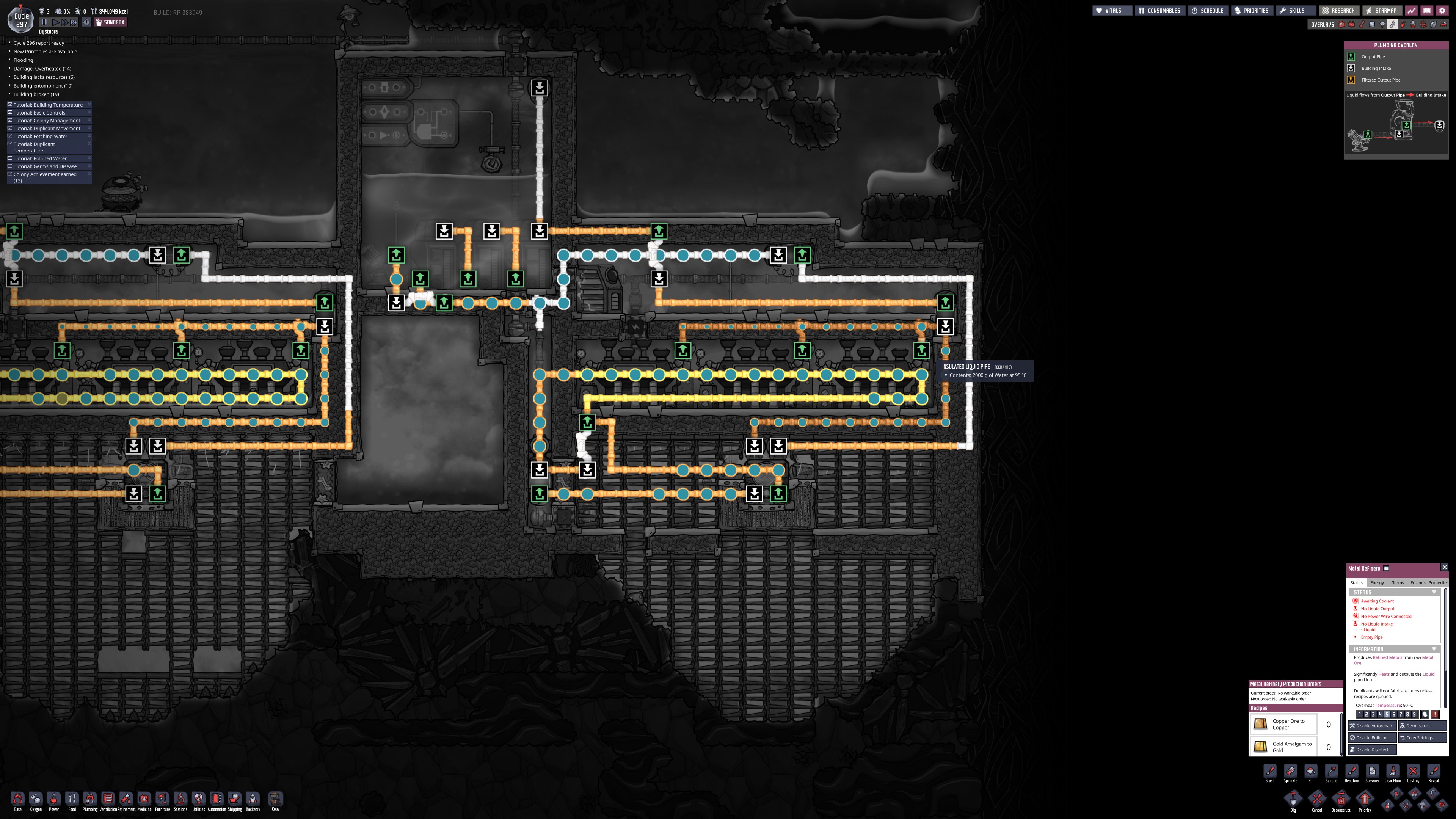
200 Deg C is the steam temperature at which increases in temperature no longer increase power output. Below 200 Deg C the steam turbines produce less than maximum power.
The aim is to keep the steam going into the turbines at ~200C. Less they do not generate enough power. More and the thermal energy is just being wasted.
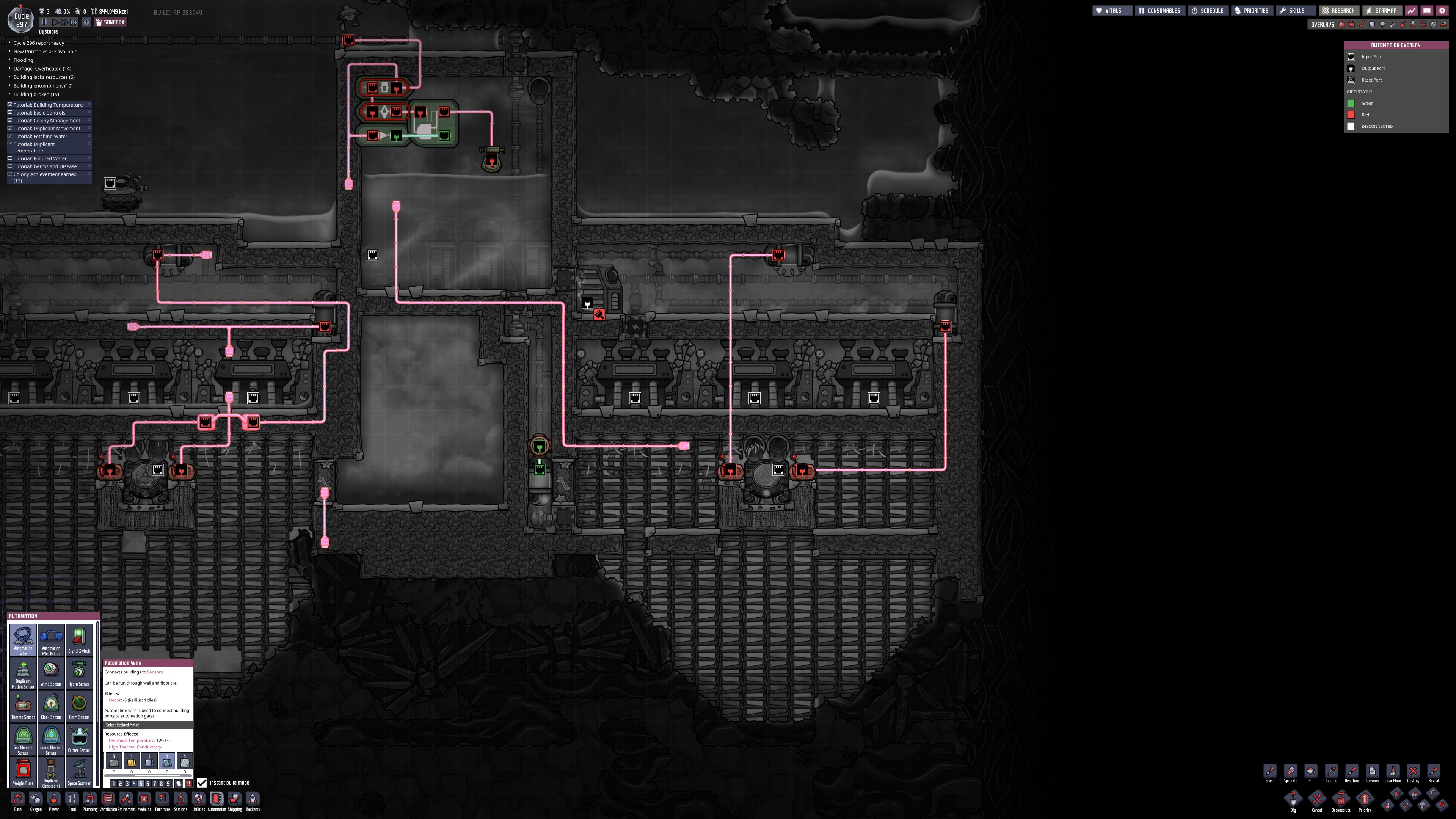
There are 2 temperature sensors on either side of the aquatuner. These provide the 'brains' of the mechanism. The temperature sensors are set to 200 and 210 Deg C respectively.
IF the 210 Deg C(too hot) sensor is triggered, then the top valve will trigger and release water into the system, increasing pressure and dropping the temperature and increasing the heat energy/tile.
IF the 200 Deg C(too cold) sensor is triggered, the output water from the turbines will be returned to storage and not placed back into the system. This allows the Steam to heat up. It also decreases the heat energy/tile of the steam.
IF the temperature is between 200 and 210 then the water output from the turbines is placed back into the system to maintain stability.
All together works exceedingly well and keeps the turbines going over 100s of cycles so far in testing.
MAINTENANCE AND OPERATION
This power plant does need regular maintenance by the Dupes.
The reason for this is that the heat has been extracted from the rocks and the steam is no longer getting hot enough.
These cold rocks then need to be mined out to expose the new hot rocks that can keep the steam hot.
Tempshift plates can be used to good effect. In theory the hot tile should still remain useful up to 200 deg C after which they subtract rather than add to the system. In practice they start to become too cold at about 350 degrees as there is a heat gradient in the system with the steam at the bottom in contact with the hot rocks being hotter than the steam at the top.
I have not yet experimented with filling the whole steam chamber with TempShift plates. I suspect this may allow use of the rocks down to under 300 Deg C.
I have put some automation at the top of the water tank to check for the condition where the water is pumped out of the system(to heat the existing steam) and thence the pressure is becoming low. At this time it is necessary for the dupes to mine and expose the hot rocks to the steam chamber. This increases steam temperature which will cause more water to be pumped back into the steam chamber and pressure to be maintained.
There is a blinking warning light that can be in central control area or other of base which will flash and let you know if this low pressure condition is happening. It is optional if you use this kind of thing or 'just keep an eye on it'. This is what the automation logic at the top of the tank does and is its only function.
IT IS IMPORTANT NOT TO LET THE STEAM PRESSURE DROP as the whole system will become unstable and will no longer work. There is "dynamic instability" in the system and if the steam pressure is too low this will be lost and the system will no longer work as intended as it will pump the water out of the system to try and bring the temperatures up leading to an infinite loop.
Temperature is maintained by the dupes mining out the cool rocks and exposing new hot ones, old tempshift plates can be recycled to be used with the newly exposed hot rocks. They do need access to the steam room and need atmo suits to do this task.
Usually the top of the steam chamber is lava which then solidifies down. Do not be disheartened by the lava solidifying, the rocks still contain immense heat, this is only an appearance. No energy is lost as the lava has the same specific heat capacity as the rocks that form when it cools. Lava is NOT required.
Be very careful when transitioning from heating the steam with Lava and heating it with the rocks. Remember that the rocks transfer heat twice as fast as the lava does, so if you used tempshift plates with the lava, you can suddenly find yourself in situation where the steam is much, much too hot. Be conservative with the use of tempshift plates around lava and realise this effect will occur when lava solidifies to rock.
FINAL REMARKS
I am happy with how these steam turbines turned out. They worked a lot better than I expected when I first designed them. Using the water/pressure regulation approach rather than a temperature regulation approach(blocking heat source when gets too hot and keeping a stable amount of water).
Please remember that this is a prototype built in the sand box.
Actual implementation will need some refinement, for example creating an airlock so the Dupes can go in and out of the Steam Chamber without affecting pressure/temps etc.
I did run a test(without increasing heat of tiles etc) and the system ran stably for at least 200 cycles without any sign of really slowing down. I reckon these geothermal stations can run for at least 500 cycles before no hot rocks being available becomes a real problem.
So these things will not last forever once built but do last a long time.
Clever person should probably be able to improve on this kind of design a lot, dump polluted water into steam chamber and get clean out at top, get rid of heat, etc, etc.
So I do hope this helps someone and the lava at the bottom gets some use now.
Gavin786
- ONI - Surviving the Early Game★ 5 (2.4k)83k views6.3k ♥54 minUpdated Aug 6, 2019
- Useful Construction Patterns★ 5 (1.8k)74k views5.2k ♥66 minUpdated Aug 29, 2020
- 10* things I wish I knew sooner...★ 5 (754)58k views1k ♥4 minUpdated Oct 6, 2017
- ONI - Surviving the Mid-Game★ 5 (1.3k)44k views3.8k ♥150 minUpdated 6 Sep, 2019
- Not Quite Beginner's Guide★ 5 (361)32k views1.1k ♥91 minUpdated Mar 26, 2023
- Руководство для начинающих. (ОСНОВЫ)★ 5 (629)32k views1.2k ♥21 minRussianUpdated 20 Apr, 2019




- Upgrading to PremiumTeam Fortress 2★ 5 (20k)1441k views11k ♥6 minUpdated May 11, 2022
- No More Room in Hell Official ManualNo More Room in Hell★ 5 (2.8k)569k views2.1k ♥29 minUpdated Apr 22, 2019
- NMRiH Community Hosting GuidesNo More Room in Hell★ 5 (526)351k views653 ♥1 minUpdated Aug 10, 2022
- ULTIMATE GUIDE FOR GAME DEV TYCOONGame Dev Tycoon★ 5 (5.8k)326k views10k ♥4 minUpdated 23 Jan, 2014
- How to 'Git Gud' Soon™MORDHAU★ 5 (2k)318k views3k ♥68 minUpdated Nov 16, 2024
- Лучшие кооперативные игры SteamPAYDAY 2★ 5 (1.5k)315k views2.1k ♥56 minRussianUpdated Apr 27, 2025






This guide was created by its original author on the Steam Community. Are you the author and want it removed? Request removal.