Heat Transfer and Materials Science
Intro
Efficiency has always been a question of mine, and while I have frequently managed to make it to the end game, I've never really reached the point where I was attempting to max out efficiencies. This guide is my attempt to review how materials interact and how best to use them for managing heat.
My tests were short but I was able to gather the information I needed to determine efficiencies.
The materials are listed in this guide with a brief explanation of systems.
These will remain on the top of the guide for ease of use.
Insulated Tiles and Pipes
Insulated Tiles and Insulated Pipes function in the same manner, to create a barrier for the movement of thermal energy or heat. The most important attribute is the Thermal Conductivity, this will determine how rapidly heat transfers to the tile. This is followed by Specific Heat Capacity, or how much thermal energy is need to heat the material.
With Thermal Conductivity, the number closer to 0 is more desirable. While with Specific Heat Capacity, the higher the value the better. As all materials have low Thermal Conductivity, small differences can impact heat transfer greatly.
Materials are listed in ranking from best to worst.
Be mindful of Melting Point
Mass (Kg): 400
*Isoresin: even with the extremely low Thermal Conductivity, I would avoid using this material as at some point I would expect it to melt
**Insulation: I would not use this for tiles unless you are starved for space, anything this could be used for can likely be surrounded by a 1 tile wide vacuum. Vacuum costs are simply space and whatever tile material chosen to surround.

Mass (Kg): 400
Mass (Kg): 100
Mass (Kg): 400
Mass (Kg): 50
Metal Tiles, Radiant Pipes and Tempshift Plates
The purpose of these objects is to shift thermal energy, so with these objects we want a high Specific Heat Capacity and a high Thermal Conductivity.
Initially, Specific Heat Capacity to stabilize temperatures will be of importance, but that will quickly be overtaken by Thermal Conductivity.
Cases where the Thermal Conductivity values are nearly identical, Specific Heat Capacity should be reviewed.
***Thoughts, based on mix-match of Thermal Conductivity and Specific Heat Capacity on materials, if you do not have access to the top tier materials: Steal or Iron and Copper for cooling or taking heat from one place; Gold or Tungsten for heating a place. If you're gathering heat use the first materials, if you're releasing heat (say into a boiler/steam generator) the second set.Mass: 100 Kg
Mass (Kg): 50
Mass (Kg): 25
Many of these are here for informational purposes and will not be sorted.
Mass (Kg): 800
*Tungsten and Wolframite should be saved for high temperature or extreme low temperature settings.
Liquids & Gases
Liquids and gases are primarily used for transporting heat, that is gathering heat from one location and moving it to another. If you use cooling systems, you are only taking heat from the location you want to cool and moving it.
For this reason you want high Specific Heat Capacity and high Thermal Conductivity. For ease of use we will be sorting the materials by *Coefficient. This value is the product of those two attributes.
As usual Thermal Conductivity should be the most important value.
*Chlorine can be used an insulator due to its abundance, however I will always recommend a vacuum gap over any other materials as nothing is a better insulator than hard vacuum.
Closing
Tests were simple:
I used 5x4 blocks of insulated tiles and metal tiles with 2 "windows" 1x2 holes filled with hydrogen.
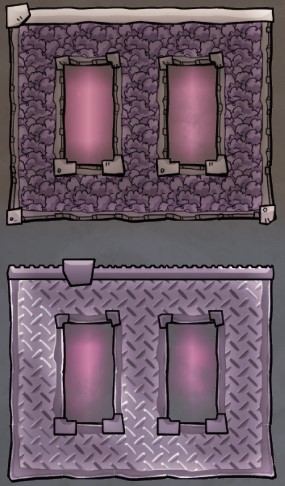
I used the measurements to determine how much the hydrogen in the left window decreased, and how much the hydrogen increased on the right. With this I was able to determine the properties of the materials and expectations on use.
For all materials the most important factor appears to be Thermal Conductivity, this determines how quickly materials heat, and transfers any heat. After that is the Specific Heat Capacity or how much thermal energy it takes to heat the object.
The metal tile tests were somewhat surprising. The objects with higher Specific Heat Capacity pulled heat more effectively from the left, but were poor at moving the heat to the right, while objects with higher Thermal Conductivity were more effective at heating the windows on the right but with higher temperatures also on the left. Thus if the goal is to remove heat, we probably want objects with higher Specific Heat Capacity, but we also want higher Thermal Conductivity so it can more efficiently transfer the heat. I am really torn on this one, but I will default to Thermal Conductivity being more important than Specific Heat Capacity.
*Further thoughts on the matter are that for situations where temperature will be more steady to default to higher Thermal Conductivity, in situations where temperatures can spike (such as geysers and volcanos) we want a higher Specific Heat Capacity to more effectively manage the heat. This again is going to depend on what we are using to manage the heat. If we are using an Aquatuner then Higher Specific Heat Capacity to reduce energy costs. If a Steam Turbine, higher Thermal Conductivity.
For insulating materials we want a high Specific Heat Capacity with a low Thermal Conductivity, this will allow the object to slowly heat and slowly transfer its heat.
For conducting materials we want a low Specific Heat Capacity with a high Thermal Conductivity, this allows the object to heat quickly and require less energy to heat. This also allows it to more effectively transfer its heat.
For Coolants (Liquids and Gases) We want high Specific Heat Capacity and Thermal Conductivity.
This allows the object to heat slowly and also quickly transfer any heat it obtains.
Specific Heat Capacity: #value(DTU/g)/ ºC is required to heat 1 g of the selected object by 1 ºC
Thermal Conductivity: This object can conduct heat to other materials at a rate of Thermal
Conductivity #value(DTU/(m*s))/ ºC W for each degree ºC difference
Between two objects, the rate of heat transfer will be determined by the object with the lowest Thermal Conductivity
Thanks!
- ONI - Surviving the Early Game★ 5 (2.4k)83k views6.3k ♥54 minUpdated Aug 6, 2019
- Useful Construction Patterns★ 5 (1.8k)74k views5.2k ♥66 minUpdated Aug 29, 2020
- 10* things I wish I knew sooner...★ 5 (754)58k views1k ♥4 minUpdated Oct 6, 2017
- ONI - Surviving the Mid-Game★ 5 (1.3k)44k views3.8k ♥150 minUpdated 6 Sep, 2019
- Not Quite Beginner's Guide★ 5 (361)32k views1.1k ♥91 minUpdated Mar 26, 2023
- Руководство для начинающих. (ОСНОВЫ)★ 5 (629)32k views1.2k ♥21 minRussianUpdated 20 Apr, 2019





- Upgrading to PremiumTeam Fortress 2★ 5 (20k)1441k views11k ♥6 minUpdated May 11, 2022
- No More Room in Hell Official ManualNo More Room in Hell★ 5 (2.8k)569k views2.1k ♥29 minUpdated Apr 22, 2019
- NMRiH Community Hosting GuidesNo More Room in Hell★ 5 (526)351k views653 ♥1 minUpdated Aug 10, 2022
- ULTIMATE GUIDE FOR GAME DEV TYCOONGame Dev Tycoon★ 5 (5.8k)326k views10k ♥4 minUpdated 23 Jan, 2014
- How to 'Git Gud' Soon™MORDHAU★ 5 (2k)318k views3k ♥68 minUpdated Nov 16, 2024
- Лучшие кооперативные игры SteamPAYDAY 2★ 5 (1.5k)315k views2.1k ♥56 minRussianUpdated Apr 27, 2025






This guide was created by its original author on the Steam Community. Are you the author and want it removed? Request removal.