How to not suck at Civ 5 multiplayer
Which Civ do I pick?
I would recommend Filthyrobot's tier list for Civ 5 multiplayer games. The full video is enlightening, but if you are curious about a specific Civ, you can look at a time stamp in the video description.I would recommend taking a look at this excel sheet for a list of all of the civs: https://drive.google.com/file/d/0BybM2PD7AqoKWWwzNjYyaHFvQ2M/view
What should be your priority when playing the game?
Normally on standard speed or higher, having a lead on science already means you have first pick of wonders, more bonuses to your tile yields, better buildings and more strategic resources unlocked compared to other players. However, on quick speed science becomes even stronger. If you try to attack someone with equivalent science to yours, by the time you have produced a military, organized it next to their border and attacked them, 20-25 turns may have gone by and those units will likely be out of date by the time they reach their cities. If they are ahead on science this problem gets even worse.
For whatever victory condition you want to achieve, higher science will always help. As a result, you need to prioritize the growth of your cities in order to achieve a high population which can be utilized for science production. When thinking about wonders, or wars, or buildings, or new expands, you need to be thinking about how those things will affect your empire's ability to produce science and maintain a tech lead. The next step being able to convert the tech advantage into win conditions using your production/gold.
When I look at the demographics screen the most important two demographics in the early/mid-game is population and crop yield. If someone is ahead on both of those, they will be ahead on literacy soon enough and after that they will likely be ahead on most of the other demographics.
TL;DR Focus on growing cities big for high science.
The early game:
After settling your capital, immediately build a scout and scout the land around your capital looking for ancient ruins, other players, city-states, places to settle, and barbarians. Once you have built your first scout, you usually have to decide which strategy you wish to pursue. If you are unsure, build another scout and continue to explore, however, often by turn 7 you need to decide what your first social policy will be.
In the early game there are only two real options for your social policy tree: Tradition or Liberty. The choice of social policy tree also is a choice of which play style do you want to play: Tall or Wide?
The default choice is Tradition, a tall empire with 4-5 high population cities. I would say this is the correct choice for about 85% of games with Liberty being the correct choice in the rest of the matches. Liberty games revolve around having 6-8 smaller cities in a wide play-style where you try to capitalize on your early game production advantage as well as your faith production advantage to carry you to victory.
Choosing which to pick to pick is a complicated decision, but without this guide becoming too long:
Tradition if you have limited lands and luxuries, or your capital is on the coast with good coastal expands, or you are stuck in a large jungle.
Liberty if you see many possible city expands (without being the target of attacks from your neighbours), with enough unique luxuries as cities (~1 lux per city). I would recommend looking at this[forums.civfanatics.com] guide for liberty early game.
Tradition (Turn 0 -100)
You've decided this looks to be a tradition game. Once you've created your second scout and researched pottery you need to grab a shrine and a worker. If you see a good start for a particular pantheon (such as lots of gold or silver tiles for Religious Idols) go for shrine first, if you don't see a lot of tiles you can improve with a worker yet go for shrine first. Otherwise get a worker first. You need to continue working on another warrior, spearman or worker until your city has grown to size 4.
Once you've built a monument and shrine, and your city is at least size 4 you can go ahead and manually pick all the high production tiles and build 3-4 settlers (your city cannot starve while building settlers). The only interruption for settlers is to either build more spearmen/warriors/workers. By turn 40 at most, you should have 4 cities planted, 1-3 workers (depending on how many you built and stole from city-states), 2 scouts, and 1-2 warriors. The build order for your cities should generally follow:
CAPITAL
Scout
Scout
Worker
Shrine
Settler
Settler
Warrior
Settler
Granary/Watermill
Library
EXPANDS
Granary
Shrine
Worker (if under 5 workers total)
Library
Now obviously the value of each of the buildings and units depends on the terrain, but the general idea is to avoid wonders and focus on planting 4 solid cities by turn 40. When settling your cities, try to keep in mind the following: fresh water, settling on hills, try being 4-7 tiles away from the capital, coastal if your capital is coastal, and being able to connect your expand via roads.
After planting our 4 cities, we need to focus on growing our cities, tributing city-states, improving our tiles, and setting up for turn 55-65 National College (NC) and turn 85-90 universities. Unfortunately, delaying any of these important science milestones and having under 100 science by turn 95 can cause you to lose the game because you will be irrelevant as other players scoop up wonders by being 5-7 turns ahead of you on science at all times. If you are confident that you can get a wonder before anyone else, and it will not delay any of these timings, then you should build it.
Liberty (Turn 0-100)
You've decided this looks to be a Liberty game. Once you've created your first scout you can build a second scout (or skip it) then build a monument, and once you've researched pottery you need to grab a shrine and a worker. If you see a good start for a particular pantheon (such as lots of wine tiles) go for shrine first, if you don't see a lot of tiles you can improve with a worker yet go for shrine first. Otherwise get a worker first. You need to continue working on another warrior, spearman or caravan until your city has grown to size 4 or 5.
Once you've built a monument and shrine as well, and your city is at least size 4 you can go ahead and manually pick all the high production tiles and build settlers (your city cannot starve while building settlers). As Liberty, focus on settling the furthest or most contested city locations first, as you will be settling 5-7 turns later than an equivalent tradition start would be. The only interruption for settlers is to either build more spearmen/warriors/workers.
When placing your Liberty cities it's alright to place them more closely together than you typically would with tradition 3-4 tiles apart for cities is fine. Try to always settle your cities on hills or on top of unique luxuries, because you will automatically get the happiness from the luxury (as long as you have the technology for the improvement). Even though your cities will be smaller with liberty, you still should be looking for tiles with high food yields, and river systems both provide food and a way to defend your cities.
In your expands you generally want to build
- Granary
- Library
- Aqueduct
- Workshop
- University
You may also want to mix in Watermill, Stone works, and a Stable depending on the terrain. You can deviate from the build order as long as it does not delay your NC and science buildings. Remember that Watermill is prioritized over granary unless there is a workable granary resource in the city.
Now obviously the value of each of the buildings and units depends on the terrain, but the general idea is to focus on planting 6-8 cities by turn 50. NC should be up around turn 80-90 for a Liberty start. Remember that as Liberty you will be behind in science somewhat, and that as a wide player you are aiming for very long term growth.
Religion and why Shrines are important
Why do I tell you to build a shrine as your first or second building and not a Granary? First of all, a granary isn't doing anything for you if you are just building settlers as you will be from around turn 15-30. However, the real reason is because getting a good pantheon and then first or second religion is a BIG deal. It is even more important if you are Liberty, because having strong faith buildings and bonuses across your large empire can help a lot with growth.
In fact, getting a shrine or two is not enough to guarantee you first or second religion. When selecting a pantheon always select one that gives a good amount of faith. Your options are pretty much Religious Idols, Desert Folklore, Earth Mother, One with Nature, Tears of the Gods, Goddess of Festivals, God King and sometimes Stone Circles. On the subject of pantheons, Fertility Rites is a trap for noobs, the 10% is actually applied to excess food, and as a result only really results in 0.5 food in the early game. Situationally, pantheons giving food or culture yields can be strong, but only if you have some other means to guarantee large faith generation (4-6 is good).
Why is getting first or second religion strong? The reason lies in the large differences in how strong each of the Founder and Follower beliefs are. Pagodas and Tithe are the two strongest beliefs (by far) and they are good for both wide and for tall empires, getting Religious Community can be situationally very strong for Tall empires, Monasteries combined with Goddess of Festivals can give amazing culture, Divine Inspiration is strong if you have some wonders, and Religious Center creates a whole new happiness building for all of your cities. After the top tier of beliefs, there is steep decline in how strong the beliefs are, making first pick of the beliefs a strong advantage.
Technology
Once you've exhausted the situational technologies above, go for Education in order to get universities. On quick-speed the meta is to go for each successive science building, in order to build a tech-lead while situationally picking up techs along the way such as Physics for Notre Dame, or Navigation for Frigates.
The main strategy is to go from Education -> Scientific Theory-> Industrialization or Radio (for first Ideology)-> Plastics. Once you've built your research labs you are free to pick up techs for your chosen victory condition such as satellites for Science Victory, Internet for Tourism, Globalization for Diplomacy, or the Stealth tech for Domination.
In essence, all victory conditions are sort of science victories because as mentioned earlier, science is incredibly powerful on quick speed.
Land Wars
- Blocker units
- Ranged units
- Siege units
- Mobile units
Blocker units are melee units that can fortify themselves and recieve terrain modifiers. Some examples are Warriors, Spearmen, Pikemen, Musketmen, Mobile SAM's, and Infantry. Blocker units are named as such because their primary purpose is to be placed in positions where they gain large amounts of defensive modifiers. For example a Riflemen unit has a base combat strength of 34, with Drill II it has +30% Combat Strength when fighting in ROUGH terrain. If the Riflemen is on rough terrain when defending it recieves another +25% combat bonus. If the Riflemen unit is fortified it recieves another +40% defensive bonus. With no other benefits such as Himeji Castle, when defending the Riflemen has a combat strength of 66.3, that is almost double the strength!
Blocker units are named as such because of a mechanic in Civ 5 combat called the zone of control. This is the surrounding 6 hexes of a unit, which, when trying to move from one of those hexes to another one of those hexes as an enemy unit, you will lose all of your movement points. Effectively, having some blocker units out front will stop the enemy mobile units from getting to your back line.
Ranged units are your back line. In the early/mid game this consists of chariot archers, archers, composite bowmen, and crossbows. The point of these units is to project strength from multiple tiles onto one tile. From many different hexes you could attack the same unit. The reason these are in the back is because ranged units have a small melee combat strength and as a result are prone to getting killed by mobile units if left undefended. The ratio of ranged units to blocker units is often 2 or 3 to 1.
Siege units are what were intended to damage cities. These units are catapults, trebuchets, cannons, artillery etc. These units have bonus strength against cities, but also require a turn to set up and have low melee combat strength. As a result, many skilled players will avoid catapults and even trebuchets in the early game, simply because chariot archers (for catapults) and crossbows (for trebuchets) are more efficient at dealing damage to units, are more mobile and deal a decent amount to cities. Siege units really come into their own with the addition of artilley. Artillery shoots at 3 range, and have indirect fire meaning they can shoot over terrain as long as they have sight of the target. Artillery pushes are strong with the addition of cavalry, which will get us into mobile units.
Mobile units are units that you use to attack the back lines, or to rush in to capture cities (and then move out of them). Some examples are horsemen, cavalry, knights, tanks, and landships. These units are different from blocker units not only because they have so many more movement points, but also because they do not recieve defensive terrain modifiers. As a result, you shouldn't have these units in places where they get attacked or in fortified positions.
Some tips in general:
Do not use ranged units, siege units or mobile units in your citadels or on your hills as fortified units, they do not recieve defensive bonuses so there is no benefit for them to be there. You should be placing your blocker units in those places instead.
If you are attacking, take workers with you to build a road to the enemy city as it will help you reinforce your units.
In multiplayer, because the game is in simultaneous you can get an advantage from being the first to launch your attacks in a given turn. You can achieve this by issuing attacks commands in between the turns rolling over. If you click attack with your units as the turn is loading, as soon as the turn loads 3-4 of your commands will go off before your opponent can react.
Another tip is to make sure that you know or have set your hotkeys for setting up an attack with artillery( default is S), ranged unit attack (default is B or you can just right click a target).
Note: Make sure that you turn of auto-unit cycle in your options.
When taking cities, do the final attack with your mobile unit because after attacking they can still move out of the city. This is because if the enemy captures the city, your unit inside the city will be killed.
Tips and Trix
I have been in a lot of multiplayer games, and these are some basic things that I see players missing (in order of importance).
Tributing City-States:
Think about the enormous advantage someone having another 400-600 gold over you in the first 50 turns of the game would be. That's how large the difference between not tributing city-states and someone tributing city-states is.
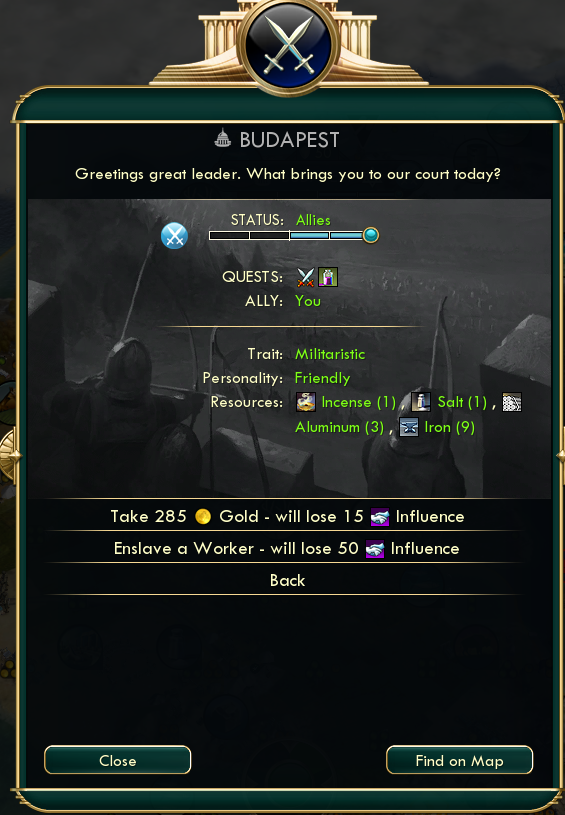
I would take a look at this guide[forums.civfanatics.com] for the exact numbers behind city-state tributing. In general, place two warriors or 1 spearmen unit within 5 tiles of a city-state and demand tribute. You can redo this every 11 turns, but usually every ~20 turns in order to overcome the negative attitude of the city-state.
Manually selecting specialists: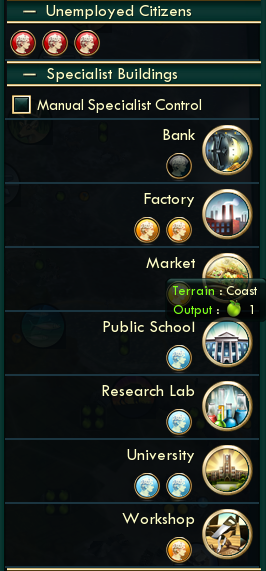
Specialists are hidden worker tiles that exist inside the buildings in your city. They appear on the right side of the city menu. Buildings such as workshops, writer's guilds and universities have specialist slots. Since great people are very important, producing them by manually selecting the specialist slots in your cities can often net you an extra 3 great scientists and engineers over the course of a game.
There is a group of great people (GP) in which producing any one of them increases the required great person points (GPP) to produce any one of the GP in the group. Great Merchants, scientists and engineers are one group. Great musicians, artists and writers are each seperate, and building each individual doesn't penalize any of the others. I would strongly recommend manually selecting the specialists in all of your cities, as the AI doesn't prioritize the slots correctly. The order of priority is Scientist slots, then engineer slots, then merchant slots. Guild slots I would place somewhere in between engineer slots and merchant slots because working the relevant guild for the artist/writer/musician is often a large boost to ones culture, and artist slots are very useful for the golden age that artists can create.
Internal trade routes:
I often see inexperience players forgetting to utilize internal trade routes. Internal food cargo ships make coastal tradition very powerful, internal food routes to your capital in general are always a good idea, and internal routes to cities with not many high food tiles are a good idea as well. Internal production routes are usually only good in the late game, as growth is not as important as production in the Atomic/Information Era.
Chopping trees:
in the first 25 turns your capital has 5-10 production. Chopping a forest down within your borders gives you 13 production (on quick speed) and outside your borders gives you 7 production. Since you should always be replacing freshwater tiles with farms, and turning hills into mines there is a huge early benefit from chopping trees.
On the topic of chopping things down, chopping down all your jungles can actually be harmful because universities give +2 science from jungles. You get good yields out of bananas (don't make them plantations) and trading posts on top of jungles.
Manually selecting tiles to work/being on production focus:
This is a very micro-intensive trick that over the course of the game will cause you to net an additional ~200 production over someone who doesn't use it. The game calculates food first, then checks if an additional population is born and then assigns that pop based on what focus your city is set to. The game then checks for the amount of production that your city produces. As a result, it is advantageous to have your city set to production focus, because when your city grows your unit will work a hill or a mine, which causes you to get an additional +2 or +3 production. You can then reassign your newly grown population manually to any tile you wish such as a food tile, and the food will be calculated when the next turn rolls over. Essentially you are taking advantage of the way the game calculates tile yields by always being on production focus and then manually selecting the worked tiles.
Since this is very click intensive, especially over larger empires, it can be a good idea to stop doing this trick after the early game, and just let all your tiles be selected by the AI.
Instantly buying the new science building
This tactic is pretty simple. If you know that in 20 or so turns you will be getting universities, and have a tall empire it is definitely worth it to avoid the ~8 turns it takes to build universties in all your cities and instead save your gold ahead of time in order to buy your universities the same turn that you research Education. This trick can net you 400-500 science in most games. You can do the same trick for public schools and research labs, although it is more expensive.
Peace-blocking with city-states:
If you are allied with a city-state and declare war on someone else, they are peace-blocked. Not only can they not declare peace with that city-state, they cannot give gold gifts or trade with that city-state (aka no way for them to become the ally). This is an effective strategy in the mid/late game. If you have the gold, it is often a good strategy to buy an ally near the person you are attacking, and in the same turn declare war on them. There are many possibilities, but it's just good to be aware of this mechanic.
On the note of city-state tips, in order to deny the tribute gold from city-states to other players, it is a good tactic to pledge to protect far away city-states as it causes the resilience for that city-state to increase.
Making use of all of the information available to you
Be familiar with all of the additional information menus.
Victory progress can be used to find out what civilizations are in the game.
The Military Advisor (under Advisor Council) can tell you how your army sizes up against a specific civilization.
Demographics can be used to figure out who is ahead, and specifically in what areas.
Diplomacy overview -> global politics tells you what each player that you have met has selected for their social policies as well as what wonders they have built.
In the trade menu, if you select to trade another player's cities, you can see how many and what size their cities are, despite you not having discovered those cities on the map (except the capital).
If you look at the tech-tree, the base tech costs are the same for each column of techs (for example Theology, Civil Service, Guilds and Metal Casting). However, if someone that you have met has already researched one of those technologies, that specific technology becomes cheaper in it's tech cost for you. If you hover over each of those techs, you can find out what techs people have researched already, by seeing which ones have a reduced tech-cost.
Some Pitfalls
Ideally, you should have 1.5 or more workers (if you have a lot of jungle) per city. This is because you have lots of tiles to improve, roads to build etc. You hamper your cities a lot by not working improved tiles, if you think about it, each improved tile is as much as +2 food or production that's almost as much as a watermill.
Rushing wonders early will (more often that not) lose you the game if it delays your early cities and National College, the reason that wonders convey such powerful benefits is because they have a huge opportunity cost. Grabbing Hanging gardens or Petra while waiting for your expands to build libraries is good, but building Stone Henge and then Temple of Artemis and finally building settlers at turn 40 can be game-losingly bad.
When dealing with barbarians, far too often I see players lose their settlers or workers to barbarians and and have all of their tiles pillaged by multiple warriors. A bad start can often mean a lost game, so making sure that you have enough warriors/scouts/spearmen to escort your workers and settlers is extremely important. Your starting warrior should ideally be back at your capital at around turn 25 in order to defend you and escort units. Ideally, you should also not be seeking out and destroying barbarians (except for city-state quests) in the early game, because having a free warrior or scout is more valuable than 18 gold from a barbarian camp.
Building on the coast and not paying attention to frigate rushes. Frigates are incredibly strong and can decimate coastal cities if the defender is unprepared (i.e doesn't have their own frigates). Land defenses and ranged units will not be enough to defend from frigates, the only counter to frigates in the renaissance era is other frigates. Having a coastal empire is very strong, but it is also risky as frigate rushes can end your game within 5-7 turns.
- Real Populations★ 5 (1.2k)79k views1.2k ♥2 minBulgarianUpdated Aug 31, 2017
- Civ-specific tricks, secrets and clarifications (BNW)★ 5 (1k)53k views2.2k ♥96 minUpdated Jun 30, 2019
- Zigzagzigal's Civ Summaries (BNW)★ 5 (1.5k)49k views3.9k ♥134 minUpdated Jun 30, 2019
- Who to Trust and Who to Avoid in Civ V★ 5 (570)41k views802 ♥12 minUpdated Jul 8, 2016
- How to win the Korea Scenario as Korea on Deity in 16 turns★ 5 (532)41k views828 ♥15 minUpdated Apr 1, 2016
- Civilization V Achievement guide★ 5 (2.4k)39k views4.2k ♥134 minUpdated Jun 13, 2014




- Upgrading to PremiumTeam Fortress 2★ 5 (20k)1441k views11k ♥6 minUpdated May 11, 2022
- No More Room in Hell Official ManualNo More Room in Hell★ 5 (2.8k)569k views2.1k ♥29 minUpdated Apr 22, 2019
- NMRiH Community Hosting GuidesNo More Room in Hell★ 5 (526)351k views653 ♥1 minUpdated Aug 10, 2022
- ULTIMATE GUIDE FOR GAME DEV TYCOONGame Dev Tycoon★ 5 (5.8k)326k views10k ♥4 minUpdated 23 Jan, 2014
- How to 'Git Gud' Soon™MORDHAU★ 5 (2k)318k views3k ♥68 minUpdated Nov 16, 2024
- Лучшие кооперативные игры SteamPAYDAY 2★ 5 (1.5k)315k views2.1k ♥56 minRussianUpdated Apr 27, 2025






This guide was created by its original author on the Steam Community. Are you the author and want it removed? Request removal.