Rocket Guide
Construction
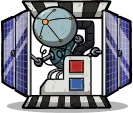 Each rocket must have an engine at its base, a Command Capsule at the top, and a Gantry providing access to the command capsule. Rockets may optionally include other modules, such as Cargo Bays for carrying materials back from expeditions or Research Modules for Data Banks.
Players can safely deconstruct and replace modules in a rocket, but modules can only be built if connected vertically (possibly via other modules) to an engine.
While there is no limit to the number of modules in a rocket, the range of a rocket is dependent on its mass, so unnecessary modules are ill-advised.
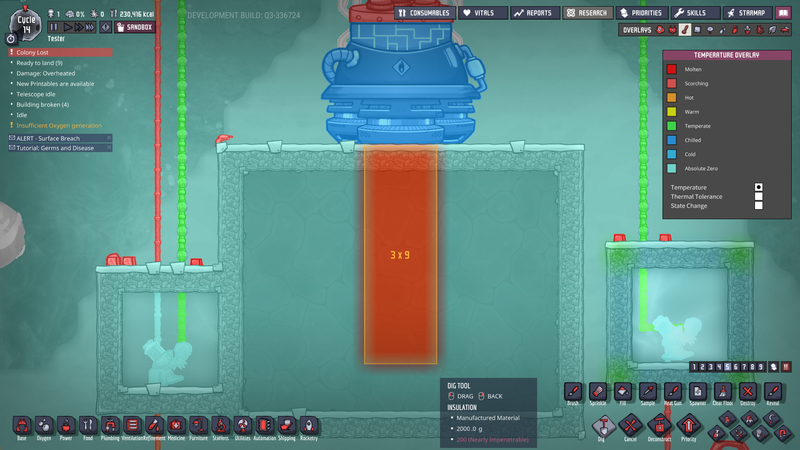
As rockets typically produce a large amount of heat during take-off, building the rocket inside an insulated tower can help to prevent heat from leaching into other parts of the base. Building the rocket in space alleviates this problem, but meteors need to be considered.
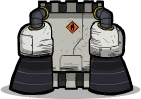 There are currently 3 engines in the game: Steam Engine, Petroleum Engine, and Hydrogen Engine. Solid Fuel Thrusters can be used in conjunction with engines to provide extra range. Note that solid fuel thrusters require their own gantry to provide access for supply errands.
Steam Engines are the entry-level rocket engine that must be used to unlock the others. Without Solid Fuel Thrusters they are limited to a 10,000 km range, allowing access to only the closest destinations on the starmap. However, they only require Steam, do not require separate fuel storage tanks, and have significantly cooler rocket exhausts.
Petroleum Engines are used in intermediate-level space exploration. In addition to the engine itself, they require Liquid Fuel Tanks and Solid or Liquid Oxidizer Tanks to function. Although technically capable of reaching any destination on the starmap, they can only reach 110,000 km destinations with cargo bays and no solid fuel. Petroleum engines using exclusively solid oxidizers (Oxylite) are further limited to a 60000 km range with cargo. Nevertheless, the fuel required is relatively easy to obtain, allowing players to collect rare space materials in preparation for the Hydrogen Engine.
Hydrogen Engines are the most advanced type of rocket engine, working similarly to Petroleum Engines but offering better distance. They run off Liquid Hydrogen, which requires temperatures below -250 °C to create, possible through the use of Super Coolant and Thermo Aquatuners.
 Cargo Bays are used to retrieve resources from destinations. There is no limit to the number of Solid, Liquid, Gas, or Biological cargo bay on a rocket, but bear in mind these add considerable weight to a rocket, reducing the distance it can travel. All cargo modules have the same weight of 2 t and the same capacity of 1 t, with the exception of Biological Cargo Bay which has a capacity of 10 items.
The resources returned from a destination depends on the save file, but is the same every time for each type of container and each specific planet on a given save. Different destination types offer different typical resource distributions (listed below).
Cargo Bays are used to retrieve resources from destinations. There is no limit to the number of Solid, Liquid, Gas, or Biological cargo bay on a rocket, but bear in mind these add considerable weight to a rocket, reducing the distance it can travel. All cargo modules have the same weight of 2 t and the same capacity of 1 t, with the exception of Biological Cargo Bay which has a capacity of 10 items.
The resources returned from a destination depends on the save file, but is the same every time for each type of container and each specific planet on a given save. Different destination types offer different typical resource distributions (listed below).- Solid Cargo Bays bring back one ton of solid material from a planet.
- Liquid Cargo Bays bring back one ton of liquid material.
- Gas Cargo Bays bring back one ton of gaseous material.
- Biological Cargo Bays bring back a small number of seeds or critters, if the destination has them.
- Utility Modules
- Research Modules will unlock information about a destination, providing 50 data units in the process that can be used with a Virtual Planetarium. Future missions to a fully analysed destination will only yield 10.
- Sight-Seeing Modules will allow passengers to come along for the trip, reducing stress.
 Every rocket ends with a Command Capsule at the top, which is where the astronaut enters and a space suit is to be provided. This is also the only part of the rocket that requires a Gantry.
Rocket Launch
- The rocket must have a fuel tank (note that Steam Engines have their fuel tanks built-in)
- A destination within the rocket's range must be selected in the Starmap
- A duplicant with the Rocket Piloting skill must be assigned and manning the Command Capsule
- The Command Capsule must have an Atmo Suit
- All Cargo Bays must be empty
- The destination must have sufficient resources for the Cargo Bays installed in the rocket
 When all conditions are met, the Command Capsule will output a Green Automation signal. Sending a Green automation signal to the Command Capsule's automation input will start the launch.
In addition to the conditions above, the rocket will not take off if there are solid blocks or buildings obstructing its flight path, such as closed bunker doors, tiles or blocks. Some objects, such as extended Gantries, will not block the rocket, but be heavily damaged or destroyed. Other objects, such as background objects (wires, pipes, etc.) and Ladders are not directly damaged by rockets, but may liquefy on contact with the rocket's exhaust gases.
During takeoff, rocket engines (and solid fuel thrusters) expel large quantities of superheated Gas around the Engine. Steam Engines and Hydrogen Engines release Steam, while Petroleum Engines and Solid Fuel Thrusters release Carbon Dioxide. Additionaly the Area below the Engine is heated up in a 3x9 Rectangle. The Heat is directly added to the current Heat of whatever Tile/Gas/Liquid is inside of the 3x9 Rectangle.
Rockets do not require full fuel tanks to launch, but all fuel and oxidizers will be consumed during launch. For this reason, it is optimal to match the fuel and oxidizer loaded into the rocket to the distance you wish to achieve. A tool like the Rocket Calculator[oni-assistant.com] can be useful here.
Rocket Return
 After an expedition, rockets will return to their initial construction location in their entirety, carrying cargo and Data Banks according to the modules included in the rocket.
 Space Scanners can be set to detect a returning rocket, which can be used to open Bunker Doors in preparation for landing.
Similarly to take-off, rockets produce a large amount of heat during landing, and can damage certain buildings in the way (most notably extended Gantries and closed bunker doors).
Rocket Tips
- Engines must be built on solid ground, but the ground can be removed afterwards with no consequence; they will take off as normal and "land" in the air when returning.
- It is possible to build multiple rockets on top of each other in a single vertical shaft. Launching lower rockets will not damage the ones above.
- All engines and thrusters have a width of 7, while all other modules have a width of 5. However, building tiles on the sides will prevent the rocket from launching.
- Decreasing the maximum storage capacity of Steam Engine or fuel tanks will cause duplicants to remove the extra. Items will be dropped on the ground (liquid fuel in canisters).
- Both Steam Engine and Liquid Fuel Tank can fit 900 kg of fuel, however due to a single input pipe, the latter can be filled with a single liquid pump in 90 seconds, while the former requires two gas pumps and 900 seconds. When using Liquid Oxygen for Liquid Oxidizer Tank (2.7 t capacity) and 3 Liquid Fuel Tanks (900 kg capacity each), rocket can be refueled in 270 seconds.
- The Heat added below an Engine is quite useful in reaching higher Temperatures. With the proper insulation the area can reach melting Temperatures for most Materials and therefore be used for generating Power with Steam Turbines, loslessly refining Crude Oil, or even melting Regolith.
Rocket Setups
- Using Steam Engine
- -- with not extra thrust
- ------- 9 small modules to first line of asteroids
- -- with Solid Fuel Thruster
- ------- 12 small modules to first line
- ------- 6 small modules to second line
- -- with 2 Solid Fuel Thrusters
- ------- 2 small modules to third line
- Using Petroleum Engine (which requires Liquid Fuel Tank and Solid Oxidizer Tank filled to 1/3 maximum - to match the amount of fuel)
- -- with no extra thrust and fuel tanks
- ------- 23 small modules to first line
- ------- 18 small modules to second line
- ------- 10 small modules to third line
- -- with 1 extra Liquid Fuel Tank you can bring large container module to as far as 50000 km
- -- with 2 extra Liquid Fuel Tanks you can bring large container module to 60000 km
Notes
 Thanks to Oxygen Not Included Wiki and friends for providing information for this guide.
Also thanks to Oni Assistant
Oni Assistant is a collection of tools and information to help inform how you play Oxygen Not Included.

 ------------- Video Game History Curator ------------------------------ Video Game History Steam Group -------
- ONI - Surviving the Early Game★ 5 (2.4k)83k views6.3k ♥54 minUpdated Aug 6, 2019
- Useful Construction Patterns★ 5 (1.8k)74k views5.2k ♥66 minUpdated Aug 29, 2020
- Compendium of Amazing Designs★ 5 (2.9k)66k views6.5k ♥77 minUpdated May 29, 2025
- 10* things I wish I knew sooner...★ 5 (754)58k views1k ♥4 minUpdated Oct 6, 2017
- ONI - Surviving the Mid-Game★ 5 (1.3k)44k views3.8k ♥150 minUpdated 6 Sep, 2019
- Not Quite Beginner's Guide★ 5 (361)32k views1.1k ♥91 minUpdated Mar 26, 2023



- Upgrading to PremiumTeam Fortress 2★ 5 (20k)1441k views11k ♥6 minUpdated May 11, 2022
- No More Room in Hell Official ManualNo More Room in Hell★ 5 (2.8k)569k views2.1k ♥29 minUpdated Apr 22, 2019
- NMRiH Community Hosting GuidesNo More Room in Hell★ 5 (526)351k views653 ♥1 minUpdated Aug 10, 2022
- ULTIMATE GUIDE FOR GAME DEV TYCOONGame Dev Tycoon★ 5 (5.8k)326k views10k ♥4 minUpdated 23 Jan, 2014
- How to 'Git Gud' Soon™MORDHAU★ 5 (2k)318k views3k ♥68 minUpdated Nov 16, 2024
- Лучшие кооперативные игры SteamPAYDAY 2★ 5 (1.5k)315k views2.1k ♥56 minRussianUpdated Apr 27, 2025






This guide was created by its original author on the Steam Community. Are you the author and want it removed? Request removal.