Winning At Squad
INTRODUCTION
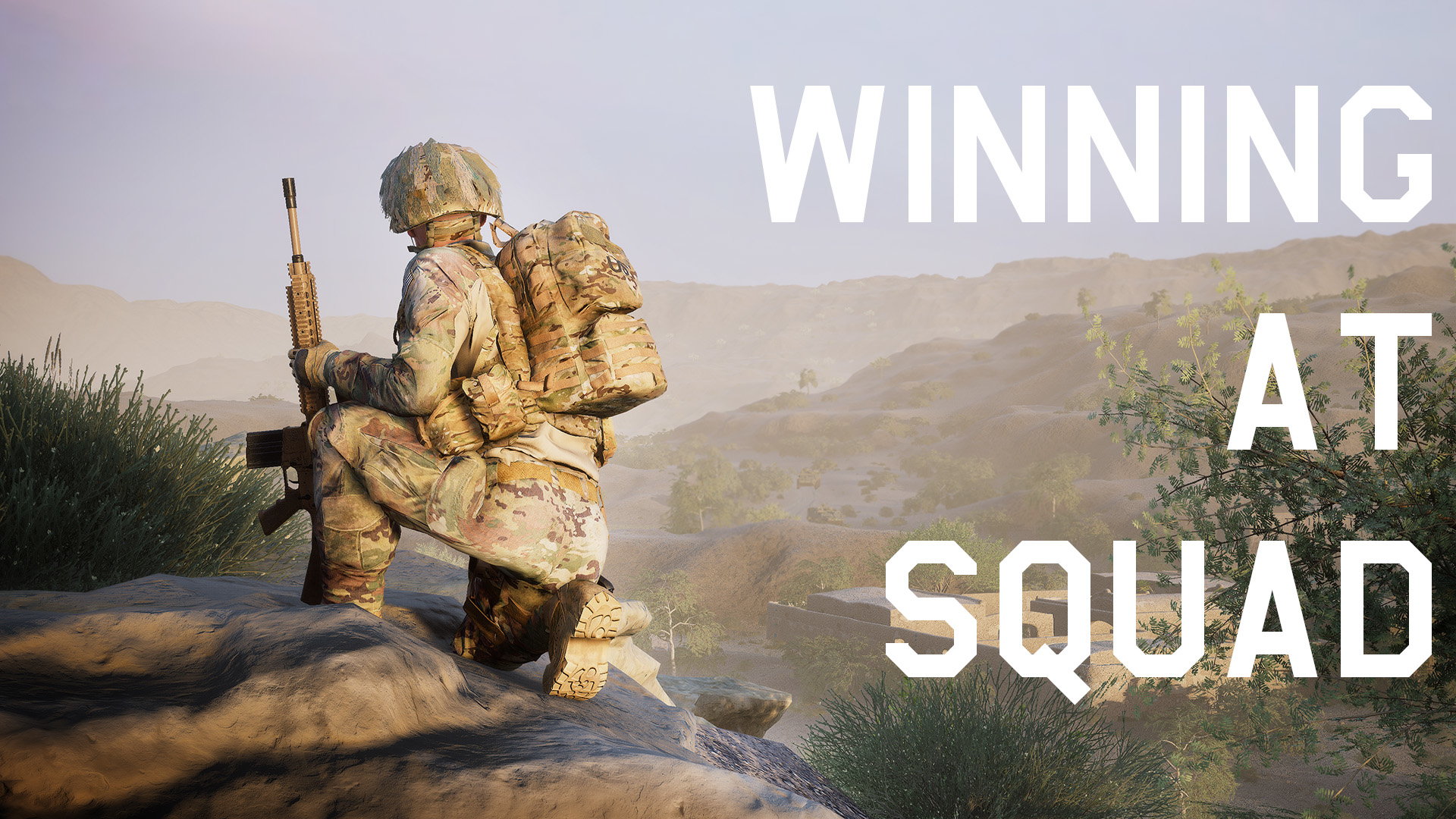
Squad is a demanding game - and games this demanding require guides to bring players up to speed on exactly what they should be doing to win. Seven years after the creation of my top-rated guide, Squad Leader 101, I'm back to help players win more games by sharing my experience, acquired over many hours played since pre-release.
This guide will be beneficial to players of all skill levels. One of the first things to remember about games like Squad, is that you can always improve. The game itself has an extremely high skill ceiling, especially when you start playing roles like squad leader and commander. Even players with thousands of hours in the game often realize over and over again just how deep the game is and how much the playerbase has yet to improve to meet the quality of the game's design.
Prepare to learn how to win more matches of Squad. Before we delve into the topic of winning games, it's important for players of all skill levels to note that Squad benefits from being played with a mind to win. The game itself is more fun when players are trying to win the match, instead of just playing for kills or a more irrelevant goal. Before we get into the topic of winning more at Squad, make up your mind that you'll be a player that plays to win from now on. I promise you that your experience of Squad will only be more fun and engaging once you make up your mind to do so.
I.C.E.T.A.L.E.

Intelligence, Communication, Engagement, Tactics, Adaptation, Logistics, and Execution. That's I.C.E.T.A.L.E.. Whether you're playing as a rifleman, or as the platoon commander, remembering I.C.E.T.A.L.E. is a great way to remember what's important about winning at Squad. Taking the time to memorize and apply I.C.E.T.A.L.E. will win you more games. This acronym includes all the most crucial aspects of achieving victory in Squad in one easy to remember word. The more responsibility you shoulder in a game of Squad, such as stepping up to squad lead or volunteering for command, the more important it is to know I.C.E.T.A.L.E.. Neglecting one or more aspects of I.C.E.T.A.L.E. can lead to devastating results for teams in Squad. If you've ever played a match that felt completely pointless and disappointing, chances are that I.C.E.T.A.L.E. was either partially or completely ignored by members of that team. The rest of this guide will break down I.C.E.T.A.L.E. in an easy to read and digestible fashion so that Squad players that earnestly want to win games will have an incredible tool for doing so.
I. (INTELLIGENCE)

Intelligence is one of the top three factors of I.C.E.T.A.L.E. when it comes to winning games - the other two being Communication and Logistics. Knowing what your team is doing, and what the enemy team is doing (as much as you can), is intelligence in a nutshell. You have two important tools when it comes intelligence - the map, and the comms channels. It's hard to overstate the importance of using the map in Squad - and using it well. Great Squad players routinely check the map, but the best ones are making sure that map markers are being used to their maximum potential. Ignore a well-marked map at your own peril. One of the best things that both squad leaders and fireteam leaders can do is to keep the map as as accurately marked as possible, and to clean up irrelevant markers as soon as they are no longer needed. If your team learns to trust a well-marked map, your chances of winning the match go up by a significant amount. Using the comms channels to relay intelligence is key to winning games, and it's important that players don't forget that Squad was designed to be a team game, and reward teamwork first and foremost.
One of the best things you can do for your team is have a mic, and use it effectively - the equally important thing to do is to listen to players that are communicating effectively on the comms channels. Keep comms brief, clear, and absolutely relevant to the situation that's unfolding. Clogging up comms is a mistake, but perhaps the worst thing players in the squad leader or commander roles can do is not use comms at all. Intelligence is relayed through the map and comms channels, and effectively utilizing both these tools is incredibly important to winning more games. One good callout can literally save a FOB from going down - so imagine how well a team that's communicating effectively is going to perform against a team that's not. If you've ever played a match where the enemy was shutting down everything your team was doing before it gained any momentum, that happened because the enemy team was demonstrating a mastery of the I. in I.C.E.T.A.L.E.. Forgetting that the enemy does use comms and the map to outplay you is a common reason why new players make critical mistakes like not displacing after using a firing position for too long. Getting shot up after shooting likely happened because your position was relayed to the enemy soldier to their team so you could be dealt with. Knowing what the enemy is doing, and properly relaying that information through the comms channels and the map, is huge when it comes to winning matches. Some of the most important things to find out about the enemy are - their position, their number, what direction they are moving in, and what kind of equipment they have (including armor and airborne vehicles). "Know thyself, know thy enemy. A thousand battles, a thousand victories." - Sun Tzu (The Art of War).
Apart from knowing what the enemy is doing, it's vital to coordinate and communicate what your team is doing from the commander level down. Commanders in particular have little time for anything but receiving intelligence, relaying intelligence, and giving battle orders. This should be a commander's primary focus, but the job of marking the map really falls to squad leaders and fireteam leaders. Clean up irrelevant markers, and keep markers as accurate as possible - use all the markers, and don't mismark things like infantry types and vehicles. A well-marked map is a huge benefit to your entire team. Remember that even if some players aren't listening to comms, few will ignore a well-marked map. Make sure the enemy is marked as well as possible, and that the markers are up-to-date and relevant to the battle. If you want something dealt with as quickly as possible, mark it on the map. It's one thing to use comms to convey that there are enemies on a HAB, and another to put an enemy helmet marker next to the FOB on the map. Quickly marking vital information will often get it dealt with by experienced players, in the way that it needs to be dealt with. It's especially important to always mark armor accurately after identifying it properly. Failing to do so can cost your team the game. Make sure your LATs, HATs, and vehicles are working with the best intel possible, and you should find it easier to win the armor war.
The most important thing to remember about intelligence is the consequences of poor or no intel - frequently finding yourself in losing engagements, losing FOBs often, losing Flags often, and having your vital assets like tanks and helicopters taken out before they become relevant to the fight at hand. Good intel wins games. Poor intel loses them. Make sure intelligence is relayed properly through the chain of command by telling squad leaders to inform their entire squads about the intel you just conveyed. Making sure squad leaders are properly relaying intel being given by the commander to soldiers in their squads is very important, and it should be one of your primary concerns as squad leader to keep your squad up to date about intel that's being relayed in command chat. There is nothing less true than the statement, "What you don't know can't hurt you," when it comes to a game like Squad. It's often what you don't know about that hurts you the worst in Squad. It's the reason your entire attack collapses - an enemy IFV that was not scouted with binoculars and marked on the map before the attack began. It's the reason your entire defense fails - an enemy force of flanking infantry that the commander didn't inform squad leaders about while using the UAV. Mark the map first, then relay the intel using comms channels so that squad leaders already have map markers to refer to when you start talking about what's going on. One of a squad leader's primary tasks is to simply keep the map marked and relay intel effectively to their squad, to other squad leaders, and to the commander. This is great practice as an SL and leads to more matches won. The main takeaway is this - poor intel, poor team performance. Every time.
C. (Communication)

Communication is another factor of I.C.E.T.A.L.E. that lands in the top three spot. Besides using comms to relay intel, they can be used to knit the team together and get it functioning as one unit. Orders are almost always relayed through comms unless you are using order markers or hand gestures. If you absolutely have to play without a mic, please use order markers effectively in lieu of giving orders verbally, and type important objectives in squad text chat. The truth of the matter is, squads are often used to squad leaders not placing their order markers with thought and consideration, and often ignore them. They are best used in conjunction with verbal orders, like: "We're attacking Dagger mark," or "I want my squad regrouping at Shield mark." It may take constant, spaced repetition to get players following your direction in Squad. Giving orders properly will be covered in the Execution section of I.C.E.T.A.L.E., but remember this: If you want it done, say it in comms, and hold people accountable.
There are often instances where extremely valuable information should be sent in written form using Team written chat. If something absolutely has to be done and you don't trust your current chain of command as commander, typing something like "Enemy on D5 FOB, please clear it - Commander" or "50 tickets, medics do some work, nobody give up - Commander" is an excellent way to make sure everyone on the team sees your order and does something about it. Putting mortar bearings in Squad or Team written chat is a quick and easy way to make sure your mortars and indirect fire units can reference it for the duration of the match. Typing something like "A2 FOB Mortars: Elevation 1150, Bearing 275 - hits Enemy Hab on D-5-3" is a great example of leading your mortar team effectively using text chat.
Just filling up the Squad channel with random thoughtless callouts not useful to your team. If you can say it in local, just say it in local. Use squad comms only for things the entire squad needs to hear, and use command chat only for things that all the SL's need to hear. Use direct comms by holding down the Numpad keys as often as it's warranted, especially for talking to vehicle units. This clears up Command chat nicely. Intel is often relayed through comms, and knowing something important is often not useful until it's relayed to people on your team that can deal with it properly. Please, don't tune out when it comes to comms, and just start playing for kills. Keep your ears open, and talk. If someone on a comms squad refuses to talk, (a squad labeled something like INF MIC), just kick them.
Welcome people to your squad as a squad leader and introduce yourself as commander. Doing so gets things off to a great start as far as the comms game goes. A simple introduction like, "I'm Vance, I'll be commanding this game," can really get people acting straight before the fighting begins, and listening to their comms. Making sure people are welcomed to a squad with something like, "Welcome Shadowhawk" is a great way to get people invested in the match and feeling seen - it'll often get them using their mics. It's often very useful to state your role when you're using comms. For example, saying something like: "Squad 4, this is Squad 2, I'm coming to deal with the enemy tank in your area," is far more effective than just using Command chat to say "I'll deal with the enemy tank." Not many players are going to have the time to look down and see who exactly is talking in the lower-left of their screen, so verbally designating yourself and the party you're talking to is often essential to making things clear in Command chat. These short "designators" are a great thing to work into your comms. If you routinely fail to get people's attention in Squad, it's probably because you're not using designators or calling people by name. Calling people by name is oftentimes the most effective way to get their attention - calling people by their roles is a great way to get ignored in the heat of a firefight. You can set your mic settings so that Command chat is left or right ear only, and use that to distinguish when people are talking in Command.
Squad leaders should be talking all the time, and commanders should be above all, listening attentively. Ignoring your squad leader's comms as commander will almost certainly piss some of them off and can drastically lower their opinion of you. Listen, respond, then take action. If you have to ignore people because you're busy, tell people that this is the case, instead of just remaining silent. Using words like "copy" and "roger" is very useful in maintaining cohesion in comms - it lets the people talking know they were heard. Please, don't say "copy" if you didn't hear what the person said, or have no intention of taking what he said seriously. Just address the issue in comms without blindly agreeing. Bantering with your squad is a great way to build rapport and is best done when there's no serious action going on.
The more you try and use comms effectively, the more you'll learn how to use comms effectively. Frequent callouts are the best way to get your squad and team dealing with things quickly and efficiently. If you make contact with the enemy, use a callout like: "Contact, enemy infantry, bearing one-five-zero, 100 meters." This communicates the enemy type (and number if applicable), their direction on the compass, and their distance to you. Call this out in local unless your squad is playing close together and the entire squad needs to hear it. Repeating yourself in comms is often a great way to make sure people hear you. Say things like "Check your fire," twice instead of once. There's a lot to great comms, and this is just the tip of the iceberg - but this section of the guide should get you thinking the right way about how to use them. The rest is up to you. The main takeaway is this - always talk on comms effectively, and always listen to effective comms.
E. (Engagement)

Engagement doesn't refer to starting firefights - it instead refers to making sure that you and the people around you are focused and engaged regarding the task at hand. It merits its own letter in I.C.E.T.A.L.E. because soldiers that are functioning on autopilot often lose games. If you examine your own approach to Squad, you might find that you are simply not engaged enough during a match to be effective. People running in and dying because they're too lazy to stop and think about what they're doing is an unfortunate side effect of not being engaged. Your own mental state while playing Squad definitely contributes to the outcome. Keeping other players engaged comes down to doing things like welcoming them to the squad, listening to and responding to their comms, giving relevant orders, and asking questions regarding poor performance or lack of comms. One of the worst ways to try and engage your teammates is to yell at them or communicate to them in a negative tone to correct their behavior. Keep your spirits high while playing Squad and keep your tone of voice calm and professional. This helps engagement and gets people invested in the match.
Engaging your squad as a squad leader and engaging your squad leaders as a commander is a very important part of leadership. Calling people by name helps with engagement, and holding people accountable is huge. If your orders are blatantly ignored by someone repeatedly and they don't explain why, kicking that player from the squad can help the rest of your squad stay engaged. Having read guides like this one or Squad Leader 101 helps with engagement - but the main thing is to have a good attitude while you play. Squad is not a game that rewards players that are not engaged. Find ways to get you and your squad engaged in Squad. If you're playing in a clan, this tends to help with engagement. Simply put, if more people simply tried harder at Squad, no matter what their current skill level, their performance would just improve. Some people do try their hardest during a game of Squad, but if the entire team is performing poorly, it could be the case that many players on it have a problem with engagement.
Engaging yourself first is necessary before engaging your squad, or your squad leaders if you're playing commander. The consequences of not being engaged are obvious - none of the other factors in I.C.E.T.A.L.E. even work or apply if players are not engaged. Applying I.C.E.T.A.L.E. itself is a sign of engagement, and you can always remember to use it constantly by remembering that engagement is a part of I.C.E.T.A.L.E. itself. There are various reasons why a player might lose engagement in a match of squad, and part of this is the fact that there was little engagement to begin with. Help other players be engaged by spreading positive vibes and not letting your confidence be shaken by mid-match defeats. Arguing needlessly in command or with your squadmates is detrimental to engagement. You can think of engagement as morale - keeping morale high in yourself and your squadmates leads to better games and gets people using their comms, among other things. The best way to increase engagement, besides being engaged yourself using comms, is to provide positive feedback to your team members. Even if the squad member doesn't have a microphone, compliment him when he does well and make sure other people hear it. Engagement is contagious, and it's really everyone's job to be engaged in a game of Squad. After a match, congratulate people who did well and use commendations to provide more positive feedback for people that did well. The consequences of not being engaged in a game of Squad are quite dire and make the entire match often feel completely unrewarding. If you are properly engaged in a match of Squad, even losing is fun. After all, most of the fun of Squad really comes from the little victories involved in trying.
Find ways to stay engaged with Squad as a game. The best squad leaders and commanders are constantly engaged during a match, and their engagement levels don't go up and down as the match progresses - they stay constant. You can just tell people that "We're going to need more engagement if we want to win," if they are obviously not in the zone while playing Squad. If their leadership doesn't tell them to do this, it's not likely that it's going to happen on its own. Providing people plenty of positive personal attention helps them to stay engaged. Instead of just yelling at people that are doing badly, go over to them in-game and ask them what's going on with them in a pleasant and helpful tone. You'll start to notice, if you play close attention, who is engaged and who is not in a game of Squad. If the one team is not engaged in a match of Squad, the match is likely to be a steamroll. I can tell when enemy players are engaged by how they play. They play carefully, methodically, and with a determination that is sometimes quite impressive. Seeing a bunch of frags come over a wall at the same time is a sign that the enemy team is engaged in the match and not just running in to shoot things up mindlessly and die. Find ways to engage yourself and your teammates during a game of Squad. The main takeaway is this - teams that aren't engaged in the first place benefit very little from I.C.E.T.A.L.E. and are prone to being quickly defeated.
T. (Tactics)

Knowing tactics isn't the most important factor in a game of Squad unless the rest of I.C.E.T.A.L.E. is being implemented. Many players focus too much on tactics and neglect things like Logistics as a result - but as a squad leader or commander, solid tactical knowledge can help out a lot. Implementing advanced military tactics in a lobby with randoms is unlikely to work, but most people understand the basics like flanking, establishing bases of fire, suppressing fire, fire superiority, scouting, and using cover and concealment. As important as tactics can become in certain firefights, the reality is that games are won and lost by proper Intel, Logistics, and Communication long before they're lost by tactics. Tactics is one of the final, but important considerations when trying to win a game of Squad.
Sending MRAPs in before logistics vehicles in a convoy is an example of solid tactics. Doing the opposite can have crippling effects on your team's progress near the beginning of a match if the logistics vehicle takes the brunt of an ambush instead of an armored vehicle. Hot dropping troops onto a point or FOB using an APC is an example of a solid tactic. Tactics extends to proper movement and pathing as an infantryman, and culminate in platoon-level tactics implemented by the commander - but the basics are learnable in the guide "Squad Leader 101" and apply in many, many situations. You can tell if your tactics are poor by the fact that you often get slowly picked apart in protracted firefights. Assuming all other things are equal in a game of Squad, the team with superior tactics will always win. Tactics are especially important for vehicle squads to master. Seemingly innocuous things like not going hull down properly can lead to your vehicle exploding before it can contribute to the fight at all. If your personal tactics are poor, you'll just find yourself shot again and again in an increasingly unrewarding spawn simulator.
Learn about things like bounding, pan and scan, and overwatch. If you don't move from cover to cover properly and simply sprint everywhere until you see an enemy like it's Call of Duty, chances are your K/D ratio will be quite poor and your contribution to the team equally unimpressive. Selecting proper firing positions is an important part of personal and squad-level tactics. Getting tactics wrong will tip the scales in the enemy's favor during important firefights that are deciding the fate of a FOB - especially true when the numbers of soldiers involved in the firefight are quite low. Perhaps the most important to tactic to master is just moving from cover to cover while managing stamina properly - peeking around corners with the lean keys and properly checking for enemies, maintaining extremely high situational awareness. Failing to do this will quickly lead to you dying many times to players that are doing this.
Players that don't stop to regain situation awareness are at an extreme disadvantage compared to an enemy with better situational awareness. Know that a lot of real-life military tactics are actually overkill for Squad, as most units composed of randoms actually lack the cohesiveness to properly implement advanced military tactics. While doings things like assigning sectors to watch is as effective in Squad as it is in real life, squad leaders have to be realistic about where the average Squad player is at. It's almost impossible to get people to implement advanced tactics without proper training in the first place, so your tactical orders are going to be limited to things that everyone can easily understand and implement in public lobbies. Overconcerning yourself with tactics when the other factors of I.C.E.T.A.L.E. haven't been implemented properly is a very bad idea. Teams that are over-focused on tactics lose to teams with superior logistics and FOB/Rally placement. Tactics only become important when the other factors of I.C.E.T.A.L.E. have been taken care of properly and can be thought of as the last consideration in I.C.E.T.A.L.E..
Overconcerning yourself with tactics at the expense of things like Intel and Logistics is like trying to snowball fight an avalanche. The sign that you are truly losing because of poor tactics is when you consistently lose fights where you are outspawning and even out-flanking the enemy. Always remember that Squad is a balanced game - factions are balanced against each other in such a way that tactics WILL become the main consideration after all other aspects of I.C.E.T.A.L.E. are followed. A losing strat can be quite obvious after it's implemented, so practice taking notes of winning strats and using them again and again. While using the same tactic over and over during the same match might yield diminishing results, mastering the art of the hot drop using APCs or IFVs will win you games consistently.
Most teams in Squad are very vulnerable to Blitzkreig-like tactics, where the enemy can't organize and respond fast enough to win the resulting fight. Don't let people call you a tryhard if you're implementing proper tactics, but don't expect them to always stay on the same page as you regarding what you're trying to do. Mastering basic personal tactics at the soldier level is important before trying to get fancier. It's better that the entire squad knows how to properly take cover and manage their stamina rather than trying to pull off a double envelopment with randoms in the heat of a firefight. The main takeaway is this - all other things being equal, Squad is an exercise in outplaying the enemy through superior tactics.
A. (Adaptation)

A famous military quote goes, "No plan survives first contact with the enemy." The ability to adapt is one of the things that distinguishes great commanders and squad leaders from average ones. Changing your approach until you have the result you desire is the path to success in battle. If you start giving prolonged thought to how often leaders in squad keep trying to make a failing plan work as-is, you'll quickly realize the value of adaptation. Many points that are held successfully in Squad are held because of adaptable defenders. Many points that are taken successfully in Squad are taken because of adaptable attackers. Although SuperFOBs have their place, the hardest thing to fight against in Squad is an enemy that adapts constantly to what you're doing. Squad is a game that gives players many tools to overcome strategic obstacles, and these tools will eventually get used by good squad leaders and commanders to subvert and counter a less adaptable enemy.
Secretly move HABs that are zeroed in by indirect fire, or entire FOBs if necessary. Flank from surprising angles. Hot drop to break stalemates. Use indirect fire to eliminate entrenched enemies. This goes beyond basic knowledge of how to counter certain tactics and deal with certain situations - the ability to think on your feet is a very important trait that good squad leaders and commanders possess. An enemy that adapts quickly to what you're doing can quickly secure victory after victory. If you're doing something that doesn't work, and you just keep doing that same thing, chances are, it's still not going to work. As basic as this sounds, these kind of mindless mistakes cause firefights of attrition that last very long amounts of time when other plans could be being made and executed.
One of the most important ways you practice adaptation in Squad is where you choose to spawn and where you choose to create spawns. If your current set of spawns isn't working, spawn somewhere else and attack from another angle. This is how many, many Flags in Squad are eventually taken - a flanking spawn from an enemy that adapted to an initial defense. If you want to succeed at defending, you need good intel on what the attackers are doing to overcome your defense, and adapt to the changes in their strategy. It's worth mentioning SuperFOBs here as they are by their nature, very inflexible - a great SuperFOB usually has to be designed by an experienced player if they're going to work against various types of attack. Even SuperFOB-type situations have to be mildly adaptable if they are to withstand concentrated attempts to breach from new angles.
Communicate the adaptations you're making with proper use of the comms channels. Note that improper adaptations can be very costly mistakes for your team to make, but sometimes necessary on the road to victory. A huge plan B that also doesn't work puts you quite behind on tickets. There is little substitute for having plenty of hours in tactical shooters, especially Squad, if you want to know how to adapt properly in Squad to win games. The best commanders know exactly how to adapt their battle plan to what their enemy is up to, and this is done through getting proper intel on what the enemy is doing. Not adapting at all will cause your strategies to be very one-dimensional and easily countered by an enemy team that takes the time to find a solution to the situation. Adaptation can be as simple as switching to full auto with your assault rifle if you failed to take an enemy out with semi-auto, but adaptation at the platoon level is usually what's required to break a long stalemate.
Placing a very smart FOB is usually the best kind of adaptation you can make in a game of Squad, period. A new, well-placed FOB can quickly secure the capture of a point or area or stabilize a defense. Adapting your approach to comms involving squad leaders or the squad under your command is often essential if you want to get things to work between you and someone else. The adaptation to make is usually changing your tone or attitude towards the soldier in question before things can move forward in a more effective manner. Commanders and squad leaders that are inflexible in attitude risk being disliked and having their orders simply not followed. Adapt and overcome, or don't and risk defeat.
The best Squad players are constantly adapting to the situations they encounter and finding creative solutions to problem after problem. It's also worth mentioning that it's never smart to underestimate Squad players, especially on servers populated by experienced players. There are players with over 4,000 hours in this game that can demolish enemies that don't know how to adapt. Constant success requires constant adaptation. While a fancy plan might work once, Squad players are apt to catch on to what enemy teams are doing and counter appropriately. Squad is a well-balanced game that gives people plenty of opportunities to work around difficult situations with things like vehicles, indirect fire, intelligence-gathering drones, and more. The worst kind of adaptation to make is the kind that needlessly costs your team a lot of tickets. Try more simple and elegant solutions before committing hard to things like a hard vehicle all-in or the like. Sometimes all it takes is one cooperative squad leader to adapt his plan and lead his squad into the point in a different way - no artillery required. The main takeaway is this - adaptation is how you snatch victory from the jaws of defeat.
L. (Logistics)

Proper logistics wins games, period. This might be the most important aspect of I.C.E.T.A.L.E., and it's for a reason. FOBs win games. Better FOBs and more FOBs is often the fastest road to the win in Squad. Squad is a game of spawns, and making sure your FOBs are strong, well-placed, and adequately supplied is foundational to the team's success. Having improper logistics almost nullifies other advantages you could secure by using I.C.E.T.A.L.E.. It may sound too simple to be true, but just having more and better spawns than the enemy is almost the win condition of Squad. FOBs without ammo tend to be much harder to defend - never underestimate the importance of just keeping the active FOB supplied properly. "Amateurs talk strategy, professionals talk logistics." - General Omar Bradley (a famous American World War 2 general).
If you truly want to be the difference-maker in the average game of Squad, be the squad leader or commander that does nothing except build an intelligent FOB network and keep it properly supplied. If I had to do pick one thing to do almost alone to ensure a win for my team, it would be building great FOBs, and making sure they are placed in ways that imply victory. Make sure that FOBs have things like cover from perimeter attack and overhead cover if they're meant to withstand sustained attack. Great players have made guides stating that proper logistics is just what wins games, especially because proper logistics is often the most neglected area of the metagame. Many leaders in Squad underestimate the importance of proper logistics, and don't make sure that FOBs are being properly placed and supplied. This likely loses games more than anything else.
Dedicated logistics squads are invaluable to their respective teams. Make sure that FOBs are constructed properly, assuming they are placed properly on the map. Having the Radio in a location that is easily found and disabled is a very correctable mistake. Many Radios are placed badly and cost the team the FOB quickly when it is discovered and destroyed. Assuming a FOB is placed well, the enemy team is going to start making plans to get to the Radio and destroy it as soon as possible. I personally like placing Radios right next to the HAB. The constantly spawning troops ensure that the Radio has plenty of natural protection. Placing the Radio in a far-off location makes it vulnerable to roaming ninjas that are intent on finding and destroying the Radio, especially if the FOB has been especially hard to take down or deal with. Make sure that Radios have overhead cover, and that HABs do too when possible. HABs that lack overhead cover benefit from overhead concealment due to UAVs and drones being able to quickly spot HABs from the air.
I've found, after a lot of experience in Squad, that a HAB placed in an area with cover (ideally overhead and 360-degree cover) and multiple exits for the defenders, and the Radio close by under overhead cover and in a place that's easily gotten to by people spawning in the HAB, is the ideal setup for a FOB. If you adjust your Construction and Ammo points, you can roll out of Main with 1800 Construction in a logi truck - enough to build three HABs, each with an ammo crate. Wasting construction on badly-placed defenses and emplacements is almost always a complete waste of those Construction points, not to mention time. Little is more demoralizing than carefully building a SuperFOB only to have a lone Engineer take it out before it becomes relevant to the game.
Logi trucks should be moved away from Radios once constructed to avoid giving away the location, and deployables should not be constructed if they're not going to be placed and manned properly, as they also give away the location of the FOB. Contrary to what some players think, properly constructed deployables are extremely strong, but often require an expert player to place them. Most people play Squad because they want to be in intense firefights, but if you really want to ensure the win - handle logistics properly. All players reading this guide should note that doing a good Logi run and making sure Logistics vehicles stay safe, constantly used, and not abandoned is one of the best things you could ever do for your team. Always heap praise onto logistics squads and squad members doing logi runs.
Helicopters are invaluable in many games for their ability to get around tight defenses and drop HABs in positions that contest a hard-to-take point. Great logistics results in a FOB network that's very hard for the enemy to deal with easily - and a well-supplied one at that. Keeping your logistics routes safe is a very important consideration and friendly armor should be contesting any attempts to make it hard to establish proper logistics lines in a game of Squad. Helicopter squads should absolutely be keeping an eye on logistics lines as they are in a unique position to safely spot ambushes from the air.
There is almost no better feeling for me, as a longtime squad leader, than to be fighting from well-placed and well-supplied FOBs that are also supported by intelligently placed deployables. A bad FOB will ruin the experience of Squad for many players, as it gets quickly discovered and artied to hell while people try to man poorly-placed emplacements. Indirect fire is very strong in Squad, and when building FOBs, great care should be taken to make sure the HAB is either hard to discover in the first place or hard to disable with indirect fire. Great HABs are hard to proxy due to being placed intelligently regarding potential attack routes.
Logistics convoys should be protected by armor and things like MRAPs and technicals, and this is one of the primary uses of the often-overlooked technical. It's almost always a waste for squads to not take a technical at the beginning of the game to protect the logi and HAB construction from enemy infantry, armor, and helicopters - all the squad leader has to do is assign two people that would have been sitting in the logi to go ahead of the logistics truck with a 50-cal equipped technical, or two MRAPs, or some variation therof. Making sure convoys are organized to protect vulnerable and important logistics vehicles makes sure matches get won instead of lost.
After enough hours in Squad, you'll agree that almost nothing is more important for achieving the final victory than proper logistics and making sure a great FOB network is built and maintained. The main takeaway is this - learn to love logistics, and love the idea that you're the real cause of that final victory because you do.
E. (Execution)
It's important to talk about orders in Squad. Although in practice, orders are rarely called orders in Squad, proper "direction" after great decision-making is core to winning games - the entire game, of course, is designed around simulating a chain of command. Execution means getting people to actually do what they should be doing, instead of just suggesting that they do so. Leading in Squad can feel like herding cats, but leaders that embrace the unpredictable nature of working with untrained randoms can find themselves captaining a makeshift raft of strangers to the shores of victory.
Making sure that your orders are not overbearing is important to make sure that they're followed at all, but the flipside (only making weak suggestions) often ensures that your orders are completely ignored, if they're even heard at all. It's important to give strong direction in Squad. It doesn't have to be yelling, or telling people that "these are orders," but telling people what you "want" done is imperative if you are going to get your squad functioning like a squad and your platoon functioning like a platoon. Repeat yourself if people ignore you, and do so until your direction is followed. There will be times to abandon an attempt to get other people to do what you want them to do, and there will be many of those moments, but if you already truly know what to do, it will be natural for your squad or platoon to follow your direction. Some suggestions may be controversial, but you'll often find that most teams actually suffer more from a lack of direction at all than over-direction or direction that results in unresolvable conflicts.
Execution is all about giving direction and making sure that direction is followed by holding people accountable. The more you hold people accountable, the more the rest of your squad will fall in line. Making good decisions early is a good way to build trust between your squad or platoon and you. Experienced players will definitely know when you're making bad decisions, but everyone has to learn Squad somehow, so don't be afraid to make mistakes. You can tell people this if they're giving you trouble. The most important thing about execution is making sure that your squad and platoon have objectives to - you guessed it - execute. Squads or entire teams that spend the match spawning randomly, playing spread out, and not communicating or coordinating often cause games to feel boring and monotonous, and are unfun to play before a likely loss. Squad leaders are absolutely the people that have to make sure their squad is playing together as a group, and making sure the squad sticks together. Squads that don't stick together quickly break down and start costing the team the game.
Ideally, every squad in a match is led by a competent SL that manages to pull his squad together and have them functioning as a team. To learn how to SL in Squad, refer to my guide "Squad Leader 101" for a complete overview on how to take over the most important role in the game. Squad leaders and commanders have to get comfortable with wrangling strangers to follow their direction - competence in ordering your team around will come with time and experience. Execution is something that's all about decision-making and follow-through. Players that don't follow intelligent direction properly quickly disappoint competent leadership, that see how preventable certain defeats could have been if their direction was simply taken more seriously.
Don't be afraid to give strong direction in Squad, as most squads are happy to take it given that it is halfway competent. You will earn commendations and congratulations from players for leading competently, and their experience of you will largely depend on the last E. in I.C.E.T.A.L.E. - your ability to give strong and competent direction. Making sure your troops are dropped off early to secure a potential Radio area on foot before the logi finally rolls after the area is cleared is a very intelligent adjustment that you can start making in your games. Pulling this off requires at least moderately strong direction - I'm never too afraid to repeat myself in Squad so that everyone hears me and gets the message. People have to play objectives to make sense out of a game of Squad - and squad leaders and commanders are the ones that are responsible for setting objectives and making sure their direction is followed through on. If your execution is lousy, you'll find that your squad and platoon cohesion breaks apart easily and that morale drops quickly.
Please respect the actual chain of command if you want games of squad to go smoothly. If the commander says you should do something, do it. He's the commander, and you're not. If you have an issue with it, bring it up with the commander. Silently ignoring direction quickly leads to catastrophe in squad. As many hours as I have squad leading, if I play rifleman, I don't lead over my squad leader's head. I just do what he says, even if he's obviously more inexperienced. If you're truly unhappy with your command, step up to do it yourself by taking the role in proper.
The best execution looks like a squad leader confidently making decisions and telling their squad members what to do, over, and over, and over again - taking responsibility for mistakes and adjusting his approach until things go better. This includes adjusting to an unresponsive or unskilled squad and making the best out of that situation by adjusting the style of direction given. The best commanders are masters of direction and know how to make intelligent decisions before relaying those decisions calmly and confidently to the team.
The worst games you'll ever play in Squad are likely going to be the result of terrible logistics, but playing matches where leaders just aren't leading is usually very disappointing to experienced players that know that the true potential of Squad is unlocked when people start giving strong direction and fulfilling their roles properly - especially leadership roles.
In the future, the playerbase will learn to give better and stronger direction and fulfill their roles better, but the important thing is to make sure that I.C.E.T.A.L.E. is being implemented in your games. The best experiences you'll ever have in squad are experiences of both leading, and being led properly. Just involving yourself in shootouts that lack leadership and proper communication is not what Squad is about. Remember to communicate, coordinate, and conquer. The main takeaway is this - strong direction makes Squad, Squad.
IN CONCLUSION
I.C.E.T.A.L.E. is what you need to know to win games. Applying every word in I.C.E.T.A.L.E. will make you a fearsome leader in Squad that quickly earns the respect of other players. A proper education can make your hours invested in Squad far more rewarding and fun, and I.C.E.T.A.L.E. is that proper education. Remember it, and apply it. Just reading this guide and forgetting it will do little for your experience of Squad and for the game as a whole. Squad is an incredibly deep game, and we've only scratched the surface of the possible metagame. The more players that apply this guide for real, the better games will be for everyone involved - win or lose.
- Vance
- Подробный гайд для новичков★ 5 (764)61k views1.1k ♥20 minRussianUpdated 28 Sep, 2023
- Squad Leader 101★ 5 (884)29k views1.5k ♥60 minUpdated 22 Jul
- Как убрать мыло на экране | 100% Способ★ 4 (113)26k views355 ♥3 minRussianUpdated 1 May, 2023
- SQUAD - raising FPS together! / SQUAD - поднимаем FPS вместе!★ 3 (31)19k views75 ♥4 minUpdated 8 Jan, 2024
- Руководство по пилотированию вертолётов★ 5 (199)18k views446 ♥32 minRussianUpdated 20 Feb, 2022
- [Squad v10.5] [EN/РУ] / Where to shoot to penetrate? / Куда стрелять чтобы пробить?★ 5 (220)15k views606 ♥1 minUpdated 17 Jun




- Upgrading to PremiumTeam Fortress 2★ 5 (20k)1441k views11k ♥6 minUpdated May 11, 2022
- No More Room in Hell Official ManualNo More Room in Hell★ 5 (2.8k)569k views2.1k ♥29 minUpdated Apr 22, 2019
- NMRiH Community Hosting GuidesNo More Room in Hell★ 5 (526)351k views653 ♥1 minUpdated Aug 10, 2022
- ULTIMATE GUIDE FOR GAME DEV TYCOONGame Dev Tycoon★ 5 (5.8k)326k views10k ♥4 minUpdated 23 Jan, 2014
- How to 'Git Gud' Soon™MORDHAU★ 5 (2k)318k views3k ♥68 minUpdated Nov 16, 2024
- Лучшие кооперативные игры SteamPAYDAY 2★ 5 (1.5k)315k views2.1k ♥56 minRussianUpdated Apr 27, 2025




This guide was created by its original author on the Steam Community. Are you the author and want it removed? Request removal.