Wolfpack (Competitive Based) ENG
Introduction
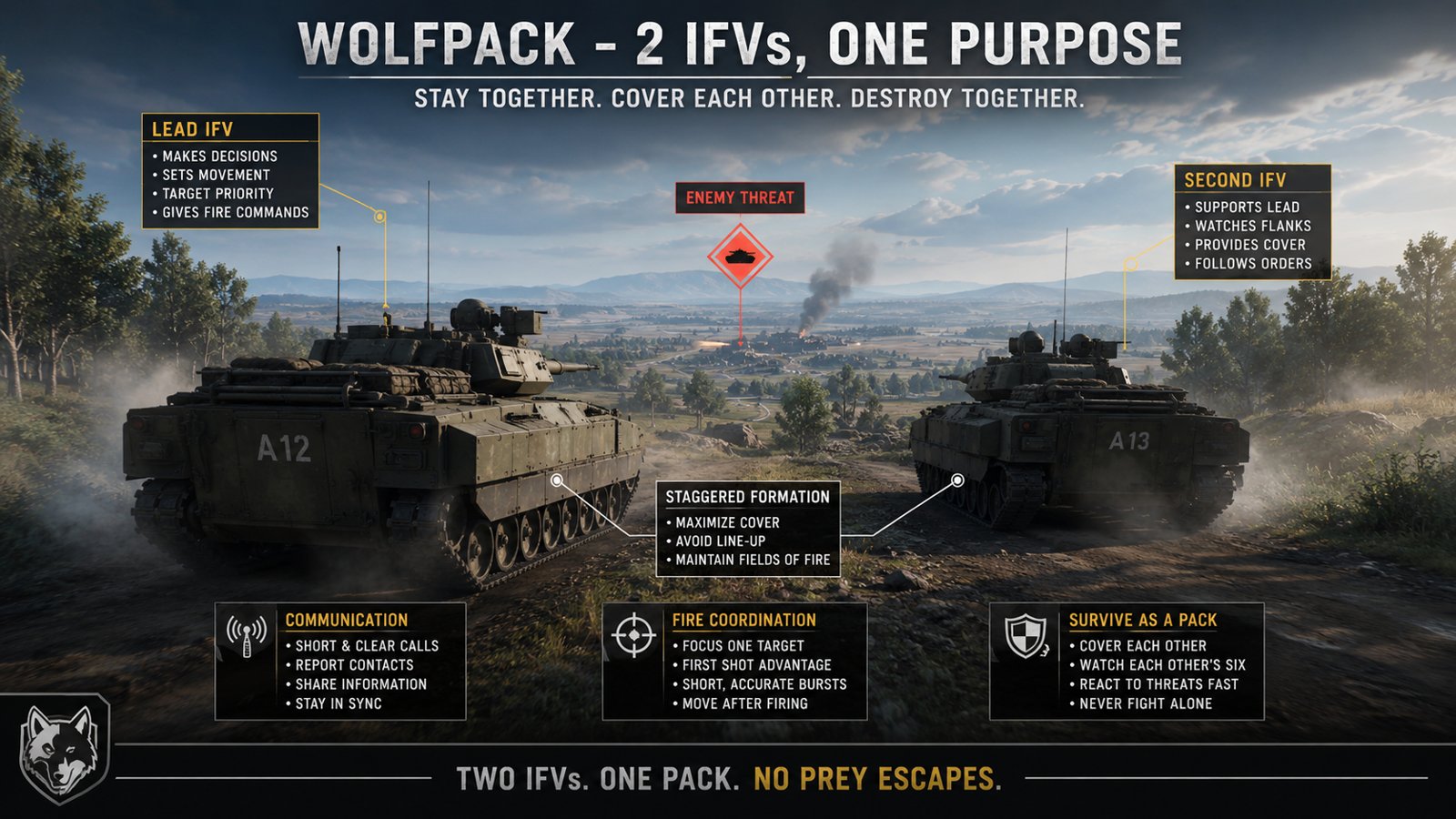
The Wolfpack tactic is based on multiple IFVs (Infantry Fighting Vehicles) working together as a coordinated combat unit. A single IFV is vulnerable. Two or more IFVs operating together become one of the strongest battlefield forces in Squad.
This guide explains positioning, movement, communication, focus fire, and advanced 2vs2 IFV combat tactics.
1. Fundamentals of Wolfpack Tactics
The core idea of the Wolfpack tactic is simple:
Never fight alone.
Multiple IFVs support each other through:
• Mutual fire support • Shared battlefield awareness • Coordinated movement • Focus fire • Flanking maneuvers • Fast reaction to threats
• Increase combat effectiveness • Reduce vehicle losses • Destroy enemy armor quickly • Control important battlefield areas • Support infantry operations • Maintain battlefield pressure
2. The Lead IFV Rule
Every Wolfpack always has one designated Lead IFV.
The Lead IFV acts as the tactical commander for all IFVs in the formation.
• Target prioritization • Fire coordination • Movement commands • Tactical decision making • Communication with infantry and command • Retreat and repositioning calls
• The Lead IFV gives all combat orders • Other IFVs follow and coordinate with the lead • If the Lead IFV is destroyed, command transfers immediately • The Lead IFV should avoid unnecessary risks
A dead Lead IFV often means a dead Wolfpack.
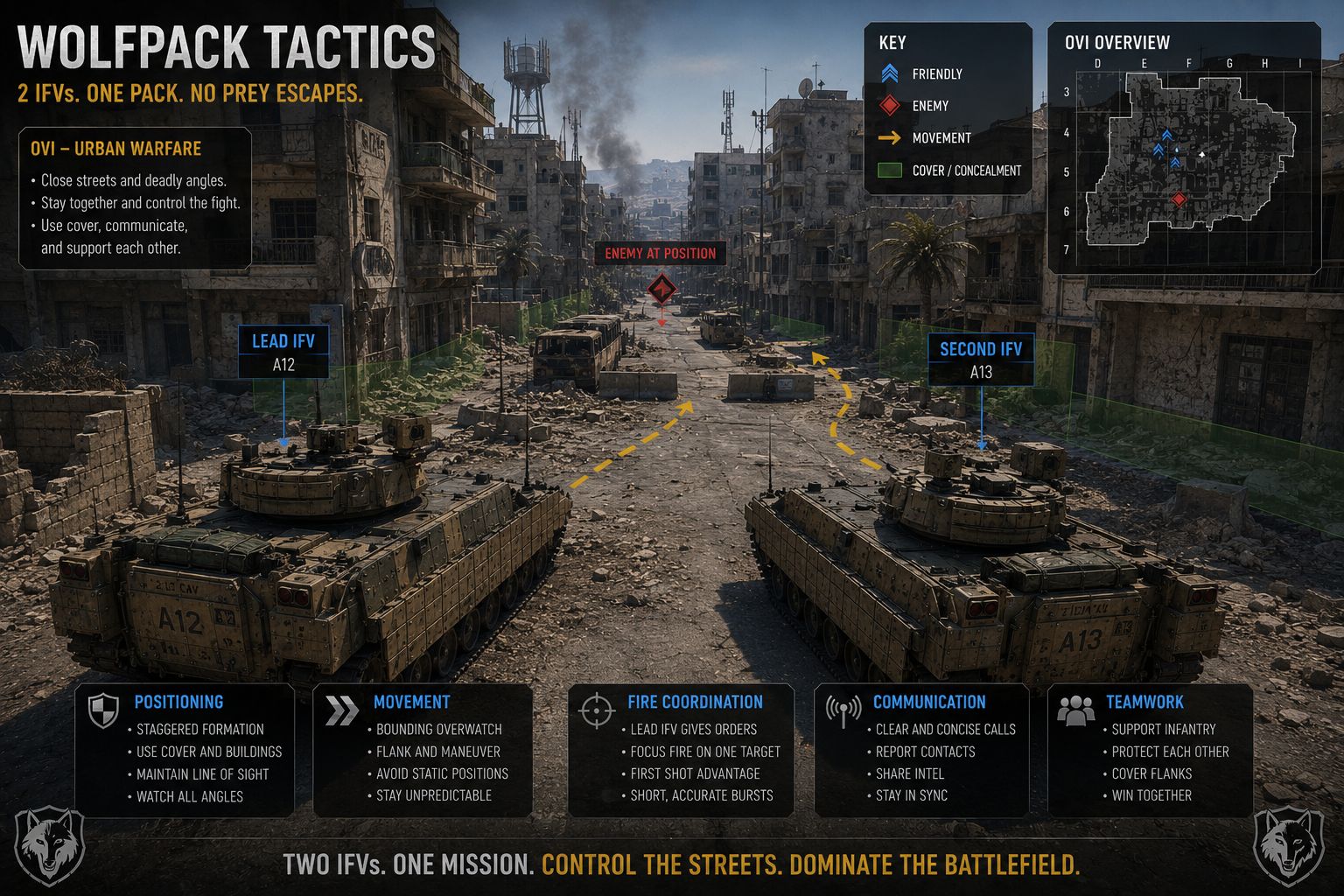
3. Positioning & Movement
Good positioning wins IFV battles before the first shot is fired.
• Use staggered formations • Never block each other’s line of fire • Maintain visibility on the battlefield • Use hills, buildings, forests, and terrain as cover • Always keep armor facing the enemy
One IFV covers while the other advances.
This prevents both IFVs from being exposed at the same time.
Attack from multiple angles to confuse and overwhelm enemy armor.
Never stay in one place for too long.
Static IFVs are easy AT targets.
When engaging around corners or terrain:
• Lead IFV takes the inside lane • Second IFV takes the outside lane • Both turn simultaneously • Both vehicles fire immediately after turning
This creates instant overwhelming firepower.
4. Fire Coordination
Coordination matters more than raw firepower.
• Fire only on command if possible • Prioritize AT infantry first • Focus fire on one target • Use short and accurate bursts • Preserve ammunition
The IFV that fires first usually wins.
Good positioning and spotting are more important than raw aim.
Spot first. Shoot first. Kill first.
5. 2vs2 IFV Combat
2vs2 IFV fights are decided by teamwork and speed.
Both IFVs engage the same enemy vehicle.
Destroying one enemy immediately creates a 2vs1 advantage.
Position IFVs at different angles.
The enemy cannot face both vehicles at the same time.
Damaged IFVs should retreat while the second vehicle continues fighting.
After firing: • Reposition
• Change angle
• Avoid predictable locations
6. Communication
Communication is the backbone of every successful Wolfpack.
• Keep callouts short and clear • Report enemy armor immediately • Share damage status instantly • Coordinate reloads and repositioning
"Enemy BMP north-east. Focus fire. Engage!"
"There is something near the trees maybe..."
7. Working with Infantry
Even the best IFV crews need infantry support.
• Reconnaissance • AT support • Enemy callouts • Building clearing • FOB defense
• Fire support • Suppression • Area denial • Protection from enemy vehicles
A coordinated infantry + IFV force is extremely difficult to stop.
8. After Destroying Enemy Vehicles
Winning the engagement is only the beginning.
• Reposition immediately
• Expect enemy AT retaliation
• Avoid staying on wrecks
• Reload and repair if necessary
If near a flag or important position:
• Secure the area
• Support advancing infantry
• Watch for enemy reinforcements
• Play defensively
• Use hit-and-run tactics
• Avoid direct engagements
• Wait for support
9. Shooting Trees, Bushes & Cover
The environment itself can be used as a weapon.
Enemies hiding in bushes or trees can be exposed by explosions and suppressive fire.
Heavy fire into cover forces enemies to reposition.
Moving enemies are easier to kill.
10. Splash Damage
Splash damage allows IFVs to damage targets without direct hits.
Effective against:
• Buildings • Trenches • Sandbags • Forest cover
Splash damage can still damage enemy vehicles hiding behind cover.
Sometimes indirect splash is safer than exposing yourself for a direct hit.
Final Words
A successful Wolfpack depends on:
• Discipline • Communication • Positioning • Mobility • Focus fire • Teamwork
One IFV is dangerous.
A Wolfpack controls the battlefield.
- Подробный гайд для новичков★ 5 (764)61k views1.1k ♥20 minRussianUpdated 28 Sep, 2023
- Squad Leader 101★ 5 (884)29k views1.5k ♥60 minUpdated 22 Jul
- Как убрать мыло на экране | 100% Способ★ 4 (113)26k views355 ♥3 minRussianUpdated 1 May, 2023
- SQUAD - raising FPS together! / SQUAD - поднимаем FPS вместе!★ 3 (31)19k views75 ♥4 minUpdated 8 Jan, 2024
- Руководство по пилотированию вертолётов★ 5 (199)18k views446 ♥32 minRussianUpdated 20 Feb, 2022
- [Squad v10.5] [EN/РУ] / Where to shoot to penetrate? / Куда стрелять чтобы пробить?★ 5 (220)15k views606 ♥1 minUpdated 17 Jun




- Upgrading to PremiumTeam Fortress 2★ 5 (20k)1441k views11k ♥6 minUpdated May 11, 2022
- No More Room in Hell Official ManualNo More Room in Hell★ 5 (2.8k)569k views2.1k ♥29 minUpdated Apr 22, 2019
- NMRiH Community Hosting GuidesNo More Room in Hell★ 5 (526)351k views653 ♥1 minUpdated Aug 10, 2022
- ULTIMATE GUIDE FOR GAME DEV TYCOONGame Dev Tycoon★ 5 (5.8k)326k views10k ♥4 minUpdated 23 Jan, 2014
- How to 'Git Gud' Soon™MORDHAU★ 5 (2k)318k views3k ♥68 minUpdated Nov 16, 2024
- Лучшие кооперативные игры SteamPAYDAY 2★ 5 (1.5k)315k views2.1k ♥56 minRussianUpdated Apr 27, 2025




This guide was created by its original author on the Steam Community. Are you the author and want it removed? Request removal.